A practical, beginner-friendly explanation of the enclosed space where an engine compresses and burns its charge — and why its shape influences power, efficiency, emissions and reliability.
What is a combustion chamber?
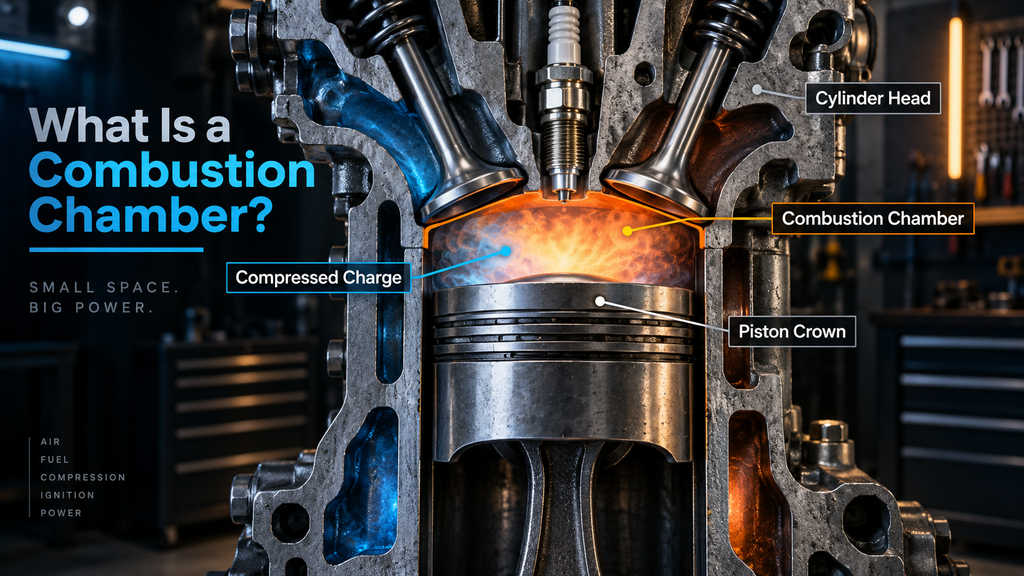
A combustion chamber is the enclosed space inside an engine cylinder where the air-fuel charge is compressed and burned. It is not usually a separate, removable part. Instead, it is a working space formed by the cylinder head, the piston crown, the upper cylinder walls, and the valve, spark-plug or fuel-injector area.
As the piston approaches the top of its stroke, the chamber becomes much smaller and the charge is compressed. Combustion then raises pressure sharply, pushing the piston down and turning chemical energy in the fuel into useful mechanical work.
Where it is located
Each cylinder has its own combustion chamber at the top of the cylinder bore. When the piston is near top dead centre, the space between the piston crown and cylinder head is at its smallest. This remaining volume is a major part of an engine’s compression-ratio calculation.
Combustion chamber vs. cylinder: what is the difference?
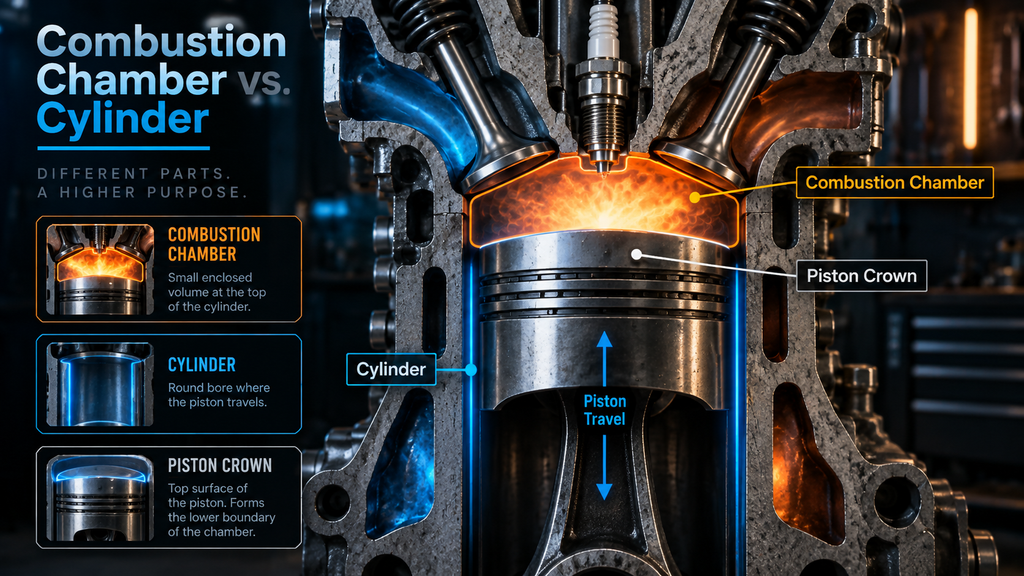
The cylinder is the bore that guides the piston through its travel. The combustion chamber is the smaller enclosed volume at the top of that cylinder when the piston rises. The piston crown helps define that volume, but the piston itself is a moving component rather than the chamber alone.
| Term | What it is | Role in combustion |
|---|---|---|
| Cylinder | The round bore in the engine block where the piston travels. | Contains the moving piston and supports the compression space above it. |
| Combustion chamber | The enclosed volume above the piston near the top of its stroke. | Houses the compressed charge and controls the conditions for combustion. |
| Piston crown | The top surface of the piston, which may be flat, dished or shaped. | Forms the lower boundary of the chamber and can guide mixture motion. |
What parts form a combustion chamber?
The final chamber shape is an engineered combination of several components. A change to the cylinder head, gasket thickness, piston design, valve layout or machining dimensions can alter chamber volume and combustion behavior.
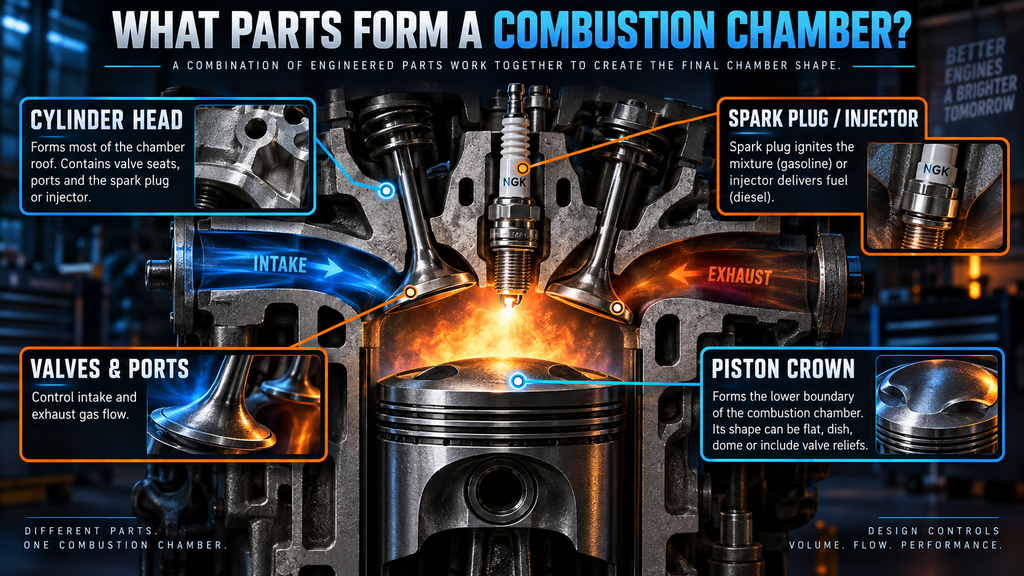
Cylinder head
The head commonly contains most of the chamber roof, valve seats, ports and the spark plug or injector mounting point.
Piston crown
Its shape can add a dish, dome, bowl or valve reliefs. In many diesel engines, the piston bowl is central to the combustion process.
Valves and ports
Intake and exhaust valves control gas flow. Their number, angle and placement affect airflow, chamber volume and flame travel distance.
Spark plug or injector
A gasoline engine normally starts combustion with a spark plug. A diesel engine injects fuel into very hot compressed air, so injector design and location are critical.
How combustion happens inside the chamber
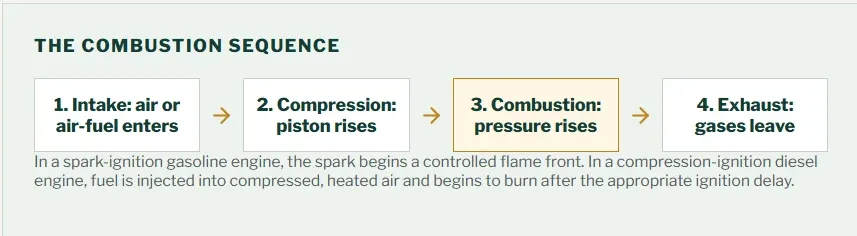
The basic four-stroke sequence gives the chamber its purpose. Exact timing and mixture preparation vary by engine, but the overall path is easy to follow.
Common combustion chamber types
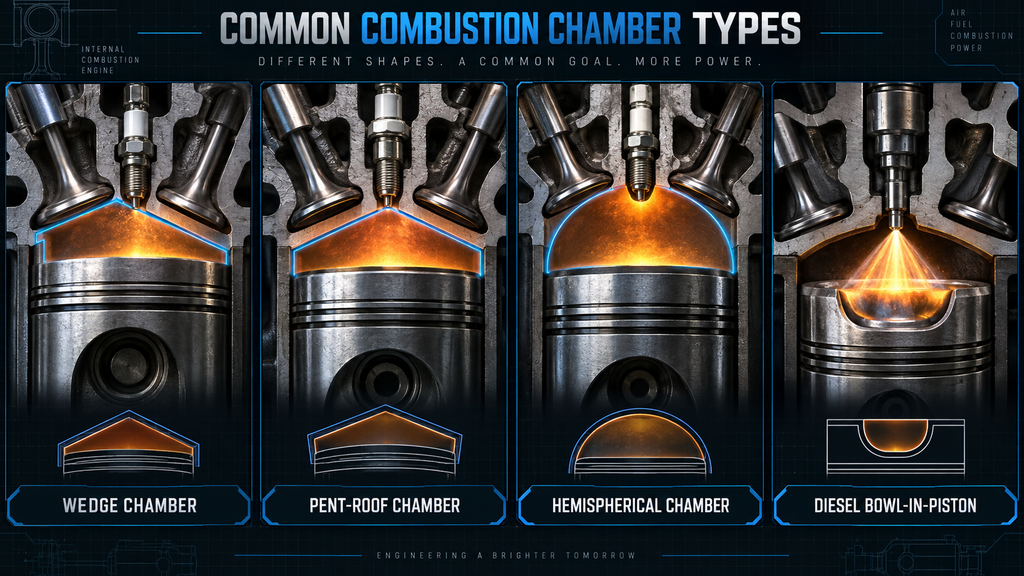
There is no universally best chamber shape. Engineers choose a layout around the engine’s valve train, fuel system, emissions targets, packaging, operating speed and intended use. These examples describe broad families rather than every production variation.
Wedge chamber
A wedge-shaped roof is common in many older and simpler overhead-valve designs. It can provide useful squish areas and straightforward manufacturing, though performance depends heavily on the full head and piston design.
Pent-roof chamber
Often used with four-valve cylinder heads, this roof shape makes room for angled intake and exhaust valves. A centrally placed spark plug can help shorten flame travel in many gasoline engines.
Hemispherical chamber
A broadly dome-like chamber can support large, angled valves and good airflow. Its real-world combustion characteristics still depend on spark-plug position, piston crown, ports and calibration.
Diesel bowl-in-piston chamber
Many modern direct-injection diesels use a shaped bowl in the piston crown. The injector spray, bowl profile and air swirl work together to mix fuel with compressed air and manage combustion.
How combustion chamber design affects engine behavior
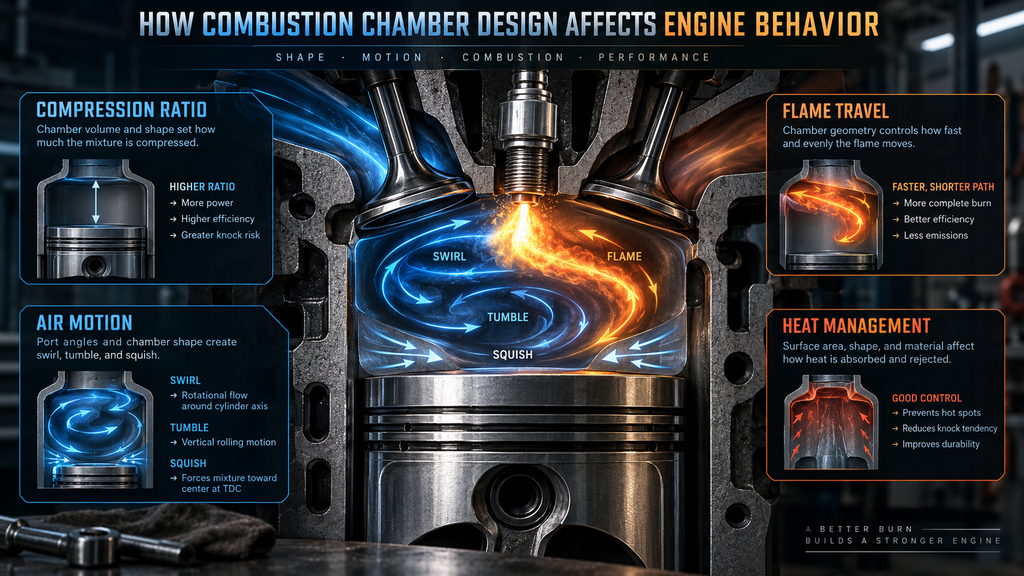
Chamber design affects how quickly and evenly the charge burns, how much heat reaches surrounding parts, and how likely the engine is to operate near its knock or emissions limits. The chamber works together with the piston crown, intake ports, fuel delivery and electronic calibration.
Key engineering priorities
- Compression ratio: chamber volume is one input, but piston shape, gasket thickness and cylinder volume also matter.
- Flame travel: a compact chamber and well-positioned spark plug can help a gasoline charge burn more consistently.
- Air motion: swirl, tumble and squish increase movement in the charge, helping mixture preparation and combustion control.
- Heat management: valve areas, cooling passages and material temperatures influence durability and abnormal-combustion risk.
What can go wrong inside a combustion chamber?
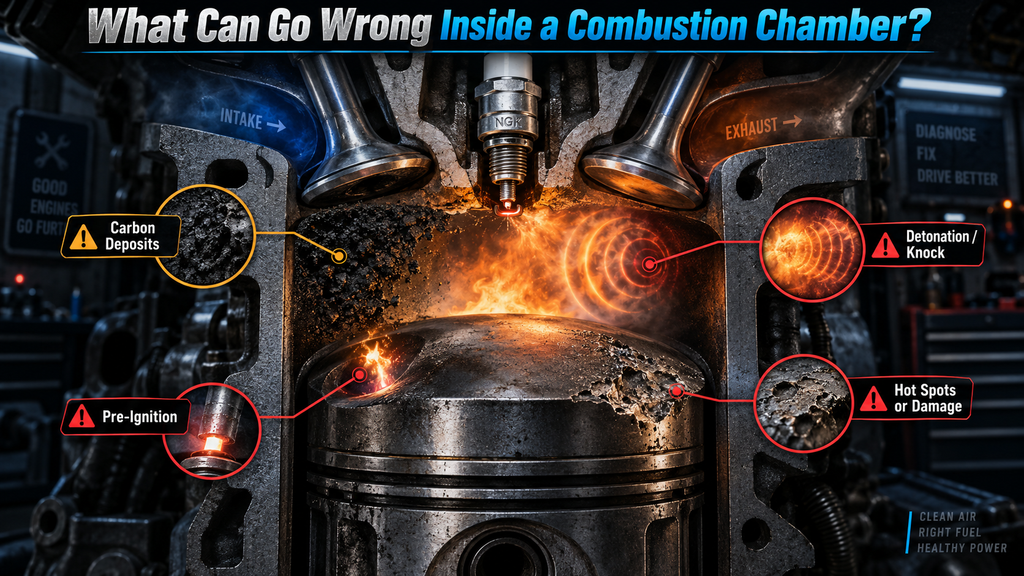
A chamber is exposed to repeated heat, pressure and combustion by-products. A symptom alone does not identify the cause, but these conditions are common reasons technicians inspect the chamber, piston tops, valves and spark plugs.
Carbon deposits
Deposits can form from normal operation, oil consumption, fuel quality or other engine conditions. They may affect chamber volume or create hot areas, but they are not the automatic cause of every knock complaint.
Detonation or knock
Knock is abnormal combustion in which part of the remaining mixture reacts too abruptly after normal ignition begins. Load, temperature, fuel octane, timing and calibration can all influence it.
Pre-ignition
Pre-ignition is different from knock. It occurs when the charge begins burning before the spark is intended to fire, often because of an overly hot surface or component. It can become damaging quickly.
What technicians inspect
Depending on the concern, inspection may include spark plugs or injectors, compression and leak-down testing, borescope images, cooling-system checks and measurements during an engine teardown.
Combustion chamber FAQs
These short answers reinforce the key distinctions that matter when learning basic engine operation or discussing a possible internal-engine concern.
Is the combustion chamber in the head or the piston?
Usually, both contribute. The cylinder head forms much of the upper space, while the piston crown forms the lower boundary as it rises. In many diesel engines, a major part of the chamber is the bowl in the piston.
Does higher compression always mean more power?
Not by itself. Compression ratio can influence efficiency and potential output, but fuel quality, combustion control, airflow, temperature, engine strength and calibration determine what is safe and useful for a specific engine.
Can a combustion chamber be cleaned?
Cleaning methods depend on the engine and the reason for the deposits. Some procedures require disassembly; others may use manufacturer-approved service methods. Avoid abrasive or chemical methods that could damage surfaces, sensors or coatings.