Welding is one of the most important joining methods used in construction, automotive repair, manufacturing, fabrication, aerospace, shipbuilding and DIY projects. Different welding types use different heat sources, electrodes, shielding methods and equipment.
Understanding the different types of welding can help you choose the right process for the material, thickness, work environment and desired finish. This guide explains the welding definition, answers how does welding work, and compares the most common welding processes and their best uses.
What Is Welding?
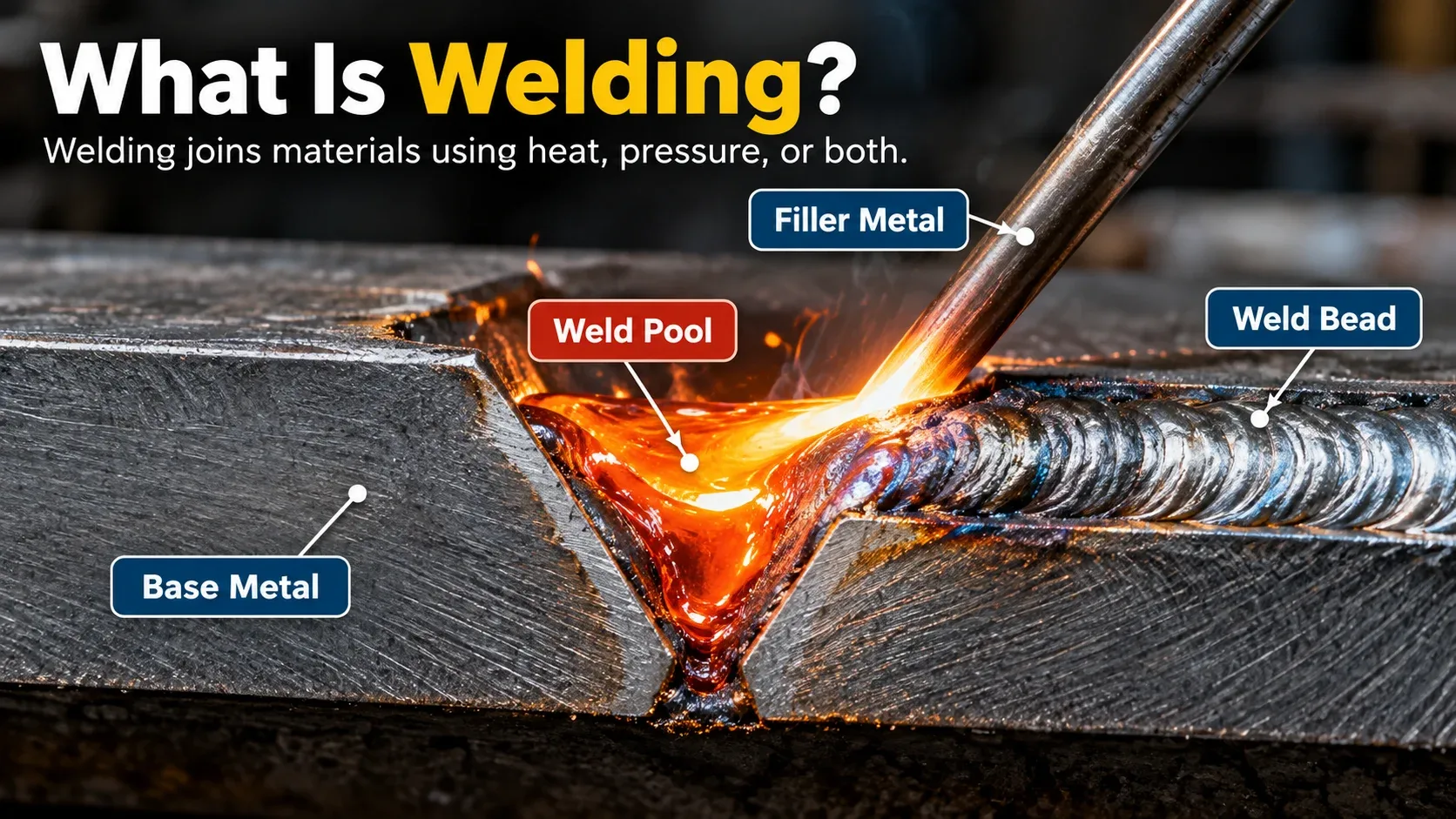
A simple welding definition is the process of permanently joining two or more materials, usually metals, by applying heat, pressure or a combination of both. Depending on the process, filler metal may also be used.
In many common welding methods, heat melts a small portion of the base materials. A molten weld pool forms and then cools to produce a permanent joint.
How Does Welding Work?
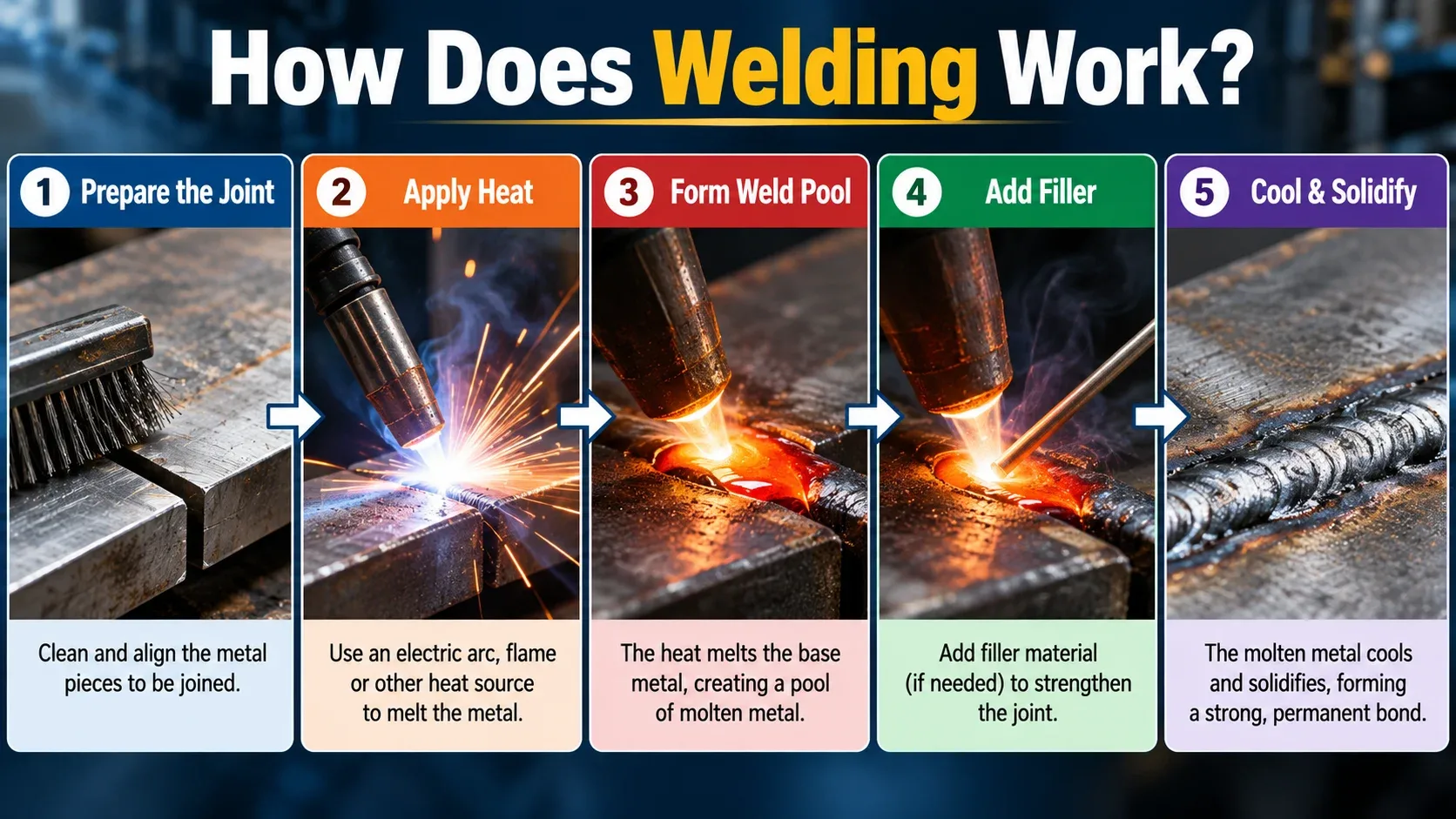
If you are asking how does welding work, the basic process can be understood in five steps.
- Prepare the joint: Remove contaminants when required.
- Apply energy: An arc, flame, laser or another source creates heat.
- Form the weld pool: The joining area melts in fusion welding.
- Add filler metal: Some processes use wire or a consumable electrode.
- Allow the weld to cool: The molten material solidifies into a joint.
What Are the Main Types of Welding?
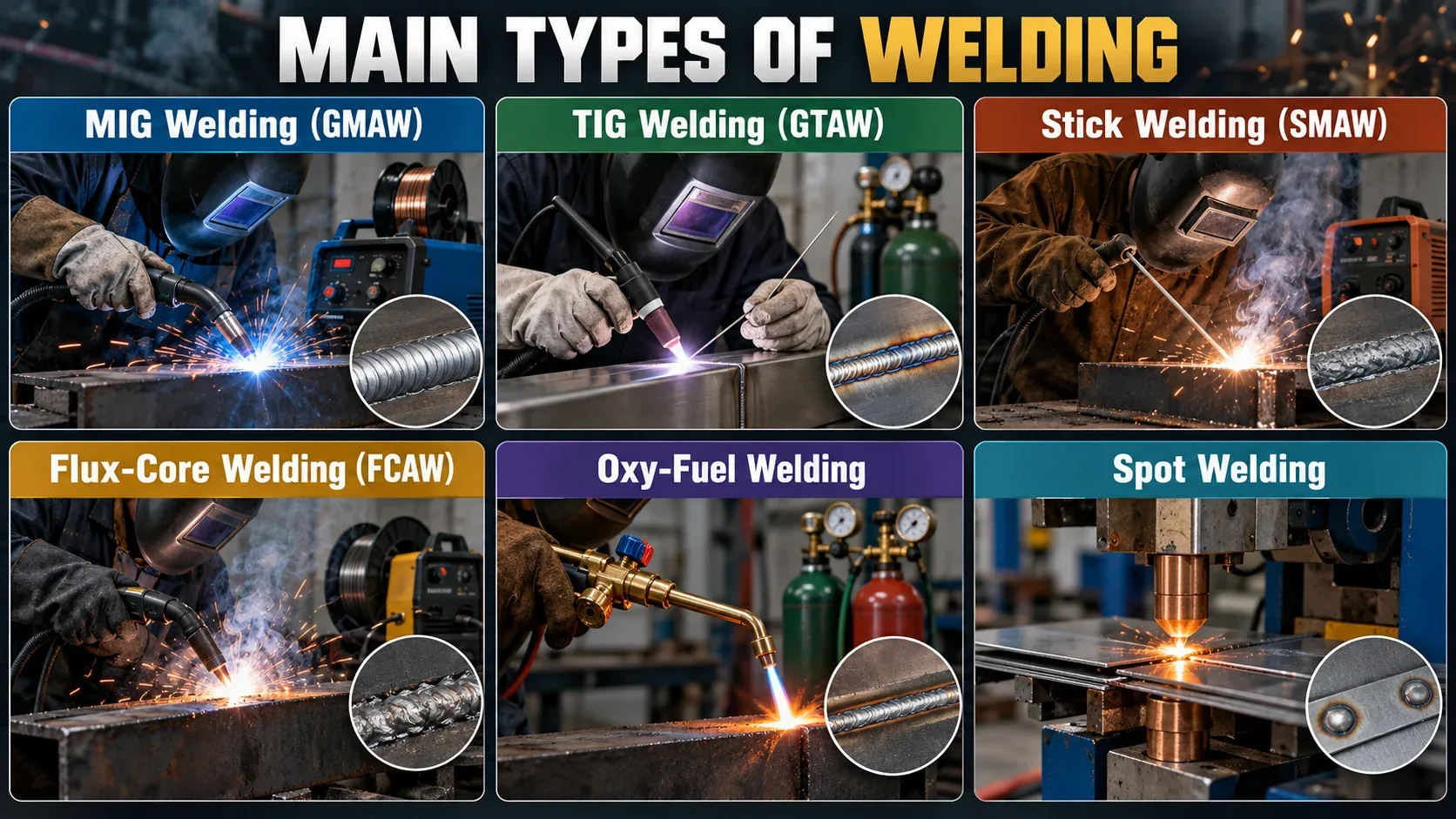
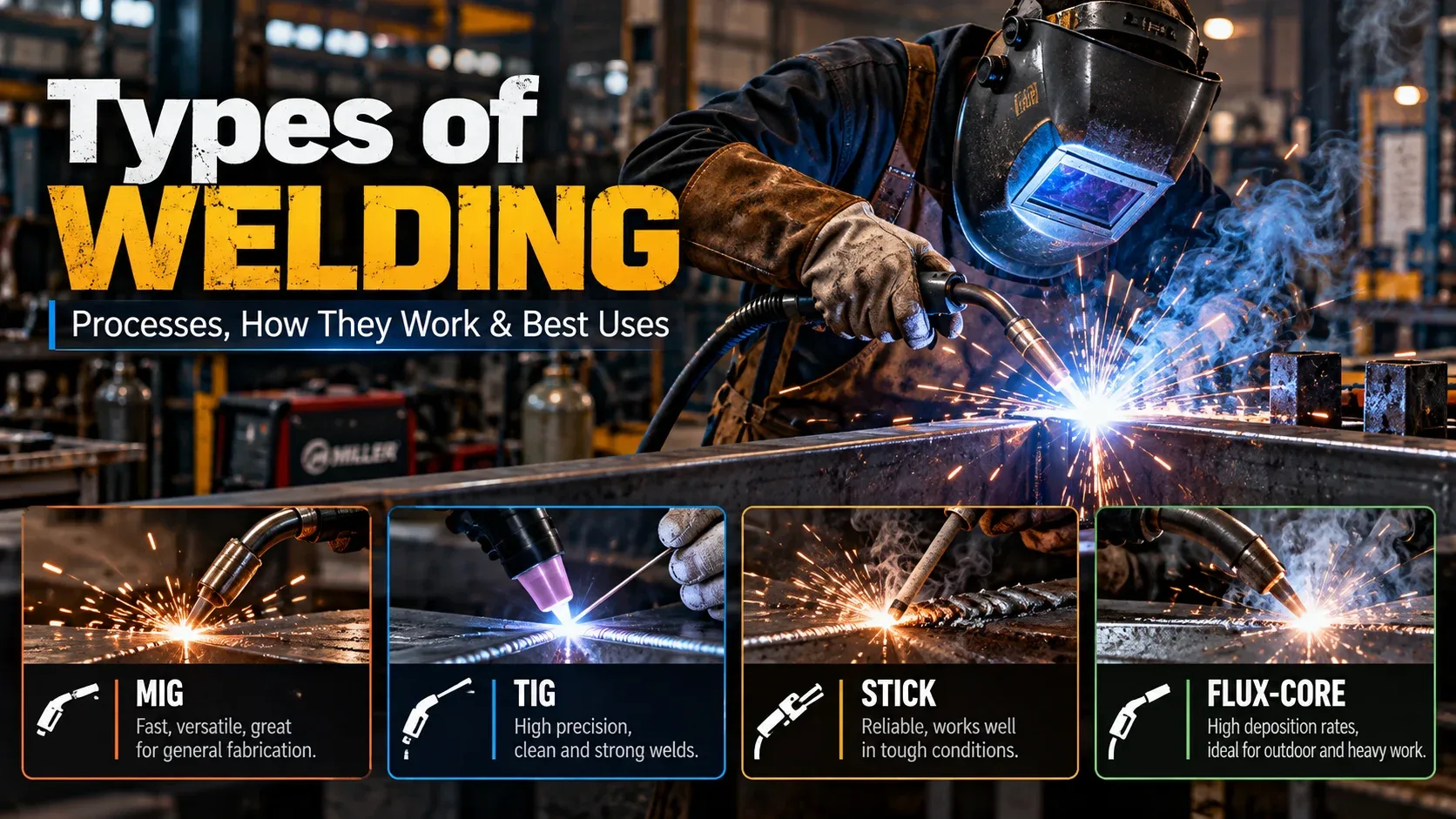
There are many specialized welding methods, but MIG, TIG, stick and flux-core are among the most commonly discussed processes for fabrication, construction and repair work.
| Welding Type | Technical Name | Common Uses | Skill Level |
|---|---|---|---|
| MIG | Gas Metal Arc Welding (GMAW) | General fabrication, automotive, manufacturing | Beginner-friendly |
| TIG | Gas Tungsten Arc Welding (GTAW) | Precision, stainless steel, aluminum | Intermediate to advanced |
| Stick | Shielded Metal Arc Welding (SMAW) | Construction, repairs, outdoor welding | Intermediate |
| Flux-Core | Flux-Cored Arc Welding (FCAW) | Heavy fabrication and structural work | Beginner to intermediate |
| Oxy-Fuel | Oxy-Fuel Gas Welding | Repairs, heating and cutting | Intermediate |
| Spot Welding | Resistance Spot Welding | Automotive and sheet-metal production | Specialized |
1. MIG Welding (GMAW)
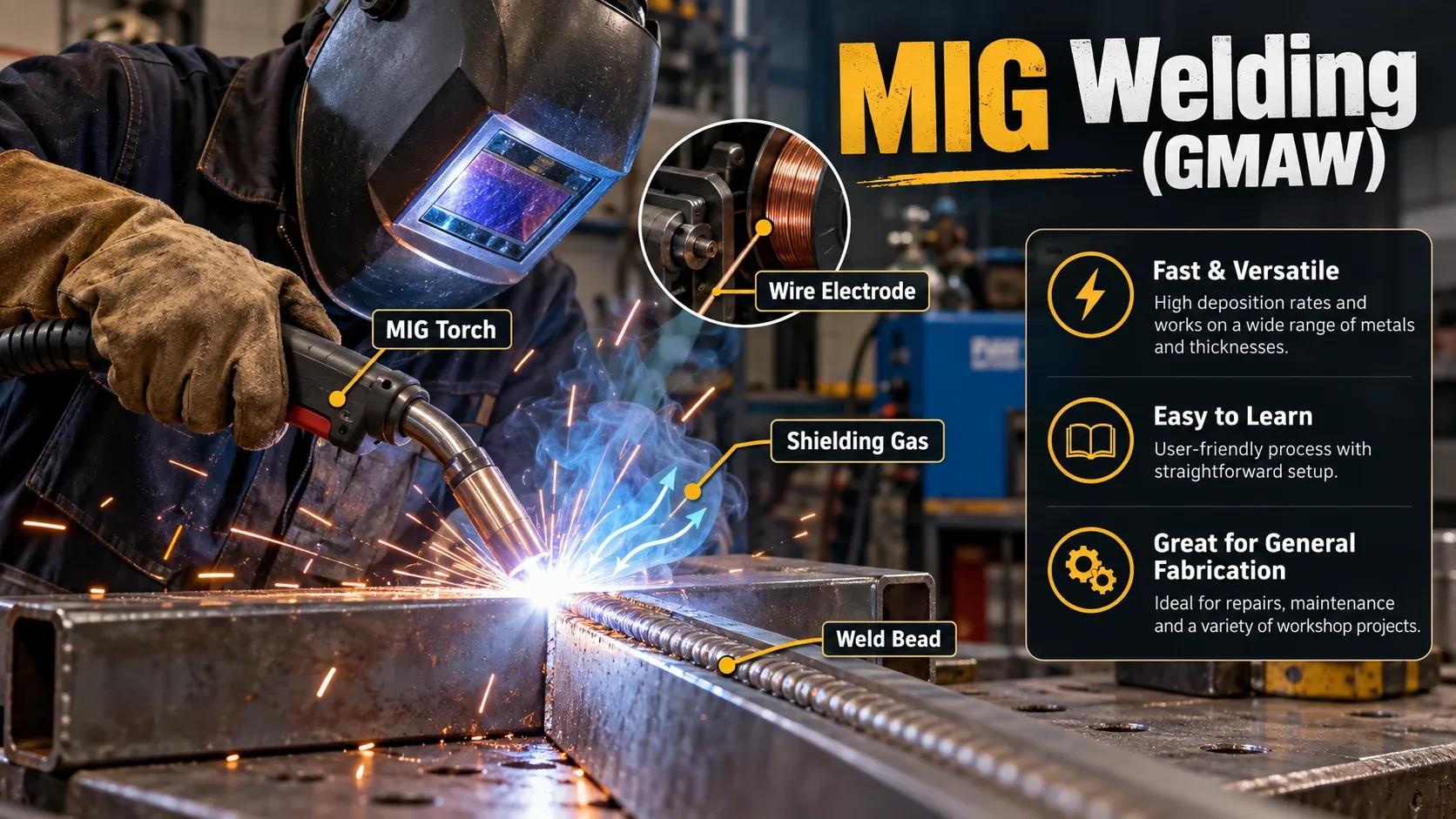
How MIG Welding Works
MIG welding, formally known as Gas Metal Arc Welding, uses a continuously fed wire electrode. The welding gun feeds the wire toward the joint while an electric arc melts the wire and base material.
Shielding gas helps protect the molten weld pool from atmospheric contamination.
2. TIG Welding (GTAW)
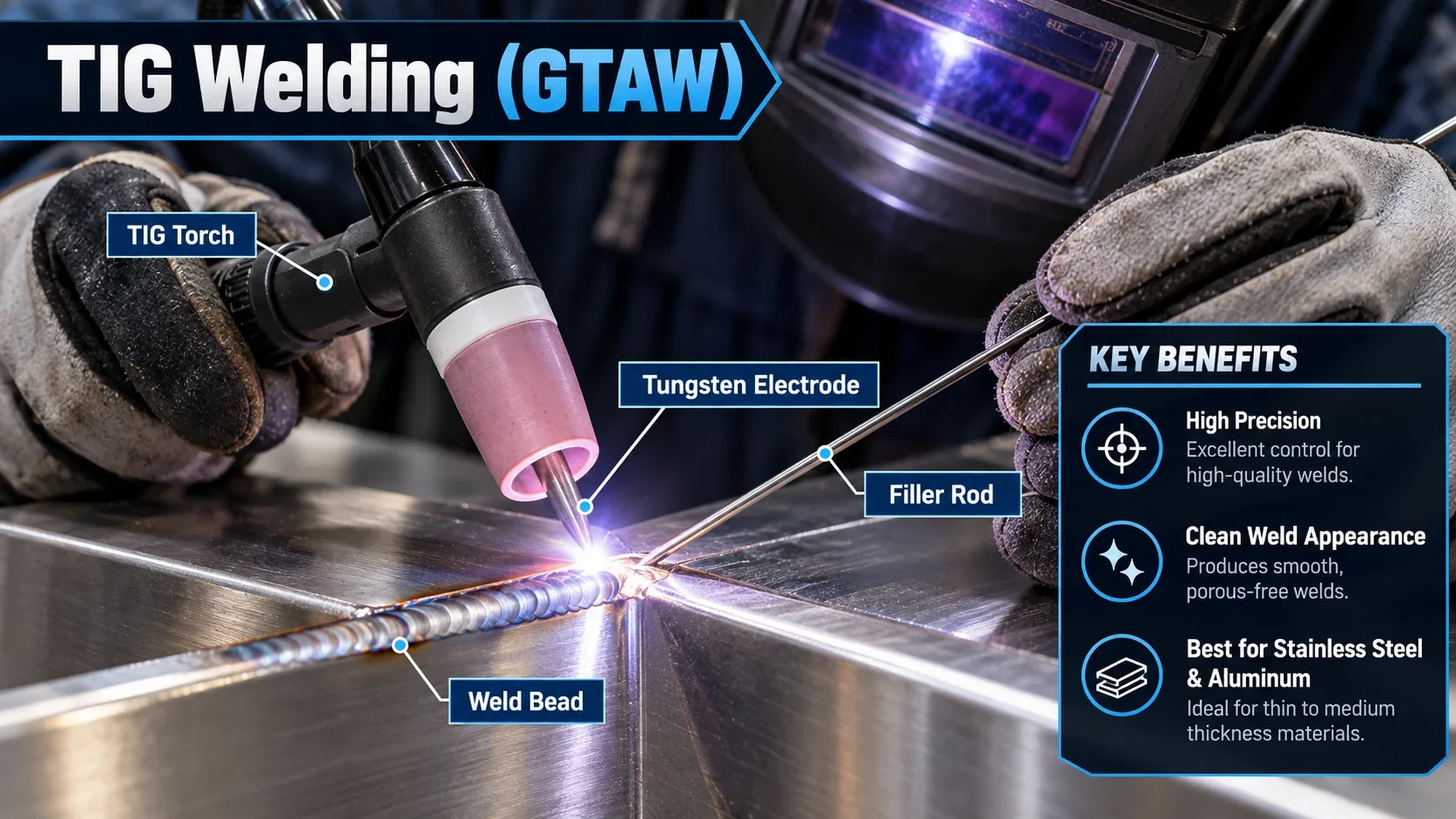
How TIG Welding Works
TIG welding uses a non-consumable tungsten electrode to create the arc. Filler metal, when required, is normally added separately.
TIG welding gives the operator excellent control over heat and filler placement, making it popular for clean and precise welding.
3. Stick Welding (SMAW)
How Stick Welding Works
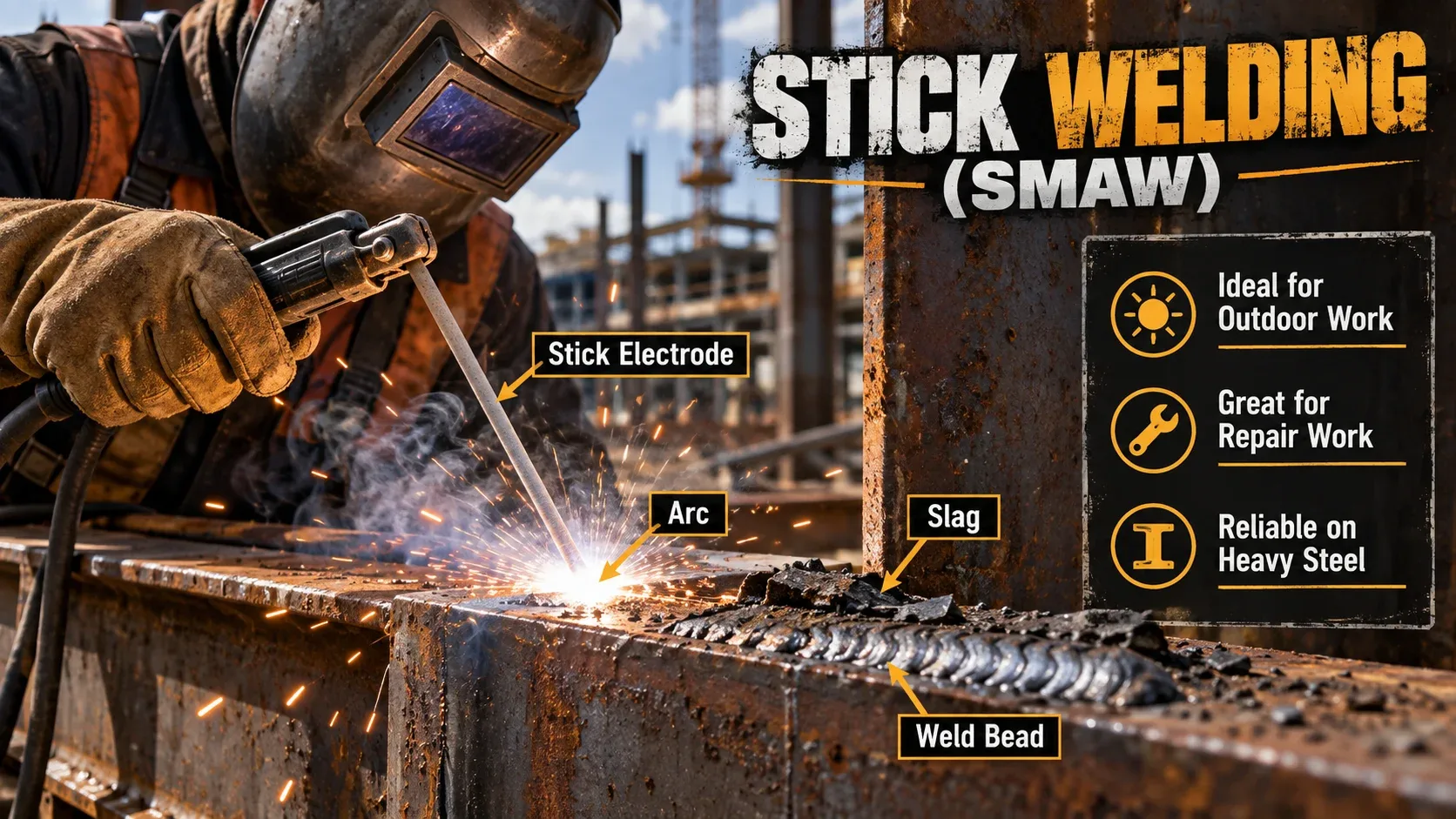
Stick welding uses a flux-coated consumable electrode. The electric arc melts the electrode and the base material.
The flux coating produces protective gases and a layer of slag that helps protect the weld during cooling.
4. Flux-Cored Arc Welding (FCAW)
How Flux-Core Welding Works
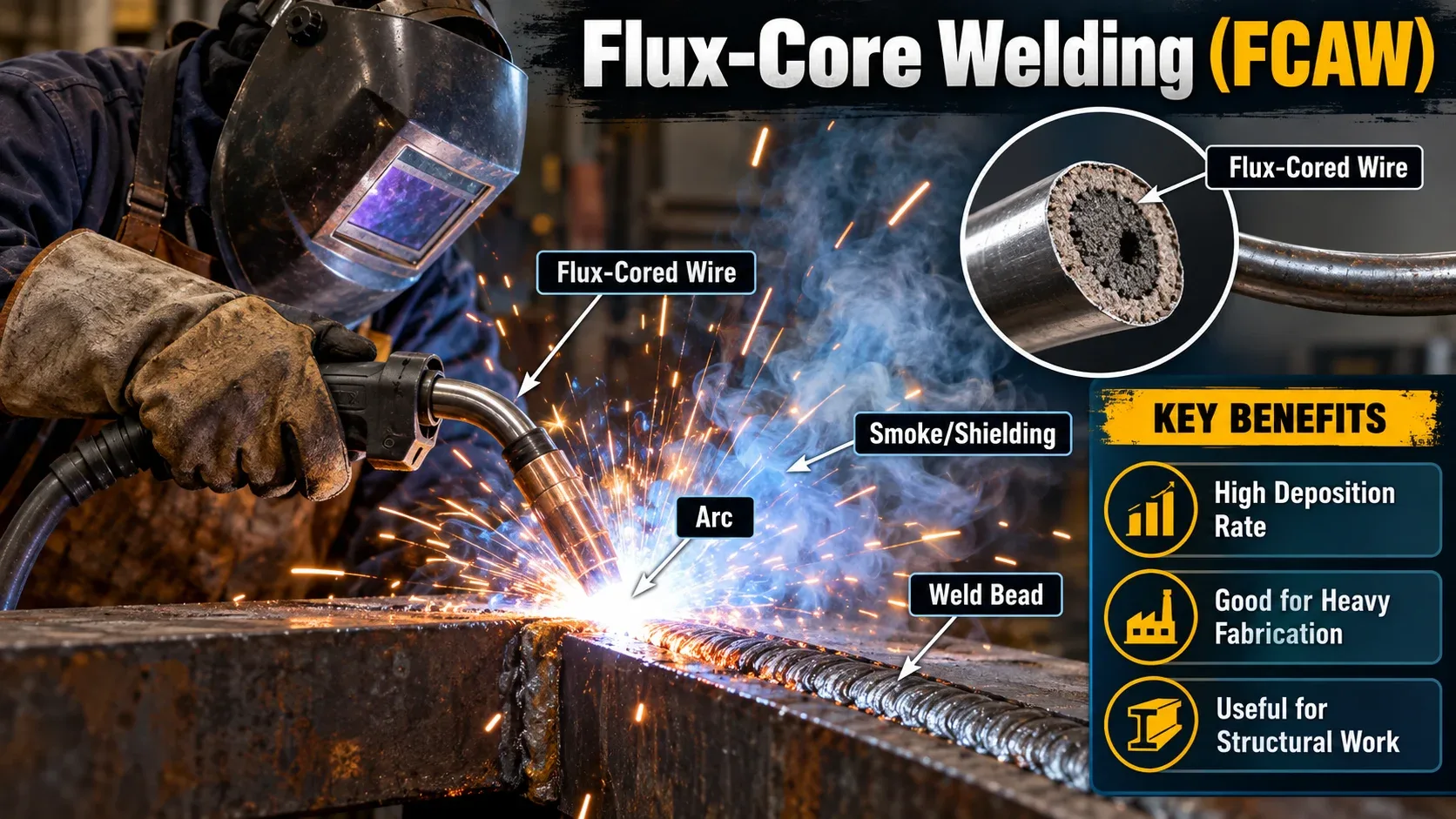
Flux-core welding uses a continuously fed tubular wire containing flux. The operating method is similar to MIG welding, but the flux inside the wire helps provide shielding.
Some FCAW wires are self-shielded while others also use external gas.
5. Oxy-Fuel Welding
Oxy-fuel welding uses a flame produced by burning fuel gas with oxygen. Acetylene is one of the most commonly recognized fuel gases used for this process.
Oxy-fuel equipment can also be used for cutting, brazing and heating, making it useful in repair and maintenance work.
6. Resistance and Spot Welding
Resistance spot welding joins overlapping sheet metal by applying pressure and electrical current through electrodes.
Electrical resistance generates heat at the contact point, creating a small fused region called a weld nugget. This method is widely used in automotive manufacturing.
7. Submerged Arc Welding
Submerged Arc Welding uses a continuously fed electrode beneath a layer of granular flux.
It is useful for long weld seams, thick materials and heavy industrial fabrication because it can achieve high deposition rates and deep penetration.
8. Plasma Arc Welding
Plasma arc welding constricts the welding arc through a nozzle to create a concentrated plasma jet.
This allows excellent control and makes the process useful for precision fabrication and automated welding.
9. Laser Beam Welding
Laser beam welding uses concentrated light energy to join materials. It can produce narrow welds at high speed while keeping the heat-affected area relatively small.
It is commonly used in advanced manufacturing, automotive production, electronics and battery assembly.
10. Electron Beam Welding
Electron beam welding uses a focused stream of high-speed electrons. Their energy is converted into heat when they strike the workpiece.
The process can create deep and narrow welds and is frequently used for specialized precision components.
MIG vs TIG vs Stick vs Flux-Core Welding
| Factor | MIG | TIG | Stick | Flux-Core |
|---|---|---|---|---|
| Learning Difficulty | Relatively easy | More difficult | Moderate | Easy to moderate |
| Weld Appearance | Clean | Excellent | More cleanup | More slag/spatter |
| Outdoor Use | Limited | Limited | Excellent | Good |
| Speed | Fast | Slower | Moderate | Fast |
| Best For | General fabrication | Precision work | Field repair | Heavy fabrication |
Which Welding Type Is Best for Beginners?
MIG welding is often one of the easiest processes to learn because the wire feeds automatically. However, the best choice depends on the type of work you plan to do.
- Garage fabrication: MIG welding
- Outdoor repair: Stick or self-shielded flux-core
- Precision work: TIG welding
- Heavy structural work: Stick or FCAW
Which Welding Process Works Best for Different Metals?
| Material | Common Welding Processes | Key Consideration |
|---|---|---|
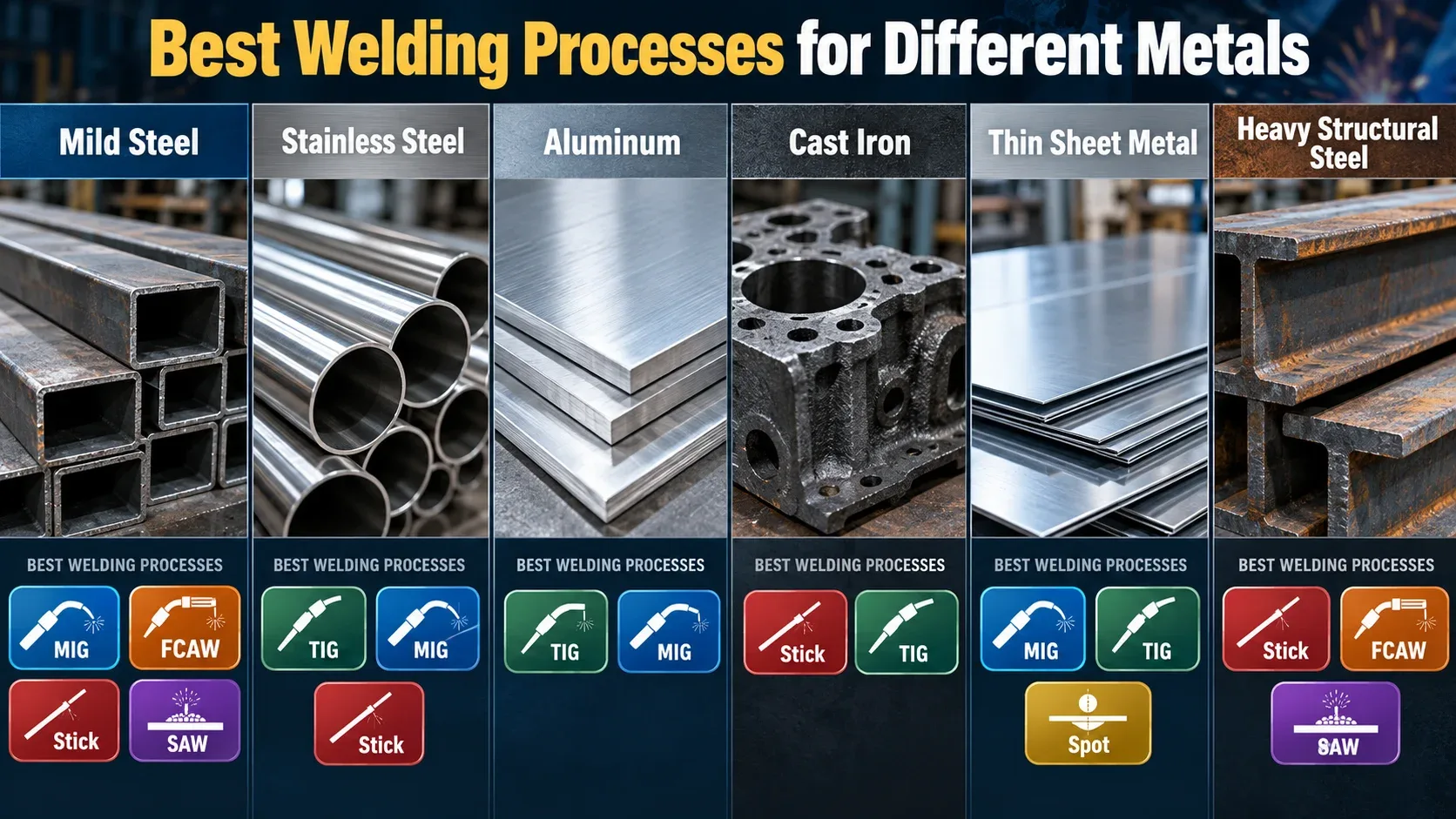
| Mild Steel | MIG, TIG, Stick, FCAW | Thickness and welding position |
| Stainless Steel | TIG, MIG, Stick | Heat and filler selection |
| Aluminum | TIG, MIG | Oxide removal and proper shielding |
| Cast Iron | Specialized Stick or TIG | Preheating and cooling control |
| Thin Sheet Metal | TIG, MIG, Spot | Avoid excessive heat and distortion |
| Heavy Structural Steel | Stick, FCAW, SAW | Penetration and joint preparation |
Best Uses for Different Welding Processes
How to Choose the Right Welding Process
- Identify the material.
- Check the material thickness.
- Consider indoor or outdoor use.
- Determine the required weld appearance.
- Consider welding position.
- Evaluate your equipment and experience.
Essential Welding Safety Tips
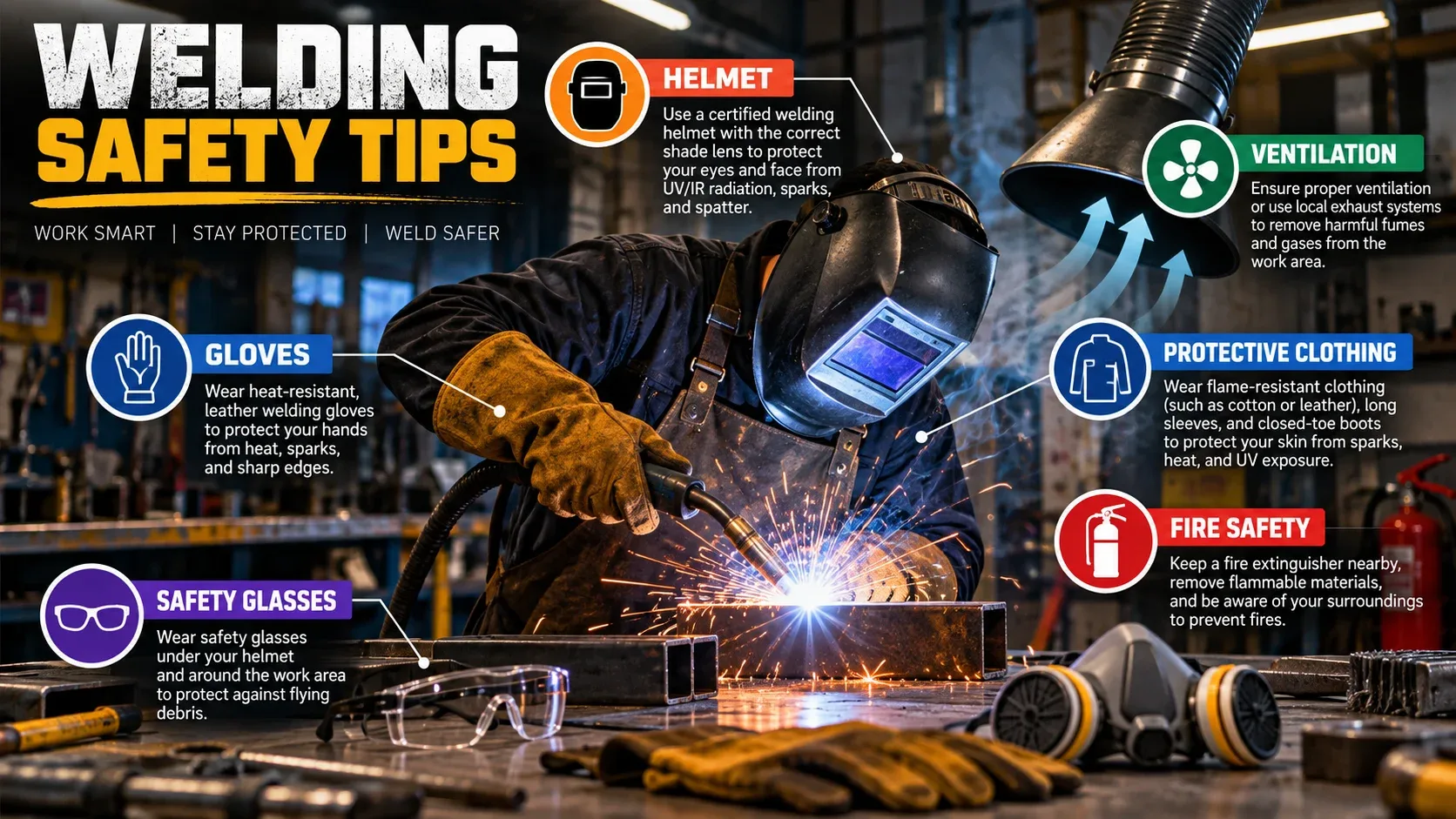
Welding involves intense heat, electrical equipment, fumes, sparks and harmful arc radiation. Proper safety equipment and training are essential.
- Wear an appropriate welding helmet.
- Use welding gloves and flame-resistant clothing.
- Protect exposed skin from arc radiation.
- Maintain adequate ventilation and fume control.
- Keep combustible materials away from the work area.
- Inspect cables, torches and electrode holders.
- Secure compressed gas cylinders properly.
- Follow equipment manufacturer safety instructions.
Common Welding Terms Beginners Should Know
Arc
An electrical discharge that creates intense heat during arc welding.
Electrode
A component that carries welding current and may be consumable or non-consumable.
Filler Metal
Additional metal used to help fill and form a welded joint.
Weld Pool
The molten metal present at the welding point during fusion welding.
Shielding Gas
Gas used to help protect the weld from atmospheric contamination.
Flux
A material used to protect and support the weld zone in several welding processes.
Slag
A protective nonmetallic layer that forms over some types of welds.
Penetration
The depth of fusion between the weld and the base material.
Heat-Affected Zone
The area surrounding the weld where the metal properties may change because of welding heat.
Frequently Asked Questions About Welding Types
What are the four main types of welding?
MIG, TIG, stick and flux-core are four of the most widely discussed welding processes for fabrication and repair work.
What is the easiest welding type to learn?
MIG welding is generally considered one of the more beginner-friendly processes because the wire feeds automatically.
Which welding type is best for outdoor use?
Stick welding and self-shielded flux-core welding are commonly used outdoors because they are less dependent on externally supplied shielding gas.
Which welding process is commonly used for aluminum?
TIG and MIG welding are commonly used for aluminum when the correct equipment, filler material, shielding gas and settings are selected.
Is MIG stronger than TIG welding?
Neither process is automatically stronger. Weld strength depends on the material, joint design, penetration, filler metal, welding procedure and operator technique.
What is the difference between welding and brazing?
Welding usually creates fusion or another permanent bond at the joint, while brazing uses a lower-melting filler metal without melting the base materials in the same way as fusion welding.
Choosing the Right Welding Process
Understanding the different welding types makes it easier to select a process for a particular material and application. MIG is useful for fast general fabrication, TIG provides excellent precision, stick welding performs well in field conditions, and flux-core is useful for structural and heavy fabrication.
Specialized processes such as spot welding, submerged arc welding, plasma welding, laser welding and electron beam welding are widely used in industrial and advanced manufacturing environments.
Material → Thickness → Joint → Location → Finish → Welding Process
No single process is ideal for every project. The right choice depends on the base metal, thickness, joint design, required quality, environment, equipment and operator experience.