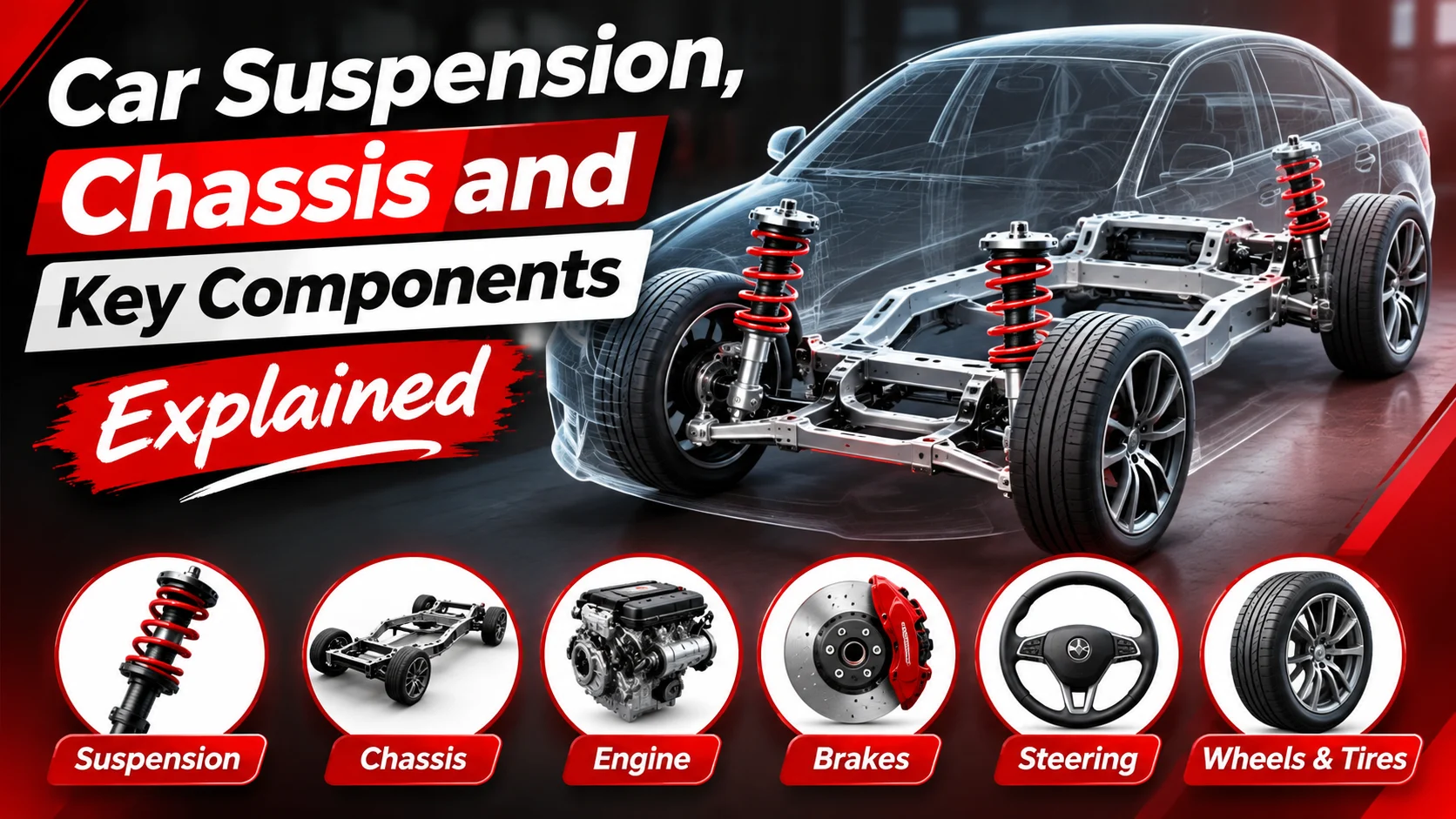
Have you ever wondered what keeps your car stable while driving over potholes, turning corners, or traveling on uneven roads? The answer involves several important mechanical systems working together beneath your vehicle.
Your car suspension, chassis, steering, brakes, and other essential components all contribute to driving comfort, performance, and safety.
Understanding these systems can help you recognize mechanical problems, communicate confidently with mechanics, and make better maintenance decisions.
In this guide, we will explain how car suspension works, the chassis definition, different suspension designs, and the most important parts of a car in simple language.
Quick Answer: Car suspension connects the wheels to the vehicle structure and helps manage road impacts, body movement, and tire contact. The chassis provides the supporting foundation for the vehicle’s major mechanical systems.
What Is Car Suspension?
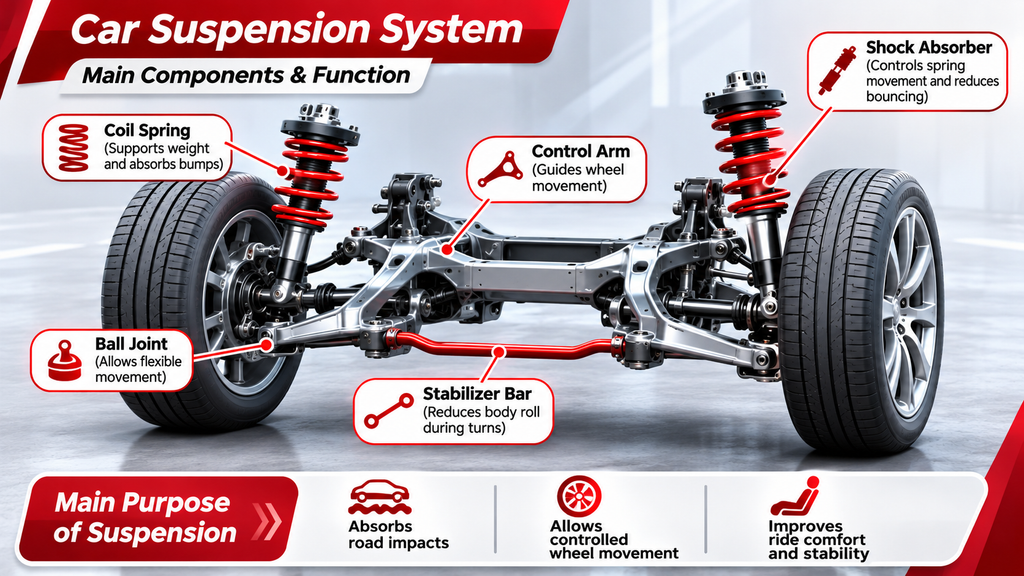
Car suspension is a mechanical system consisting of springs, shock absorbers, linkages, and other components that connect the wheels to the vehicle’s supporting structure.
Its main purpose is to allow controlled wheel movement while reducing the impact of uneven road surfaces on the vehicle body.
01
Ride Comfort
Reduces the vibrations and movement passengers experience when traveling over uneven roads.
02
Vehicle Stability
Helps control body movement during cornering, braking, and acceleration.
03
Tire Contact
Allows the wheels to follow road contours, contributing to traction and handling.
04
Weight Support
Supports the vehicle’s sprung weight, including passengers and cargo within approved load limits.
How Does Car Suspension Work?
When your car travels over a bump, the suspension allows the wheel to move relative to the vehicle body. Springs temporarily store energy, while shock absorbers control movement and reduce repeated bouncing.
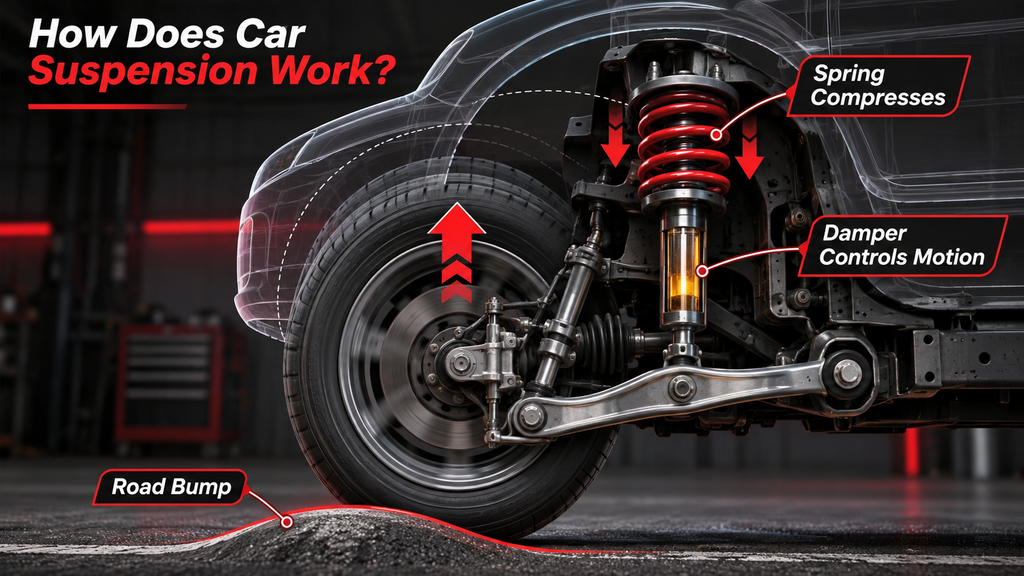
- Road impact: The tire encounters a bump or uneven surface.
- Wheel movement: The wheel moves upward relative to the vehicle body.
- Spring compression: The spring compresses and temporarily stores energy.
- Damping: The shock absorber controls suspension movement.
- Recovery: The suspension extends and settles toward its normal position.
This process happens continuously while driving, helping maintain a more comfortable and controlled ride.
Main Components of a Car Suspension System
Several components work together to support the vehicle and guide wheel movement. Although suspension designs vary, the following parts are commonly found in modern vehicles.
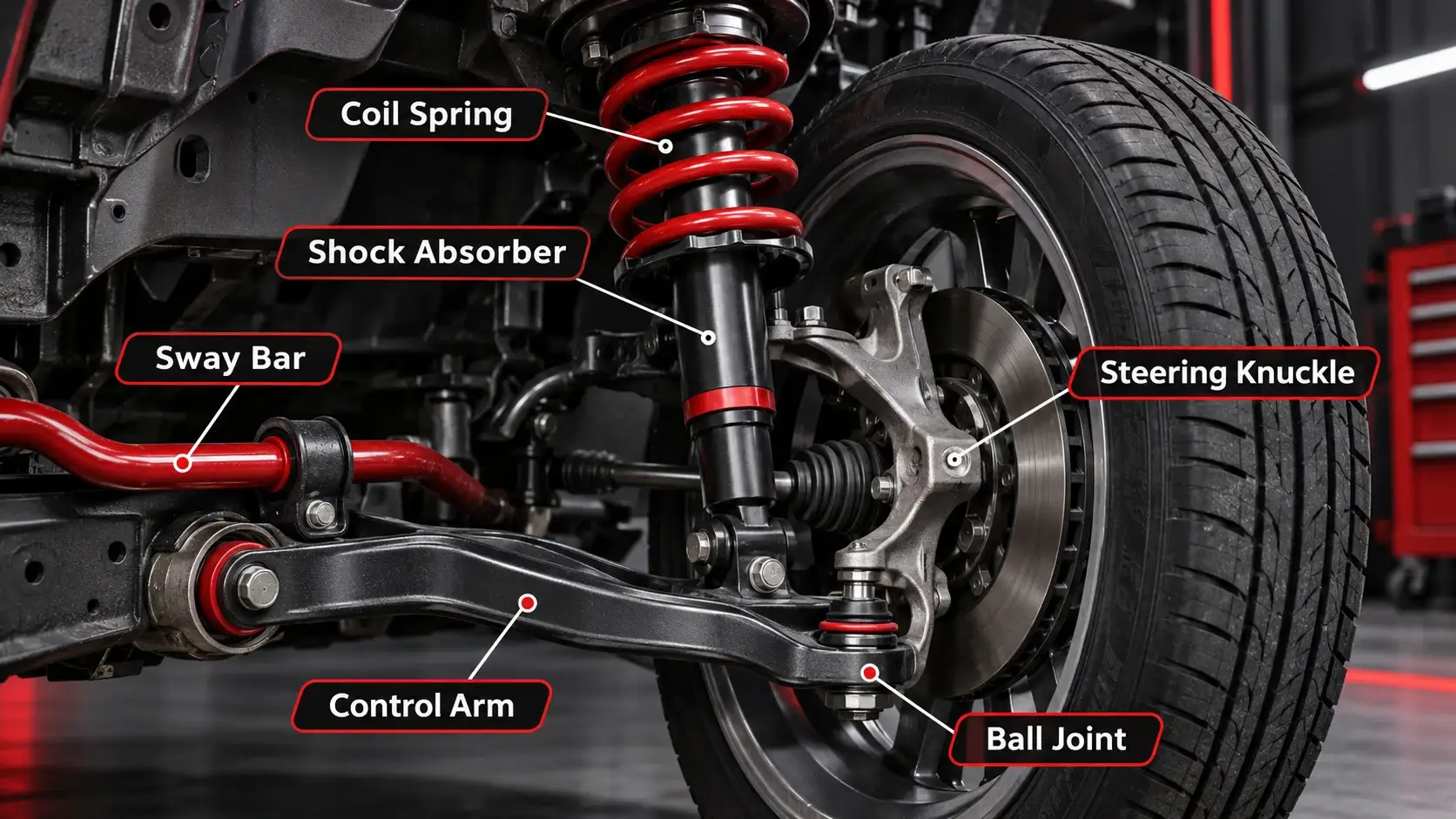
1. Suspension Springs
Springs support the vehicle’s sprung weight and allow the wheels to move over uneven surfaces. Common designs include coil springs, leaf springs, torsion bars, and air springs.
2. Shock Absorbers
Shock absorbers control spring movement and reduce excessive bouncing. Most conventional dampers use hydraulic fluid and internal valves to resist movement.
3. Suspension Struts
Struts provide damping while also performing a structural role in locating the wheel assembly. They are commonly used in modern passenger cars.
4. Control Arms
Control arms connect the wheel assembly to the vehicle structure or subframe and guide suspension movement through a controlled path.
5. Ball Joints
Ball joints allow angular movement between connected suspension components, accommodating suspension travel and, where applicable, steering movement.
6. Stabilizer Bar
Also called a sway bar or anti-roll bar, this component helps reduce excessive body roll by resisting differences in suspension movement between opposite wheels.
7. Suspension Bushings
Bushings provide flexible connections between components while helping reduce noise, vibration, and harshness.
Good to Know: Springs primarily support sprung weight, while shock absorbers control movement. Although they work together, they perform different functions.
What Are the Different Types of Car Suspension?
Manufacturers use different suspension designs depending on vehicle size, intended use, available space, comfort requirements, and handling characteristics.
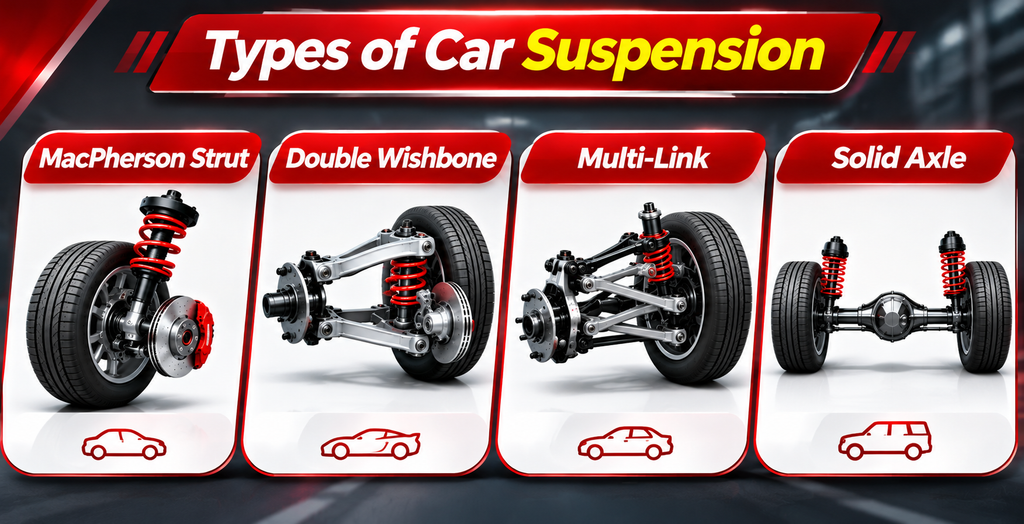
| Suspension Type | Main Feature | Common Use |
|---|---|---|
| Independent | Allows separate wheel movement | Passenger cars |
| Dependent | Uses a rigid axle connecting opposite wheels | Trucks and SUVs |
| MacPherson Strut | Compact structural strut design | Sedans and crossovers |
| Double Wishbone | Uses upper and lower control arms | Sports cars and SUVs |
| Multi-Link | Uses multiple wheel-guiding links | Modern and luxury cars |
| Air Suspension | Uses pressurized air springs | Luxury vehicles and trucks |
These categories can overlap. For example, a vehicle may use independent multi-link suspension with air springs. No single suspension design is ideal for every vehicle or driving condition.
What Is a Chassis? Chassis Definition Explained
Chassis Definition: A chassis is the supporting structural foundation of a vehicle and, depending on the technical context, its associated mechanical assemblies.
The chassis provides mounting locations for important components such as the suspension, steering system, drivetrain, and axles. It also helps manage the forces generated during acceleration, braking, and cornering.
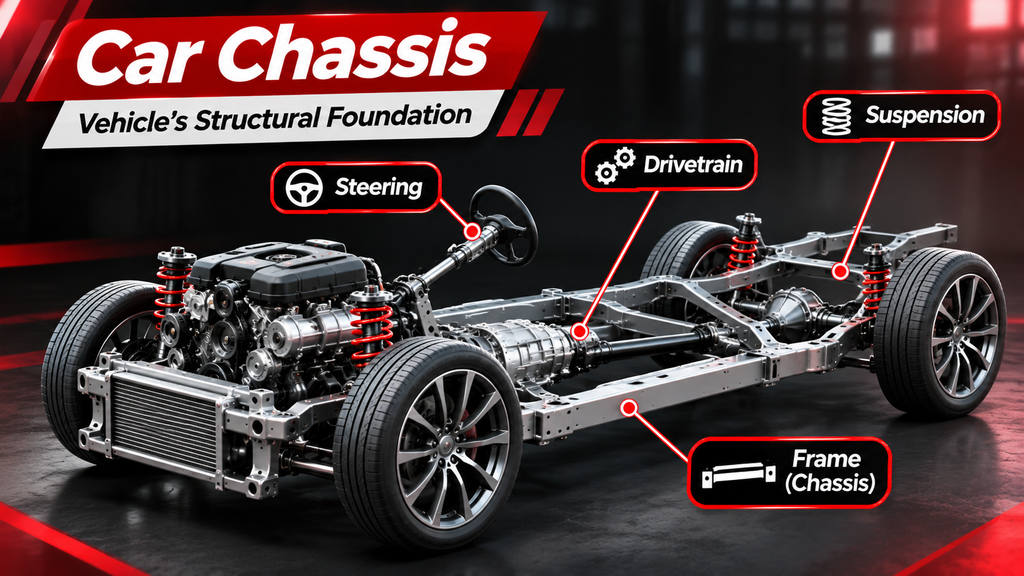
Main Functions of a Car Chassis
- Supports major vehicle components.
- Provides structural mounting locations.
- Helps manage forces generated during driving.
- Supports the intended suspension and steering geometry.
- Contributes to the vehicle’s overall structural safety design.
Common Types of Car Chassis
Ladder Frame
Uses separate structural rails and crossmembers. Common in pickup trucks and certain SUVs.
Unibody
Integrates the body and supporting structure. Widely used in modern passenger vehicles.
Space Frame
Uses a network of interconnected structural members, often in specialized or performance vehicles.
Backbone Chassis
Uses a central supporting structural member. Found in certain specialized and historical vehicles.
Chassis vs. Frame vs. Car Body
Although these terms are often used interchangeably, they describe different aspects of vehicle construction.
| Component | Definition | Main Purpose |
|---|---|---|
| Chassis | Vehicle structural and mechanical foundation | Supports major vehicle systems |
| Frame | Supporting structural framework | Provides structural support |
| Body | Passenger and cargo enclosure | Provides space, protection, and vehicle shape |
In a unibody vehicle, the body and supporting structure are integrated. In a traditional body-on-frame vehicle, the body is mounted on a separate frame.
What Are the Main Parts of a Car?
A modern vehicle contains many interconnected components. Understanding the main parts of a car and their functions makes automotive maintenance and basic mechanical concepts easier to understand.
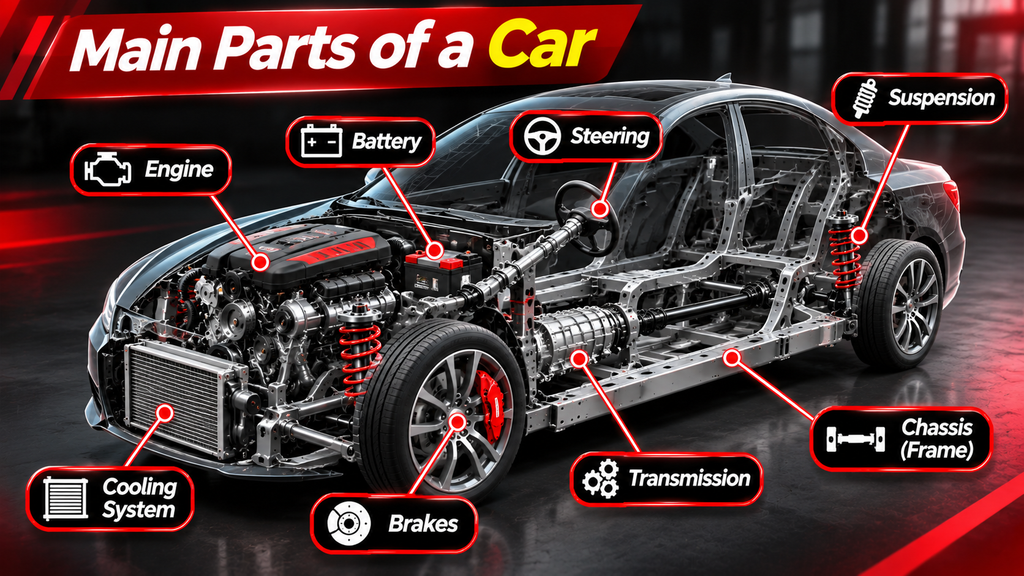
| Car Part | Primary Function |
|---|---|
| Engine | Converts fuel energy into mechanical power. |
| Transmission | Manages power delivery and speed relationships. |
| Chassis | Provides the supporting vehicle foundation. |
| Suspension | Supports sprung weight and controls wheel movement. |
| Steering System | Allows the driver to control vehicle direction. |
| Braking System | Slows and stops the vehicle. |
| Battery | Stores electrical energy. |
| Alternator | Generates electrical power in most conventional vehicles. |
| Radiator | Helps transfer heat from coolant to surrounding air. |
| Fuel System | Stores and delivers fuel to the engine. |
| Exhaust System | Manages exhaust gases, noise, and emissions. |
| Wheels and Tires | Provide contact with the road. |
| Drivetrain | Transfers mechanical power toward the driven wheels. |
Electric vehicles use different powertrain components, including electric motors and high-voltage battery packs, but still require suspension, steering, brakes, tires, and supporting structures.
How Do the Chassis and Suspension Work Together?
The chassis provides mounting locations for the suspension, while the suspension allows controlled movement between the wheels and the vehicle structure.
When you turn a corner, suspension components help manage body roll and wheel movement. During braking, the system helps control forward body movement. On rough roads, springs and dampers work together to manage impacts.
Damage to suspension mounting points or structural components can affect wheel positioning, handling, and overall vehicle stability. This is why both systems must remain in good condition.
6 Common Signs of a Bad Car Suspension
Suspension components can wear over time or become damaged after severe road impacts. The following symptoms may indicate that your vehicle needs an inspection.
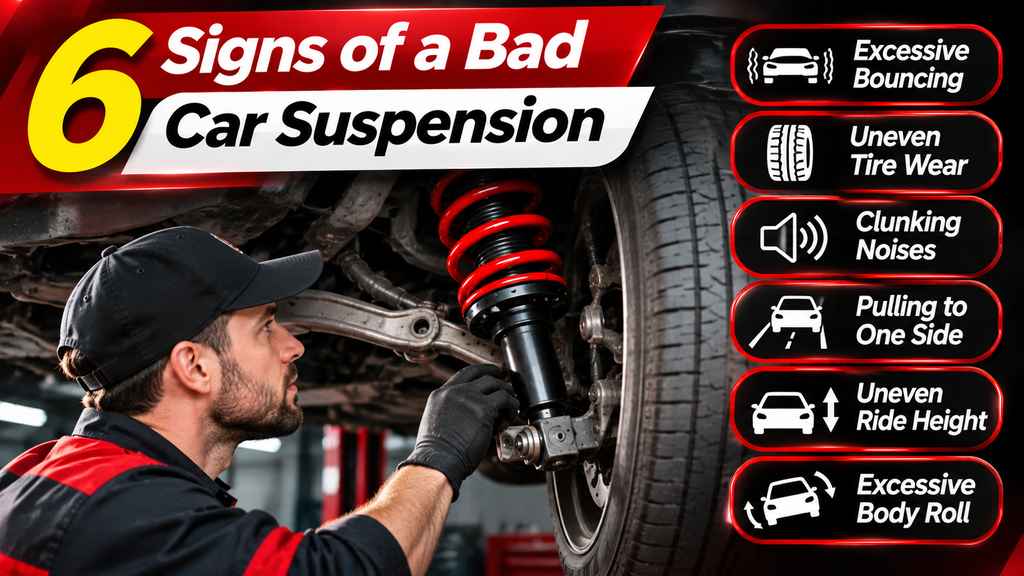
01
Excessive Bouncing
Repeated bouncing after bumps may indicate reduced damping performance.
02
Uneven Tire Wear
Worn suspension components or incorrect alignment may contribute to irregular tire wear.
03
Clunking Noises
Worn joints, bushings, mounts, or sway bar links may produce unusual sounds.
04
Vehicle Pulling to One Side
Suspension, steering, alignment, tire, or brake problems may affect directional stability.
05
Uneven Ride Height
One corner sitting unusually low may indicate a spring, air suspension, or structural problem.
06
Excessive Body Roll
Unusual body movement during normal turns may indicate changes in suspension condition.
Safety Warning: These symptoms do not automatically confirm a failed suspension component. If your vehicle becomes difficult to control, a wheel appears displaced, or a suspension component breaks, stop driving as soon as it is safe and arrange professional assistance.
How to Maintain Your Car Suspension System
Regular maintenance and responsible driving can help reduce unnecessary wear and preserve the vehicle’s intended handling characteristics.
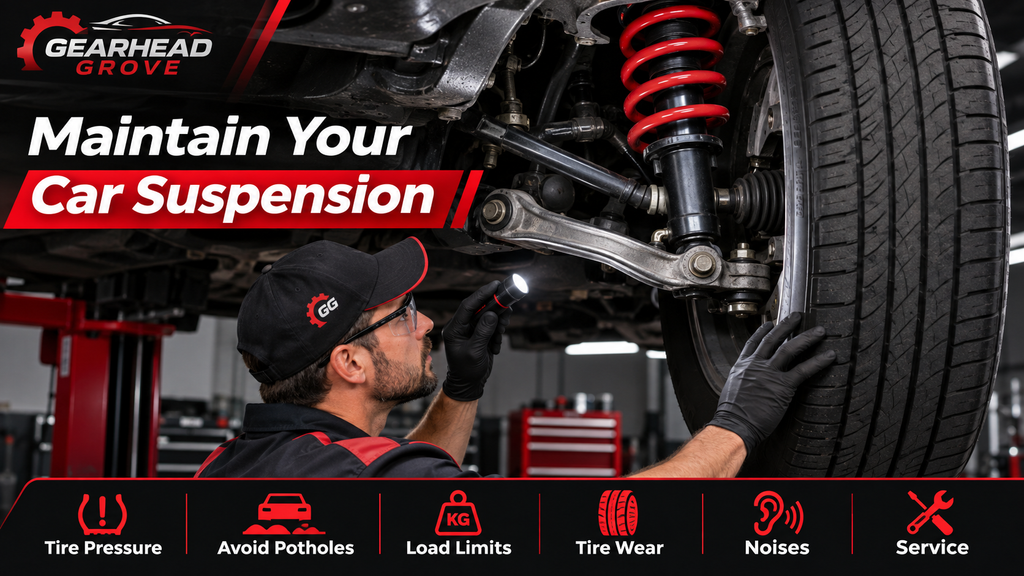
- Check tire pressure: Maintain the manufacturer’s recommended cold tire pressure.
- Avoid severe road impacts: Reduce speed safely before potholes and uneven surfaces.
- Follow vehicle load limits: Avoid carrying more weight than your vehicle is rated to support.
- Inspect tire wear: Unusual tread wear may indicate alignment or suspension problems.
- Address unusual noises: Arrange an inspection when new knocking or rattling sounds develop.
- Follow maintenance schedules: Refer to the owner’s manual for recommended inspection procedures and intervals.
Maintenance Tip: There is no universal replacement mileage for suspension components. Their lifespan depends on vehicle design, driving conditions, maintenance, and environmental exposure.
Frequently Asked Questions
What is the main purpose of car suspension?
Car suspension supports sprung weight, controls wheel movement, improves ride comfort, and contributes to tire contact and vehicle stability.
What is a car chassis in simple words?
A car chassis is the supporting foundation of a vehicle that provides mounting locations for its major structural and mechanical components.
Are the chassis and suspension the same?
No. The chassis provides structural support, while the suspension connects the wheels to the vehicle structure and controls relative movement.
What are the three main types of suspension?
Three broad categories are independent, dependent, and semi-independent suspension. Each category contains different mechanical designs.
Can bad suspension affect steering?
Yes. Worn or damaged suspension components can influence wheel positioning, steering response, and directional stability.
Do electric cars have suspension systems?
Yes. Electric vehicles require suspension systems to support their weight, manage road impacts, and maintain handling characteristics.
Can you drive with damaged suspension?
It depends on the severity of the damage. Broken components, severe instability, or compromised steering require you to stop driving safely and arrange professional assistance.
Final Thoughts
Car suspension, chassis construction, and other essential vehicle components work together to provide a comfortable, stable, and controlled driving experience.
Understanding the main parts of a car makes it easier to recognize warning signs, understand repair recommendations, and maintain your vehicle effectively.
Always follow manufacturer maintenance recommendations and seek professional diagnosis when suspension, steering, or structural problems develop.