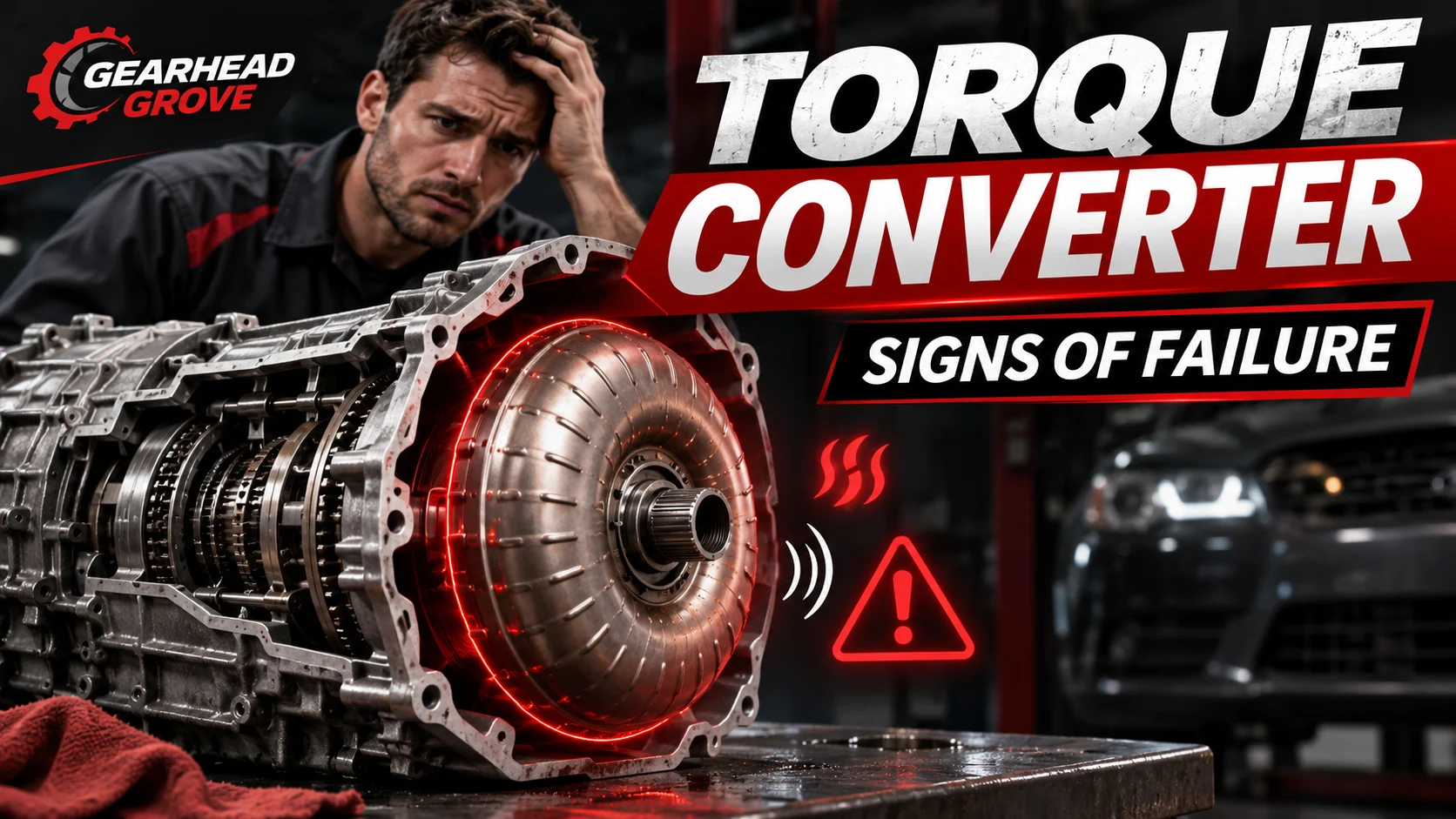
A torque converter is a fluid-filled coupling between the engine and certain automatic transmissions. It transfers engine power to the transmission while letting the engine keep running when the vehicle stops. If your car shudders or slips, the converter is one possibility—not a diagnosis.
The converter can multiply torque as you pull away and, in many designs, lock its clutch at cruising speed to reduce slip. But not every automatic uses one: dual-clutch transmissions, for example, use clutches instead. Check your vehicle’s transmission design before treating converter advice as applicable.
At a glance
- It sits between the engine and transmission on vehicles equipped with a conventional torque-converter automatic.
- Shudder, slipping, vibration, stalling, heat, and noise have several possible causes.
- A qualified technician should confirm the fault with vehicle-specific tests before replacement.
The basics
What Is a Torque Converter?
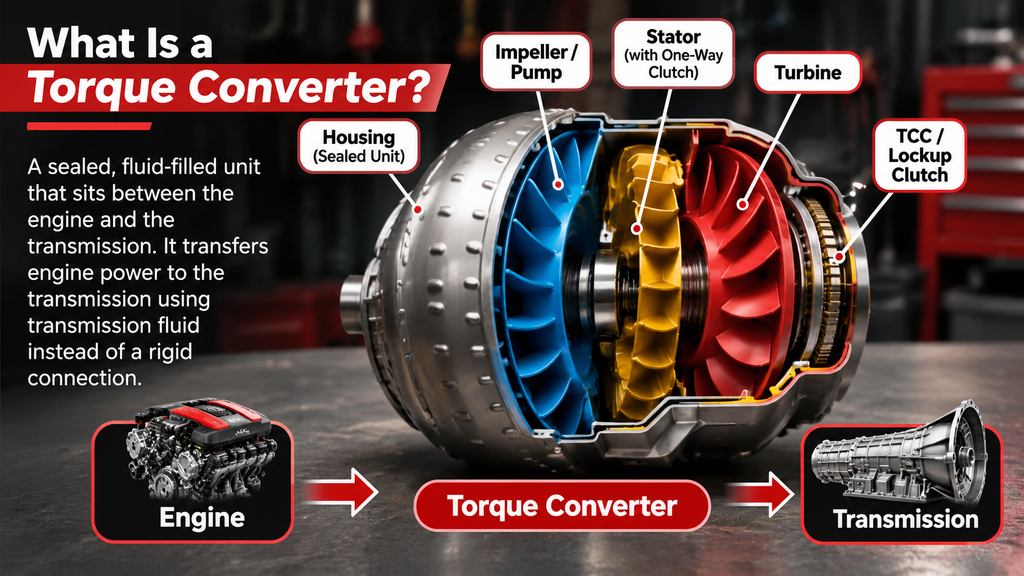
A torque converter is a sealed, fluid-filled unit mounted between the engine and the transmission. The engine turns its housing; transmission fluid carries that motion to the transmission input. Unlike a rigid connection, the fluid coupling allows the engine to idle while the vehicle is stopped in gear.
It is usually inside the transmission bell housing, where the transmission meets the engine. You generally cannot inspect its internal parts without removing the transmission. “Automatic” does not always mean “torque converter”: transmission designs vary, so use your owner’s information or service documentation to identify yours.
The job
What Does a Torque Converter Do?
It transfers engine power to the transmission smoothly, lets the vehicle stop without stalling a running engine, and can increase torque delivered to the transmission during low-speed acceleration. At suitable cruising conditions, a torque converter clutch (TCC), often called a lockup clutch, can connect the engine and transmission more directly to reduce fluid-coupling slip and heat.
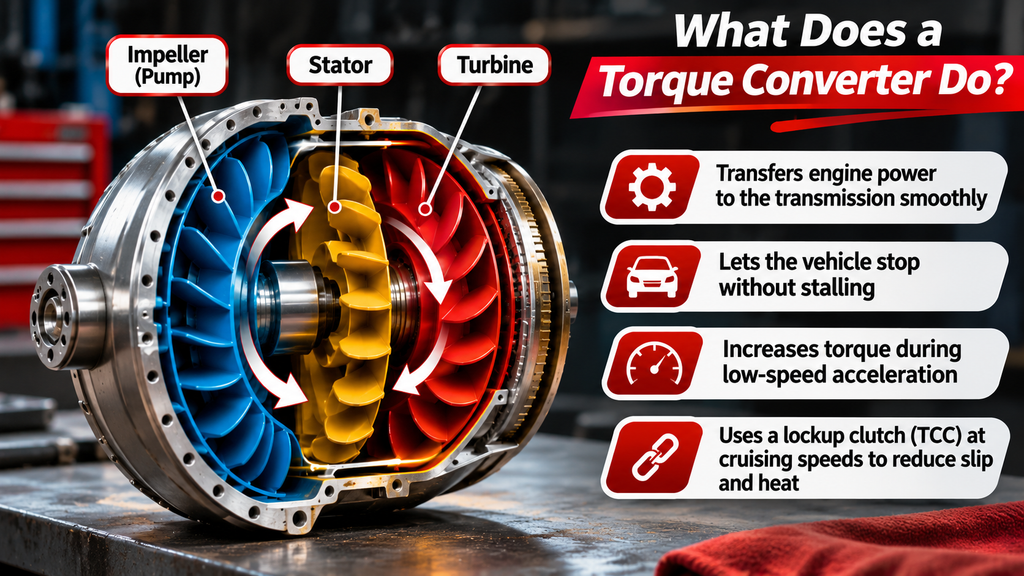
When and how that clutch applies depends on the vehicle’s control strategy. It should not be assumed to be locked at every road speed or whenever the transmission is in its highest gear.
Inside the unit
How Does a Torque Converter Work?
The engine spins the impeller (also called the pump), which pushes transmission fluid outward. Moving fluid acts on the turbine, turning the transmission input. This is fluid coupling: power crosses the gap through moving fluid rather than a direct mechanical connection.
At low speed, returning fluid meets the stator. Its one-way clutch lets it redirect fluid in a way that helps the impeller, producing torque multiplication when the turbine is turning much more slowly than the impeller. As their speeds approach one another, that multiplying effect falls away. Under the right driving conditions, the TCC engages to reduce the remaining slip.
Labeled visual
Main Parts of a Torque Converter
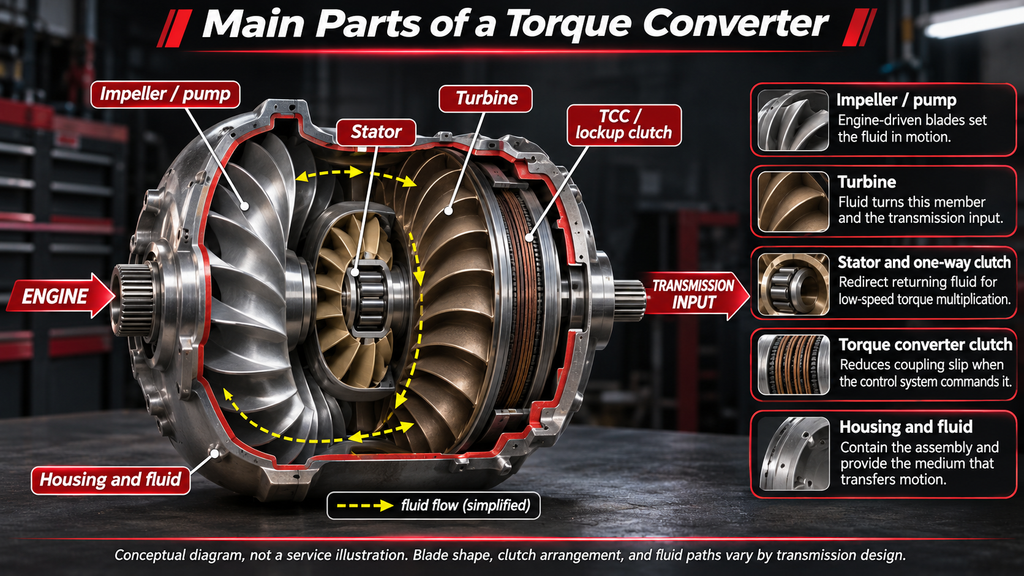
Impeller / pump
Engine-driven blades set the fluid in motion.
Turbine
Fluid turns this member and the transmission input.
Stator and one-way clutch
Redirect returning fluid for low-speed torque multiplication.
Torque converter clutch
Reduces coupling slip when the control system commands it.
Housing and fluid
Contain the assembly and provide the medium that transfers motion.
What you might notice
8 Possible Signs of a Bad Torque Converter
These are possible indicators, not proof. Shuddering, slipping, vibration, stalling, overheating, and unusual noise can also come from fluid, transmission, engine, or driveline problems.
- Shudder during steady driving
A brief rumble or shake around clutch apply may involve TCC operation, but tires, misfires, and other faults can feel similar. - Engine revs rise without matching acceleration
Apparent slipping can also result from internal transmission clutch wear, low fluid, or hydraulic-control faults. - Vibration at certain speeds
Look beyond the converter to tires, axles, driveshafts, engine mounts, and misfires. - Hesitation or weak takeoff
Engine performance, fluid pressure, or transmission problems may be responsible. - Stalling when coming to a stop
A clutch that fails to release is one possibility; idle-control and engine faults also need checking. - Transmission overheating
Excessive slip can make heat, but low fluid, restricted cooling, heavy loads, or other transmission faults can too. - Unusual whining, rattling, or grinding
Noises need to be located carefully; bearings, pumps, accessories, and other rotating parts can be the source. - A warning light or TCC-related code
A code identifies a circuit or performance concern to diagnose—not necessarily a converter to replace.
Important: Even several symptoms together do not confirm a failed torque converter. Record when they happen—speed, temperature, gear, acceleration, and warning lights—then have the system tested.
Why problems develop
What Causes Torque Converter Failure?
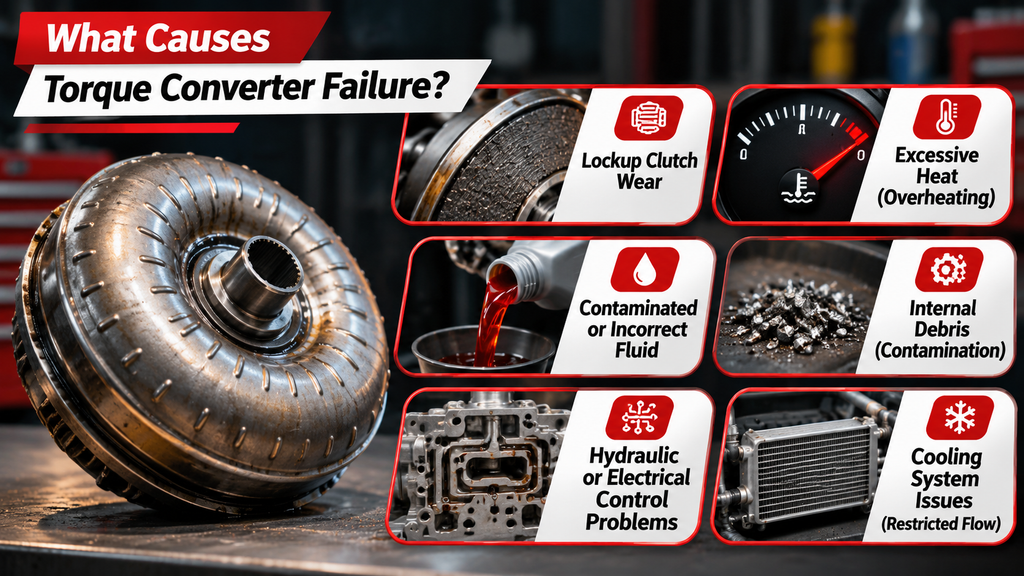
Possible causes include wear of the lockup clutch or internal components, excessive heat, contaminated or incorrect fluid, and debris from another transmission failure. Hydraulic or electrical control problems can also create converter-like symptoms without the converter itself being the root cause.
A replacement recommendation should account for contamination and the underlying cause. Installing a new unit without addressing a related transmission or cooling-system problem may not solve the complaint.
Avoid a false diagnosis
Torque Converter vs. Other Problems
Use patterns as clues, not verdicts. A technician should connect the symptom to scan data, inspection findings, and the vehicle’s service procedure.
| What you notice | Converter-related possibility | Other causes to check |
|---|---|---|
| Shudder at steady cruise | TCC apply or controlled slip | Engine misfire, tires, driveline, fluid condition |
| Revs flare during acceleration | Excessive coupling or clutch slip | Internal transmission clutches, low fluid, pressure control |
| Vibration with road speed | Possible converter imbalance | Wheel/tire balance, axles, driveshaft |
| Stalls when stopping | TCC may not release | Engine idle or fuel/air-control fault |
| Heat, leak, or noise | Possible converter or seal issue | Cooling, fluid level, pump, seals, bearings |
A transmission is the larger assembly that selects gear ratios; the converter is one power-transfer component on vehicles equipped with it. Fluid condition may be a clue, but fluid appearance alone cannot identify a failed converter. An engine misfire or driveline vibration can also be mistaken for transmission shudder.
Confirm the cause
How a Professional Diagnoses a Suspected Torque Converter Fault
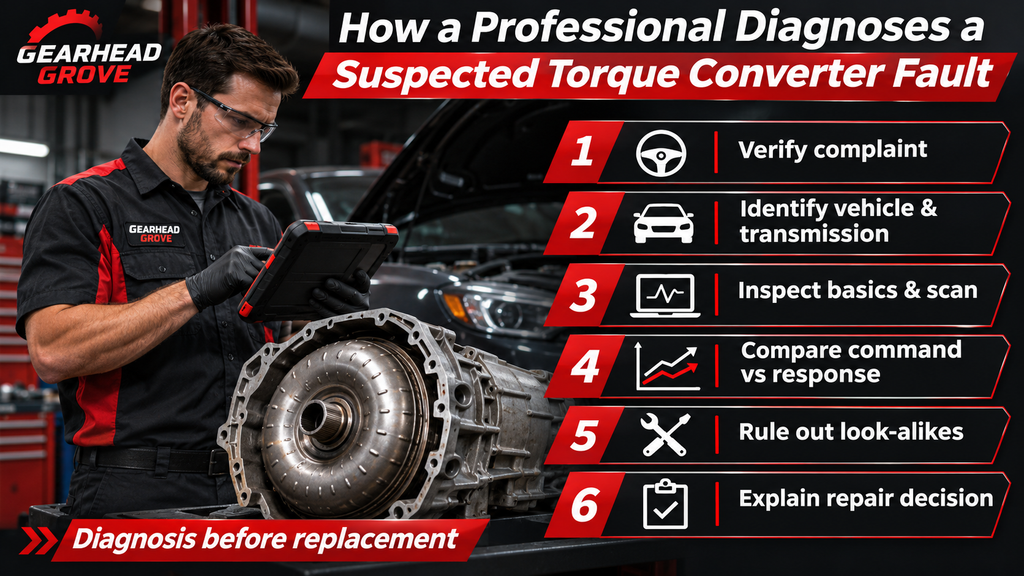
- Verify the complaint. Reproduce it safely and note operating conditions, including whether it occurs during a shift, at steady speed, or while stopping.
- Identify the exact vehicle and transmission. Consult its manufacturer service information, relevant technical service bulletins, and specified diagnostic sequence.
- Inspect basics and scan the vehicle. Check for leaks and applicable fluid-level/condition procedure, then record fault codes and relevant live data. A code is a starting point, not a parts order.
- Compare command with response. Where supported, compare commanded TCC operation with measured slip and related speed or temperature data under the manufacturer’s specified conditions.
- Rule out look-alikes. Check engine operation, transmission hydraulics and controls, cooling, and driveline causes as indicated by the evidence.
- Explain the repair decision. Ask which tests confirm the failed component and what related contamination or cooling work is required.
Test thresholds, scan-data names, road-test conditions, and fluid-check steps are vehicle-specific. Do not apply a bulletin or slip-RPM value from one transmission to another.
Safety first
Can You Drive With a Suspected Bad Torque Converter?
If a symptom is mild and the vehicle otherwise behaves normally, avoid unnecessary trips and arrange an inspection soon. There is no reliable universal “safe mileage” for an undiagnosed problem.
Stop driving and seek assistance
Pull over safely and arrange a tow or roadside help for severe slipping, overheating, an active fluid leak, loss of drive, stalling in traffic, or any unsafe behavior. Continued operation can create a hazard or worsen damage. Follow any vehicle warning instructions.
Repair decisions
Torque Converter Replacement Cost: What Changes the Estimate?
There is no responsible universal price. The quote depends on the vehicle and transmission, parts availability and quality, local labor rates, access and labor time, fluid and seals, diagnostics, and whether related transmission, cooler, or contamination work is needed. Removing the transmission often makes labor a major part of the bill.
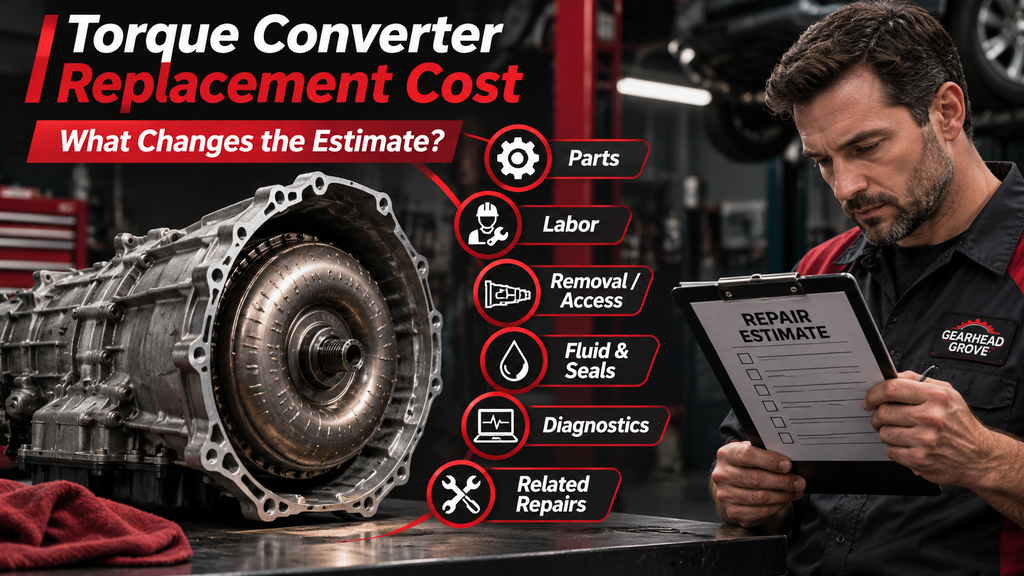
Ask for a written, itemized estimate that separates diagnosis, converter, labor, fluid, and any additional repairs. Compare the evidence for replacement with alternatives such as a fluid-level correction, control repair, engine repair, or broader transmission work. Do not approve a converter solely because a symptom “sounds like” one.
Care
How to Help Prevent Torque Converter Problems
Follow the manufacturer’s fluid specification, service interval, and filling or level-check procedure for your exact vehicle. Address leaks and overheating promptly, and investigate new shudder or slipping before it becomes severe. Operating under heavy loads should stay within the vehicle manufacturer’s guidance.
Do not assume every vehicle needs a transmission flush—or that a flush procedure suitable for one model is suitable for another. Consult the owner’s manual and vehicle-specific service information before servicing the fluid.
Quick answers
Frequently Asked Questions
Does every automatic transmission have a torque converter?
No. Many conventional automatics do, but other automatic designs, including dual-clutch transmissions, use different ways to connect the engine and transmission. Confirm the design fitted to your vehicle.
Can a bad torque converter cause shuddering?
Yes, a TCC-related concern can cause shudder under some conditions. Engine misfires, tires, driveline issues, fluid problems, and other transmission faults can also cause a similar sensation. Testing is needed.
Does a TCC code mean the converter must be replaced?
No. A TCC-related code may involve controls, wiring, fluid pressure, sensors, or internal transmission issues. Follow the applicable manufacturer diagnostic procedure.
Can changing the transmission fluid fix the problem?
Sometimes a fluid-related issue contributes to a symptom, but a fluid change cannot repair a mechanically failed component. First confirm the correct fluid, level procedure, service guidance, and likely cause for your vehicle.
Is a torque converter the same as a transmission?
No. On vehicles equipped with one, the converter transfers power from the engine to the transmission; the transmission then provides gear ratios. A symptom can involve either or neither.