
If your steering wheel is pulling to one side or your tires are wearing unevenly, you already know you need a wheel alignment. But before you drive into a shop, you need to know exactly what you should be paying.
Skip the guesswork. Based on current 2026 shop rates and parts pricing, here is exactly what a wheel alignment costs right now.
2026 Wheel Alignment Pricing Table
| Type of Alignment | Best For | Average Shop Cost |
| Front-End Alignment (2-Wheel) | Older cars and trucks with solid rear axles. | $50 – $100 |
| Standard 4-Wheel Alignment | Most modern sedans, SUVs, AWD, and 4×4 vehicles. | $100 – $200 |
| ADAS Recalibration Alignment | Modern cars with Lane Keep Assist or Adaptive Cruise. | $250 – $400+ |
Note: Dealerships typically charge 20% to 40% more than independent tire shops for the exact same laser alignment service.
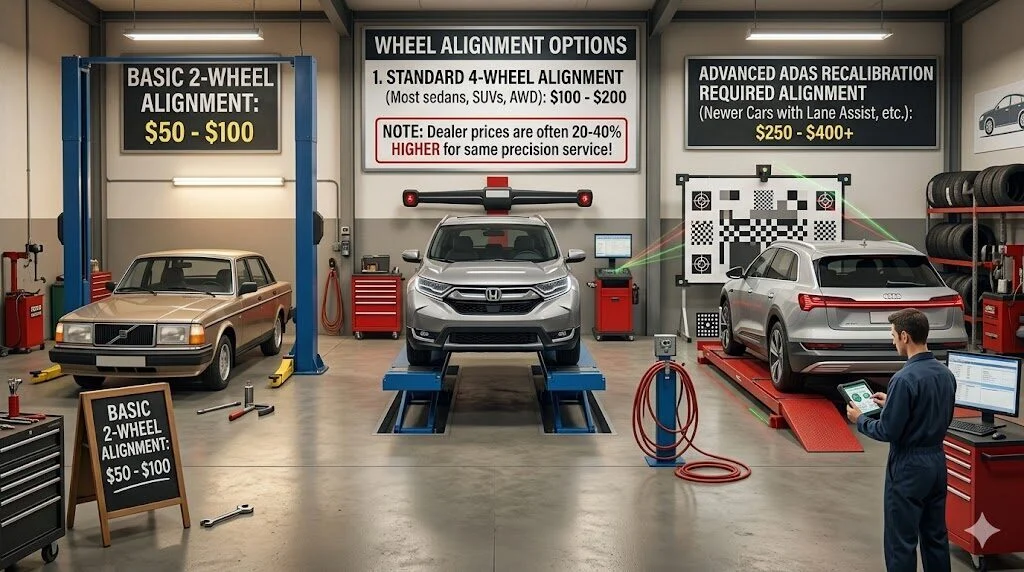
The “ADAS Tax”: Why Alignments Suddenly Cost $250+
If you drive a car built after 2018, you might be shocked when the service advisor hands you a $300 bill for a simple alignment. This isn’t a scam—it is the “ADAS Tax.”
Modern vehicles are equipped with Advanced Driver Assistance Systems (ADAS). When a technician adjusts the physical geometry of your wheels, they also have to plug a diagnostic scanner into your car’s OBD-II port to reset the Steering Angle Sensor (SAS) and recalibrate the forward-facing cameras.
If they skip this step, your Lane Keep Assist might pull you into oncoming traffic because the computer thinks the car is turning when it is actually driving straight. The specialized equipment required for this recalibration is exactly why prices have surged for newer vehicles.

Understanding Your Alignment Printout (Red vs. Green)
As a technician, the first thing I do after putting a car on the Hunter alignment rack is print the current geometry specs. A good shop will always hand you a printout with “Before” and “After” graphics.
Here is what those numbers actually mean:
- Toe (The Tire Killer): Imagine looking down at your feet. If your toes point inward (pigeon-toed) or outward (duck-footed), your tires will scrub against the pavement, shredding the tread in a matter of weeks.
- Camber (The Cornering Angle): If the top of your tire leans in toward the engine or out toward the fender. Too much negative camber wears out the inside edge of your tire fast.
- Caster (The Steering Stability): This doesn’t affect tire wear, but it affects how the steering wheel returns to the center after you take a corner.
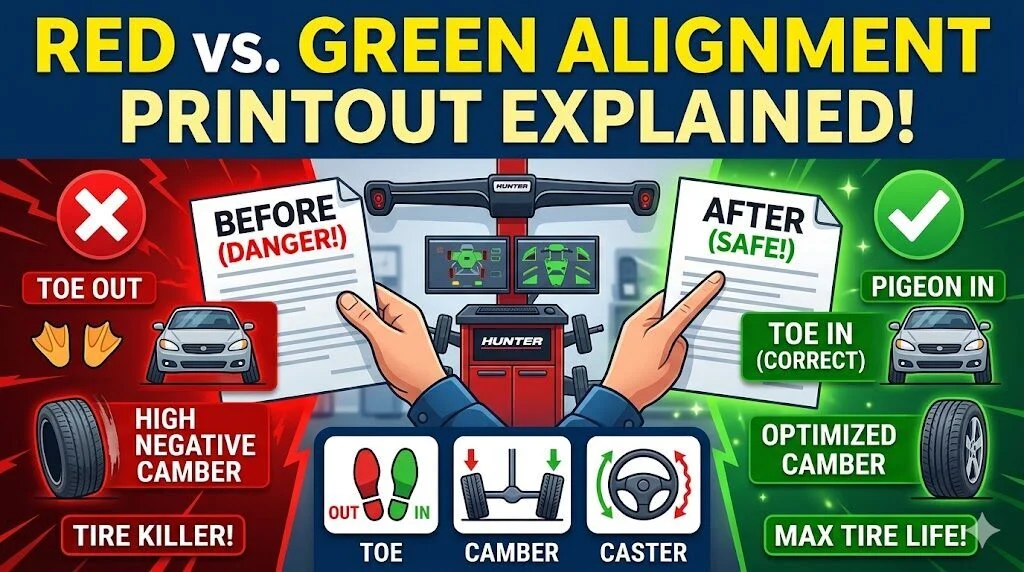
If the boxes on your printout are Green, you are within factory specifications. If they are Red, adjustments are legally and mechanically required.
Mechanic Warning: Watch Out for These 3 Alignment Upsells
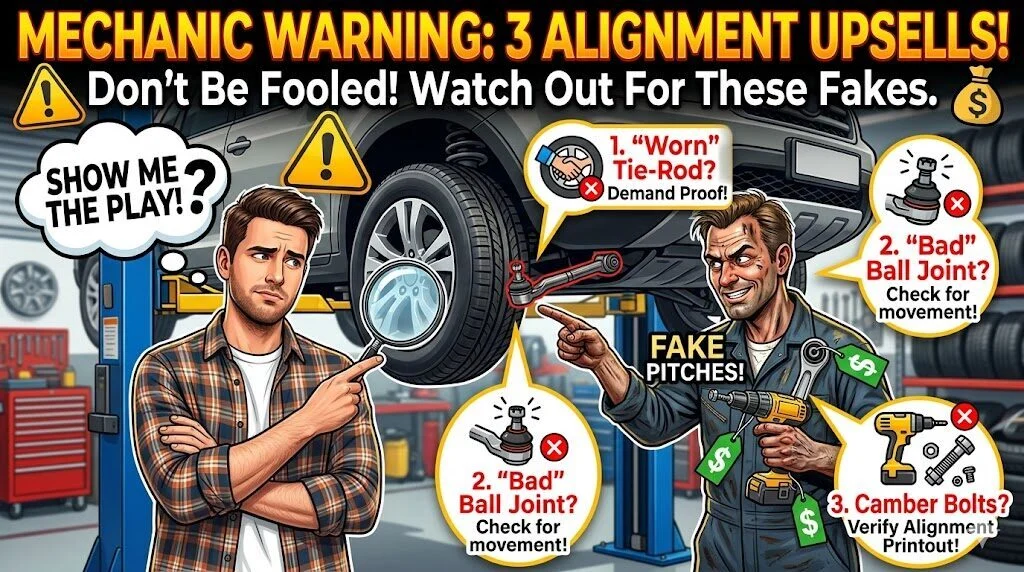
Because wheel alignments are a relatively low-profit service, some less reputable shops use the alignment rack as a way to sell you expensive suspension parts. Be on guard for these three common upsells:
1. The “Worn Tie-Rod” Pitch
Mechanics cannot perform an alignment if your steering components are loose. They will often claim your inner or outer tie-rods are shot.
- Your Defense: Ask the mechanic to physically take you into the bay and “show me the play.” A bad tie-rod will visibly clunk and wiggle when the wheel is shaken side-to-side. If it is tight, decline the repair.
2. The “Bad Ball Joint” Upsell
Similar to tie-rods, they might claim your lower control arm ball joints are failing.
- Your Defense: Ask them to shake the wheel from top-to-bottom. If there is no movement or clicking sound, your ball joints are likely fine.
3. The Camber Bolt Add-On
Some factory vehicles do not have adjustable camber bolts installed from the factory. A shop might charge you an extra $80-$100 to drill out the factory rivets and install aftermarket camber kits.
- Your Defense: This is often a legitimate required repair if your car was in an accident or hit a massive pothole, but always ask to see the alignment printout first to prove the camber is actually in the red.
Frequently Asked Questions (FAQs)
How long does a wheel alignment actually take?
For a standard 4-wheel alignment on a modern computerized rack, the process takes 45 to 60 minutes. If your vehicle has severely rusted suspension bolts that need to be heated with a torch, or if it requires ADAS recalibration, expect it to take up to two hours.
How often should I pay for a wheel alignment?
You do not need an alignment every time you get an oil change. The industry standard is to get your alignment checked once a year, every 12,000 miles, or immediately after buying a new set of tires to protect your investment.
Is a $50 alignment worth it?
If an independent shop is offering a $50 alignment, it is almost certainly a “Front-End Only” alignment, or a “Toe-and-Go” service where they only adjust the easiest component (the toe) and ignore the camber and caster. For modern cars, it is worth paying the $100+ for a comprehensive 4-wheel laser alignment.
Also read wheel alignment cost and repair guides
Also read 2-wheel vs 4-wheel alignment
Also read ADAS alignment cost