
A complete guide to finding tire recycling near me, understanding disposal costs, and choosing the most responsible option for your old tires.
If you’ve recently replaced your vehicle’s tires, you’re probably wondering what to do with the old ones. Searching for “tire disposal near me” is the first step — but the results can be confusing. Between recycling centers, tire retailers, municipal programs, and used tire places near me listings, it’s hard to know which option is legitimate, affordable, and environmentally responsible.
This guide breaks down every practical option for disposing of old tires safely. You’ll learn where to find tire recycling near me, whether tire discounters accept used tires, what disposal typically costs, and how recycled tires are repurposed. Whether you have two tires or twenty, you’ll walk away knowing exactly what to do — legally and responsibly.
What Is Tire Disposal and Why Does It Matter?
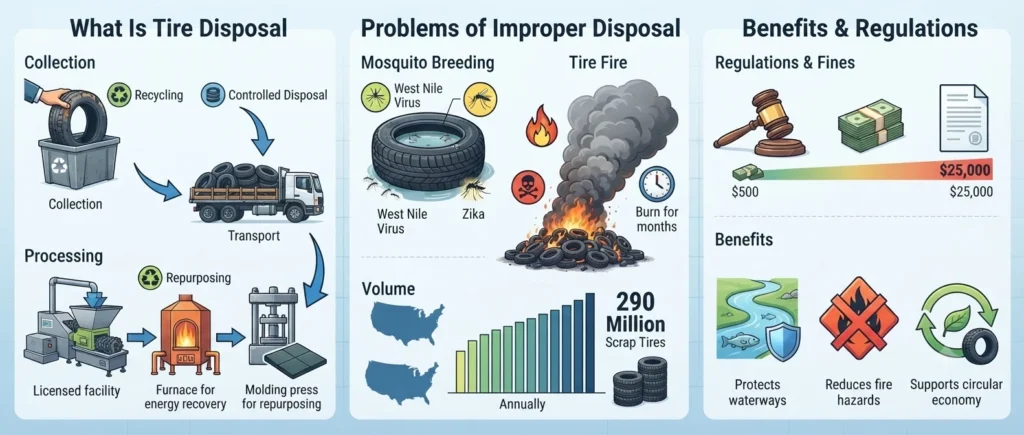
Tire disposal refers to the process of safely removing end-of-life tires from use through recycling, repurposing, or controlled disposal at licensed facilities. Tires cannot simply be thrown in household trash in most states — they require special handling due to their size, chemical composition, and potential environmental impact.
Improperly discarded tires create serious problems. Stockpiled tires become breeding grounds for mosquitoes carrying diseases like West Nile virus and Zika. Tire fires are extremely difficult to extinguish, release toxic chemicals into the air and soil, and can burn for months. The EPA estimates that approximately 290 million scrap tires are generated annually in the United States alone.
Most states have specific regulations governing tire disposal. Illegal dumping can result in fines ranging from $500 to $25,000 depending on jurisdiction and volume. Beyond legal consequences, responsible tire disposal protects waterways, reduces fire hazards, and supports the circular economy by keeping valuable rubber materials in productive use.
Where Can You Dispose of Old Tires Near You?
Tire retailers are the most convenient option for most people. When you purchase new tires, most shops — including Discount Tire, Tire Rack installation partners, Costco, Walmart Auto Care, and local independent shops — will dispose of your old tires for a small fee (typically $3–$5 per tire). Many include this fee automatically in your installation quote. If you’re already getting new tires installed, this is the simplest path.
Local recycling centers and county waste facilities often accept tires, sometimes for free during designated collection events. Check your county or city waste management website — many publish annual tire amnesty days where residents can drop off a limited number of tires at no charge. These events are particularly useful if you have multiple tires stored in a garage or shed.
Auto repair shops and dealerships may accept old tires, especially if you’re a customer. Call ahead to confirm — policies vary. Some independent mechanics accumulate tires and arrange bulk pickups from licensed haulers. Landfill transfer stations in some states still accept whole tires for a per-tire fee, though many landfills have banned whole tire disposal entirely.
Used tire places near me — shops specializing in secondhand tires — may accept tires with remaining tread depth for resale. This is worth exploring if your tires still have usable life. These businesses inspect, grade, and resell used tires at a fraction of new tire prices, serving budget-conscious drivers and extending tire life cycles.
Tire Recycling Near Me: How It Works
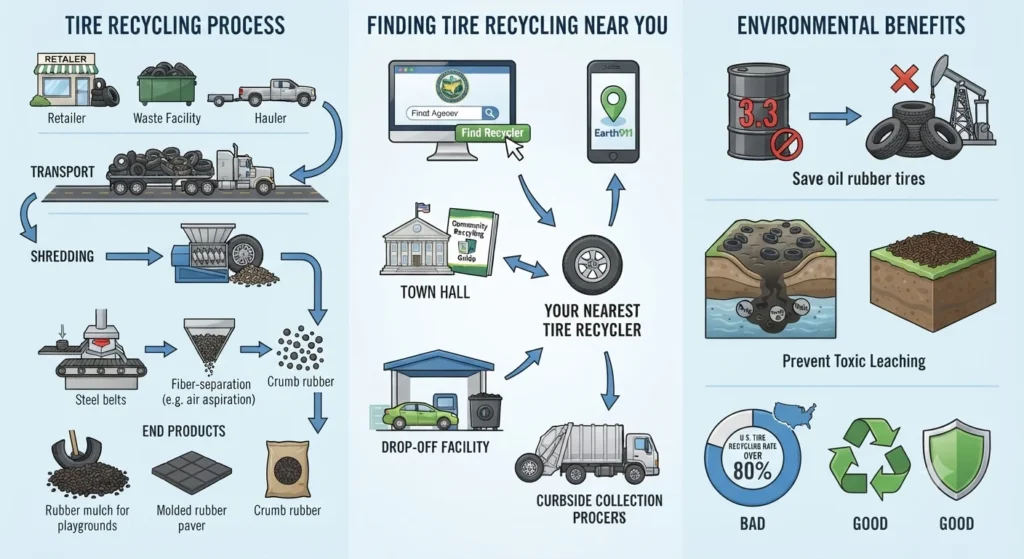
Tire recycling begins with collection from retailers, waste facilities, and haulers. Tires are transported to processing plants where they undergo shredding — industrial machines cut tires into smaller chips. These chips are then further processed through granulation, which removes steel belts (via magnets) and textile fibers, leaving clean crumb rubber of various particle sizes.
To find tire recycling near me, start with your state environmental agency’s website — most maintain directories of licensed tire recyclers and processors. Earth911.org and your local municipality’s recycling guide are also reliable resources. Many communities partner with tire recycling companies that offer scheduled drop-off locations or curbside collection for a fee.
The environmental benefits are significant. Recycling one ton of tires saves approximately 3.3 barrels of oil compared to producing new rubber from virgin materials. It also prevents the release of heavy metals and toxic chemicals that leach from tires degrading in landfills or illegal dump sites. The tire recycling industry in the U.S. now processes over 80% of annually generated scrap tires.
Can Tire Shops and Tire Discounters Take Old Tires?
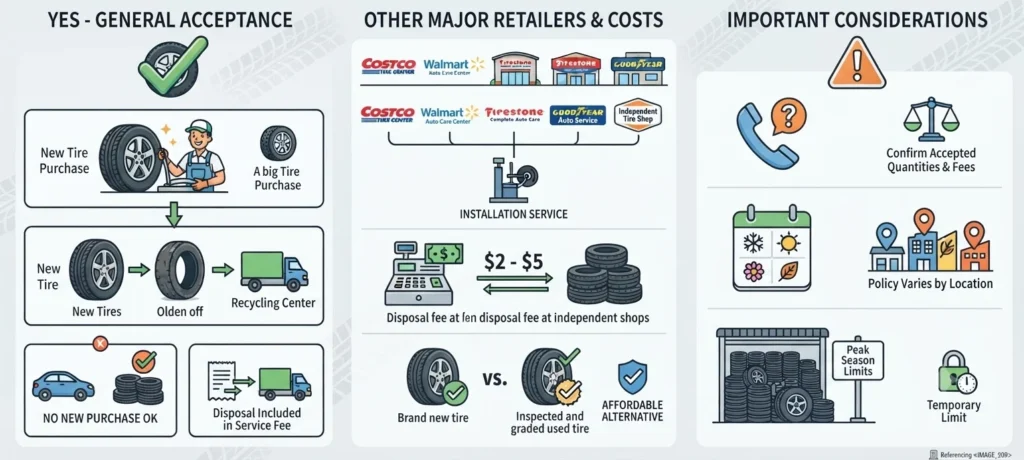
Yes — most tire retailers accept old tires, particularly when you’re purchasing new ones. Discount Tire (America’s largest independent tire retailer) accepts up to 4 old tires per customer for recycling, even without a new tire purchase, though policies may vary by location. When buying new tires from Discount Tire, old tire disposal is typically included in the service fee.
Other major retailers have similar programs. Costco Tire Center, Walmart Auto Care Centers, Firestone Complete Auto Care, and Goodyear Auto Service all accept old tires during new tire installation. Independent shops typically charge $2–$5 per tire for disposal. Some tire discounters also sell quality used tires — inspected and graded for remaining tread life — offering an affordable alternative to new purchases.
Important note: not all locations accept tires without a purchase. Always call ahead to confirm current policy, accepted quantities, and fees. Policies change seasonally and may differ between franchise locations. During peak tire-change seasons (spring and fall), some shops temporarily limit accepted quantities due to storage constraints.
What Happens to Recycled Tires?
Tire-derived fuel (TDF) is the single largest end-use for scrap tires, accounting for roughly 40% of recycled volume. Cement kilns, pulp and paper mills, and electric utilities use TDF as a supplemental fuel source. Tires produce more energy per pound than coal and burn cleaner when processed in properly equipped industrial facilities with emissions controls.
Crumb rubber — ground tire rubber in granular form — goes into playground surfaces, athletic field infill, rubberized asphalt for road construction, rubber mulch for landscaping, and molded rubber products like floor mats and dock bumpers. Civil engineering applications use whole or shredded tires as lightweight fill material for road embankments, retaining walls, and drainage layers.
Retreading — applying new tread to a sound tire casing — extends tire life significantly and is standard practice in commercial trucking. Retreaded tires cost 30–50% less than new tires and meet the same federal safety standards. For passenger vehicles, retreading is less common but available through specialty shops. Pyrolysis (heating tires in the absence of oxygen) recovers oil, carbon black, and steel for industrial reuse.
Can You Sell or Reuse Used Tires?
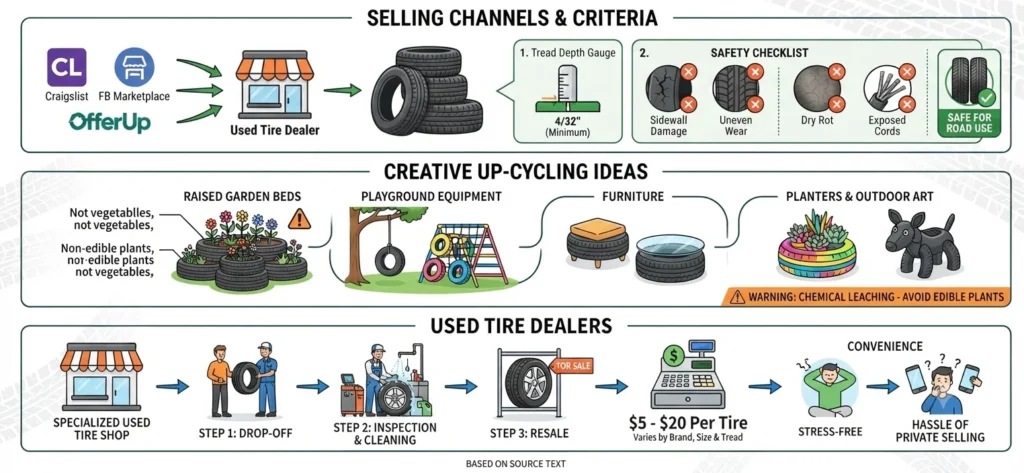
Used tires with 4/32″ or more remaining tread depth often have resale value. Used tire dealers, Craigslist, Facebook Marketplace, and OfferUp are common selling channels. Matching pairs or full sets sell more easily. Before listing, inspect tires for sidewall damage, uneven wear, dry rot, and exposed cords — only sell tires that are genuinely safe for continued road use.
Creative reuse is another option. Tires make durable raised garden beds, playground equipment, retaining walls, and erosion barriers. DIY communities repurpose tires into furniture, planters, and outdoor art. While these projects keep tires out of the waste stream, be aware that tires can leach chemicals into soil over time — avoid using them for growing edible plants.
Used tire places near me — specialized shops dealing in secondhand tires — will often buy or accept tires with usable tread. They handle inspection, cleaning, and resale. This is the easiest route if you want to recoup some value without the hassle of private selling. Expect $5–$20 per tire depending on brand, size, and remaining tread depth.
How Much Does Tire Disposal Cost?
At tire retailers during new tire purchase, disposal fees range from $2–$5 per tire and are often bundled into the installation price. Standalone drop-off at recycling facilities typically costs $3–$8 per passenger tire and $8–$15 for truck or oversized tires. Some facilities charge more for tires still mounted on rims — removing tires from rims beforehand can save money.
Free options exist. Many counties hold annual or semi-annual tire collection events where residents can drop off 4–8 tires at no cost. Some state environmental programs fund free recycling through tire disposal fees charged at the point of new tire sale (you’ve already paid for disposal when you bought your current tires). Check your state’s environmental agency website for details.
For large quantities (10+ tires), commercial tire haulers offer bulk pickup services ranging from $50–$200 depending on volume and location. Fleet managers and businesses should establish relationships with licensed haulers for regular scheduled pickups. Always request a receipt documenting proper disposal — this protects you legally if tires are later found dumped illegally.
Tire Disposal Mistakes to Avoid

Illegal dumping is the most serious mistake — fines range from hundreds to tens of thousands of dollars, and you may be liable for cleanup costs. Never dump tires in vacant lots, wooded areas, waterways, or dumpsters not designated for tire disposal. Burning tires is illegal in all 50 states due to toxic emissions including heavy metals, carbon monoxide, and sulfur compounds. Tire fires are classified as hazardous materials incidents.
Storing tires outdoors where they collect rainwater creates mosquito breeding habitat — a public health concern. If you must store tires temporarily, keep them covered or drill drainage holes. Selling unsafe used tires (with less than 2/32″ tread, sidewall damage, or dry rot) exposes you to civil liability if a buyer experiences a failure. Finally, ignoring local regulations can be costly — some states require tire disposal documentation from businesses and even homeowners with large quantities.
Frequently Asked Questions
Where can I dispose of tires near me?
The most common options are tire retailers (during new tire purchase), local recycling centers, county waste facilities, and community collection events. Search your city or county waste management website for specific locations and schedules in your area.
Can I recycle tires for free?
Yes, in many areas. County tire amnesty days, state-funded collection events, and some retailer programs offer free tire recycling. Availability varies by location — check your local government website for scheduled free collection events.
Does Discount Tire recycle old tires?
Yes. Discount Tire accepts old tires for recycling, typically up to 4 tires per visit. When purchasing new tires, disposal of old tires is generally included in the service fee. Policies may vary by location, so call ahead to confirm.
How much does tire disposal cost?
Typical costs range from $2–$5 per passenger tire at retailers (during purchase) and $3–$8 per tire at recycling facilities. Truck tires cost more ($8–$15). Free options include county collection events and some state-funded programs.
Can tires go in household trash?
No — in most states, tires are banned from regular household trash and landfills. They must be disposed of through designated tire recycling or disposal channels. Placing tires in household trash can result in refused pickup and potential fines.
What happens to recycled tires?
Recycled tires become tire-derived fuel, crumb rubber for playgrounds and athletic fields, rubberized asphalt, rubber mulch, and civil engineering fill material. Some tires are retreaded for continued road use. Pyrolysis recovers oil and carbon black.
Are used tires worth selling?
If your tires have 4/32″ or more tread remaining with no sidewall damage, they may be worth $5–$20 each to used tire dealers or private buyers. Matching pairs and full sets command higher prices. Tires with less tread or visible damage have no resale value.
Where can I find used tire places near me?
Search for ‘used tires’ or ‘used tire places near me’ on Google Maps to find local dealers. These shops buy, inspect, and resell tires with remaining usable life. You can also check Craigslist, Facebook Marketplace, and OfferUp for local used tire listings