

An ASE-certified master technician with 15 years of hands-on experience explains everything you need to know about rotating tires the right way.
Tire rotation is one of the cheapest ways to extend tire life by 20–30%. Most vehicles need tires rotated every 5,000–7,500 miles. The correct tire rotation pattern depends on your drivetrain (FWD, RWD, or AWD). A tire rotation service typically costs $20–$50 — or is free at Discount Tire if you purchased your tires there.
What Is a Tire Rotation and Why Does It Matter?
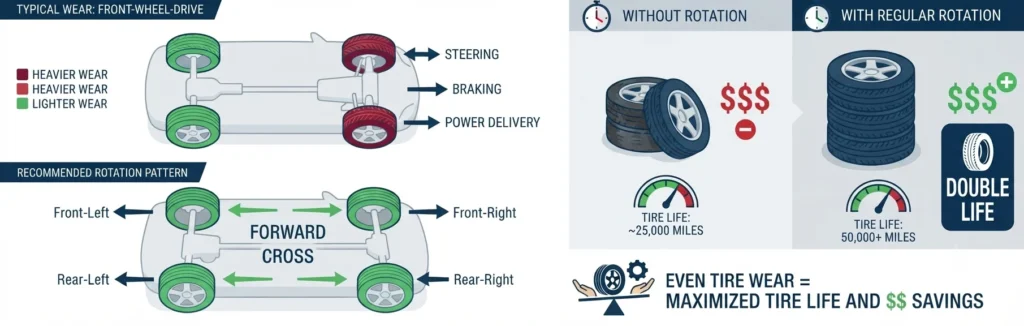
A tire rotation is the practice of moving your tires from one position on the vehicle to another — for example, swapping the front tires to the rear and vice versa. The goal is simple: even out tread wear so all four tires wear at the same rate and last as long as possible.
In my 15 years of rotating tires, I’ve seen countless drivers skip this basic service and end up replacing two tires at 25,000 miles when the full set should have lasted 50,000+. Front tires on a front-wheel-drive car wear 2–3× faster than rears because they handle steering, braking, and power delivery. Without regular rotation, you’re throwing money away.
How Often Should You Rotate Your Tires?
The standard recommendation is to rotate tires every 5,000 to 7,500 miles — roughly every other oil change. But how often you should rotate your tires depends on a few factors I always check when a customer asks:
If you’re unsure, check your owner’s manual. Most manufacturers specify an interval. At Discount Tire and similar tire rotation service providers, technicians will often remind you when you’re due based on your mileage records.
- Aggressive driving or heavy loads: rotate every 3,000–5,000 miles.
- Normal commuting on paved roads: every 5,000–7,500 miles is fine.
- Performance or staggered-size tires: rotation may be limited to front-to-back only — consult your tire shop.
Tire Rotation Patterns: Which One Is Right for Your Vehicle?
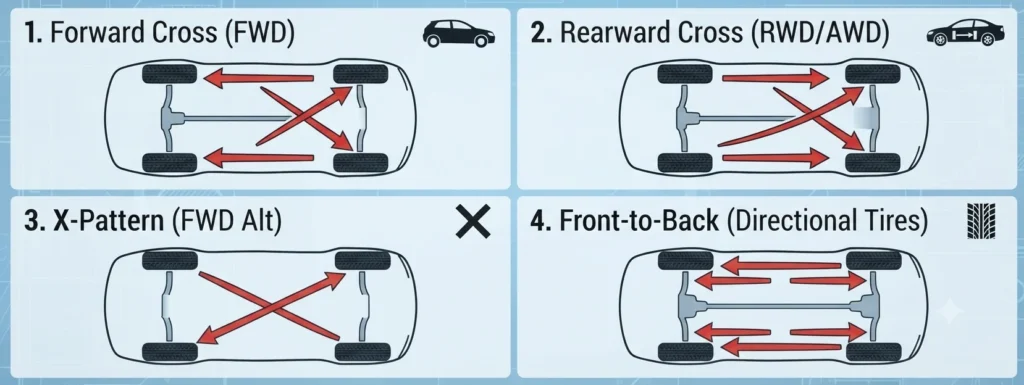
The correct tire rotation pattern depends on your drivetrain and whether your tires are directional or non-directional. Here are the most common patterns I use daily in the shop:
- Forward Cross (FWD vehicles): Front tires move straight to the rear. Rear tires move to the front but cross sides (left rear → right front).
- Rearward Cross (RWD/AWD vehicles): Rear tires move straight to the front. Front tires move to the rear and cross sides.
- X-Pattern (FWD alternative): All four tires cross — left front → right rear, right front → left rear, and vice versa.
- Front-to-Back (directional tires): Tires stay on the same side but swap front and rear positions. This is the only option for directional tread patterns.
Tire Rotation and Balance: Should You Do Both?
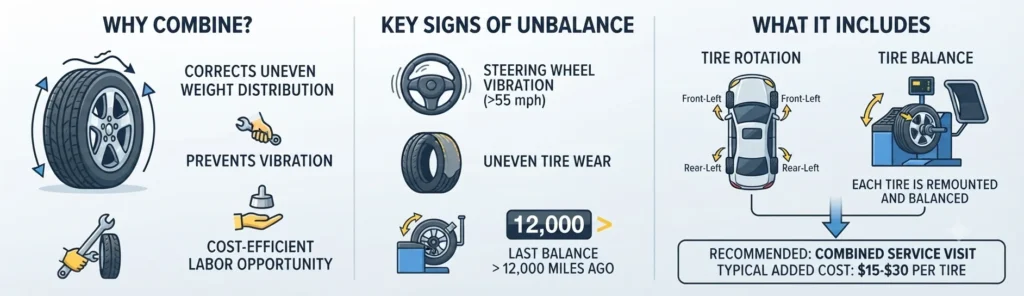
I always recommend combining tire rotation and balance into one service visit. Balancing corrects uneven weight distribution on the wheel-tire assembly, which causes vibration at highway speeds. Every time a tire is removed for rotation, it’s the perfect opportunity to rebalance — you’re already paying for the labor of removing and remounting.
Signs you need balancing along with your rotation: steering wheel vibration above 55 mph, uneven wear on the inner or outer edge, or it’s been more than 12,000 miles since your last balance. A combined tire rotation and balance service typically adds $15–$30 per tire over rotation alone.
How Much Does a Tire Rotation Cost?
Tire rotation cost varies by location and provider. Here’s what I typically see across the industry:
- Discount Tire tire rotation: FREE for life if you purchased your tires there. This is one of the best deals in the industry — I’ve sent hundreds of customers their way for this reason alone.
- Independent shops and dealerships: $20–$50 for a standard four-tire rotation. Some bundle it with an oil change for a package discount.
- Tire rotation and balance combined: $80–$150 total (all four tires). Worth it every 12,000–15,000 miles or if you notice vibration.
How to Rotate Tires Yourself (DIY Steps)
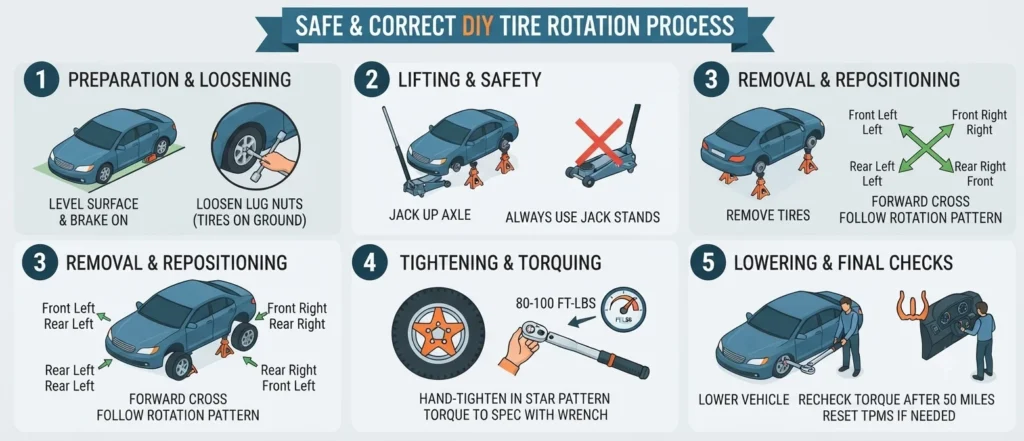
If you’re comfortable with a jack and lug wrench, rotating tires at home is straightforward. Here’s my recommended process — the same steps I train junior technicians on:
- Park on a flat, level surface. Engage the parking brake. Loosen (but don’t remove) all lug nuts while tires are still on the ground.
- Jack up one axle at a time using jack stands for safety — never work under a car supported only by a floor jack.
- Remove tires and reposition them according to your vehicle’s correct rotation pattern (check your owner’s manual or the patterns above).
- Hand-tighten lug nuts in a star pattern, then torque to manufacturer spec (typically 80–100 ft-lbs for passenger cars). A torque wrench is essential — over-tightening warps rotors.
- Lower the vehicle, recheck torque after driving 50 miles, and reset your TPMS if your system requires relearning.
Frequently Asked Questions
How often should tires be rotated on an AWD vehicle?
AWD vehicles should have tires rotated every 3,000–5,000 miles — more frequently than FWD or RWD. Because all four wheels receive power, even small differences in tread depth can strain the drivetrain and cause premature wear on the transfer case or differential.
Is a tire rotation the same as tire balancing?
No. Tire rotation changes the position of tires on the vehicle to even out wear. Tire balancing adds small weights to the wheel to eliminate vibration. They’re complementary services — I recommend doing both together, but they solve different problems.
How much is a tire rotation at Discount Tire?
Discount Tire offers free tire rotation for the life of your tires if you purchased them there. Even if you bought tires elsewhere, their rotation service is typically $20–$25. It’s one of the most affordable tire rotation services available nationwide.
What happens if you never rotate your tires?
Your front tires (on FWD cars) will wear out 2–3× faster than your rears. You’ll end up replacing two tires prematurely while the other two still have plenty of tread. This uneven wear also compromises handling, braking distance, and may void your tire warranty — most manufacturers require proof of regular rotation.
Can I rotate tires with different tread depths?
Yes — that’s actually the point of rotation. However, if the difference exceeds 2/32″ between tires, some AWD systems may be affected. In that case, I recommend replacing the most worn tire or consulting your owner’s manual for maximum allowable tread difference.