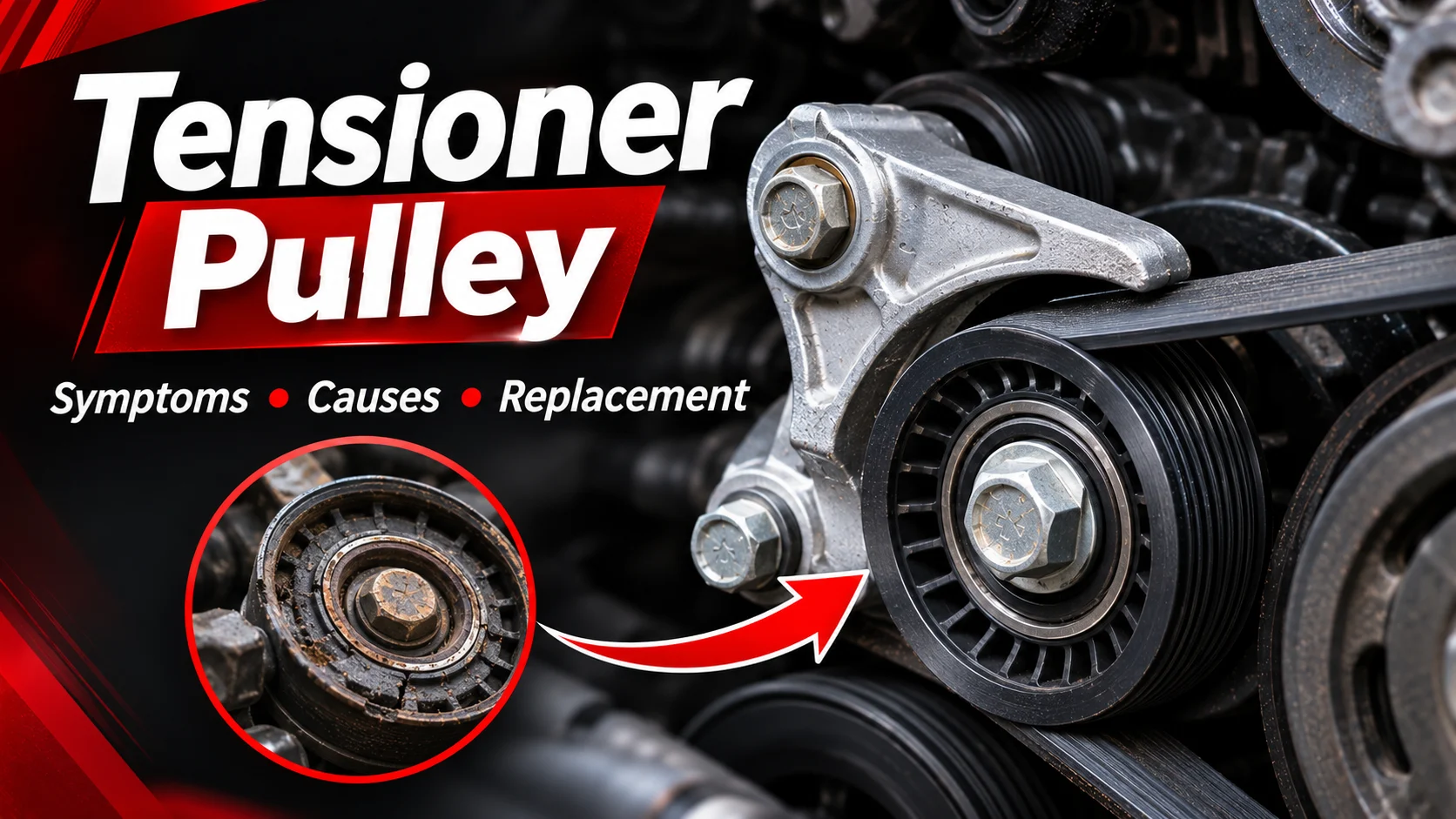
A tensioner pulley is a small but important component of your car’s belt-drive system. It helps the serpentine belt run smoothly while the tensioner mechanism maintains the correct belt tension.
When this pulley or its associated tensioner assembly begins to fail, you may notice squealing, chirping, rattling, unusual belt movement, or premature belt wear. Because several other engine components can produce similar symptoms, identifying the actual cause before replacing parts is essential.
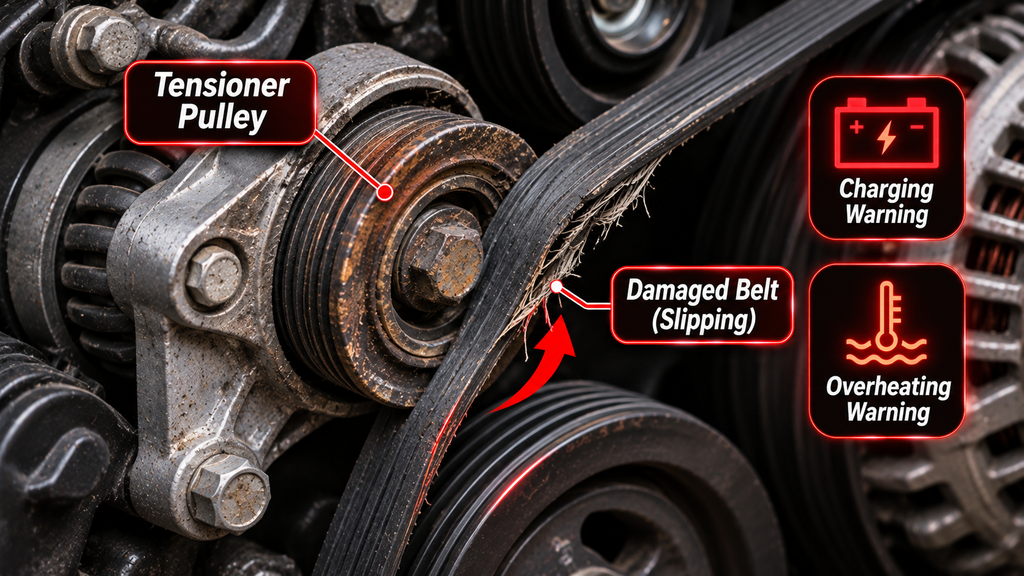
A failing tensioner system can eventually damage or dislodge the belt. Depending on the vehicle, belt failure may interrupt alternator charging, power steering assistance, air conditioning, or even engine cooling.
In this complete guide, you’ll learn what a tensioner pulley does, how it works, the signs of failure, how to inspect it, replacement costs, and when you should stop driving.
Quick Answer: What Is a Tensioner Pulley?
A tensioner pulley is the rotating wheel attached to a belt-tensioning mechanism. In an automatic serpentine-belt system, the tensioner’s spring-loaded arm maintains belt tension while the pulley guides the moving belt. A worn bearing, damaged pulley surface, weak spring, or defective tensioner damper may cause noise, belt misalignment, slippage, and accessory-drive problems.
What Is a Tensioner Pulley?
A tensioner pulley is a rotating pulley that forms part of a drive-belt tensioning system. Its job is to provide a smooth contact surface for the belt while the tensioner mechanism applies the force required to keep the belt properly tensioned.
On many modern gasoline and diesel engines, the tensioner pulley works with the serpentine belt that drives engine accessories such as the alternator, air conditioning compressor, and, on some vehicles, the power steering pump or water pump.
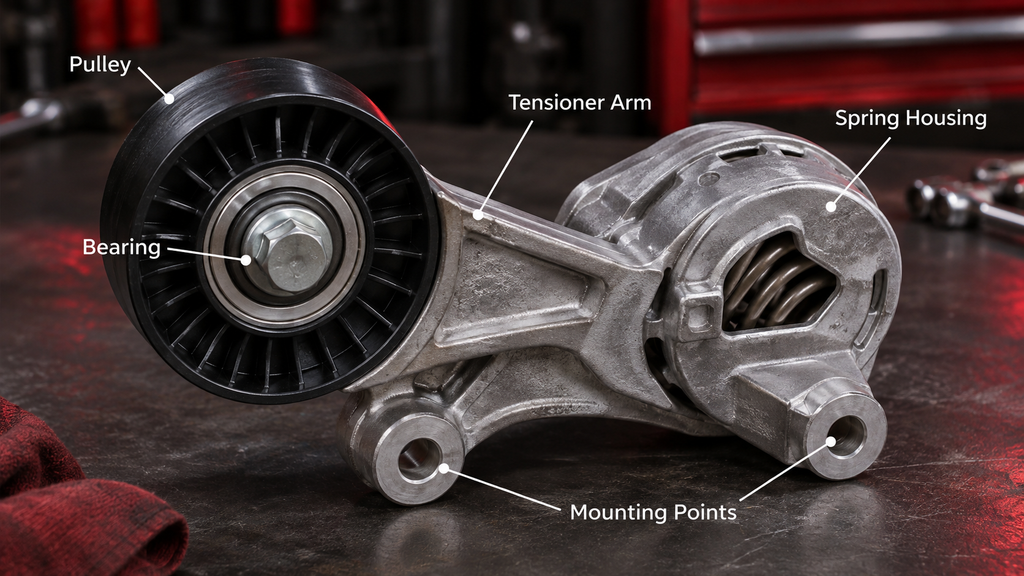
Tensioner Pulley
The rotating wheel and bearing that contact the belt. Its surface may be smooth or grooved, depending on belt routing.
Tensioner Assembly
The complete mechanism, often including the pulley, arm, spring, damping components, housing, and mounting hardware.
On automatic systems, a spring-loaded mechanism supplies belt tension. The pulley itself does not create that spring force; it transfers the tensioner’s force to the belt.
For a wider explanation of components in the engine compartment, see our guide to automobile engine parts and their functions.
How Does a Tensioner Pulley Work?
The engine’s crankshaft rotates a drive pulley, which moves the serpentine belt around the pulleys of the accessories connected to that belt.
As engine speed and accessory loads change, the belt-drive system experiences variations in force and vibration. The tensioner helps keep the belt operating within the intended tension range.
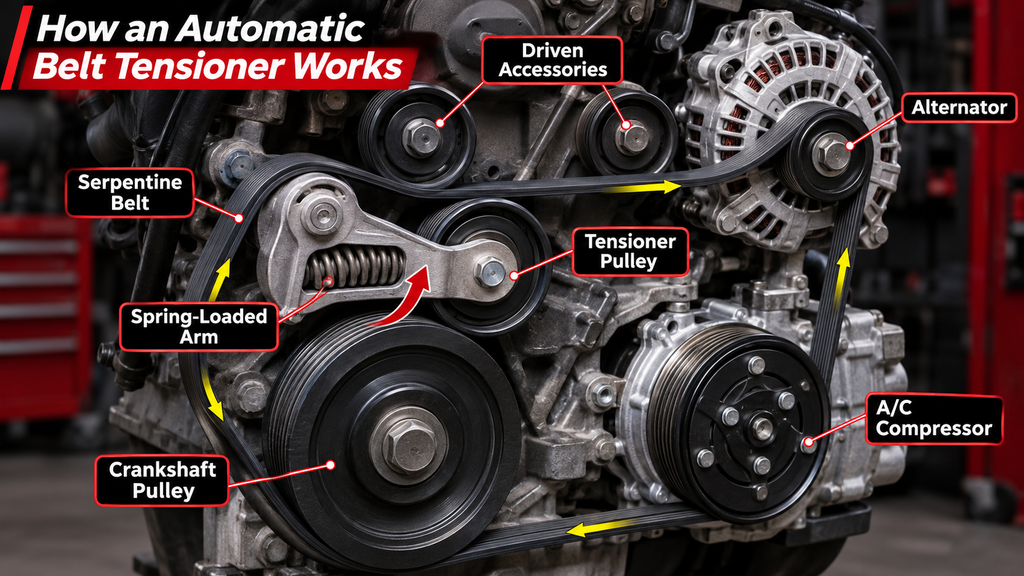
STEP 01
Crankshaft Drives the Belt
The crankshaft pulley transfers rotational power to the accessory belt.
STEP 02
Tensioner Applies Force
A spring or another specified adjustment mechanism maintains the required belt tension.
STEP 03
Pulley Rotates
The pulley bearing permits rotation as the belt passes over the pulley surface.
STEP 04
Damper Controls Movement
In equipped systems, damping limits excessive tensioner-arm oscillation and helps stabilize the belt.
If the bearing starts binding, the pulley can generate noise and heat. If the tensioner spring loses force or the damper deteriorates, the belt may slip, vibrate, or move abnormally even when the pulley bearing remains functional.
That is why a complete belt-drive inspection is more reliable than replacing a tensioner pulley based only on an unfamiliar engine noise.
Where Is the Tensioner Pulley Located?
The tensioner pulley is usually found along the accessory drive belt path on the front or side of the engine, depending on engine orientation and vehicle packaging.
It is often mounted to a movable arm connected to a spring-loaded tensioner housing. However, the precise position and appearance vary by engine.
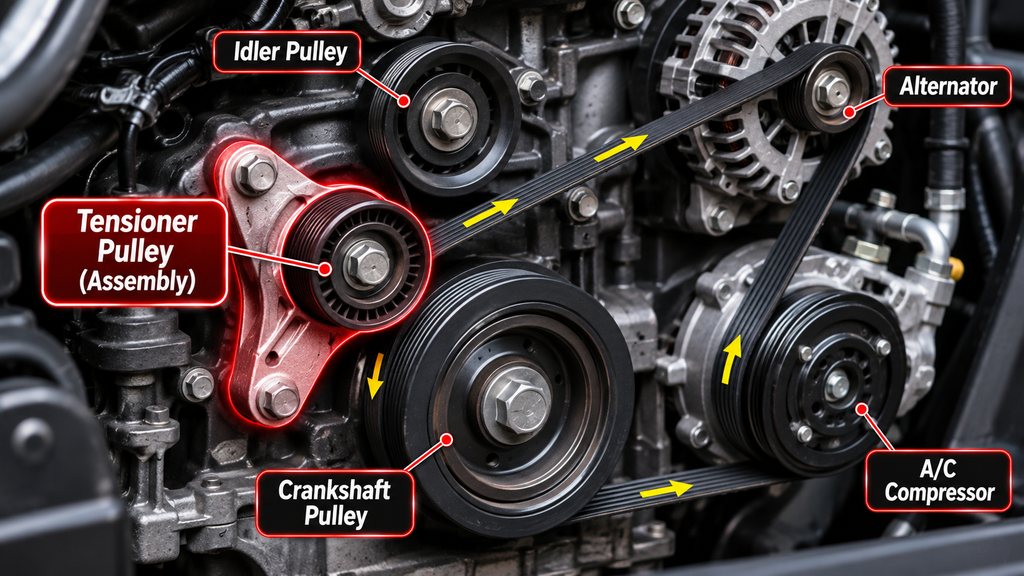
Tensioner location depends on the engine’s accessory belt routing and mounting arrangement.
How to Identify It
With the engine switched off and fully stopped, consult the belt routing diagram in the owner’s manual, service information, or under-hood label where available.
Look for a pulley attached to a tensioner arm or adjustment bracket rather than assuming every small pulley is a tensioner.
Some automatic tensioners have a square tool-receiving opening or hex-shaped feature for controlled belt tension release. Its use, position, and direction of movement are vehicle-specific.
Safety Note
Never put hands, tools, or loose clothing near moving belts or pulleys. Electric cooling fans can start unexpectedly, even with the engine off. Follow the manufacturer’s safety and electrical isolation procedures before working near the accessory drive.
Types of Belt Tensioners
Not all belt-drive systems use the same type of tensioner. Automotive accessory drives may use automatic, manually adjusted, or other specialized tensioning arrangements.
Identifying the correct system matters because inspection and replacement procedures are not interchangeable.
| Type | How It Works | Main Consideration |
|---|---|---|
| Automatic Spring-Loaded | An internal spring acts on a movable arm and pulley to maintain tension. | Check bearing condition, arm travel, spring force and damping. |
| Manual Adjustment | Belt tension is set during installation by adjusting a component or bracket. | Requires manufacturer-specified tension-setting procedure. |
| Specialized Hydraulic or Dampened | Uses a dedicated damping or hydraulic arrangement in applicable systems. | Inspection and service depend on the exact design. |
Accessory Belt vs Timing Belt Tensioner
The accessory-belt tensioner supports the external belt that drives accessories such as an alternator or air conditioning compressor.
A timing-belt tensioner, where fitted, maintains tension in the engine’s camshaft timing drive. Incorrect timing-belt tension or timing loss can cause severe engine damage, particularly in interference engines.
These components should not be confused. This article focuses primarily on the external accessory-drive tensioner pulley, not internal engine timing-belt service.
7 Symptoms of a Bad Tensioner Pulley
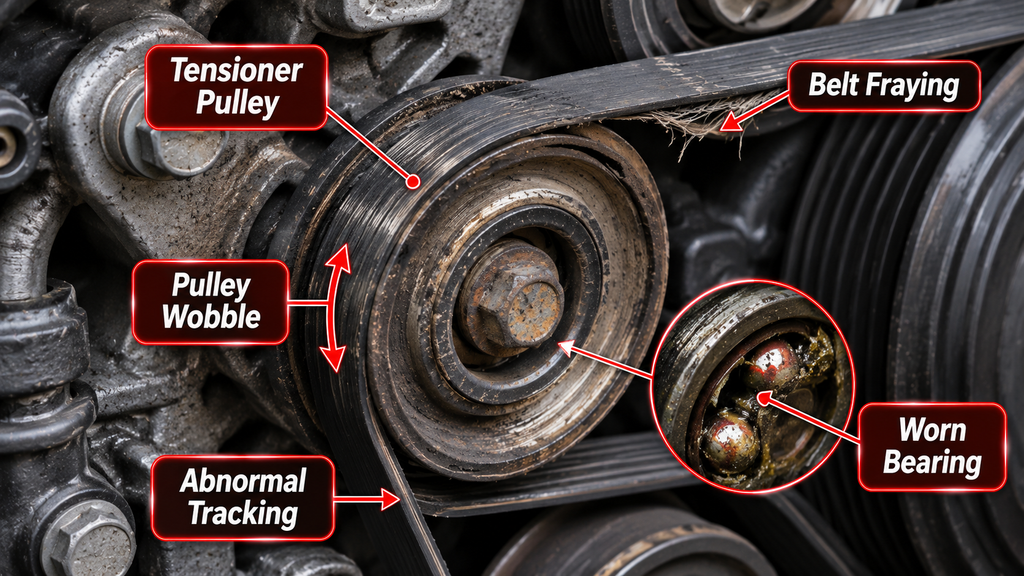
A damaged tensioner pulley bearing or failing tensioner assembly can produce several noticeable symptoms. Some involve unusual sounds, while others affect belt tracking or accessory performance.
However, none of these symptoms independently proves that the pulley is defective. Similar problems may come from worn belts, idler pulleys, alternator bearings, crankshaft pulleys, or other accessories.
1. Squealing Noise from the Engine
A high-pitched squeal can occur when the belt slips across one or more pulleys. Insufficient tension is one possible cause, but contamination, an incorrect belt, or another accessory problem can produce similar sounds.
Squealing that changes during startup, acceleration, or air conditioning operation deserves further diagnosis.
2. Chirping or Repetitive Squeaking
Short repetitive chirps may indicate a belt alignment or tracking problem. A worn tensioner pivot, damaged bearing, or misaligned accessory pulley can contribute to the condition.
3. Grinding, Growling, or Rough Bearing Noise
A pulley bearing that has lost lubrication or developed internal damage may produce grinding or growling sounds. The noise may change with engine speed, but a professional must isolate the source.
4. Pulley Wobble or Belt Misalignment
If the pulley or tensioner arm is misaligned, the belt may run toward the edge of a pulley instead of tracking correctly.
Persistent belt wander or visible pulley wobble can indicate a problem requiring prompt inspection.
5. Excessive Tensioner Arm Movement
Some movement is normal in an automatic tensioner. Large, repeated oscillations can suggest a worn damping mechanism, spring problems, or unusual vibration from another belt-drive component.
6. Accelerated Serpentine Belt Wear
Uneven belt wear, fraying edges, glazing, missing ribs, or repeated belt displacement may occur when the belt is misaligned or a component is binding.
Belt damage can also result from pulley grooves, debris, fluid contamination, and installation problems.
7. Accessory Performance or Charging Problems
If belt slippage becomes severe or the belt comes off, accessories driven by that belt may stop functioning.
You may encounter a charging-system warning, loss of hydraulic power steering assistance, reduced air conditioning performance, or overheating if the engine’s coolant pump is belt-driven.
For help understanding charging warnings, see our guide to service battery charging system warnings and causes.
Symptoms and Possible Causes at a Glance
| Symptom | Possible Causes | Best Next Step |
|---|---|---|
| High-pitched squeal | Belt slip, weak tensioner, contamination | Check belt condition and tensioner operation |
| Repeated chirping | Pulley alignment or tracking issue | Check alignment and component runout |
| Grinding noise | Pulley or accessory bearing wear | Isolate the affected bearing |
| Belt running off center | Pivot wear, misalignment, incorrect installation | Inspect all pulley planes and mountings |
| Arm bouncing excessively | Damper or spring issues; accessory vibration | Diagnose tensioner and connected accessories |
| Belt fraying | Misalignment, damaged pulley, debris | Inspect before another belt is fitted |
| Battery light or overheating | Loss of belt-driven accessory function | Stop safely and assess the system |
What Causes a Tensioner Pulley to Fail?
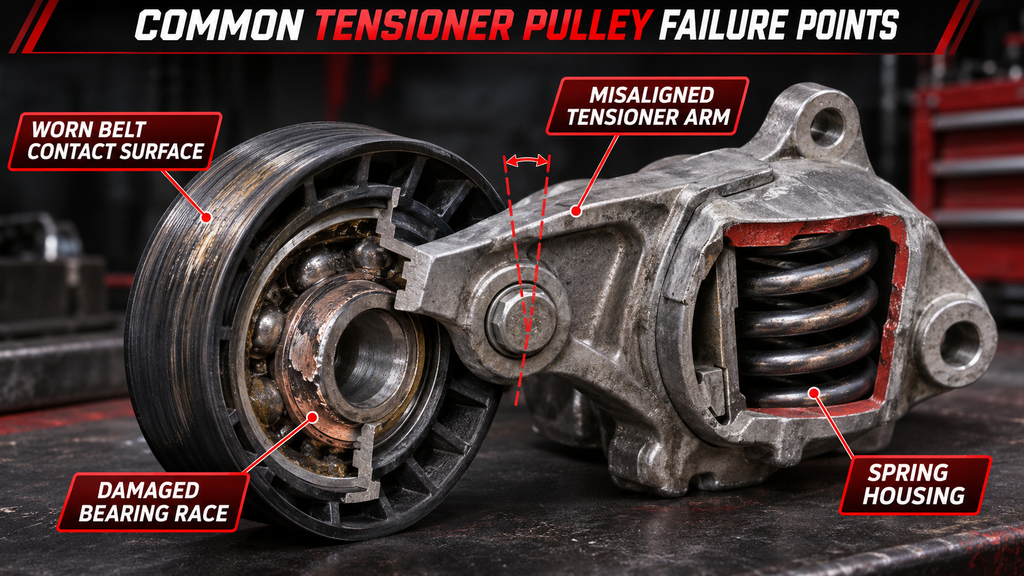
Most tensioner pulley problems develop from mechanical wear, abnormal loads, contamination, or a fault elsewhere in the accessory drive.
Understanding the cause matters because replacing a pulley without correcting the underlying issue may result in another early failure.
Bearing Wear
Like other rotating bearings, pulley bearings gradually wear over time. Damage to bearing surfaces or seals may cause rough rotation, noise, unwanted play, or seizure.
Contamination
Oil, coolant, road debris, and other contaminants can damage belt surfaces or contribute to premature bearing and pulley wear.
Fluid leakage should be repaired before fitting replacement belt-drive parts.
Tensioner Spring or Damper Wear
As an automatic tensioner ages, its internal spring, pivot, or damping mechanism may deteriorate.
Reduced tension or unstable arm movement can create belt slippage and vibration even when the pulley bearing is still functional.
Incorrect Belt or Component Installation
An incorrect belt length, inappropriate replacement pulley, misaligned bracket, or improper fastener installation can overload parts or cause the belt to track incorrectly.
Problems Elsewhere in the Belt Drive
A seized accessory bearing, faulty alternator overrunning pulley where fitted, or crankshaft vibration damper issue may place additional stress on the tensioner.
For related belt maintenance concerns, read our article on alternator belt replacement costs and symptoms.
Tensioner Pulley vs Idler Pulley: What’s the Difference?
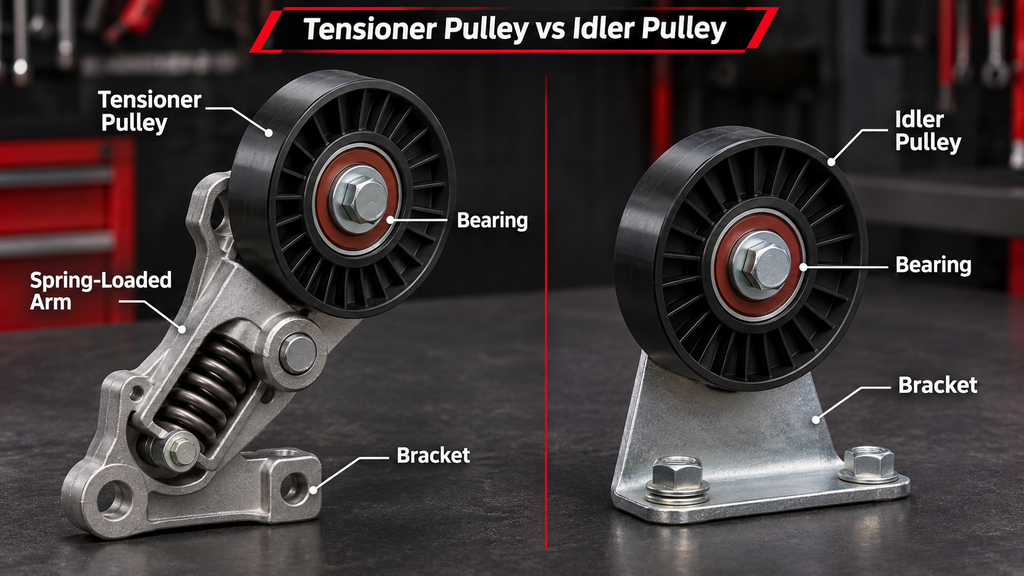
A tensioner pulley and an idler pulley can look very similar because both provide rotating surfaces for the belt. However, their functions within the accessory-drive system are different.
Confusing them can lead to ordering the wrong replacement part or overlooking the actual cause of a belt problem.
| Feature | Tensioner Pulley | Idler Pulley |
|---|---|---|
| Main Purpose | Transmits tensioner force to the belt | Guides belt routing and wrap angle |
| Mounting | Part of a tensioning mechanism | Usually fixed to a bracket or engine |
| Rotating Bearing | Yes | Yes |
| Spring Mechanism | Often in associated automatic tensioner | Normally none |
| Possible Failure | Bearing, pulley, arm, spring, damper | Bearing or pulley damage |
Both types of pulley can cause grinding, chirping, or belt-tracking problems when their bearings or surfaces become damaged.
The correct diagnosis depends on checking component condition and belt routing, not simply identifying the loudest area of the engine.
How to Check a Tensioner Pulley for Problems
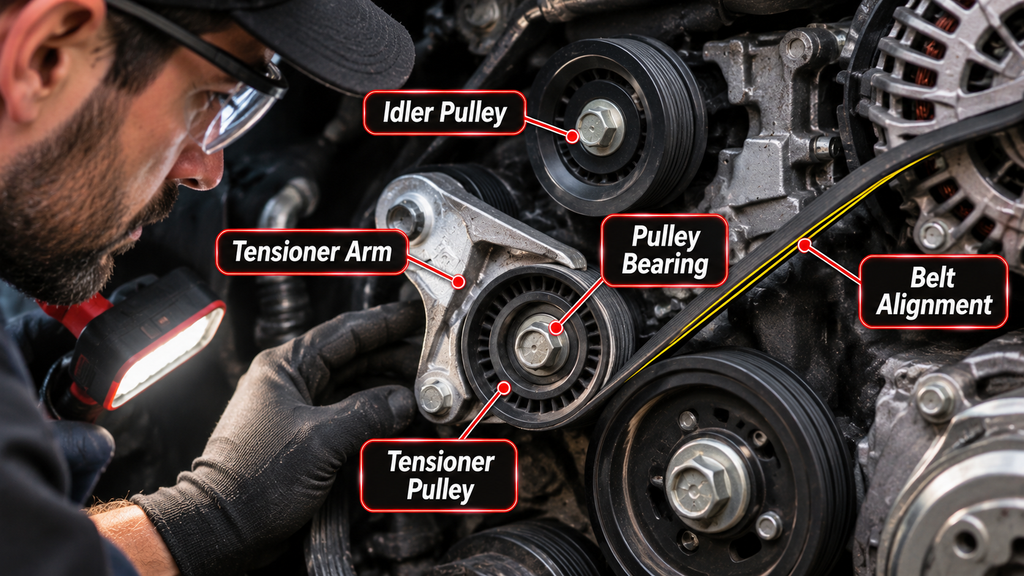
A proper tensioner pulley inspection should begin with the engine safely switched off. A technician typically examines the belt condition, pulley alignment, bearing rotation, tensioner movement, and surrounding accessories.
The following checklist is a general overview, not a universal procedure for every vehicle. Follow your exact service manual before removing the belt or moving the tensioner.
Step 1: Inspect the Belt Visually
Check for missing belt ribs, damaged edges, glazing, unusual wear patterns, and signs of oil or coolant contamination.
A worn or contaminated belt may be responsible for noise even when the tensioner pulley is working properly.
Step 2: Check Pulley Alignment
Look for a belt running toward the edge of a pulley, unusual positioning, damaged mounting brackets, or obvious pulley wobble.
Accurate alignment measurements may require professional tools and vehicle-specific procedures.
Step 3: Inspect the Pulley Bearing
Once the belt has been safely removed according to service instructions, the technician can rotate the pulley by hand and check for roughness, binding, looseness, or abnormal noise.
Some bearing drag may be normal in sealed designs, so the inspection should consider manufacturer guidance rather than relying on free-spin duration alone.
Step 4: Evaluate Tensioner Arm Operation
The tensioner arm should operate through its intended range without obvious sticking, binding, excessive looseness, or damaged stops.
Automatic tensioners can store considerable spring force. Never release them abruptly or force them beyond their designated travel limits.
Step 5: Inspect Other Accessories
Check the condition of other belt-driven pulleys and accessories according to the vehicle’s service procedure.
An alternator bearing, idler pulley, water pump, or air conditioning compressor pulley may be responsible for a sound that initially appears to come from the tensioner.
Step 6: Confirm the Repair
After correcting the diagnosed defect, confirm correct belt routing, seating, component alignment, and tensioner operation using the appropriate verification process.
Workshop Tip: Diagnosis Before Parts Replacement
Do not spray belt dressing, oil, or other chemicals onto a running belt to identify noise. Avoid improvised listening tools near moving parts. A controlled inspection by a qualified technician is safer and more reliable
Can You Drive With a Bad Tensioner Pulley?
Driving with a suspected bad tensioner pulley is risky because the pulley or tensioner may deteriorate further and cause the accessory belt to slip, derail, or break.
The immediate consequences depend on which systems are driven by that belt. In some cars, losing the belt mainly affects charging and air conditioning; in others, it can also interrupt coolant circulation or hydraulic power steering assistance.
When to Stop Driving
Stop as soon as it is safe and shut the engine off if you notice a rapidly rising temperature gauge, overheating warning, heavy belt grinding, smoke, a broken or displaced belt, or sudden loss of steering assistance.
A charging warning that appears with belt noise or accessory failure also requires prompt attention, since the vehicle may be operating from limited battery power.
Important Safety Warning
Do not continue driving an overheating engine to reach a repair shop. Continuing to operate the vehicle with compromised cooling can result in serious engine damage. Arrange roadside assistance or towing when safe operation cannot be confirmed.
Our guides to what to do when a car overheats and engine cooling and antifreeze leaks explain related warning signs.
If the belt system remains intact but unusual noise persists, schedule an inspection rather than assuming the vehicle is safe for an extended journey.
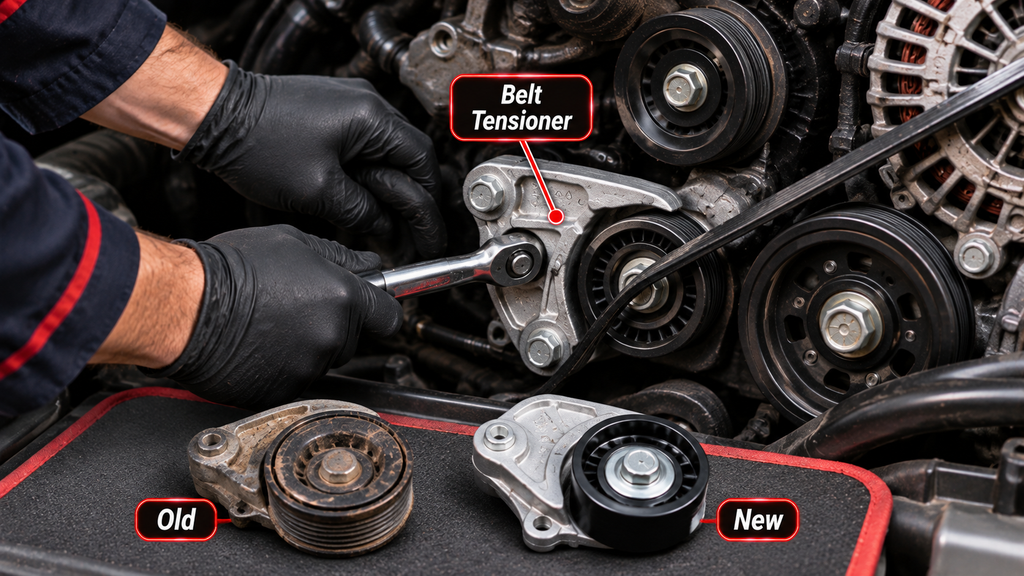
How to Replace a Tensioner Pulley: Step by Step
Replacing a tensioner pulley can range from a straightforward accessory-drive repair to a more involved job requiring removal of nearby components.
The exact procedure depends on engine layout, component accessibility, whether pulley-only replacement is permitted, and how the tensioner is mounted.
General Replacement Overview
- Confirm the problem: Diagnose the affected pulley or tensioner mechanism before ordering parts.
- Identify the exact replacement: Use the correct vehicle make, model, year, engine, and manufacturer part information.
- Prepare the vehicle: Park securely, allow the engine to cool, and follow the manufacturer’s electrical and mechanical safety precautions.
- Document belt routing: Consult the factory belt diagram and identify the correct tensioner-release method.
- Release belt tension: Use the specified tool and direction. Control the spring-loaded arm carefully; never let it snap back.
- Remove the affected component: If pulley-only service is authorized, remove the pulley using the prescribed procedure. Otherwise, replace the complete assembly.
- Inspect the remaining belt drive: Check the belt, accessory bearings, idler pulleys, mounting surfaces, and alignment.
- Install the replacement: Follow manufacturer-specific orientation, fastener, thread-locking, and torque requirements.
- Refit the belt: Verify that the belt ribs are seated correctly on every grooved pulley and that the routing matches the service diagram.
- Verify operation: Inspect clearance and belt positioning before performing the specified operating check. Keep hands and tools away from the running engine.
Can You Replace Only the Pulley?
Some tensioner designs allow a separate pulley to be replaced, but others require the complete assembly to be serviced as a unit.
Even where pulley-only service is physically possible, a worn spring, pivot, or damper may make complete tensioner replacement the more appropriate repair.
Follow the replacement part manufacturer’s application instructions and the vehicle’s service documentation. Do not improvise pulley-only repairs on assemblies that are not designed to be serviced that way.
Should You Replace the Serpentine Belt Too?
A belt showing wear, contamination, edge damage, or incorrect tracking may need replacement at the same time.
Inspecting the entire accessory drive is important because a worn pulley may have damaged the belt, and an unhealthy belt-drive system can shorten the life of a new tensioner.
Replacing parts as a set may be reasonable when age, condition, and manufacturer recommendations justify it; unnecessary replacement should not be treated as mandatory for every vehicle.
How Much Does Tensioner Pulley Replacement Cost?
Tensioner pulley replacement costs vary across the United States based on vehicle design, parts availability, labor rates, and whether the repair involves only the pulley or the entire tensioner assembly.
The following figures are broad budgeting estimates, not verified quotes for a specific vehicle or repair shop.
| Repair or Component | Illustrative US Cost |
|---|---|
| Standalone tensioner pulley part | $25–$110+ |
| Complete accessory-belt tensioner part | $60–$250+ |
| Pulley replacement, parts and labor | $125–$350+ |
| Complete tensioner replacement, parts and labor | $200–$500+ |
| Additional serpentine belt, if needed | Varies by belt design and shared labor |
Cost note: These are approximate US planning ranges for accessory-belt systems. Luxury vehicles, difficult access, OEM parts, high regional labor rates, additional repairs, and taxes may increase the total. Timing-belt tensioner repairs are a separate category and may cost considerably more.
What Affects the Final Repair Price?
- Vehicle and engine: Some engines provide easy access, while others have limited working space.
- Replacement type: A complete tensioner assembly usually costs more than a standalone pulley.
- Parts quality: OEM and high-quality aftermarket components may differ in price and availability.
- Labor rates: Independent repair shops and dealerships may charge different rates.
- Related damage: A damaged belt, idler pulley, or accessory bearing may add necessary repairs.
Money-Saving Tip
Before approving repairs, ask the mechanic to identify the confirmed fault, explain whether pulley-only replacement is allowed, and provide an itemized estimate for parts, labor, and any related belt-drive work.
How to Prevent Premature Tensioner Pulley Failure
Tensioner pulleys are wear components, so no maintenance routine can guarantee they will last indefinitely. However, periodic inspections and timely belt-drive repairs can reduce the likelihood of unexpected failure.
The most useful preventive approach is to assess the complete belt-drive system rather than treating each pulley as an isolated component.
Follow the Manufacturer’s Service Schedule
Use the owner’s manual and service information to determine the appropriate accessory-belt inspection and replacement intervals for your vehicle.
Fix Fluid Leaks Promptly
Oil and coolant contamination may damage belts or contribute to premature wear. Identify and repair the source of leakage before replacing affected components.
Use Correct Replacement Parts
Confirm belt length, pulley diameter, groove configuration, bearing specification, and tensioner fitment against the exact engine application.
Investigate New Noises Early
Do not ignore a newly developed chirp, squeal, growl, or rattle near the belt drive, especially when accompanied by unusual belt movement.
Inspect Related Components
During belt service, check accessible idler pulleys, tensioner operation, belt condition, and relevant accessory-drive components according to the service procedure.
In some vehicles, the water pump is part of the accessory belt system. Learn about the differences between mechanical and electric engine water pumps to better understand these arrangements.
Frequently Asked Questions About Tensioner Pulleys
What does a tensioner pulley do?
A tensioner pulley contacts and guides the moving drive belt while the associated tensioning mechanism maintains the correct belt tension. Its bearing allows the pulley to rotate with the belt.
What are the signs of a bad tensioner pulley?
Possible signs include grinding, chirping, squealing, pulley wobble, rough bearing movement, belt misalignment, and abnormal belt wear. These symptoms require confirmation because other components can cause them.
What does a failing tensioner pulley sound like?
A failing pulley bearing may produce growling, grinding, or rattling sounds. Belt slippage or alignment problems may cause squealing or chirping. Sound alone cannot reliably identify the faulty component.
Can a bad tensioner pulley cause the belt to come off?
Yes. A seized bearing, damaged pulley, misaligned tensioner, or insufficient belt tension can contribute to belt displacement or breakage.
Is it safe to drive with a bad tensioner pulley?
It is not advisable to continue driving with a confirmed serious pulley or tensioner fault. Belt failure may interrupt important accessories and, depending on the engine, cause overheating or loss of steering assistance. Stop safely when serious symptoms occur.
How much does it cost to replace a tensioner pulley?
A standalone accessory-belt tensioner pulley replacement may cost roughly $125–$350 or more, including labor, while replacing a complete tensioner assembly may cost roughly $200–$500 or more. Actual prices depend on the vehicle and repair requirements.
Can you replace just the pulley instead of the tensioner?
Only if the manufacturer or approved replacement procedure supports pulley-only service and the rest of the tensioner is in good condition. Many applications are better serviced by replacing the complete assembly.
How long does a tensioner pulley last?
There is no universal lifespan. Service life depends on component design, engine operating conditions, contamination, belt-drive loads, and maintenance history. Inspect according to the manufacturer’s guidance and replace when a defect is confirmed.
What is the difference between an idler pulley and a tensioner pulley?
An idler pulley mainly guides belt routing, while a tensioner pulley works with a mechanism that maintains belt tension. Both contain rotating bearings and may have similar external appearances.
Can a bad tensioner pulley cause overheating?
Yes, on engines where the affected belt drives the coolant pump. If the belt slips severely or comes off, coolant circulation may stop or decrease. Other engines use different water-pump arrangements, so the consequence varies.
Should I replace the tensioner when replacing a serpentine belt?
Inspect the tensioner whenever the belt is serviced. Replacement may be appropriate when the unit is worn, damaged, or recommended by the manufacturer, especially if belt-drive components have reached the end of their service life.
Final Thoughts
A tensioner pulley helps keep the engine’s accessory belt moving smoothly while the belt-tensioning mechanism maintains the proper operating tension.
When the pulley bearing or tensioner assembly fails, symptoms may include squealing, chirping, grinding, pulley wobble, poor belt tracking, or premature belt wear. However, these problems can also originate from other belt-drive components.
For the most reliable repair, inspect the complete belt-drive system, identify the actual defect, and follow the vehicle manufacturer’s service procedure. Replace the pulley or full tensioner assembly only as appropriate for that specific design.
Key Takeaway
A noisy engine belt does not automatically mean the tensioner pulley is bad. Accurate diagnosis, correct replacement parts, and timely attention to belt-drive problems can prevent unnecessary repairs and reduce the risk of unexpected accessory failure.