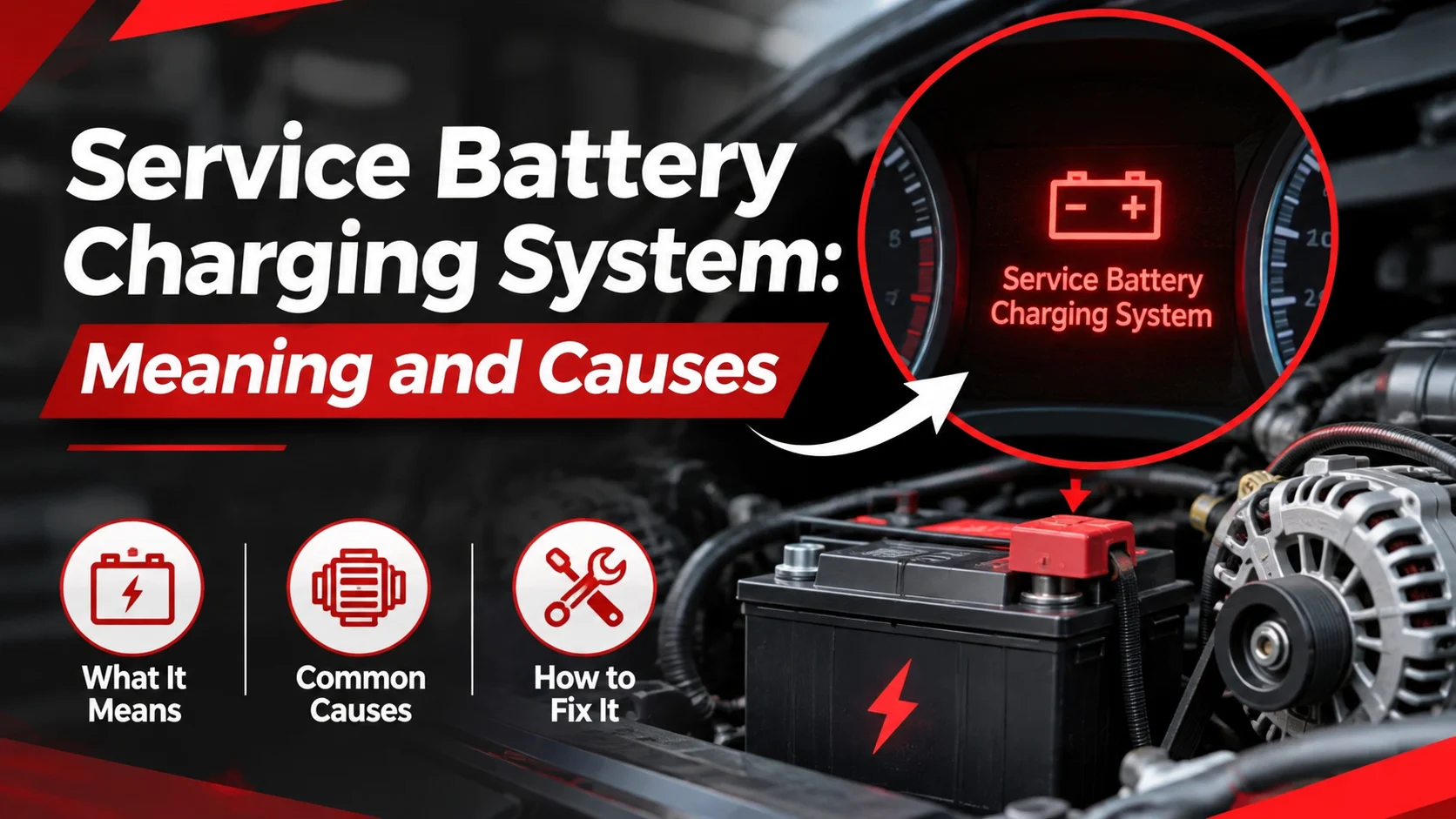
Seeing a Service Battery Charging System warning on your dashboard can be concerning, especially when your vehicle still seems to run normally. This message usually means the vehicle has detected a problem with its electrical charging system. The cause could be a failing alternator, a loose connection, a damaged drive belt, or another electrical fault.
The important thing is not to assume that the battery itself needs replacing. Understanding what this warning means, how serious it can be, and which checks are safe to perform can help you avoid unnecessary repairs and unexpected breakdowns.
Quick Answer
Service Battery Charging System means your vehicle has detected a potential problem with battery charging or the electrical system that supports it. The alternator, voltage regulator, battery connections, wiring, or related controls may be involved. If the charging system stops supplying enough power, the vehicle may run on its remaining battery charge, eventually stall, or fail to restart.
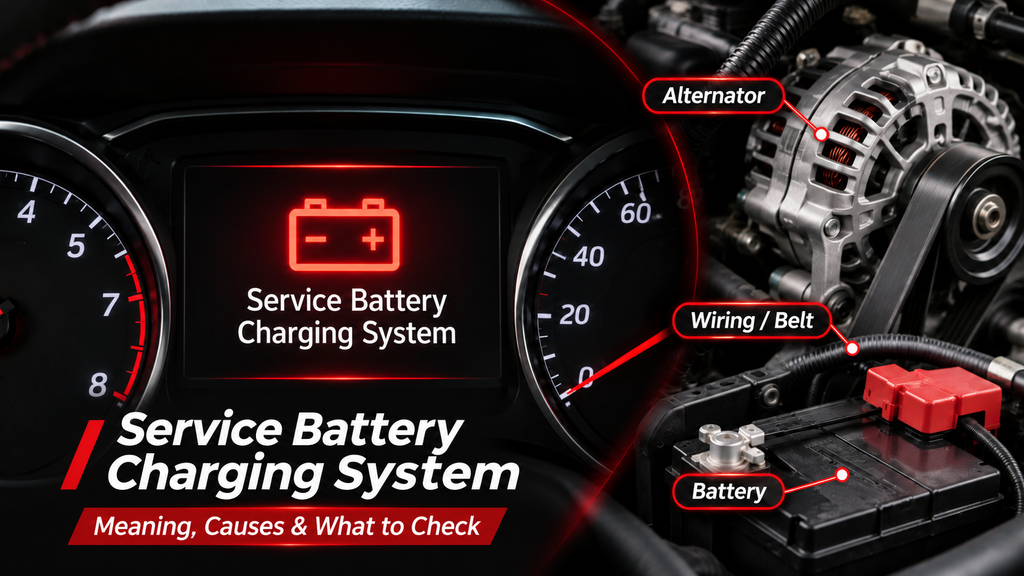
What Does Service Battery Charging System Mean?
The warning indicates that your vehicle’s onboard monitoring system has identified a potential problem involving battery charging or electrical power management. It does not necessarily mean that the battery is defective.
In a conventional gasoline-powered vehicle, the alternator produces electrical power while the engine runs. This supports electrical accessories and replenishes the battery’s charge.
If charging performance falls outside the expected operating conditions, the vehicle may display a warning. Some models use more advanced computer-controlled charging systems, so the exact triggering conditions vary.
What Does the Battery Charging System Include?
Alternator
Produces electrical power while the engine runs on conventional engine-driven charging systems.
12-Volt Battery
Stores electrical energy and supplies power during starting and when needed.
Voltage Regulation
Helps control charging output according to electrical demand and system conditions.
Wiring and Connections
Carry electrical power and signals between system components.
Depending on the vehicle, the system may also include a battery current sensor, control modules, fuses, and an engine accessory drive belt.
Is It Safe to Drive With This Warning?
A charging-system warning should be taken seriously. Although a vehicle may continue running temporarily, there is no dependable distance or driving time that can be guaranteed after a charging failure.
If the alternator stops supplying adequate power, the battery may temporarily operate electrical systems. As its remaining charge decreases, essential equipment may begin malfunctioning and the engine may stall.
| Situation | Recommended Action |
|---|---|
| Warning appears but vehicle seems normal | Avoid unnecessary electrical loads, find a safe place to stop, and arrange diagnosis promptly. |
| Warning repeatedly appears | Have the charging system inspected before relying on the vehicle for another trip. |
| Headlights dim or electrical systems malfunction | Pull over safely and request assistance. |
| Engine stalls, smoke appears, or a burning smell develops | Stop safely, shut down if appropriate, and request roadside help. Do not continue driving. |
Important Safety Warning: Do not assume the vehicle is safe simply because it starts or drives normally. If steering assistance, braking assistance, lights, or other essential functions become abnormal, stop as safely as possible and seek professional help. Never sacrifice visibility or windshield clearing just to conserve electrical power.
What Causes the Service Battery Charging System Warning?
Several different electrical or mechanical faults can trigger the warning. The following are common causes worth investigating, but testing is necessary before confirming which component is responsible.
1. Failing Alternator
A faulty alternator is one possible reason the vehicle cannot maintain appropriate electrical power. Internal wear, electrical faults, or regulator problems can reduce or interrupt charging output.
Symptoms may include dimming headlights, repeated battery discharge, electrical accessories behaving abnormally, or a vehicle that eventually stops running.
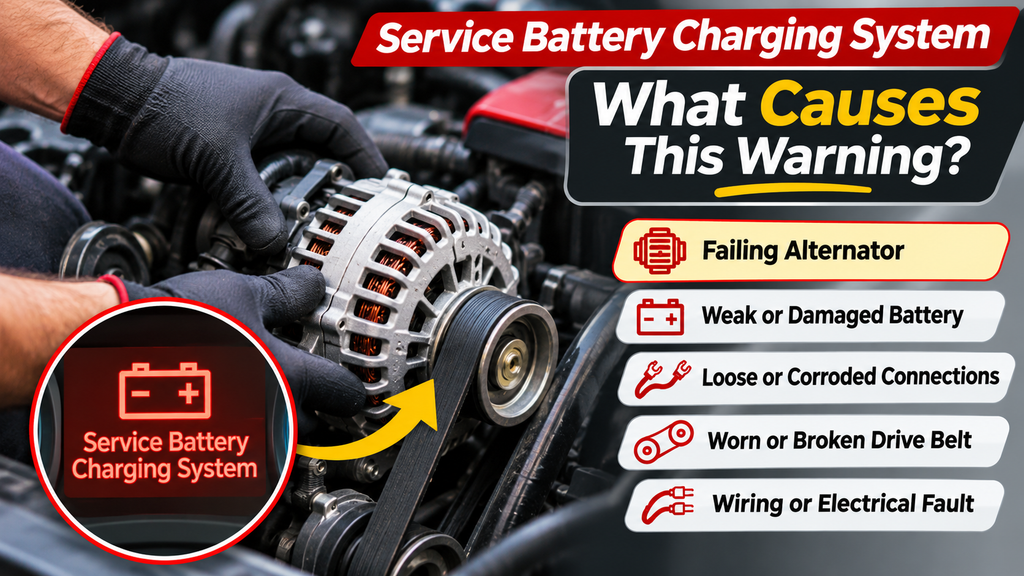
2. Weak or Damaged Battery
A deteriorated battery may struggle to hold a charge or support electrical demand. A defective battery can contribute to charging-related concerns, although a weak battery is not proof of alternator failure.
Batteries can also lose charge because of repeated short trips, prolonged storage, excessive electrical consumption, or an existing charging fault.
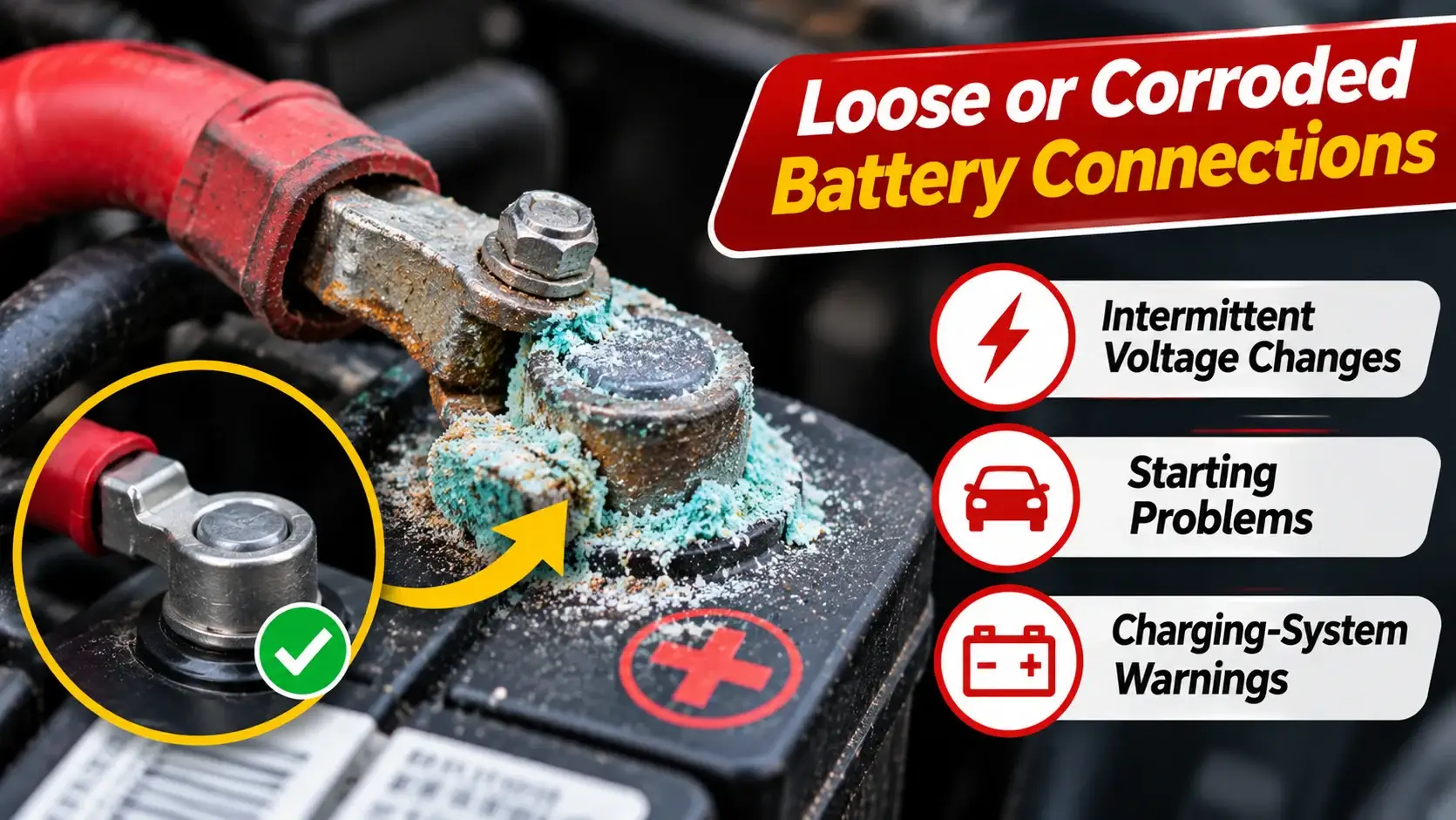
3. Loose or Corroded Battery Connections
Loose terminals, damaged cables, and corrosion can interfere with electrical connections. This may cause intermittent voltage changes, starting problems, and charging-system warnings.
Corrosion sometimes appears as white, blue, or greenish deposits near battery terminals. However, connections can also be defective without obvious visible corrosion.
4. Worn or Broken Serpentine Belt
Many conventional vehicles use a serpentine belt to drive the alternator. If the belt slips, breaks, or loses proper tension, alternator output may decrease or stop.
Squealing noises, visible belt damage, or additional mechanical symptoms may accompany the problem. On some engines, the same belt also drives the water pump or other important accessories.
Belt Safety: If a drive belt has failed, do not continue driving until the affected accessories are identified. Engine overheating can occur on vehicles where the belt also drives the water pump. Never inspect a moving belt with your hands.
5. Faulty Voltage Regulator
Voltage regulation keeps charging output within appropriate operating limits. A malfunctioning regulator can cause insufficient or excessive voltage.
Depending on the vehicle design, regulation may occur inside the alternator or through an electronically controlled charging system.
6. Damaged Wiring, Fuses, or Ground Connections
Electrical current needs a reliable path between the alternator, battery, and vehicle electrical system. Damaged wiring, poor grounds, or circuit protection faults can interrupt this path.
These problems may require wiring diagrams, voltage-drop testing, and professional diagnosis. Replacing the alternator will not correct every wiring-related fault.
7. Battery Sensor or Charging Control Problems
Modern vehicles may use sensors and control modules to manage charging based on battery condition, temperature, and electrical demand.
An inaccurate sensor signal or charging-control malfunction can trigger warnings even when major mechanical components appear functional. Diagnostic trouble codes and manufacturer-specific procedures help identify these issues.
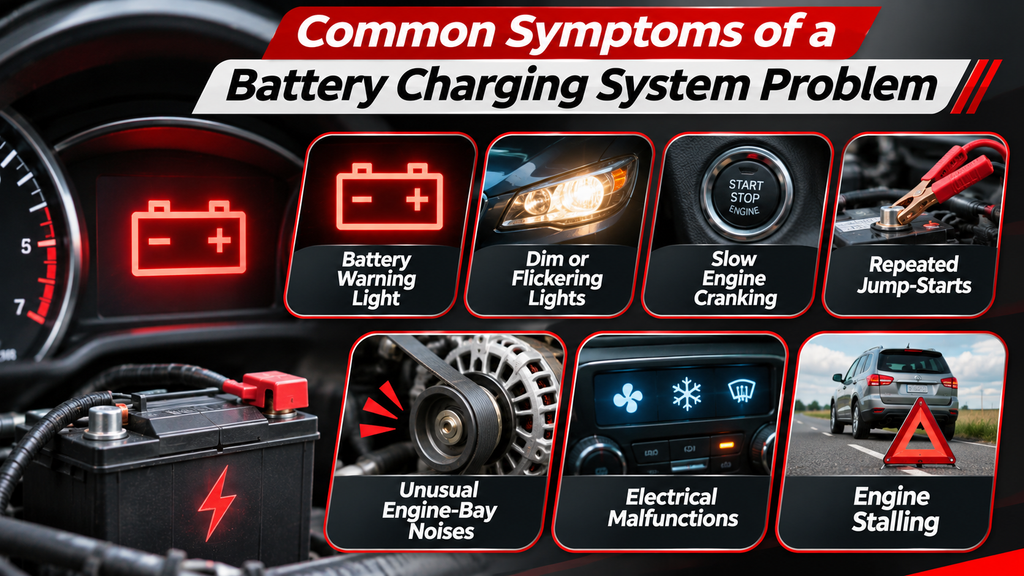
Common Symptoms of a Battery Charging System Problem
The warning message may be the first sign of trouble. Other symptoms can help a technician determine which tests to perform.
- Battery warning light: A red battery-shaped dashboard indicator may illuminate.
- Dim or flickering lights: Electrical supply may be unstable or insufficient.
- Slow engine cranking: The battery may not have enough stored energy.
- Repeated jump-starts: The battery may not be charging properly or may be unable to retain its charge.
- Unusual engine-bay noises: Belt, pulley, or alternator bearing problems may produce squealing or grinding.
- Unexpected electrical malfunctions: Accessories and electronic systems may operate inconsistently.
- Engine stalling: Severe power loss may interrupt essential engine-control functions.
How to Diagnose a Battery Charging System Problem
A systematic inspection helps prevent unnecessary parts replacement. Start with basic safety checks, then use electrical testing to narrow down the cause.
Park Safely and Switch Off the Engine
Choose a safe location away from traffic. Turn the engine off before inspecting visible components. If the vehicle is overheating, smoking, or showing severe electrical problems, arrange professional assistance instead.
Inspect Battery Connections
Look for obvious corrosion, loose connections, damaged cables, battery swelling, or leaks. Do not handle damaged or leaking batteries. Follow the owner’s manual before disconnecting any terminals.
Check the Drive Belt Visually
With the engine completely off, inspect visible belt areas for cracks, fraying, or a missing belt. Keep hands and tools away from moving parts. Some vehicles do not use a conventional belt-driven alternator.
Measure Battery Voltage
If you are comfortable using a digital multimeter, measure voltage across the accessible 12-volt battery test points according to the vehicle manufacturer’s instructions.
Request a Complete Charging-System Test
If the warning persists, have a technician inspect charging output, battery condition, wiring integrity, relevant trouble codes, and charging-control operation.
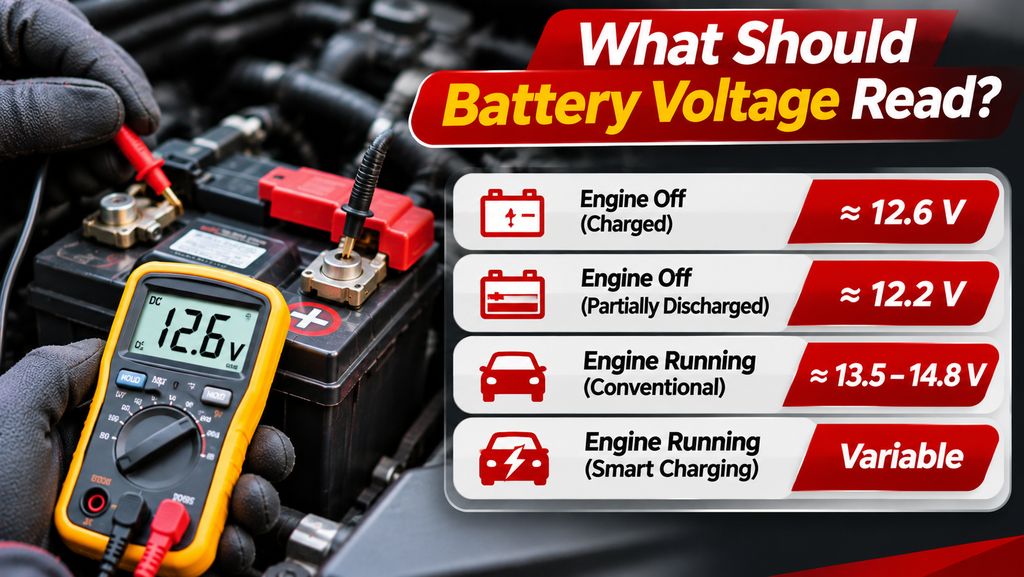
What Should Battery Voltage Read?
Voltage measurements can provide useful clues, but must be interpreted with the battery’s condition, temperature, electrical demand, and vehicle charging strategy in mind.
| Test Condition | Typical Reference | What It Suggests |
|---|---|---|
| Engine off, rested lead-acid battery | Approximately 12.6 V | Often indicates a near-fully charged conventional 12-volt lead-acid battery. |
| Engine off, rested battery | Approximately 12.2 V | May indicate partial discharge, depending on battery type and temperature. |
| Engine running, conventional charging system | Often approximately 13.5–14.8 V | May indicate charging activity, but is not a universal pass/fail range. |
| Engine running, smart charging system | Variable by design | Requires manufacturer-specific operating conditions and test procedures. |
These figures are general reference values, not diagnostic specifications for every vehicle. Surface charge, battery chemistry, temperature, and computer-controlled charging can change readings.
Testing Safety: Never disconnect a battery cable while the engine is running to test the alternator. This outdated method can create electrical hazards and may damage vehicle electronics. Do not probe exposed high-current terminals or high-voltage hybrid components without proper training.
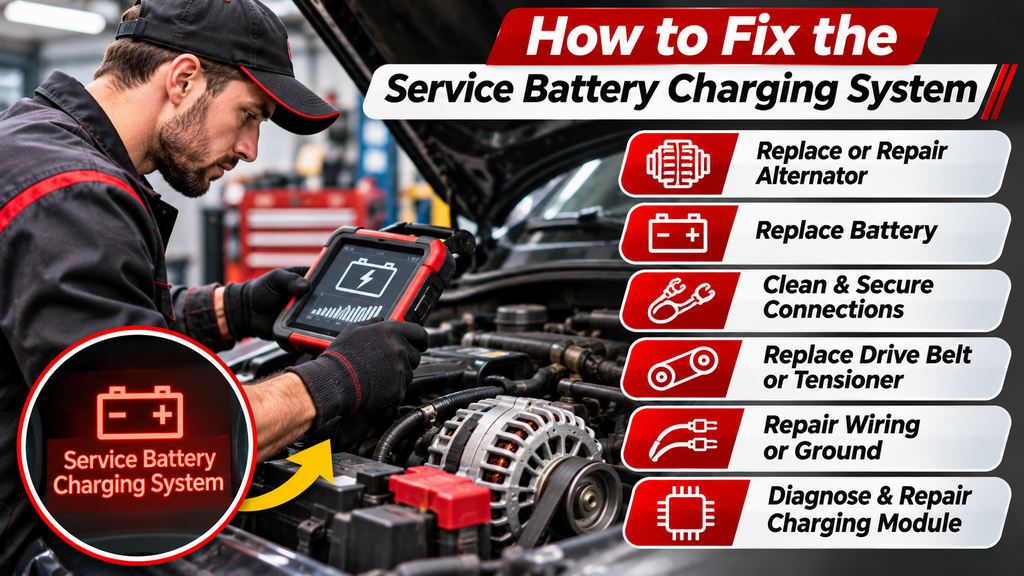
How to Fix the Service Battery Charging System Warning
The correct repair depends on the actual fault. Clearing the warning or disconnecting the battery does not resolve an underlying charging problem.
| Confirmed Problem | Possible Repair |
|---|---|
| Defective alternator | Repair or replace the alternator as appropriate for the vehicle. |
| Battery fails testing | Replace the battery with the correct specification and perform any required registration. |
| Corroded or loose connections | Clean, repair, or properly secure connections using approved procedures. |
| Damaged drive belt or tensioner | Replace the defective components and inspect related pulleys. |
| Open circuit or poor ground | Repair the affected wiring, connection, or electrical circuit. |
| Charging sensor or module fault | Diagnose the control system and repair, calibrate, or replace components as necessary. |
On some modern vehicles, battery replacement may require electronic registration or configuration. Repairs should follow the service procedures applicable to the exact model and model year.
Battery vs. Alternator: How Can You Tell the Difference?
A battery supplies stored electrical energy, while an alternator supplies power during engine operation in conventional vehicles. Problems with either component can produce overlapping symptoms.
| Symptom | Battery Concern | Alternator Concern |
|---|---|---|
| Slow cranking after parking | Possible | Possible due to inadequate charging |
| Vehicle starts after a jump but later stalls | Possible | Strong reason to test charging output |
| Repeatedly discharged battery | Possible | Possible |
| Warning appears while driving | Possible | Charging system requires inspection |
| Abnormal running voltage | Not conclusive | Requires further charging-system diagnosis |
Key takeaway: Symptoms alone rarely identify the failed component. Battery testing, charging-system testing, and electrical circuit checks may all be necessary.
How Much Does It Cost to Fix a Battery Charging System?
Repair costs depend on the vehicle, location, labor rates, parts availability, and the exact problem. A loose electrical connection may need relatively minor work, while alternator replacement or complex wiring diagnosis can be substantially more expensive.
Battery type also affects cost. Vehicles equipped with start-stop technology may require an AGM or EFB battery and a registration procedure, depending on manufacturer requirements.
| Repair Type | Typical Cost Considerations |
|---|---|
| Battery replacement | Battery size, chemistry, labor, and registration requirements. |
| Alternator replacement | Component price, engine access, labor time, and vehicle model. |
| Belt replacement | Belt routing, tensioner condition, and installation labor. |
| Wiring or terminal repair | Damage severity and diagnostic time. |
| Electronic diagnosis | Scan-tool requirements, testing time, and manufacturer-specific procedures. |
Before authorizing an expensive repair, request the test results supporting the diagnosis. A written estimate should identify parts, labor, and any additional programming charges.
Why Does the Warning Come On and Then Go Off?
An intermittent charging warning may indicate a problem that occurs only under certain operating conditions.
Possible explanations include a loose electrical connection, temperature-related alternator fault, slipping drive belt, intermittent wiring problem, or charging-control issue.
The message disappearing does not necessarily mean the system has repaired itself. A technician may be able to retrieve stored diagnostic codes or identify irregular operation during testing.
Can a New Battery Fix the Warning?
Replacing the battery may resolve the problem if testing confirms that the battery itself is faulty and the rest of the charging system operates correctly.
However, a new battery will not repair a defective alternator, damaged charging cable, broken belt, or electronic charging-control fault.
If the alternator is not charging properly, even a new battery may eventually discharge. That is why testing the entire system is more reliable than replacing parts based on a warning message alone.
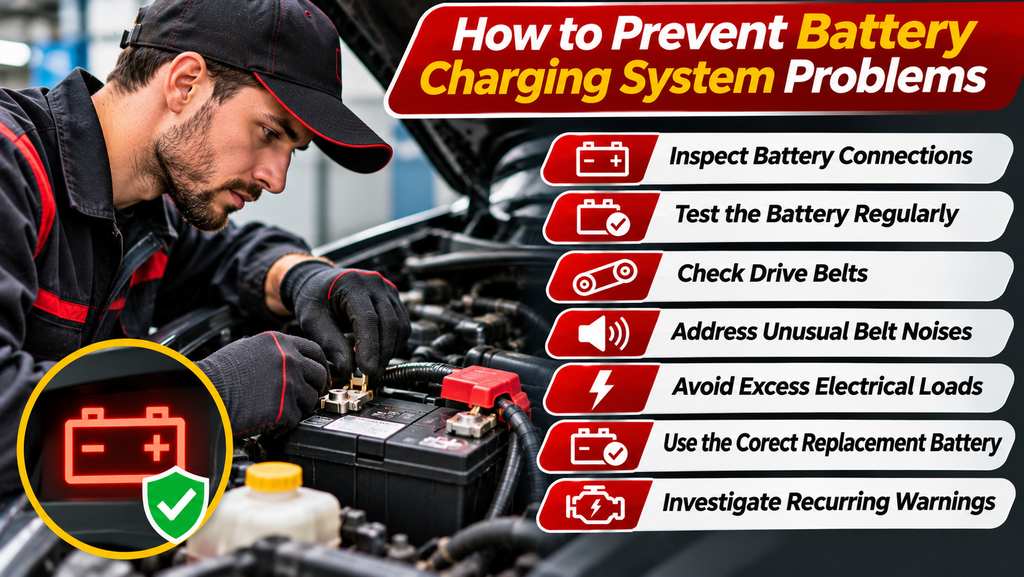
How to Prevent Battery Charging System Problems
Not every electrical failure can be prevented, but regular maintenance can reduce some risks and help identify problems early.
- Inspect accessible battery connections during routine maintenance.
- Have the battery tested when its performance deteriorates or before extreme weather conditions.
- Check drive belts according to the manufacturer-recommended maintenance schedule.
- Address unusual belt noises and repeated starting problems promptly.
- Avoid adding electrical accessories that exceed the vehicle’s supported capacity.
- Use replacement batteries that match manufacturer requirements.
- Investigate recurring charging warnings instead of repeatedly jump-starting the vehicle.
Frequently Asked Questions
1. What does Service Battery Charging System mean on a Chevy?
It indicates that the vehicle has detected a potential issue with its charging system. Possible causes include an alternator problem, wiring fault, battery connection issue, or charging-control malfunction.
2. Can I drive with a charging-system warning?
Continued driving can be risky if charging has failed. Find a safe place to stop and arrange diagnosis. If the vehicle shows serious electrical problems, stalling, or overheating, request assistance.
3. Does this warning mean my alternator is bad?
Not necessarily. The alternator is one possible cause, but wiring, battery connections, sensors, and other system components can produce similar warnings.
4. Can a weak battery trigger the warning?
Yes, a defective or significantly discharged battery may contribute to charging-related problems. Testing is needed to identify the underlying cause.
5. Will a new battery solve the problem?
Only if the battery is the actual problem and the charging system is functioning properly. A new battery cannot fix a defective alternator or broken charging circuit.
6. Why does the warning appear intermittently?
Intermittent warnings may result from loose connections, unstable charging output, belt slippage, or electrical control faults. The problem should still be investigated.
7. Can the vehicle shut off while driving?
Yes. If the charging system fails and the battery becomes sufficiently discharged, essential electronic systems may stop operating and the engine can stall.
8. Can a bad serpentine belt cause this warning?
Yes. On vehicles with a belt-driven alternator, a broken or slipping belt can reduce or stop electrical generation.
9. What voltage should a charging system produce?
Many conventional systems operate around 13.5–14.8 volts while charging, but modern computer-controlled systems can vary significantly. Always consult vehicle-specific specifications.
10. Can I reset the charging-system warning?
Some warnings disappear after the underlying problem is corrected. Simply clearing codes or disconnecting the battery does not repair an electrical fault.
11. What should I test first?
Begin with safe visual checks of battery connections and accessible drive-system components. A complete battery and charging-system test should follow when the cause is unclear.
12. How urgent is the warning?
It deserves prompt attention because a serious charging failure can cause a breakdown. The urgency increases if the battery light stays on, lights dim, or the vehicle develops electrical or engine-performance problems.
Final Thoughts
The battery charging system is essential for keeping a conventional vehicle’s electrical equipment powered and its battery replenished. A charging-system warning indicates that something may not be working as intended, but it does not identify a failed component by itself.
If the message appears, prioritize safety, pay attention to additional symptoms, and have the system properly tested. Identifying the real cause before buying replacement parts can save money and help prevent another breakdown.