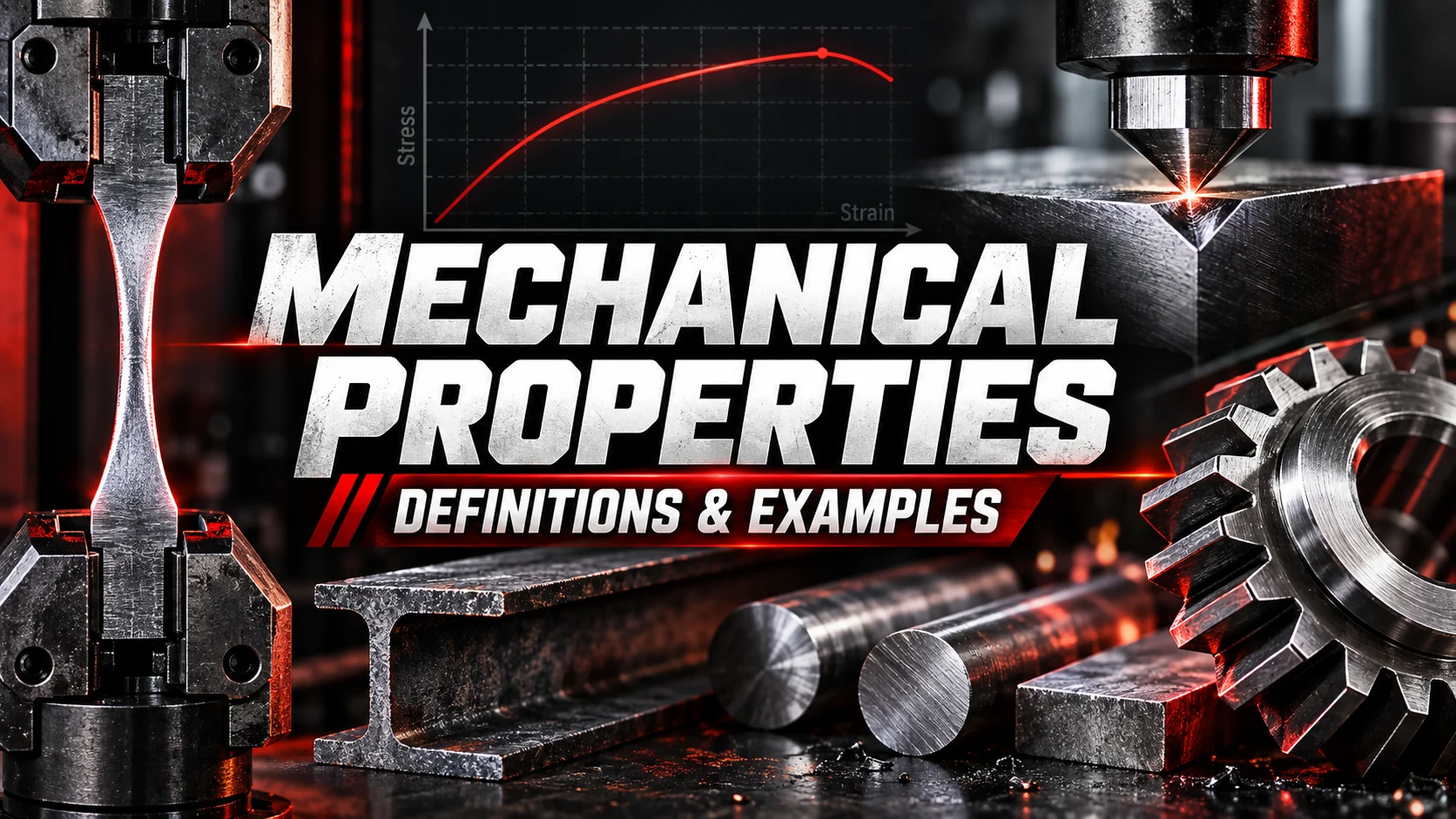

The mechanical properties of materials describe how a material behaves when forces, loads, impacts, or repeated stresses are applied. These properties help engineers predict whether a material will bend, stretch, crack, wear, or fail in service.
Understanding strength, stiffness, hardness, toughness, ductility, fatigue, creep, and related properties is essential when selecting materials for machines, vehicles, structures, tools, and engineering devices.
Quick Answer
Important mechanical properties of materials include strength, stiffness, hardness, toughness, elasticity, plasticity, ductility, brittleness, resilience, fatigue resistance, creep resistance, wear resistance, and impact strength. Engineers compare these properties to determine whether a material is suitable for a specific application.
What Are Mechanical Properties of Materials?
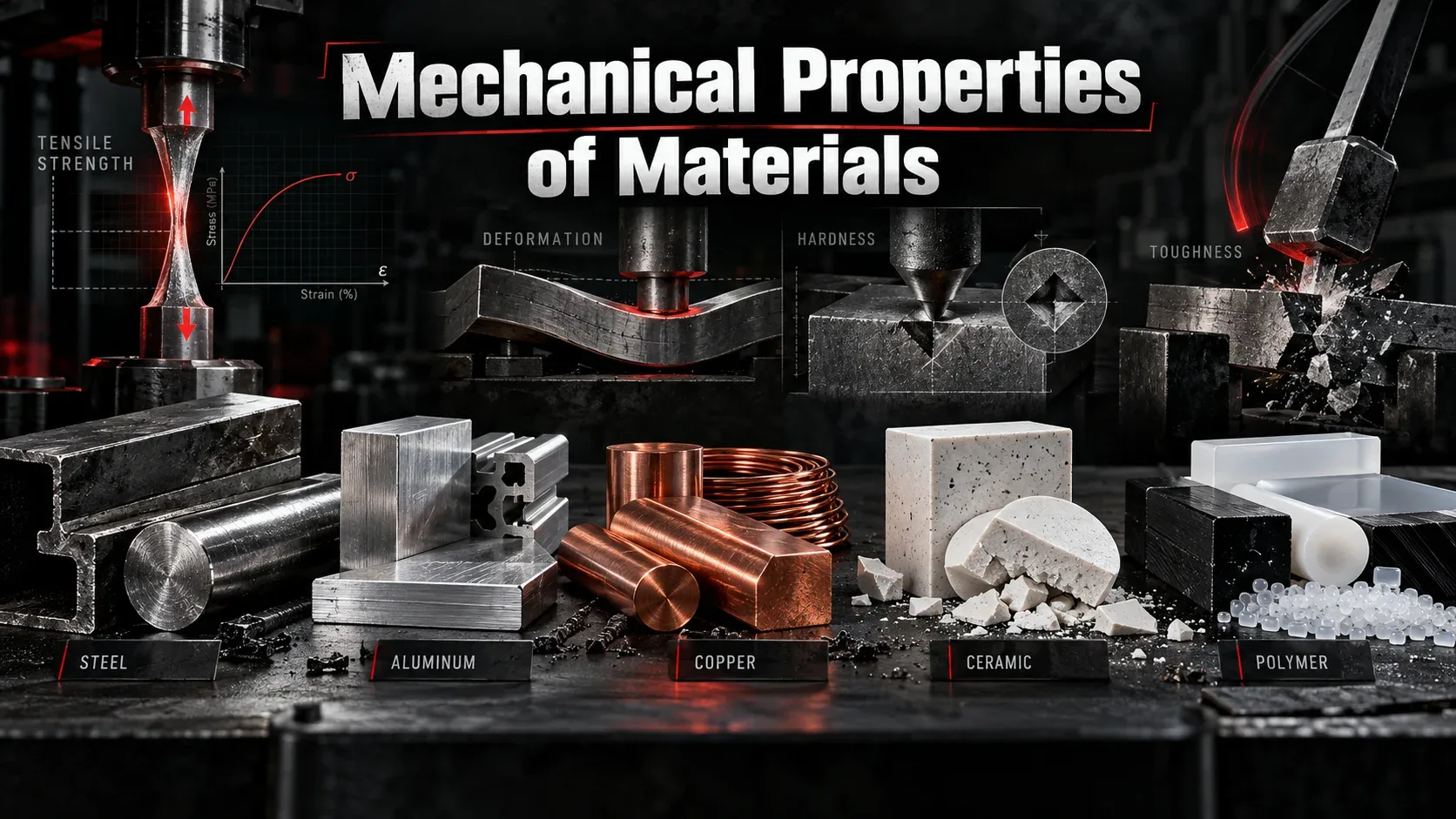
Mechanical properties describe how a material responds when it is subjected to forces such as tension, compression, bending, shear, impact, or repeated loading.
These properties do not describe the shape of a component. Instead, they describe the behavior of the material itself under specified conditions.
Why Are Mechanical Properties Important?
Bridge Beam
Needs sufficient strength and stiffness to carry loads without failure or excessive bending.
Car Spring
Needs elasticity, resilience, and fatigue resistance.
Cutting Tool
Needs hardness, wear resistance, and heat resistance.
Hammer Head
Needs toughness so it can absorb repeated impacts without cracking.
Crankshaft
Needs strength, toughness, and excellent fatigue resistance.
Turbine Blade
Needs creep resistance and strength at elevated temperature.
Stress and Strain: The Foundation of Material Behavior
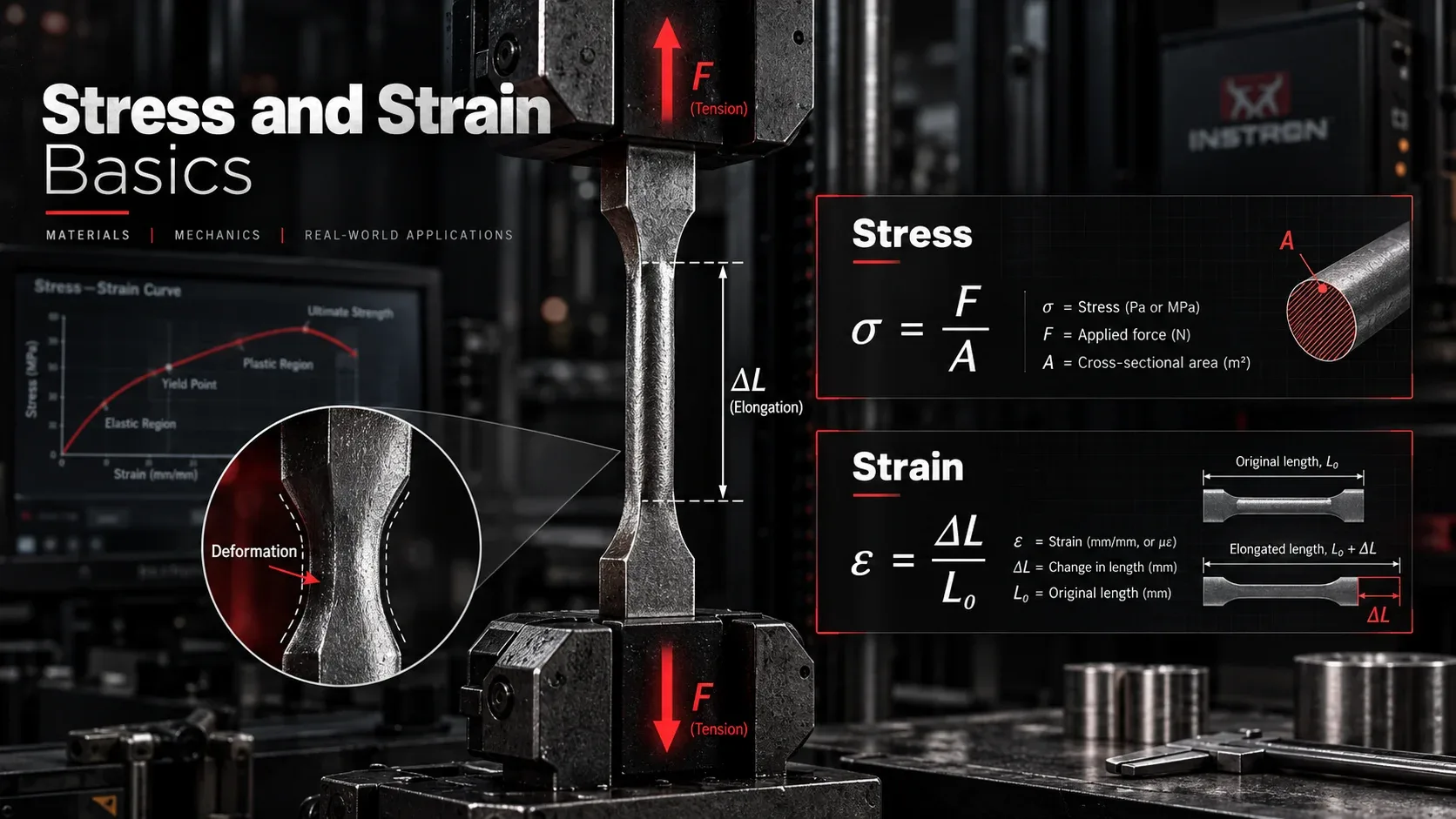
What Is Stress?
Stress describes the internal force acting within a material relative to the cross-sectional area carrying that load.
What Is Strain?
Strain describes how much a material changes in length compared with its original length.
Stress and strain are fundamental concepts because many mechanical properties are determined by measuring how a material responds as stress increases.
Elastic and Plastic Deformation Explained
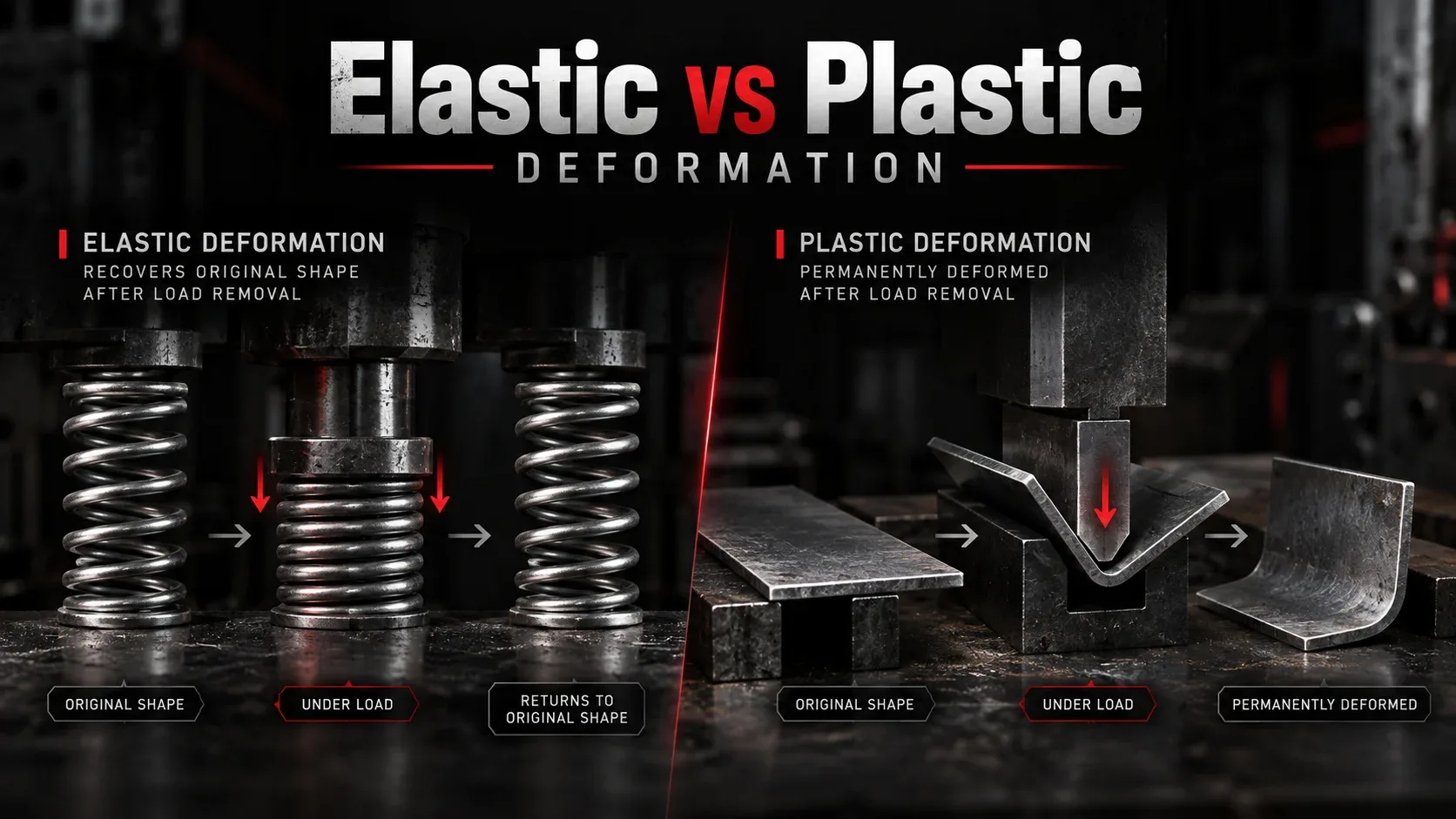
The material changes shape under load but returns to its original dimensions when the load is removed.
Example: A properly loaded metal spring.
The material undergoes permanent deformation and does not fully return to its original dimensions after unloading.
Example: Sheet metal permanently bent into a bracket.
Strength
Strength is the ability of a material to resist applied stress without yielding, fracturing, or otherwise failing.
Tensile Strength
Resistance to forces that pull a material apart.
Compressive Strength
Resistance to forces that push or crush a material.
Shear Strength
Resistance to forces that cause adjacent sections to slide past one another.
Yield Strength
The stress level at which permanent deformation begins under the specified test conditions.
Stiffness
Stiffness is the resistance of a material or component to elastic deformation. In materials engineering, stiffness is commonly associated with elastic modulus, such as Young’s modulus in tension.
Strength vs Stiffness: What Is the Difference?
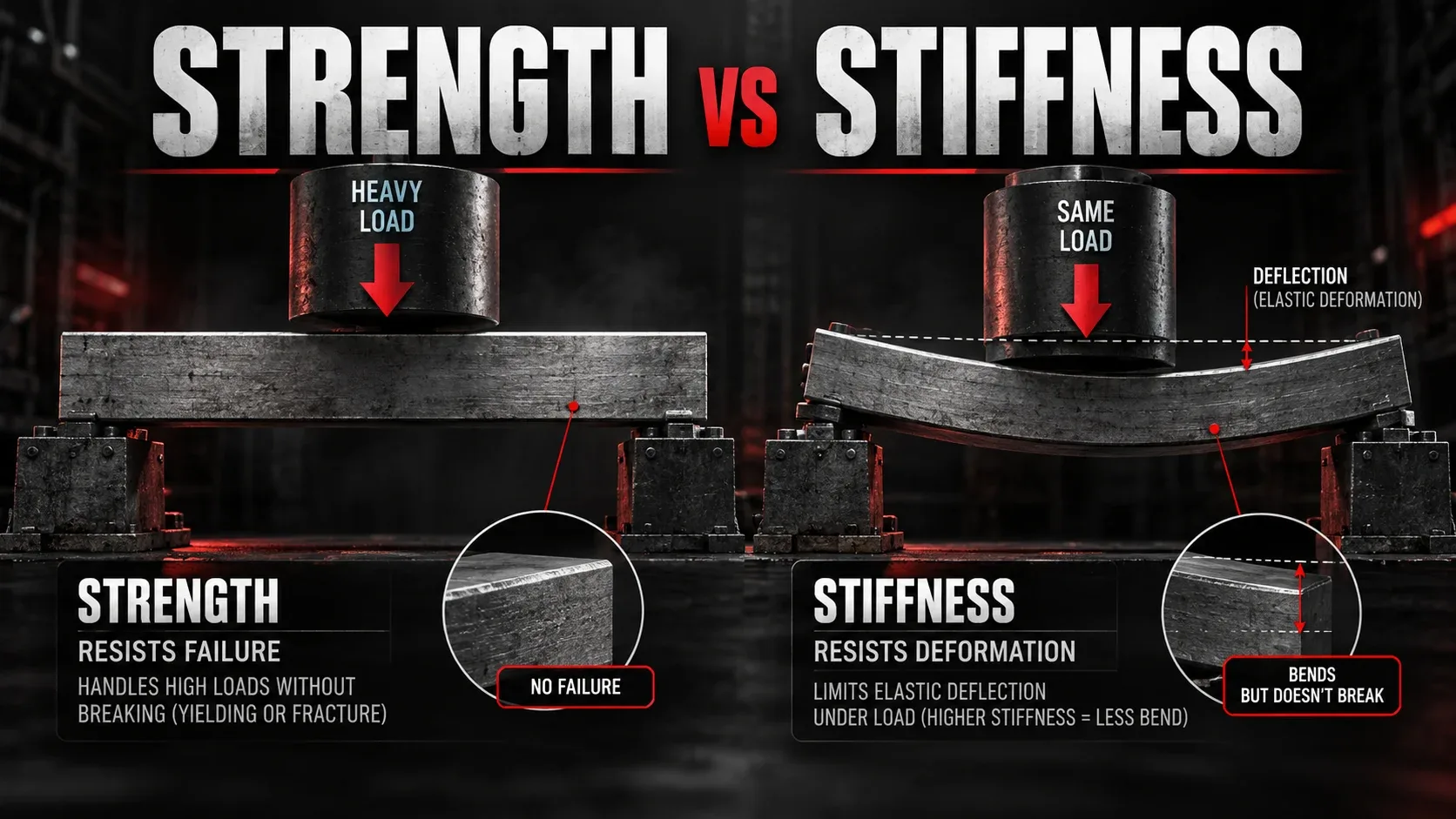
| Property | Main Question | Engineering Meaning |
|---|---|---|
| Strength | How much load can it withstand? | Resistance to yielding or failure |
| Stiffness | How much will it deform? | Resistance to elastic deformation |
Hardness
Hardness describes a material’s resistance to localized permanent deformation, indentation, scratching, and in many situations, wear.
Common Hardness Tests
- Rockwell hardness test
- Brinell hardness test
- Vickers hardness test
Toughness
Toughness is the ability of a material to absorb energy and deform before fracturing. A tough material combines resistance to cracking with the ability to tolerate some deformation.
Hardness vs Toughness
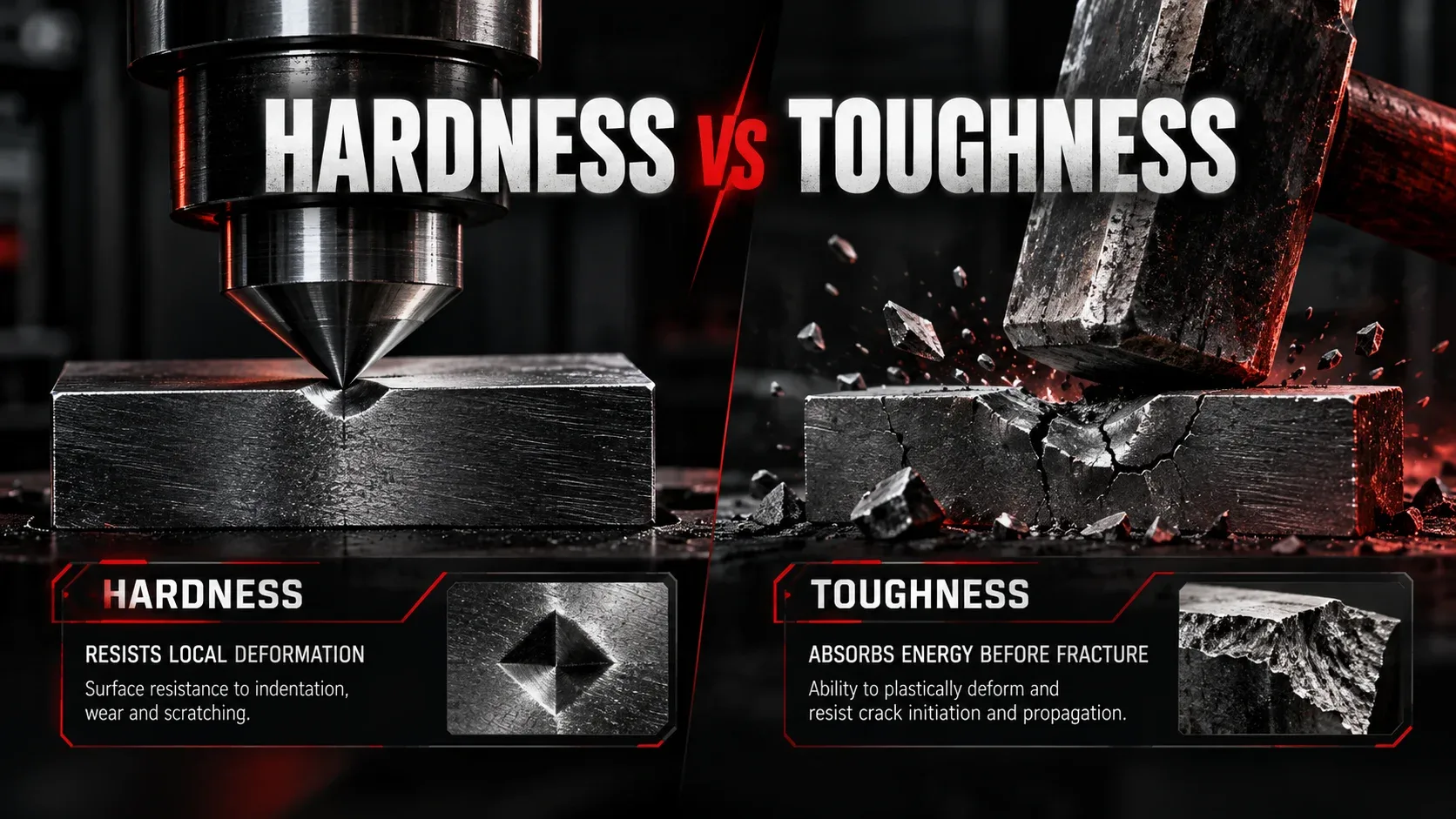
Resistance to indentation, surface deformation, scratching, and wear.
Ability to absorb energy and resist fracture under loading or impact.
A material can be very hard but still brittle. Increasing hardness does not automatically mean a component will resist impact better.
Elasticity
Elasticity is the ability of a material to return to its original dimensions after the applied load is removed, provided the material has not been stressed beyond its elastic limit.
Plasticity
Plasticity is the ability of a material to undergo permanent deformation without fracturing.
- Forging
- Rolling
- Stamping
- Bending
- Deep drawing
Ductility
Ductility describes a material’s ability to undergo significant plastic deformation in tension before fracture.
Ductility is often evaluated using percentage elongation or reduction in area during a tensile test.
Malleability
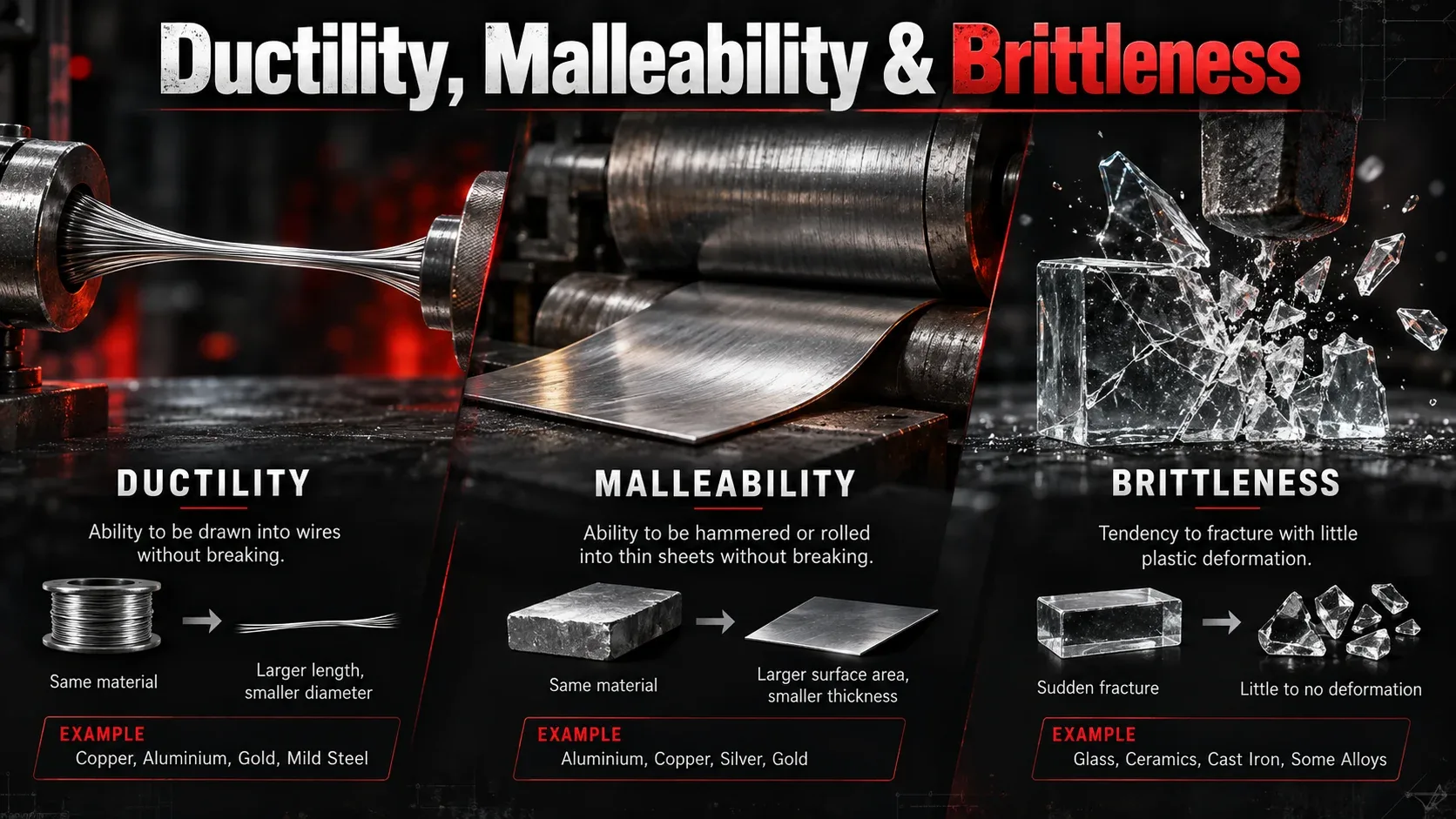
Malleability is the ability of a material to deform plastically under compressive loading and be formed into sheets without cracking.
Associated mainly with deformation in tension, such as drawing metal into wire.
Associated mainly with deformation in compression, such as rolling metal into sheet.
Brittleness
Brittleness is the tendency of a material to fracture with little plastic deformation.
Resilience
Resilience is the ability of a material to absorb energy while deforming elastically and release that energy when the load is removed.
Fatigue Resistance
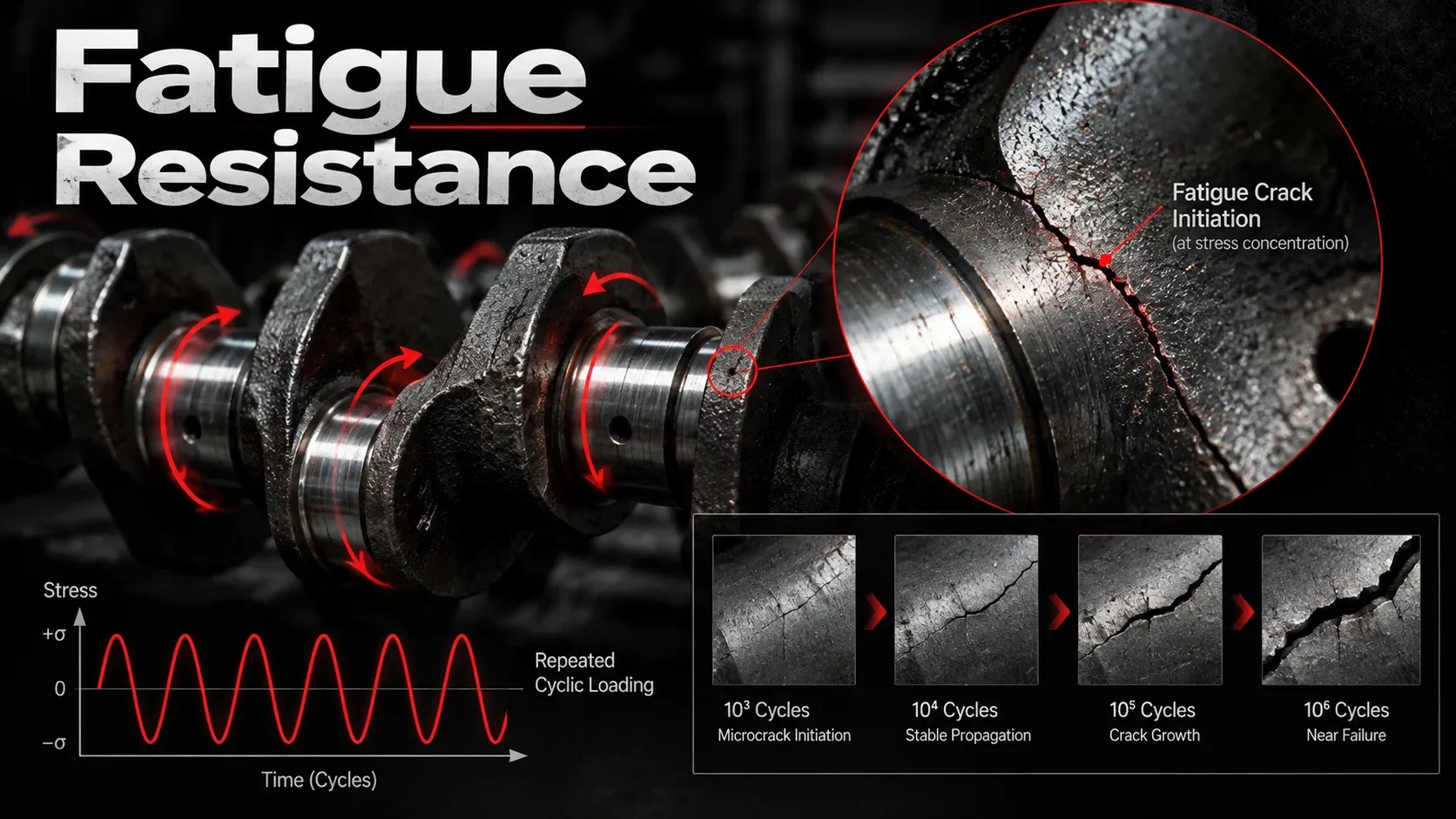
Fatigue resistance describes a material’s ability to withstand repeated or cyclic loading.
- Crankshafts
- Axles
- Gears
- Aircraft structures
- Suspension components
- Rotating shafts
Creep Resistance
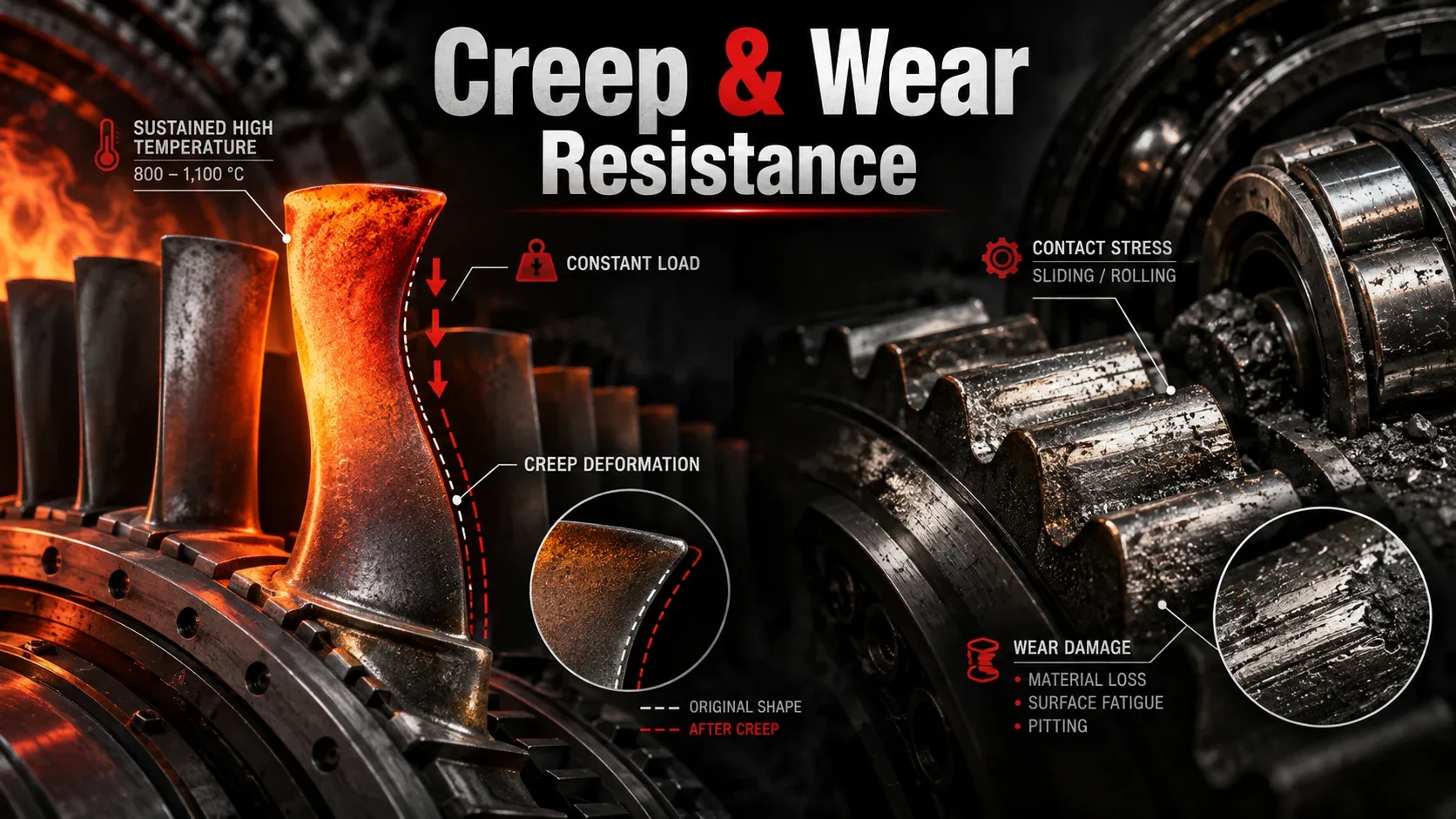
Creep is slow, permanent deformation that occurs when a material is subjected to sustained stress for a long period, particularly at elevated temperature.
- Turbine blades
- Boilers
- Power plants
- High-temperature piping
- Engines and exhaust systems
Wear Resistance
Wear resistance describes the ability of a material to resist gradual material loss caused by friction, abrasion, sliding contact, or repeated surface contact.
Impact Strength
Impact strength describes how well a material can withstand suddenly applied loads.
Standardized impact tests such as Charpy and Izod testing can be used to compare the energy absorbed by test specimens during fracture.
Mechanical Properties of Materials at a Glance
| Property | Simple Meaning | Example |
|---|---|---|
| Strength | Resists failure under load | Bridge beam |
| Stiffness | Resists elastic deformation | Machine frame |
| Hardness | Resists indentation and wear | Cutting tool |
| Toughness | Absorbs energy before fracture | Hammer head |
| Elasticity | Returns to original shape | Spring |
| Plasticity | Permanently deforms without fracture | Formed sheet metal |
| Ductility | Stretches before breaking | Copper wire |
| Brittleness | Fractures with little plastic deformation | Glass |
| Resilience | Stores elastic energy | Spring |
| Fatigue Resistance | Handles repeated loading | Crankshaft |
| Creep Resistance | Resists long-term deformation | Turbine blade |
| Wear Resistance | Resists surface material loss | Gear |
Examples of Mechanical Properties in Common Materials
Steel
Depending on grade and heat treatment, steel can provide high strength, toughness, hardness, and fatigue resistance.
Aluminum
Aluminum alloys are lightweight and often ductile, but generally have lower stiffness than steel.
Copper
Copper is highly ductile and formable, making it useful for wire and tubing.
Ceramics
Many ceramics are very hard and strong in compression but relatively brittle.
Polymers
Polymer properties vary widely and can be strongly influenced by temperature, loading rate, and time.
Cast Iron
Many cast irons have good compressive strength and wear resistance but lower ductility than many steels.
Mechanical vs Structural Properties: What Is the Difference?
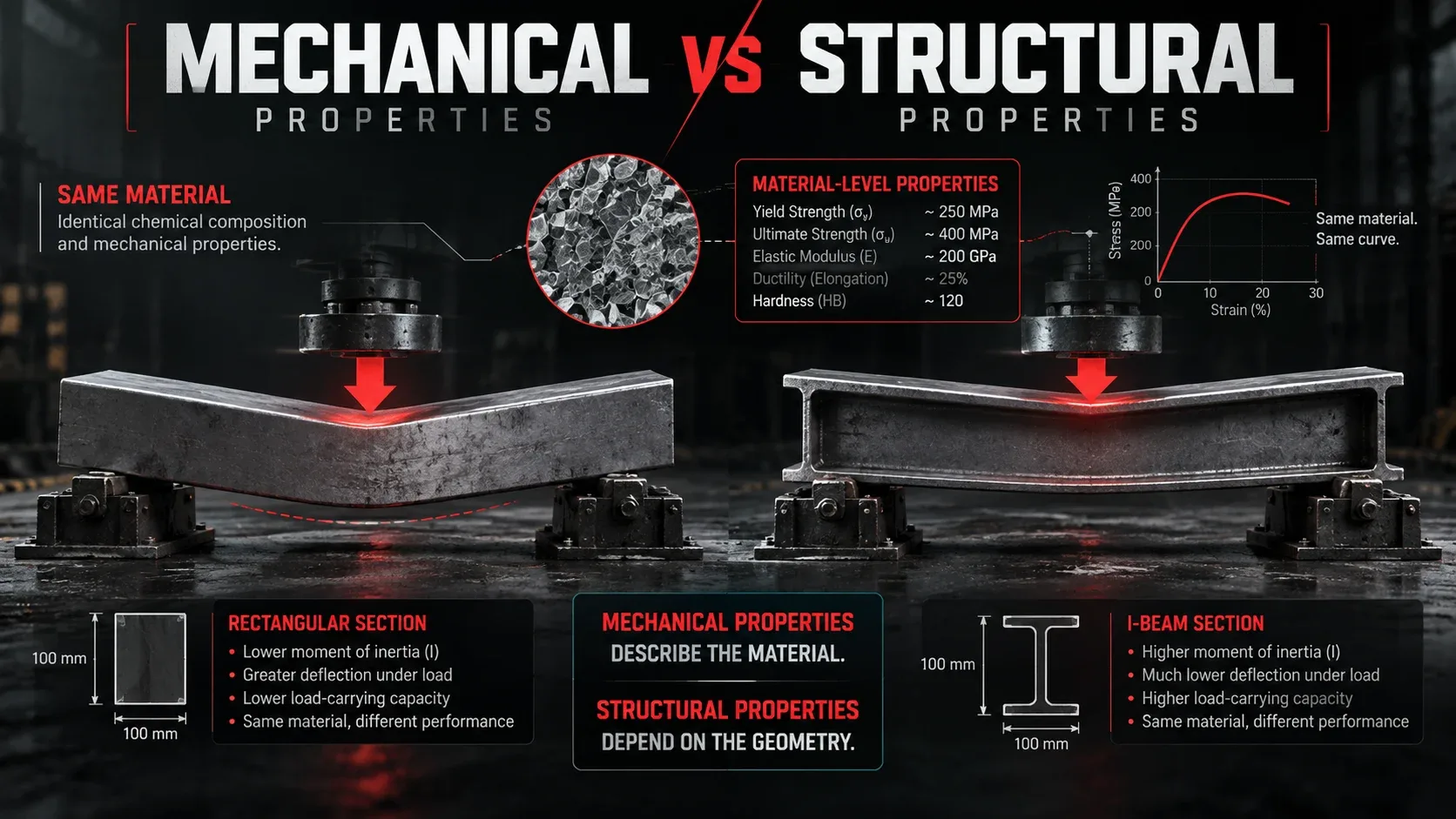
Examples include strength, stiffness, hardness, toughness, ductility, and fatigue resistance.
Depend on material choice, dimensions, cross-sectional shape, supports, loading, and overall geometry.
Two beams made from the same steel can have very different bending performance if their cross-sectional shapes are different.
Mechanical and Structural Properties in Engineering Devices
Understanding mechanical and structural properties and devices requires looking at both the material itself and the design of the component.
Gear
Needs hardness, wear resistance, strength, and fatigue resistance.
Spring
Needs elasticity, resilience, strength, and fatigue resistance.
Bridge Beam
Needs strength, stiffness, toughness, and suitable structural geometry.
Cutting Tool
Needs hardness, wear resistance, and resistance to thermal softening.
Pressure Vessel
Needs strength and toughness, with creep resistance important in high-temperature service.
Axle
Needs strength, toughness, and excellent fatigue resistance.
How Engineers Measure Mechanical Properties

Tensile Test
Used to determine yield strength, tensile strength, and elongation.
Hardness Test
Measures resistance to localized indentation.
Impact Test
Measures the energy absorbed by a specimen during sudden fracture.
Fatigue Test
Evaluates performance under repeated cyclic loading.
Creep Test
Measures deformation over time under sustained load, often at elevated temperature.
Compression Test
Evaluates material behavior under compressive loading.
Understanding a Stress-Strain Curve
- Elastic region: deformation is recoverable.
- Yield point: significant permanent deformation begins.
- Plastic region: permanent deformation continues.
- Ultimate tensile strength: maximum engineering stress reached.
- Fracture: specimen finally breaks.
What Factors Affect Mechanical Properties?
- Chemical composition
- Heat treatment
- Manufacturing process
- Cold working
- Grain size
- Microstructure
- Temperature
- Loading rate
- Material defects
- Surface condition
How Mechanical Properties Help Engineers Choose Materials
Common Misunderstandings About Material Properties
- Harder does not always mean stronger.
- Stronger does not always mean stiffer.
- Brittle does not automatically mean weak.
- Toughness is not the same as hardness.
- Elasticity is not simply the same as flexibility.
- Material properties can change with temperature and processing.
Frequently Asked Questions About Mechanical Properties of Materials
What are the main mechanical properties of materials?
Common mechanical properties include strength, stiffness, hardness, toughness, elasticity, plasticity, ductility, brittleness, resilience, fatigue resistance, creep resistance, wear resistance, and impact strength.
What is the most important mechanical property?
There is no single most important property. The required property depends on the application, loading, environment, and expected failure mode.
What is the difference between strength and hardness?
Strength describes resistance to failure under applied load, while hardness describes resistance to localized surface deformation or indentation.
What is the difference between toughness and brittleness?
Tough materials can absorb substantial energy before fracture, while brittle materials tend to fracture with relatively little plastic deformation.
What is stiffness?
Stiffness describes resistance to elastic deformation. At the material level, it is commonly related to elastic modulus.
What is ductility?
Ductility is the ability of a material to undergo plastic deformation in tension before fracture.
What causes fatigue failure?
Repeated cyclic loading can initiate and grow cracks over time, eventually causing failure.
Why is creep important?
Creep can cause permanent deformation in components subjected to sustained load, especially at elevated temperatures.
Final Thoughts on Mechanical Properties of Materials
Understanding the mechanical properties of materials helps engineers predict how materials will respond to forces, deformation, impact, repeated loading, wear, and high-temperature service.
Strength, stiffness, hardness, toughness, ductility, fatigue resistance, creep resistance, and other properties each describe a different part of material behavior.
No single material is best at every property. Good engineering means choosing the right balance of properties for the specific component, structure, or device.