
Driver assistance technology can make everyday driving more convenient by helping with braking, steering, following distance, lane positioning, and awareness around the vehicle. In the Honda CR-V lineup, many core safety technologies are included across the range, but additional features become available as you move into higher trims. For shoppers comparing options, reviewing the Honda CR-V inventory in Sanford, NC can help identify which model provides the combination of technology and equipment that fits their needs.
Honda Sensing Comes Standard Across the CR-V Lineup
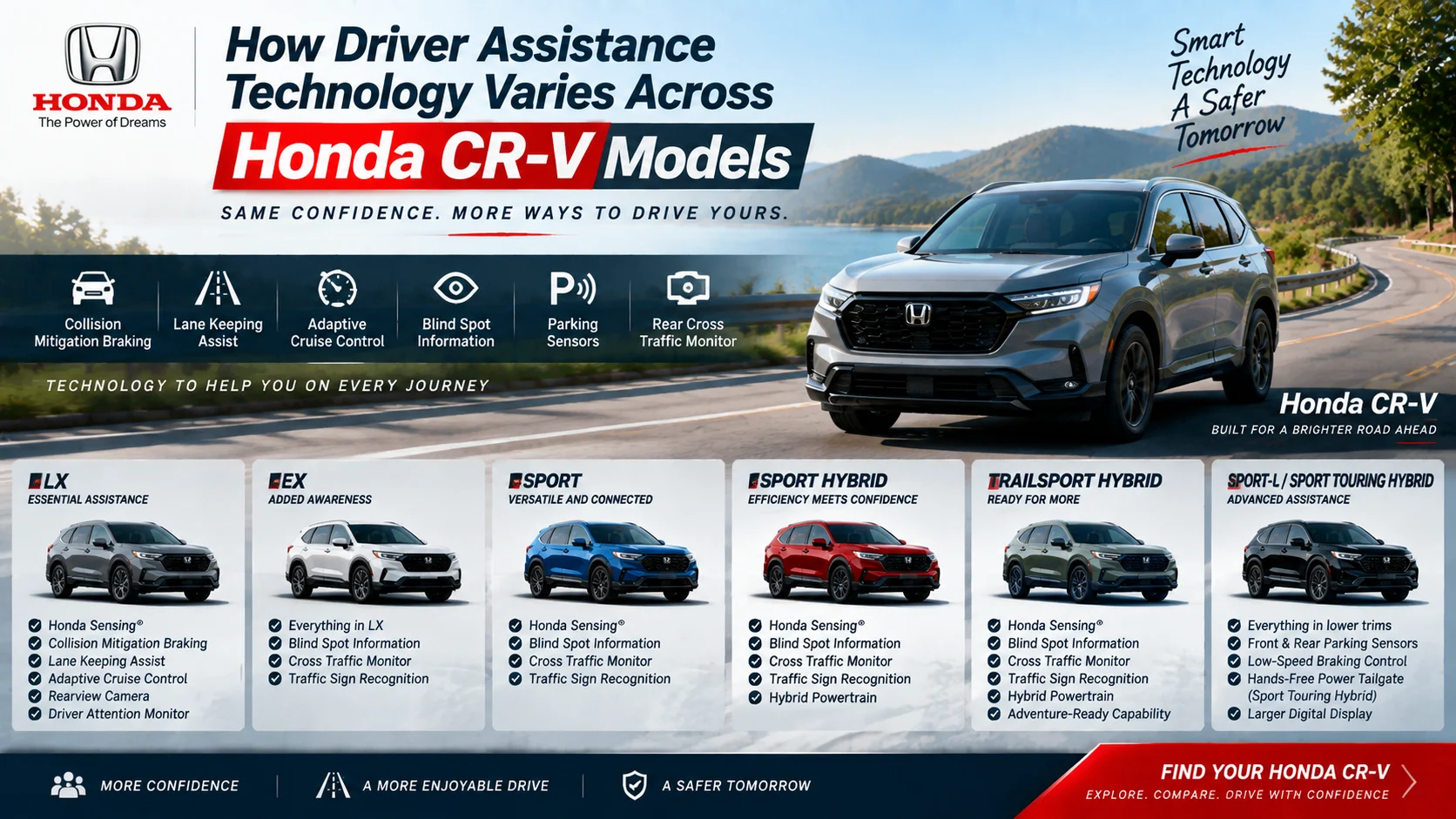
Honda equips the 2026 CR-V lineup with its Honda Sensing® suite of driver-assistance technologies. The package includes important systems such as Collision Mitigation Braking System, Road Departure Mitigation, Lane Keeping Assist, Adaptive Cruise Control, Lane Departure Warning, and automatic high-beam headlights.
This means buyers do not necessarily need to select a higher trim to receive core driver-assistance functions. Even the entry-level CR-V provides a substantial collection of technologies designed to assist during everyday driving.
CR-V LX: Essential Driver Assistance
The CR-V LX provides the foundation of the lineup’s driver-assistance technology. Its standard systems include Collision Mitigation Braking System, Driver Attention Monitor, Auto High-Beam Headlights, and a rearview camera with dynamic guidelines.
Honda Sensing technologies such as Adaptive Cruise Control with Low-Speed Follow, Lane Keeping Assist System, Road Departure Mitigation, Lane Departure Warning, and Forward Collision Warning are also part of the CR-V’s safety technology package.
For drivers who want basic assistance without moving into an upper trim, the LX establishes a strong technology baseline.
EX: Additional Awareness Around the Vehicle
Moving into the EX adds technologies designed to improve awareness when changing lanes or backing out of parking spaces. Honda lists Blind Spot Information and Cross Traffic Monitor as Honda Sensing features available from the EX and above.
Blind Spot Information can help draw attention to vehicles approaching from areas that may be difficult to see through the mirrors, while Cross Traffic Monitor can assist when reversing from a parking space or driveway.
These features can be particularly useful in busy parking lots, multi-lane roads, and other situations where surrounding traffic can be difficult to monitor.
Sport and Sport Hybrid Models
The Sport and Sport Hybrid models retain the CR-V’s core Honda Sensing technologies while offering different powertrain configurations. Honda’s 2026 specifications show driver-assistance features such as Adaptive Cruise Control, Collision Mitigation Braking System, Lane Departure Warning, Lane Keeping Assist, Road Departure Mitigation, Blind Spot Information, Cross Traffic Monitor, and Traffic Sign Recognition across the listed CR-V configurations.
The Sport Hybrid also combines these assistance technologies with Honda’s two-motor hybrid system. This gives buyers an option to prioritize hybrid powertrain efficiency while retaining the CR-V’s driver-assistance technology.
TrailSport Hybrid: Assistance for Different Driving Conditions
The TrailSport Hybrid adds a more adventure-oriented configuration to the CR-V lineup while retaining the model’s driver-assistance systems. Honda lists Honda Sensing technologies across its 2026 CR-V trims, including Adaptive Cruise Control, Lane Keeping Assist, Road Departure Mitigation, Collision Mitigation Braking System, Blind Spot Information, and Cross Traffic Monitor.
Driver assistance can be useful on both paved roads and longer trips where changing traffic conditions require greater awareness. However, these systems are designed to assist the driver rather than replace active attention and control.
Sport-L Hybrid and Sport Touring Hybrid
Higher CR-V trims add equipment that can make low-speed maneuvering and parking easier. The 2026 Sport-L Hybrid and Sport Touring Hybrid include front and rear parking sensors, while Low-Speed Braking Control is also available on these higher configurations.
Low-Speed Braking Control is designed to help prevent certain low-speed collisions by applying braking assistance when appropriate. The Sport Touring Hybrid sits at the top of the CR-V range and adds further convenience and technology equipment, including a hands-free power tailgate and a larger digital instrument display.
How the Technology Differences Affect Daily Driving
The differences between CR-V models are less about whether driver assistance is available and more about how much additional assistance and vehicle awareness technology is included.
Lower trims provide important collision, lane, and cruise-control assistance. Mid-level trims add features such as blind-spot and cross-traffic monitoring. Higher trims can add parking sensors and low-speed braking assistance.
This tiered approach allows buyers to choose a CR-V based on how much technology they want without giving up the fundamental Honda Sensing safety features.
Conclusion
Honda CR-V models share a common foundation of driver-assistance technology, but equipment varies as buyers move through the trim lineup. The LX provides core assistance features, while models such as the EX add greater surrounding-vehicle awareness. Sport, Sport Hybrid, TrailSport Hybrid, Sport-L Hybrid, and Sport Touring Hybrid configurations build on that foundation with different combinations of technology and convenience features.