
A clear, labelled diagram of air conditioning showing how refrigerant flows through every major component to cool your cabin.
If your car’s air conditioner is blowing warm air — or you simply want to understand how the system works — a clear diagram of air conditioning is the fastest way to make sense of it. Written descriptions of pressure changes and refrigerant states can feel abstract without a visual reference showing which component connects to which.
This article provides a labelled air conditioning system diagram that traces the refrigerant from the compressor through every major part and back again. Below the diagram, each component is explained in plain language so you can confidently discuss repairs with a qualified technician.
Car AC System Diagram: The Complete Refrigerant Cycle
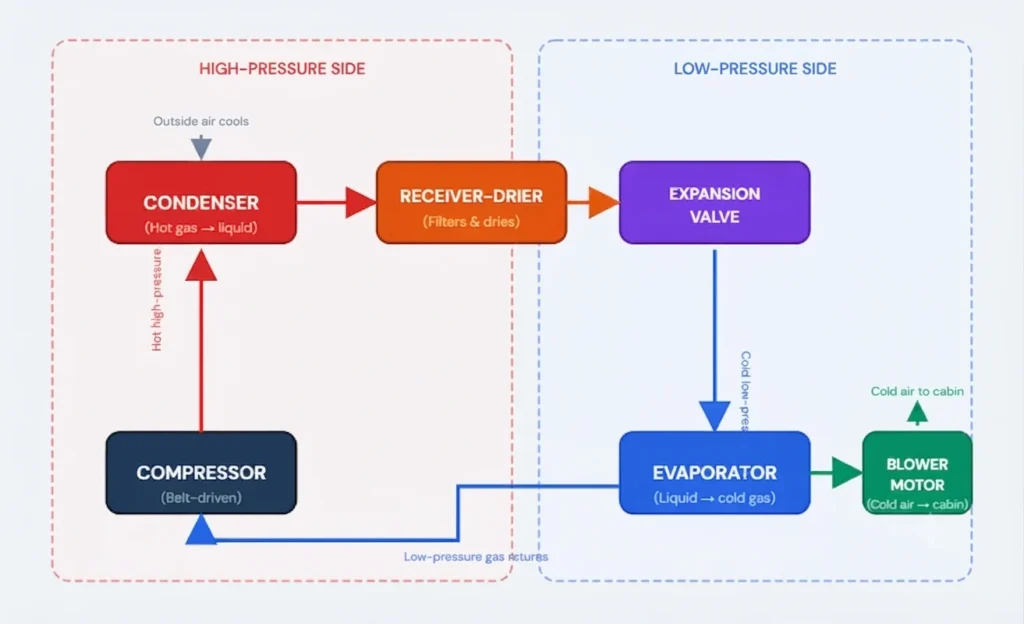
Air conditioning system diagram showing refrigerant flow: Compressor → Condenser → Receiver-Drier → Expansion Valve → Evaporator → back to Compressor. Red area = high-pressure side. Blue area = low-pressure side.
How the Refrigerant Cycle Works (Step by Step)
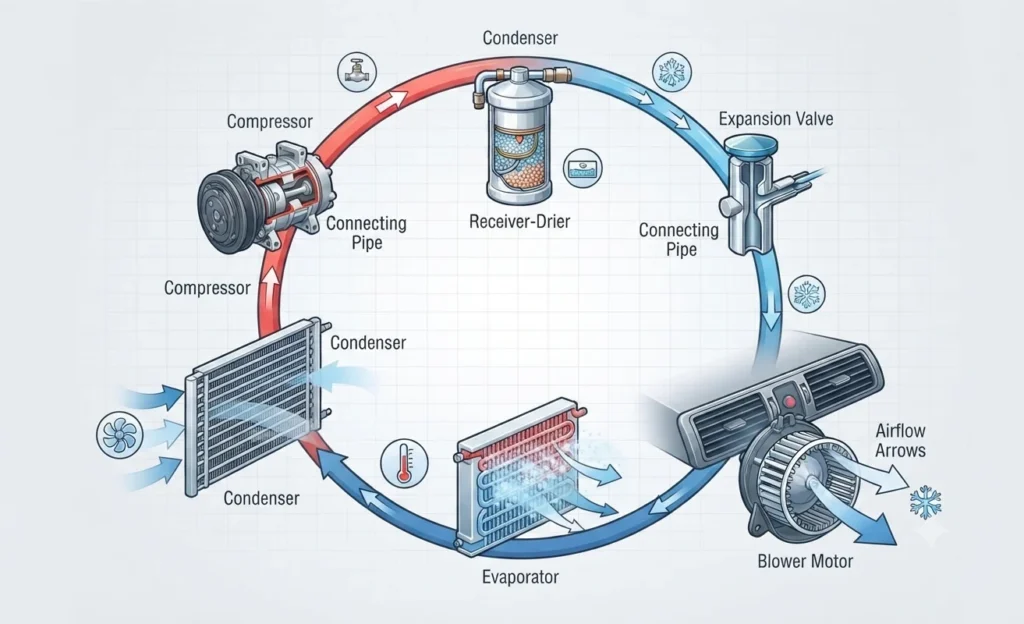
The AC system is a closed loop. Refrigerant (usually R-134a or R-1234yf) circulates continuously, absorbing heat from inside the cabin and releasing it outside. It does this by changing between a gas and a liquid at different pressures — a process that happens over and over while the AC is running.
On the high-pressure side (compressor to expansion valve), the refrigerant is compressed into a hot, high-pressure gas, then cooled and condensed into a warm liquid. On the low-pressure side (expansion valve to compressor), the liquid expands into a cold, low-pressure mist that absorbs cabin heat through the evaporator.
The blower motor pushes cabin air across the cold evaporator fins. The air loses its heat to the refrigerant and exits the vents as cold air. Meanwhile, the now-warmed refrigerant gas returns to the compressor to repeat the cycle.
Compressor: The Heart of the System
The compressor is a belt-driven pump mounted on the engine (or electrically driven in hybrid and electric vehicles). It draws in low-pressure refrigerant gas from the evaporator and squeezes it into high-pressure, high-temperature gas. This pressurization is what drives the entire refrigerant cycle.
Common failure symptoms: AC blows warm air, loud clicking or grinding noise from the engine bay when AC is engaged, compressor clutch not engaging, or the AC fuse blowing repeatedly. A seized compressor often contaminates the entire system with metal debris.
Condenser: Releasing Heat to the Outside Air
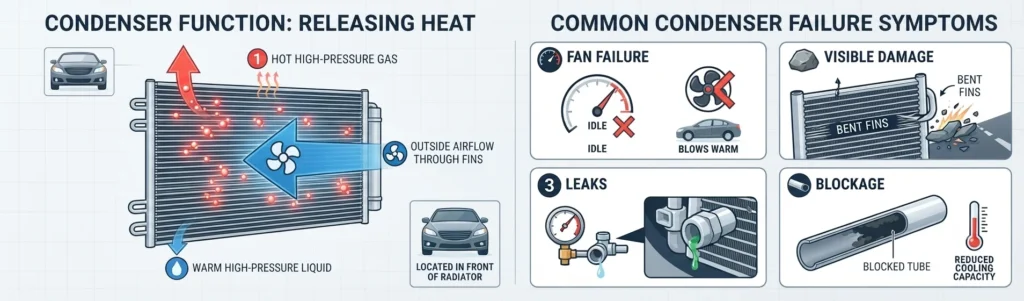
Located in front of the radiator, the condenser looks like a second radiator. Hot, high-pressure gas from the compressor enters the condenser and gives up its heat to outside air flowing through the fins. As the gas cools, it condenses into a warm, high-pressure liquid.
Common failure symptoms: AC works while driving but blows warm at idle (condenser fan failure), visible damage or bent fins from road debris, or refrigerant leaks at the fittings. A blocked condenser reduces cooling capacity significantly.
Receiver-Drier: Filtering and Removing Moisture
The receiver-drier (or accumulator on some systems) sits between the condenser and the expansion valve. It contains a desiccant that absorbs moisture and a filter that traps debris. Moisture in an AC system can freeze at the expansion valve and form corrosive acids.
This component should be replaced whenever the system is opened to the atmosphere (for example, during a compressor replacement) because the desiccant becomes saturated once exposed to ambient air.
Expansion Valve: Creating the Pressure Drop
The expansion valve (or orifice tube in some vehicles) is a restriction point that rapidly drops the pressure of the liquid refrigerant. This sudden pressure drop causes the refrigerant to partially evaporate into a cold, low-pressure mist. Think of it like releasing the nozzle on a compressed air can — the rapid expansion makes it very cold.
Common failure symptoms: Evaporator icing up (valve stuck open), insufficient cooling (valve stuck closed or partially blocked), or inconsistent temperature from the vents.
Evaporator: Where Your Cabin Air Gets Cold
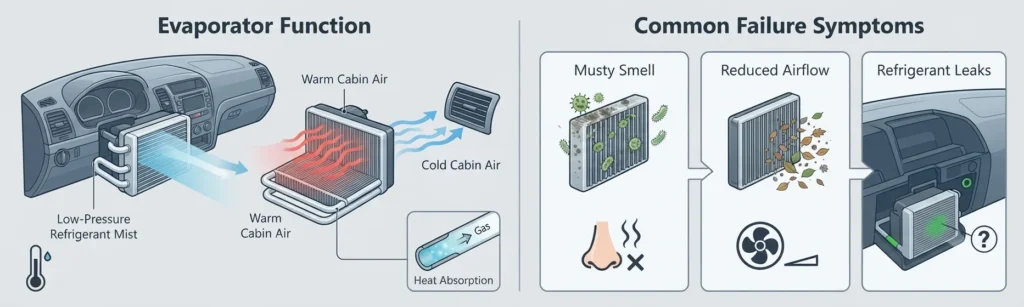
Located inside the dashboard, the evaporator is a small heat exchanger with thin aluminum fins. The cold, low-pressure refrigerant mist flows through its tubes. The blower motor pushes warm cabin air across the fins. The refrigerant absorbs the heat from the air, and the air exits cold through the vents.
Common failure symptoms: Musty or mouldy smell (bacterial growth on damp fins), reduced airflow (debris blocking the evaporator face), or refrigerant leaks that are difficult to locate because the evaporator is buried inside the dash.
Blower Motor: Moving Air Through the Cabin
The blower motor is an electric fan that draws cabin air (or outside air) across the evaporator and pushes it through the dashboard vents. It does not cool the air — the evaporator does that. The blower simply moves air. If the blower motor fails, you get no airflow at all even though the refrigerant system may be working perfectly.
High-Pressure Side vs. Low-Pressure Side
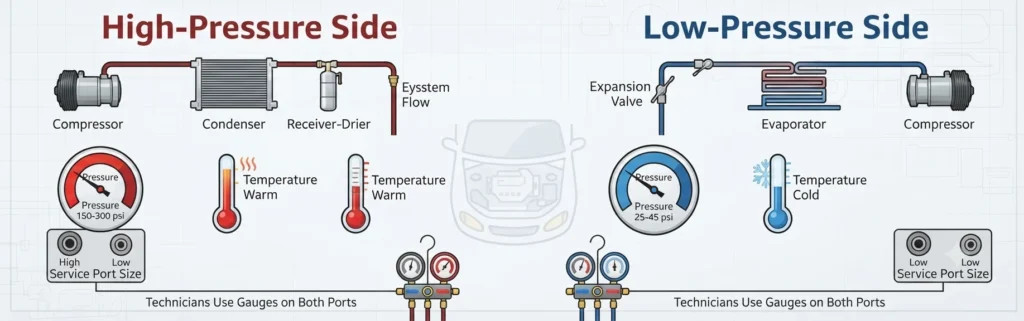
The high-pressure side runs from the compressor outlet through the condenser and receiver-drier to the expansion valve inlet. Refrigerant here is under high pressure (typically 150–300 psi) and relatively warm. The service port on this side has a larger fitting.
The low-pressure side runs from the expansion valve outlet through the evaporator and back to the compressor inlet. Refrigerant here is under low pressure (typically 25–45 psi) and cold. The service port on this side has a smaller fitting. Technicians use gauges on both ports to diagnose system health.
Common AC Symptoms and What They Mean
The following table connects common symptoms to possible problem areas. These are starting points for diagnosis, not confirmed fixes — a qualified technician uses pressure readings, temperature measurements, and leak detection equipment to pinpoint the actual fault.
| Symptom | Possible Area to Inspect |
|---|---|
| AC blows warm air | Low refrigerant, compressor, or electrical fault |
| AC cools only while driving | Condenser fan or airflow problem |
| Weak airflow from vents | Cabin filter, blower motor, or evaporator restriction |
| Compressor clicking or cycling | Low refrigerant pressure or electrical issue |
| Unusual smell from vents | Cabin filter, evaporator moisture, or contamination |
| Water pooling under the car | Normal condensation from evaporator drain (usually not a fault) |
Important: Symptoms can overlap. For example, warm air could indicate a refrigerant leak, a failed compressor, a blocked condenser, or an electrical fault. Professional diagnosis is recommended before replacing parts.
⚠️ Safety Warning: Automotive AC systems contain pressurised refrigerant that can cause frostbite and eye injuries. Refrigerant must not be released into the atmosphere — it is regulated under the EPA Clean Air Act (Section 608). Recovery, evacuation, and recharging require certified equipment. Do not attempt to open refrigerant lines without proper training and tools. Always consult a qualified technician.
Frequently Asked Questions
How does an air conditioning system work in a car?
The compressor pressurizes refrigerant gas and pushes it through the condenser where it releases heat and becomes a liquid. The liquid passes through the expansion valve, drops in pressure, and becomes a cold mist inside the evaporator. The blower motor pushes warm cabin air over the evaporator, cooling it before it exits through the vents. The warmed refrigerant returns to the compressor and the cycle repeats.
What is the difference between the condenser and the evaporator?
The condenser releases heat to the outside air (it is mounted in front of the radiator). The evaporator absorbs heat from the cabin air (it is mounted inside the dashboard). Both are heat exchangers, but they work in opposite directions.
Why does my car AC blow warm air?
The most common cause is low refrigerant due to a slow leak. Other possibilities include a failed compressor clutch, a blocked condenser, a faulty expansion valve, or an electrical problem preventing the compressor from engaging. A technician can connect pressure gauges to identify the issue quickly.
Can I recharge my car AC myself?
DIY recharge cans are available, but they only add refrigerant — they cannot detect leaks, evacuate moisture, or measure whether the system is actually low. Repeated recharging without fixing the underlying leak wastes money and can damage the compressor. A professional leak test and proper evacuation is the recommended approach.
Can low refrigerant damage the compressor?
Yes. Refrigerant carries lubricating oil through the system. When refrigerant is low, the compressor receives less lubrication, which increases friction and heat. Over time this can cause the compressor to seize, turning a relatively inexpensive leak repair into a much more costly compressor replacement.
Summary: Understanding Your Car’s AC System
A diagram of air conditioning makes the refrigerant cycle easy to follow: compressor → condenser → receiver-drier → expansion valve → evaporator → and back to the compressor. The high-pressure side releases heat outside. The low-pressure side absorbs heat inside. The blower motor delivers the cooled air to your cabin.
Understanding this air conditioning system diagram gives you enough knowledge to recognise common symptoms, ask informed questions at the repair shop, and avoid approving unnecessary work. If your AC is not cooling properly, have a qualified technician perform a pressure test and leak inspection before simply adding more refrigerant.