Your car’s air conditioner blows warm air, and your first thought is that it needs more Freon. That is understandable, but adding refrigerant without diagnosing the problem can leave you paying for a recharge that does not solve anything.
This guide explains what people mean by car A/C Freon, how to identify the correct refrigerant, which symptoms deserve attention, and what to ask before approving service.
Quick Answer
Car A/C refrigerant transfers heat from the passenger compartment to the outside air. “Freon” is a brand name often used informally for refrigerant. Vehicles require a specific refrigerant and charge amount; warm air alone does not prove the system needs a recharge.
What Is Car A/C Freon?
Refrigerant is the working fluid inside your vehicle’s air-conditioning circuit. It changes pressure and physical state as it circulates, allowing the system to absorb cabin heat and release that heat outdoors.
The compressor circulates refrigerant, the condenser releases heat, an expansion device regulates its flow, and the evaporator absorbs heat from air passing into the cabin. Refrigerant is different from engine coolant, which serves the engine’s cooling system.
Although drivers commonly say “Freon,” that word does not identify the exact product a vehicle needs. The refrigerant designation on the vehicle label is what matters.

How to Find the Correct Refrigerant for Your Car
Start with the A/C information label, usually found in the engine compartment. Check the owner’s manual or vehicle-specific service information if the label is missing or unreadable.
| Refrigerant | Where You May Find It | Key Consideration |
|---|---|---|
| R-12 | Some older vehicles | Check for documented refrigerant conversions. |
| R-134a | Many earlier and mid-generation vehicles | Use only in systems specified for it. |
| R-1234yf | Many newer vehicles | Requires compatible equipment and service procedures. |
These are common examples, not an exhaustive list. Model year alone cannot reliably identify the correct refrigerant, particularly if the vehicle has been modified.
For more detail, read our R-134a refrigerant guide or our explanation of R-1234yf refrigerant and its servicing requirements.
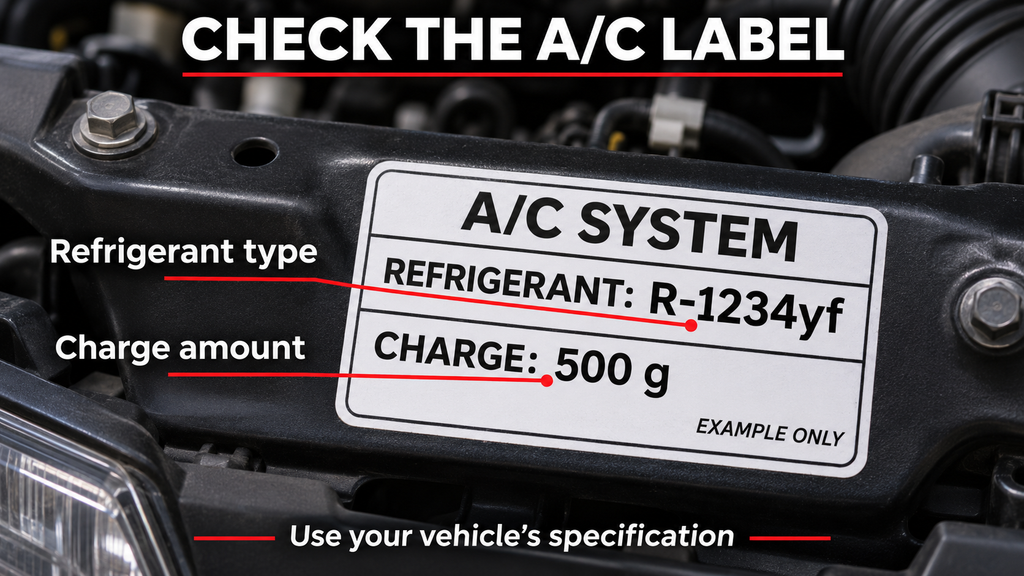
Important: R-134a and R-1234yf are not interchangeable. Never mix refrigerants or use adapters to force an incompatible connection.
Does Warm Air Mean Your Car Needs Refrigerant?
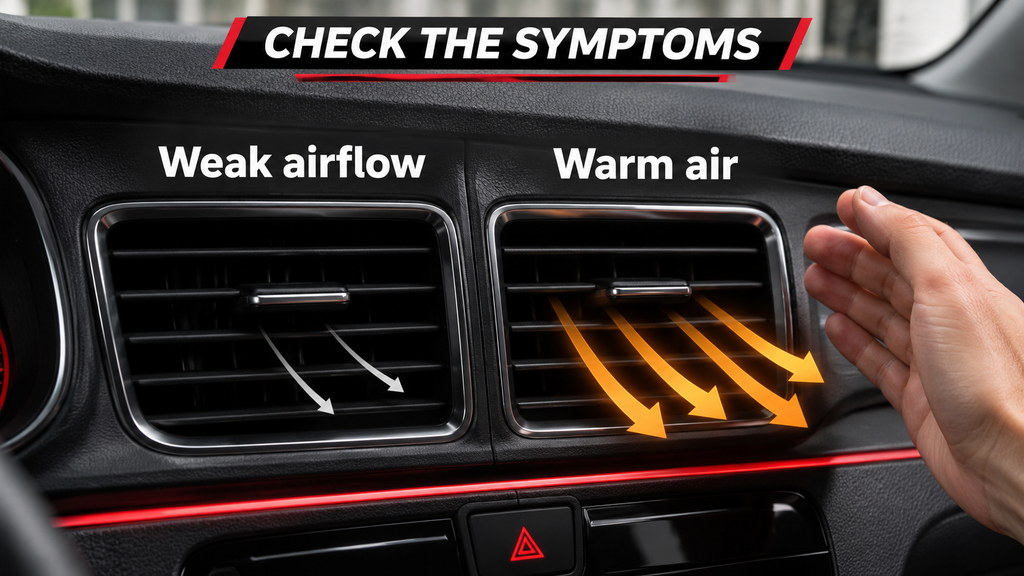
Not necessarily. Low refrigerant is one possible cause, but electrical faults, compressor problems, poor condenser airflow, and temperature-control faults can also affect cooling.
| What You Notice | Possible Explanation | Useful Next Step |
|---|---|---|
| Strong airflow that stays warm | Refrigerant, compressor, electrical, or temperature-control fault | Arrange cooling-system diagnosis. |
| Weak airflow at several fan settings | Restricted cabin filter, blower, or airflow-control issue | Check accessible items according to the manual. |
| Cooling improves while driving | Condenser airflow or another operating-condition fault | Tell the technician when cooling changes. |
| Cooling fades again after a recharge | An unresolved leak or another underlying fault | Request diagnosis before another top-up. |
Safe Checks Before Booking Service
- Confirm that A/C is selected and the temperature setting is correct.
- Note whether airflow changes normally with fan speed.
- Record whether the problem affects every vent or only one side.
- Check the cabin filter only if the manual describes an accessible procedure.
- Write down unusual noises and previous A/C repairs.
Keep hands away from belts and fans, and leave refrigerant connections closed. Our guide to car A/C not cooling explains the broader troubleshooting possibilities.
Why Does Car A/C Refrigerant Become Low?
Refrigerant circulates through a closed circuit; it is not normally consumed like fuel. A low charge warrants investigation for leakage or an incorrect previous charge.
Potential leak locations include seals, hose connections, service valves, the condenser, compressor, and evaporator. Some leaks are difficult to access and require specialized testing.
An oily mark may help a technician choose an inspection area, but it does not confirm a refrigerant leak by itself. Likewise, clear water dripping beneath a vehicle after A/C use can be normal condensation.
Recharge versus repair: Restoring refrigerant can improve cooling when the charge is low, but it does not permanently fix the opening through which refrigerant escaped.
What Should Professional A/C Service Include?
A useful service starts by confirming the complaint and checking the vehicle’s specifications. Depending on the symptoms, the technician may inspect airflow, control operation, system pressures, temperatures, and refrigerant condition.
If refrigerant work is needed, the procedure should use compatible equipment and follow the manufacturer’s instructions. This may involve recovery, leak diagnosis, repairs, evacuation, charging by the specified mass, and checking performance afterward.
A gauge reading alone does not establish exactly how much refrigerant is inside the system. The specified charge also varies by vehicle configuration, including some front-and-rear A/C systems.

Should You Use a DIY A/C Recharge Kit?
A recharge kit cannot diagnose every reason for warm air. Its gauge also cannot confirm the correct refrigerant quantity across every operating condition.
Guessing can introduce too much refrigerant, an incompatible product, or unwanted additives. These mistakes can reduce cooling and complicate subsequent service.
Choose professional diagnosis when the refrigerant type is uncertain, a previous recharge did not last, the system has been opened, or unusual noises accompany poor cooling. Avoid adding stop-leak products without manufacturer approval.
Refrigerant systems operate under pressure, and escaping refrigerant can cause injury. Do not open lines, bypass protective controls, or release refrigerant to check whether the system contains any.
What Affects the Cost of Car A/C Service?
A refrigerant recharge, a leak diagnosis, and a component replacement are different services. Comparing their prices as though they are the same job can be misleading.
The final bill depends on refrigerant type and quantity, local labor rates, testing, repair access, and the parts required. Request a vehicle-specific written estimate rather than relying on one universal price.
Questions to Ask the Repair Shop
- Which refrigerant and charge specification does my vehicle require?
- What testing supports the diagnosis?
- Was a leak located, and where is it?
- Does the estimate include diagnosis, repair, refrigerant, and final testing?
- What warranty applies to the work?
Frequently Asked Questions
How often should car A/C Freon be replaced?
Follow vehicle-specific maintenance guidance. Refrigerant is not normally replaced at a universal mileage interval; poor cooling or a low charge calls for diagnosis.
Can I mix R-134a and R-1234yf?
No. Use the refrigerant specified for the system. Mixing products can contaminate the circuit and create servicing problems.
Does weak airflow mean refrigerant is low?
Not by itself. Restricted airflow can involve the cabin filter, blower, or air-distribution system. Cooling performance and airflow need separate assessment.
Will a recharge repair a leak?
No. Adding refrigerant replaces lost charge but does not repair the leaking component or connection.
Should I keep using the A/C if it makes grinding noises?
Switch the A/C off and arrange inspection. If noise continues, warning lights appear, or the engine overheats, stop safely and seek assistance.
Choose Diagnosis Before a Recharge
Start by identifying the refrigerant specified for your vehicle and describing the symptoms accurately. Warm air, weak airflow, and cooling that changes with driving conditions can point toward different investigations.
The best next step is a confirmed diagnosis, the correct refrigerant, and a repair plan that addresses the cause of lost cooling.