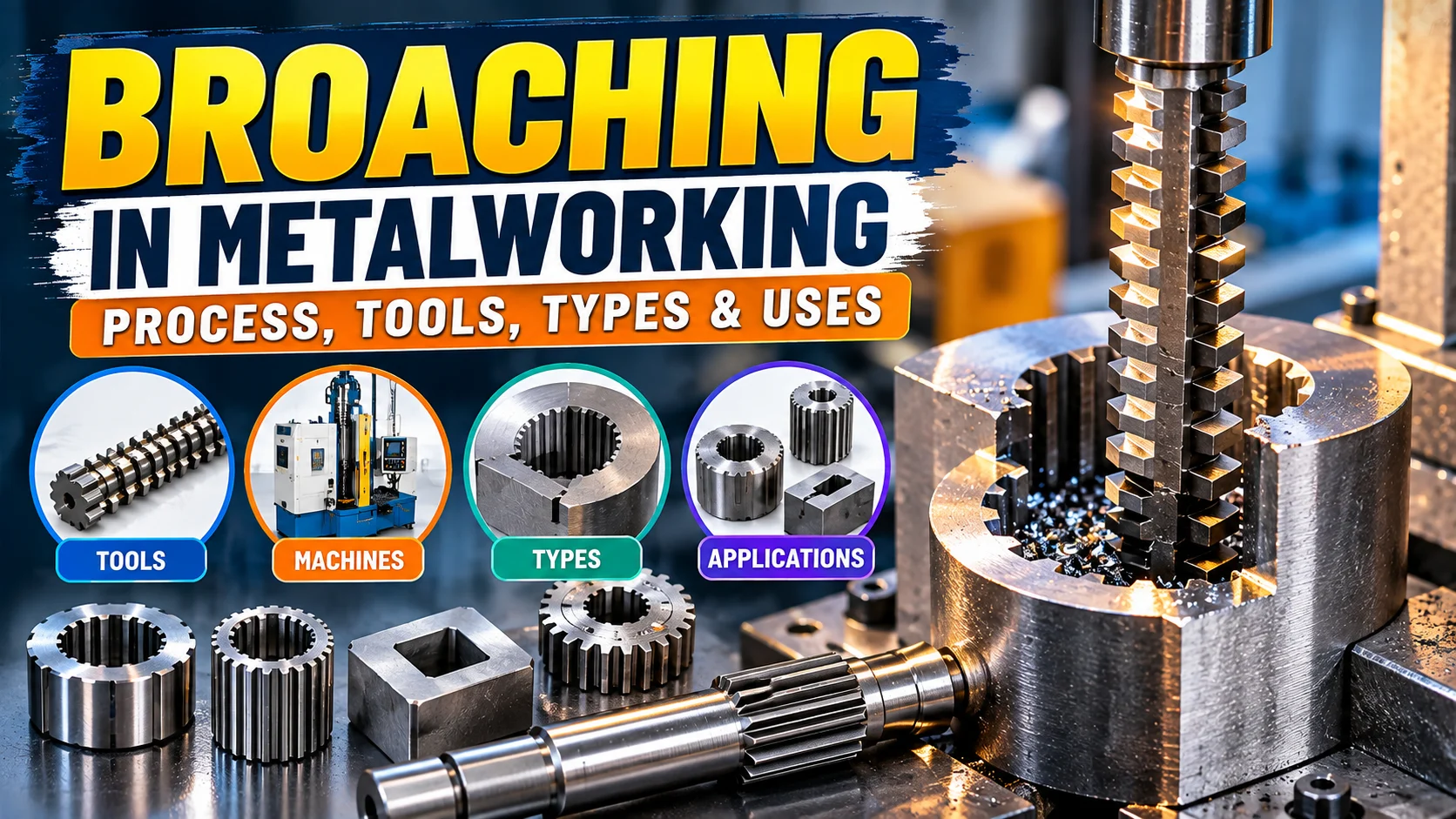

Broaching is a precision machining process used to produce accurate internal and external shapes by moving a multi-tooth cutting tool across or through a workpiece. In broach metalworking, each cutting tooth removes slightly more material than the tooth before it, allowing roughing, semi-finishing, and finishing to take place during a controlled stroke.
The process is widely used for manufacturing keyways, splines, shaped holes, flat surfaces, slots, and other repeatable profiles. This guide explains what broaching means, how the process works, the main types of broaches and machines, common applications, advantages, limitations, and important factors that affect machining quality.
What Is Broaching in Metalworking?
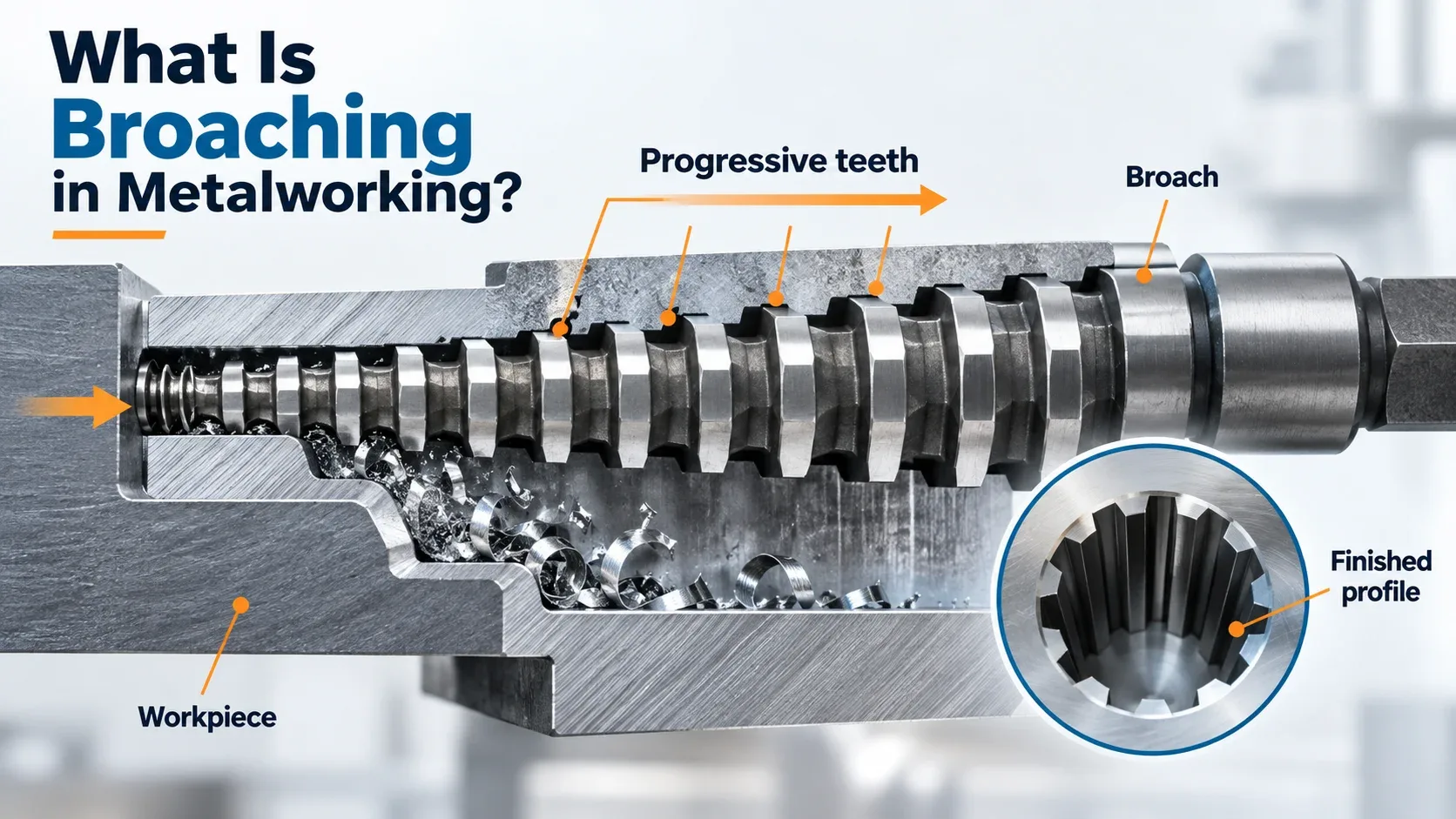
Broaching is a machining process in which a specially designed cutting tool moves relative to a workpiece to remove material progressively. Unlike a single-point cutting tool, a broach contains many cutting teeth arranged in sequence.
The earliest teeth generally perform rough cutting, the middle teeth refine the shape, and the final teeth bring the feature to its finished dimensions. Because several machining stages can be built into one tool, broaching metalworking can produce highly repeatable features efficiently when the part geometry and production volume are suitable.
A broach may be pushed, pulled, or rotated depending on the type of operation. Internal broaching works inside an existing hole or opening, while external broaching removes material from an exposed surface.
How Does the Broaching Process Work?
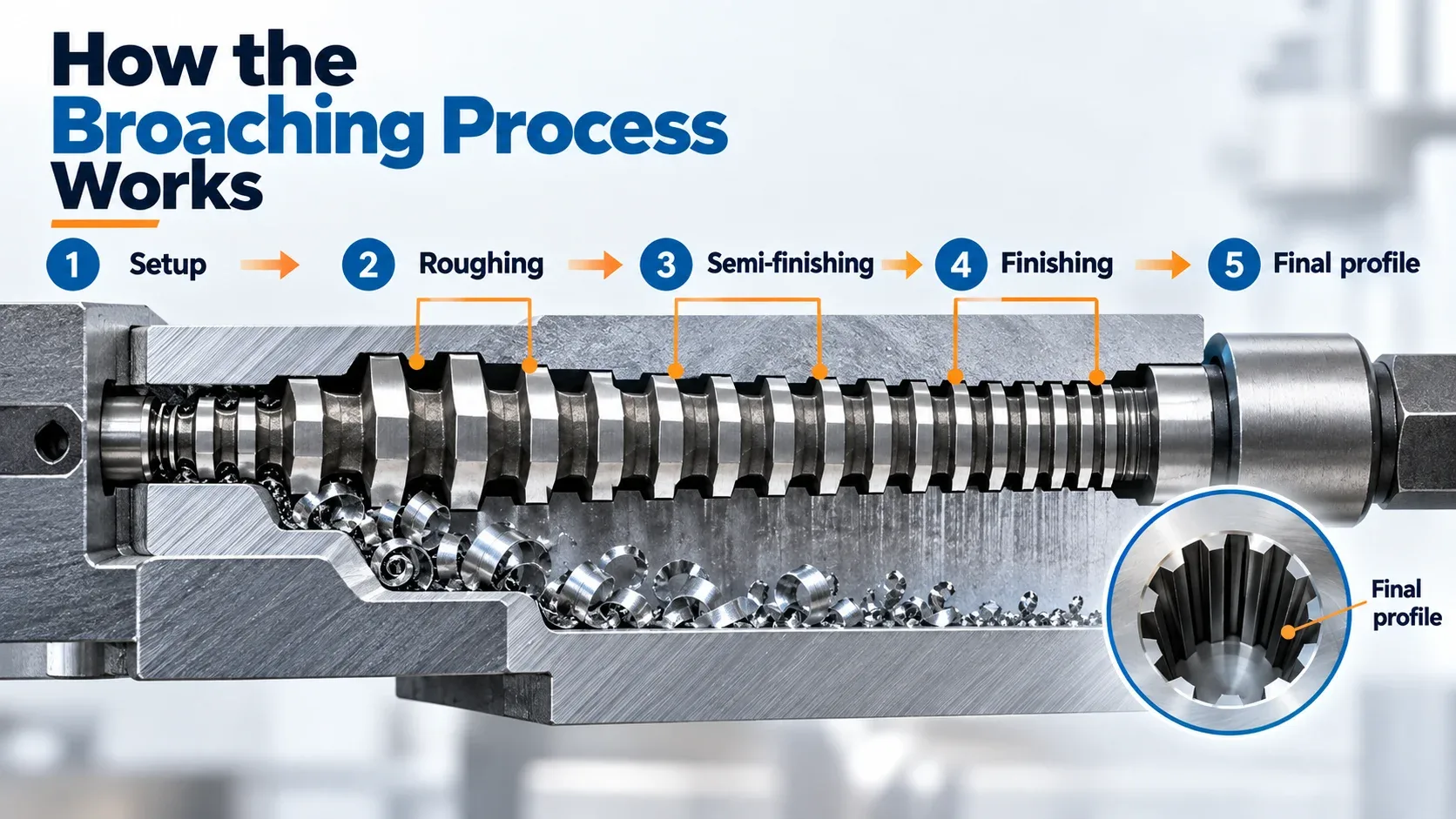
Broaching removes material gradually rather than attempting to cut the complete final shape at once. The exact setup depends on the machine, tool design, workpiece material, and feature being produced.
- Prepare the workpiece: The component is positioned so that the broach can enter the required cutting area.
- Secure and align the part: Proper alignment helps maintain dimensional consistency.
- Engage the broach: The first cutting teeth begin removing material.
- Rough the feature: Successive teeth progressively increase the cut.
- Semi-finish the profile: Intermediate teeth bring the geometry closer to final size.
- Finish the cut: Final teeth establish the required dimensions and surface condition.
- Inspect the part: The finished feature is checked for size, shape, and surface quality.
Main Parts of a Broach Tool
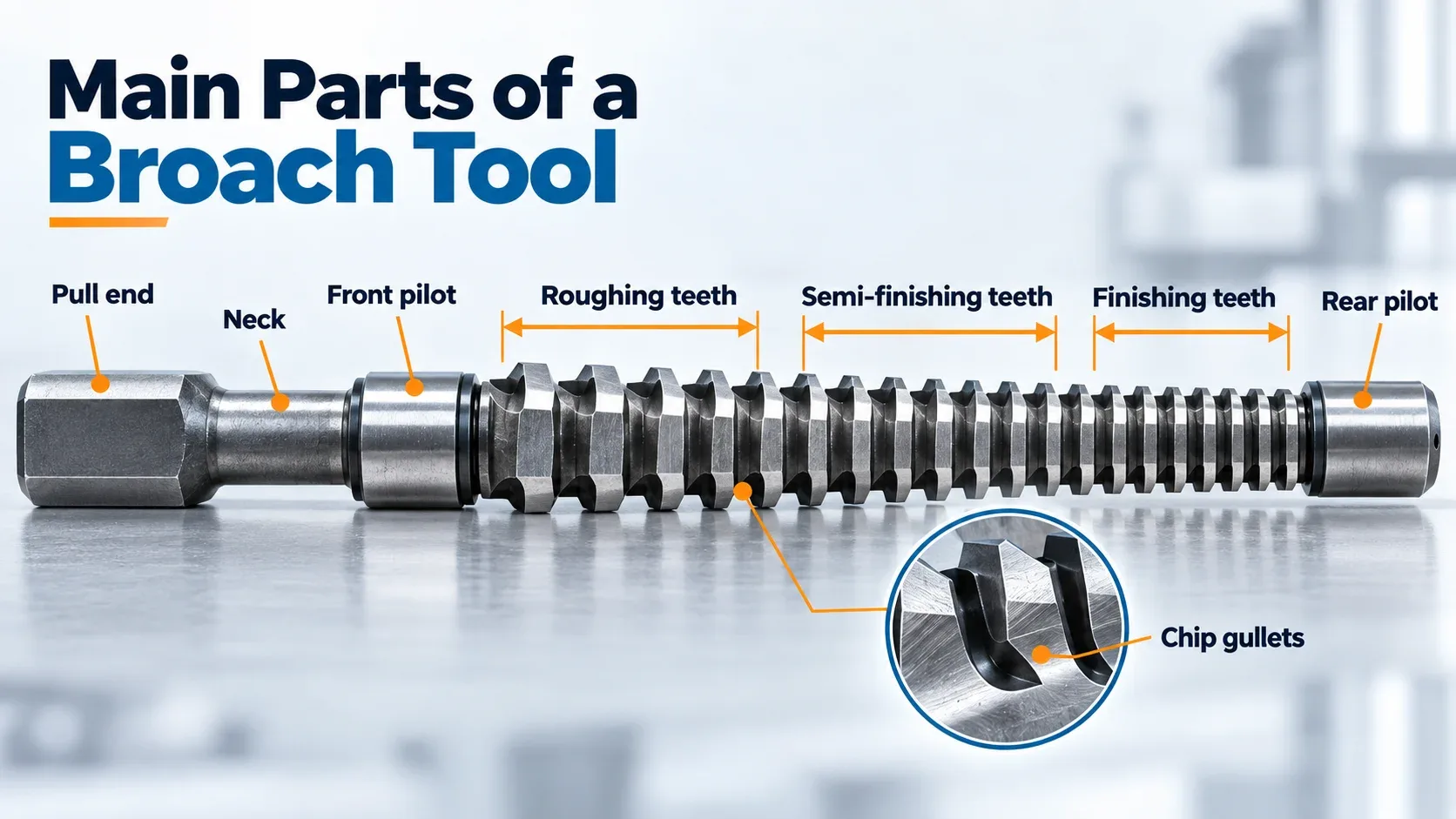
Pull End or Shank
Connects the broach to the pulling mechanism of the machine in pull-broaching applications.
Neck
Provides clearance and connects the pulling section with the main cutting portion.
Front Pilot
Guides and aligns the broach before the cutting teeth fully enter the workpiece.
Roughing Teeth
Remove most of the material as the tooth size progressively increases.
Semi-Finishing Teeth
Refine the profile and prepare it for the finishing section.
Finishing Teeth
Establish the final dimensions and help create the required surface finish.
Rear Pilot
Helps support alignment as the final teeth pass through the component.
Chip Gullets
Provide space between teeth for storing and controlling chips during cutting.
Types of Broaching in Metalworking
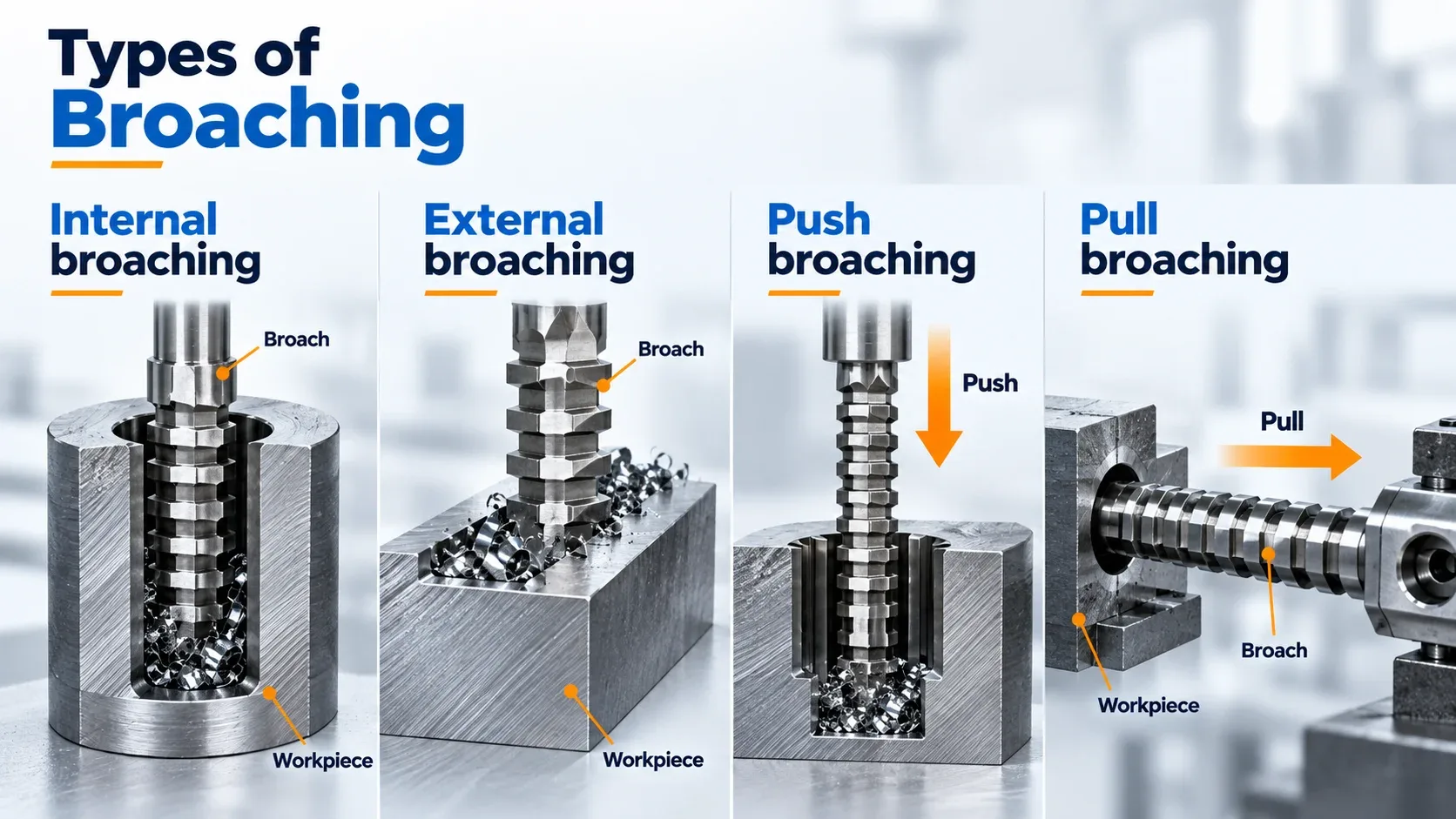
Internal Broaching
Internal broaching removes material from inside a hole or opening. A starting hole is normally required so the pilot and cutting section can enter the workpiece.
- Keyways
- Internal splines
- Internal gear profiles
- Square holes
- Hexagonal holes
- Special internal profiles
External or Surface Broaching
External broaching removes material from an exposed surface and can be used to create flats, grooves, slots, contours, and other external forms.
Push Broaching
In push broaching, the tool is pushed through or across the workpiece. Push broaches are generally shorter because long tools can be more susceptible to buckling under compressive forces.
Pull Broaching
Pull broaching draws the cutting tool through the workpiece under tensile load. This method is well suited to longer broaches and is widely used in production applications.
Continuous Broaching
In continuous broaching, workpieces move continuously past stationary or controlled cutting tools. The method is generally associated with repetitive production.
Rotary Broaching
Rotary broaching is a specialized process used to create polygonal forms such as square and hexagonal holes. The broach is held at a slight angle while controlled rotational movement generates the required profile.
Common Types of Broach Tools
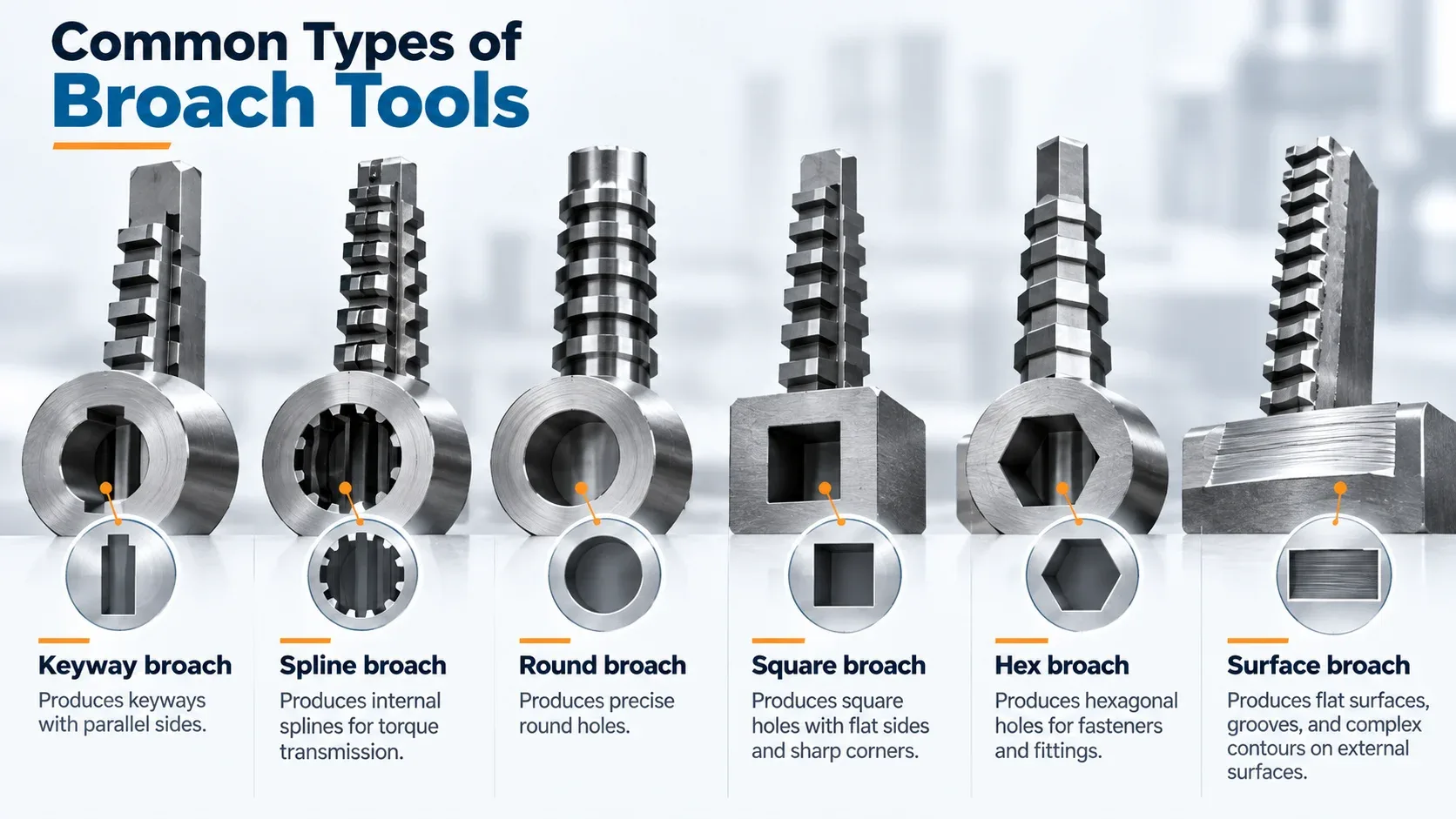
- Keyway broaches: Create key slots in gears, pulleys, hubs, and similar components.
- Spline broaches: Produce internal spline profiles.
- Round broaches: Size or finish circular openings.
- Square broaches: Produce square internal profiles.
- Hex broaches: Create hexagonal openings.
- Surface broaches: Machine exposed surfaces, grooves, and contours.
- Pot broaches: Machine external profiles using cutting teeth arranged within a cylindrical tool body.
- Form broaches: Produce specialized shapes designed for a specific component.
What Is a Broaching Machine?
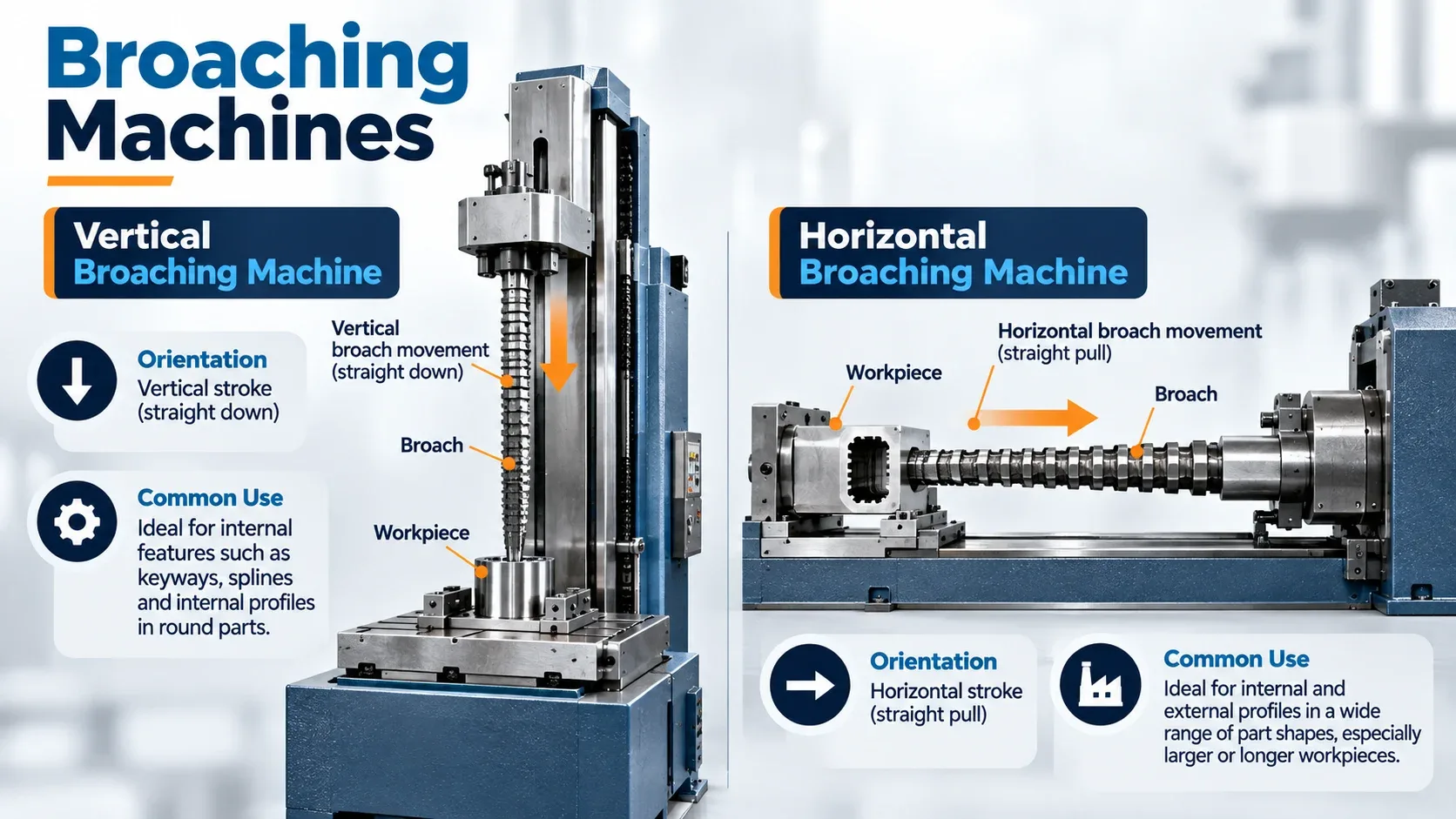
A broaching machine provides the controlled force, stroke, alignment, and speed needed to move the broach relative to the workpiece.
Vertical Broaching Machines
Vertical machines move the broach along a vertical axis. They are used for internal and external applications depending on machine configuration.
Horizontal Broaching Machines
Horizontal machines move the broach along a horizontal path and are commonly suited to long pull-type broaches.
Hydraulic Broaching Machines
Hydraulic broaching machines provide smooth and controlled cutting force and are commonly used for both pushing and pulling operations.
Automated Broaching Systems
Automated and servo-controlled broaching systems can integrate part handling, cutting, and process monitoring into production lines.
What Materials Can Be Broached?
Many machinable metals can be processed with broaching when suitable tooling, cutting conditions, and lubrication are used.
- Carbon steel
- Alloy steel
- Stainless steel
- Cast iron
- Aluminum alloys
- Brass
- Bronze
- Selected nickel-based alloys
Material hardness, chip formation, work-hardening characteristics, tool material, cutting fluid, and machine rigidity all influence broaching performance.
What Is Broaching Used For?
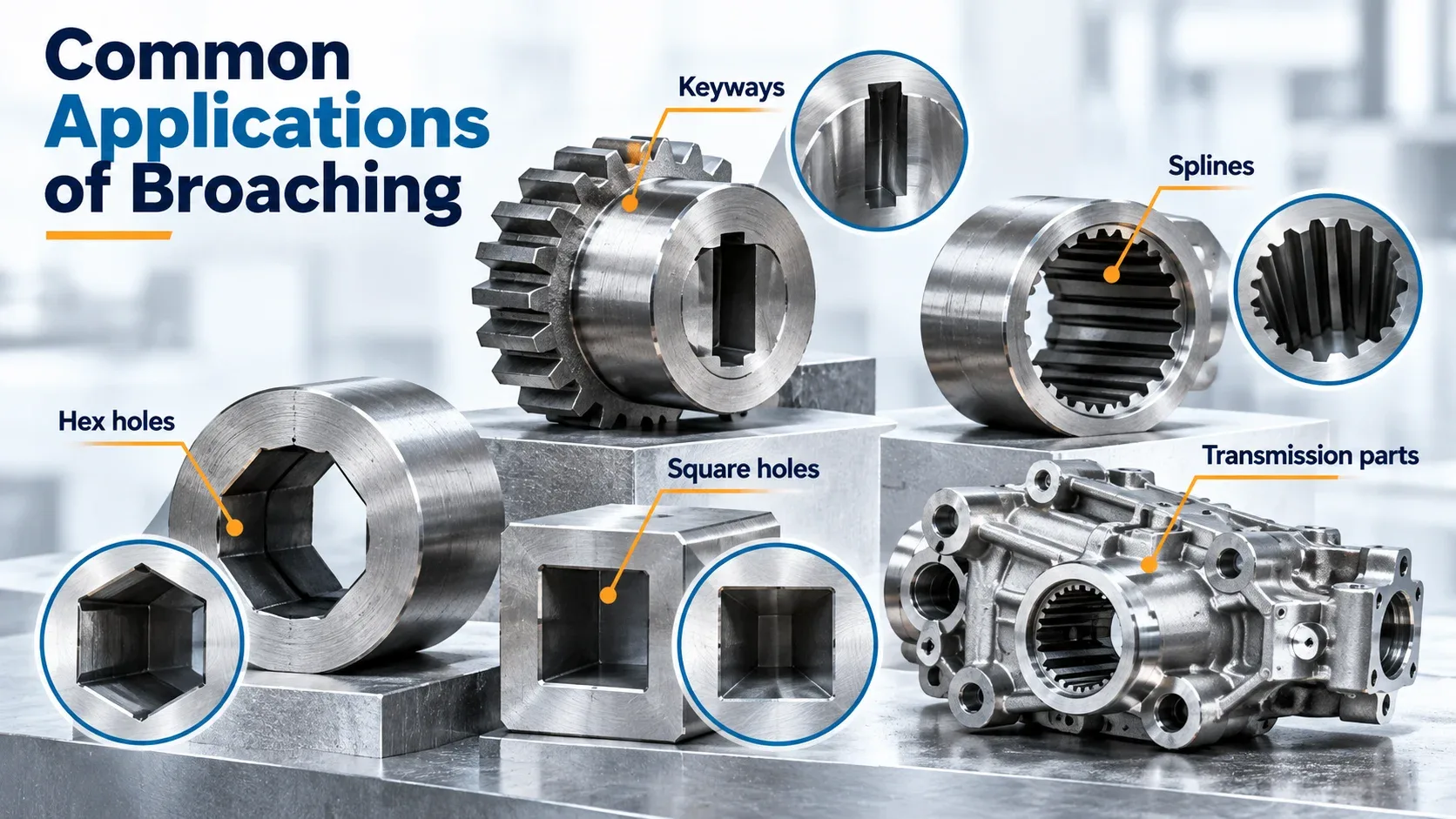
Broaching is commonly selected when accurately shaped features need to be produced repeatedly.
- Keyways in gears, pulleys, and hubs
- Internal splines
- Transmission components
- Connecting-rod features
- Internal gear profiles
- Square and hexagonal holes
- Turbine components
- Aerospace components
- Slots and grooves
- Flat external surfaces
- Special manufacturing profiles
Internal vs External Broaching
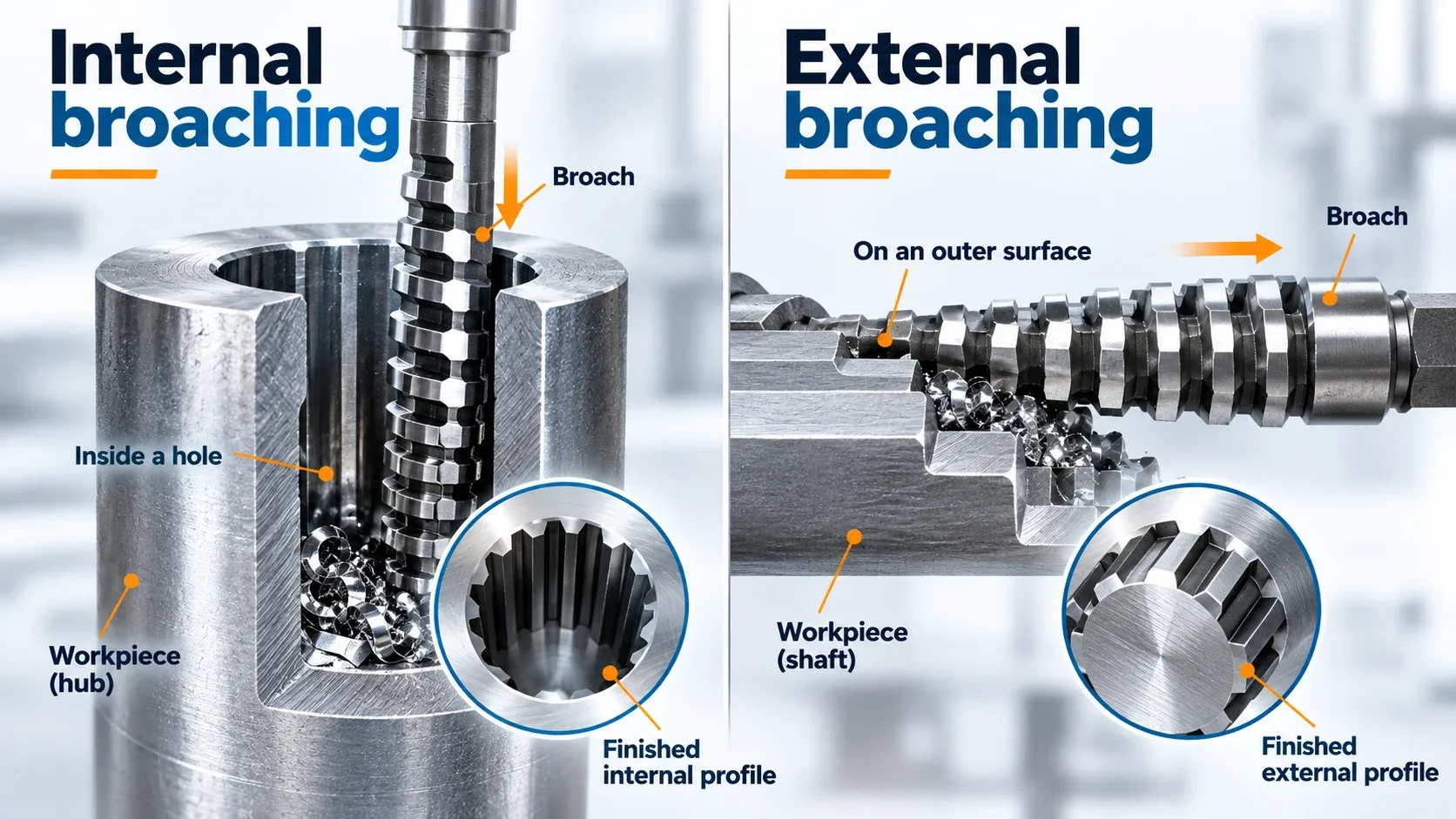
| Feature | Internal Broaching | External Broaching |
|---|---|---|
| Cutting location | Inside a hole or opening | On an exposed surface |
| Common features | Keyways, splines, shaped holes | Flats, slots, grooves, contours |
| Starting requirement | Usually requires an opening | Works on an exposed surface |
| Typical components | Hubs, gears, bushings | Machine parts and external profiles |
Push Broaching vs Pull Broaching
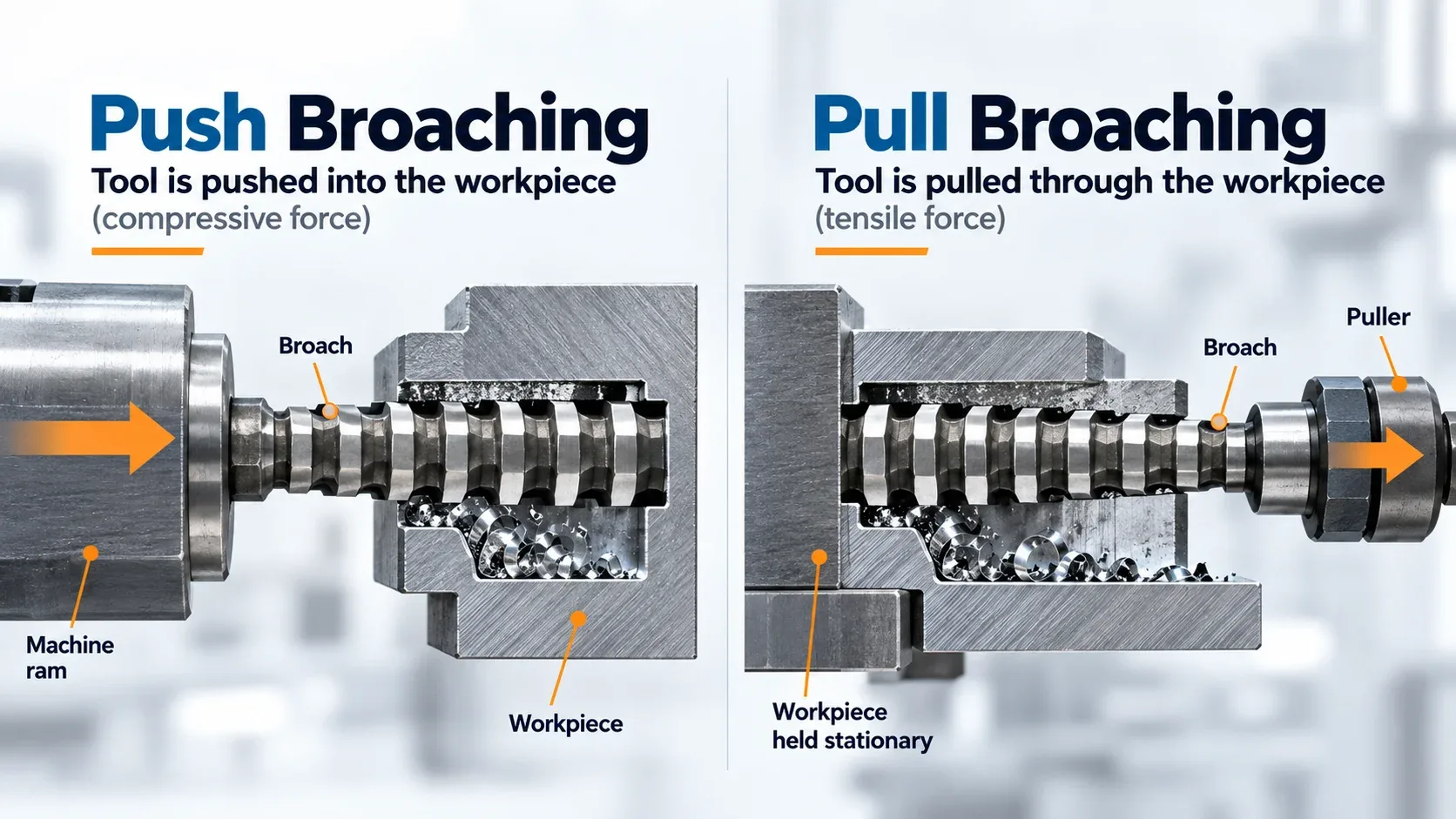
| Factor | Push Broaching | Pull Broaching |
|---|---|---|
| Tool loading | Compression | Tension |
| Tool length | Usually shorter | Can be longer |
| Buckling concern | Higher with long tools | Lower |
| Common use | Short internal cuts | Production internal broaching |
Advantages of Broaching
- High repeatability
- Complex profiles can be produced efficiently
- Good surface finish
- Consistent dimensional results
- Short cycle times in suitable applications
- Roughing and finishing can be incorporated into one tool
Disadvantages and Limitations of Broaching
- High initial tooling cost
- Broaches may be designed for a specific profile
- Specialized machinery may be required
- Tool sharpening and maintenance are important
- May be less economical for low-volume production
- Part geometry may restrict tool access
- Design changes may require new tooling
Broaching vs Milling, Shaping and Slotting
| Process | Tool Type | Typical Strength | Flexibility |
|---|---|---|---|
| Broaching | Progressive multi-tooth tool | Repeatable profiles | Lower with dedicated tooling |
| Milling | Rotating multi-edge cutter | Wide range of geometries | High |
| Shaping | Reciprocating single-point tool | Flat surfaces and simple profiles | Moderate |
| Slotting | Vertically reciprocating tool | Slots and internal features | Moderate |
The best machining process depends on the component geometry, production quantity, material, required tolerances, tooling investment, and available equipment.
What Are Broaching Tools Made From?
Broaching tools must maintain their cutting geometry under repeated loads. Common broach materials include high-speed steel, powder metallurgy high-speed steel, carbide in selected applications, and coated cutting tools.
The appropriate material depends on the workpiece, cutting speed, machine rigidity, tool life requirements, and production volume.
Why Lubrication Matters in Broaching
Cutting fluids can help improve the broaching process by reducing friction and controlling heat.
- Reduce friction
- Control cutting temperature
- Improve surface finish
- Assist chip evacuation
- Reduce cutting-edge wear
- Extend tool life
The correct cutting fluid depends on the workpiece material, broach design, machine, and process requirements.
How Accurate Is Broaching?
Broaching can produce consistent dimensions and controlled profiles when the machine, tool, fixture, and process conditions are properly maintained.
- Broach condition
- Machine alignment
- Fixture rigidity
- Workpiece material
- Lubrication
- Chip evacuation
- Tool wear
- Cutting parameters
Actual tolerance and surface-finish capabilities vary according to the tool design, machine, material, component geometry, and production requirements.
Common Broaching Problems and Their Causes
| Problem | Possible Causes |
|---|---|
| Poor surface finish | Worn teeth, inadequate lubrication, or chip damage |
| Incorrect dimensions | Tool wear, alignment problems, or damaged teeth |
| Chatter marks | Poor rigidity, unstable setup, or inadequate support |
| Broken teeth | Excessive cutting load, hard spots, or misalignment |
| Chip packing | Insufficient chip space or poor chip evacuation |
| Uneven cutting | Misalignment or damaged tooling |
When Is Broaching the Right Machining Process?
Broaching is often a suitable choice when the same accurately defined feature needs to be manufactured repeatedly.
- High repeatability is required.
- The same geometry is produced repeatedly.
- The component provides suitable tool access.
- Complex internal profiles must be produced efficiently.
- Production quantity can justify specialized tooling.
- Reducing machining cycle time is important.
Milling, shaping, slotting, EDM, or other machining methods may be more suitable when quantities are low or the design changes frequently.
Example: How a Keyway Is Broached
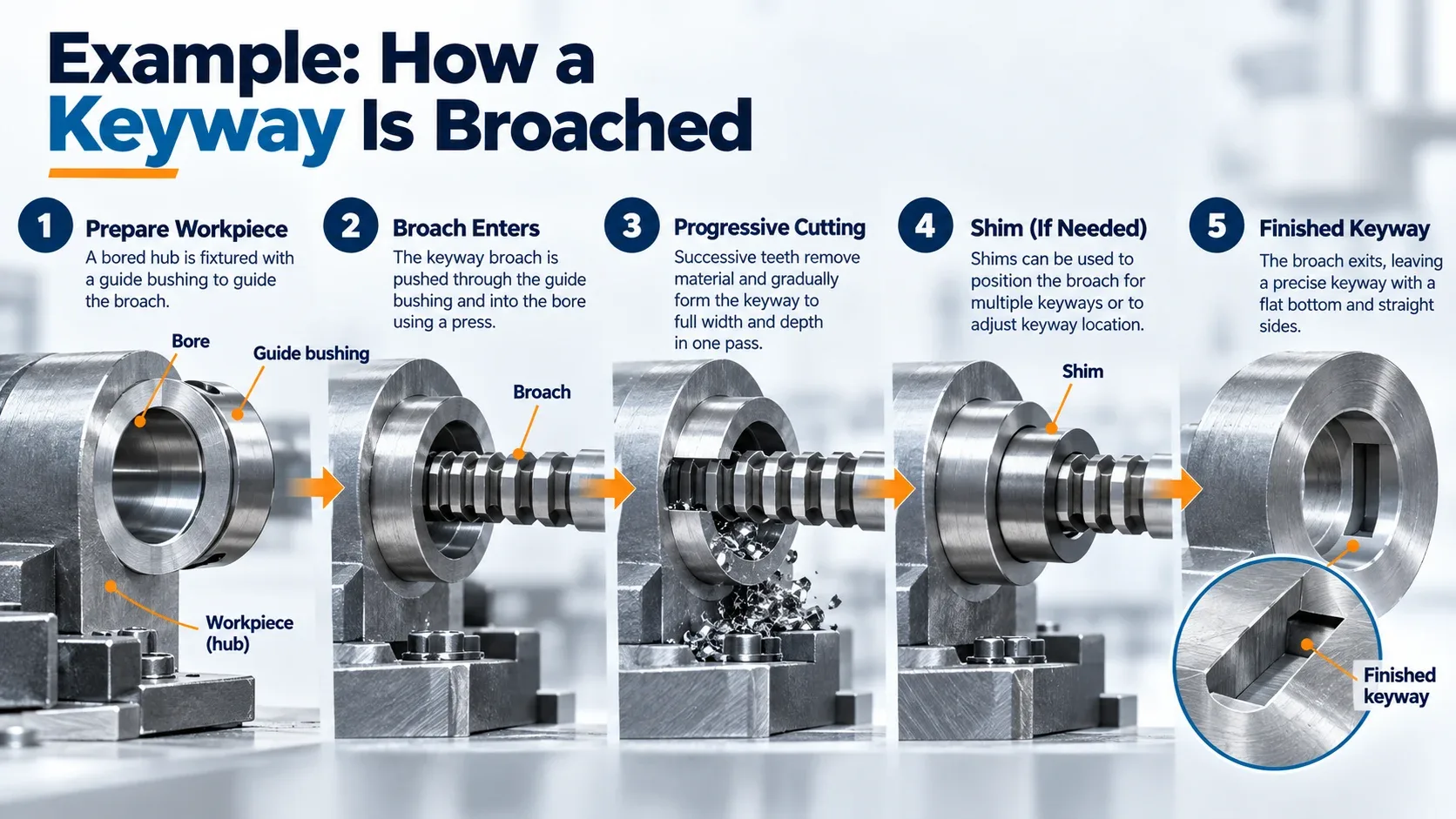
A keyway is a simple example for understanding broach metalworking. The operation creates a slot inside a gear, pulley, or hub so that a key can connect the component to a shaft.
- A suitable bore is created in the workpiece.
- A broach guide or bushing is inserted.
- The keyway broach is positioned in the guide.
- The broach moves through the component.
- Progressively larger cutting teeth remove material.
- Shims may be used with some keyway systems for additional passes.
- The completed keyway is inspected.
Frequently Asked Questions About Broach Metalworking
What does broaching mean in metalworking?
Broaching means removing material using a multi-tooth cutting tool in which successive teeth progressively increase the cut until the required profile is created.
What is a broach tool?
A broach is a cutting tool containing multiple progressively arranged cutting teeth. Different sections may perform roughing, semi-finishing, and finishing.
What is broaching used for?
Broaching is commonly used for keyways, splines, slots, shaped holes, internal gear forms, flat surfaces, and specialized profiles.
What is the difference between broaching and milling?
Broaching uses a progressive multi-tooth tool that normally produces a defined feature during a controlled stroke. Milling uses a rotating cutter and generally offers more flexibility for different geometries.
What is internal broaching?
Internal broaching removes material inside a hole or opening to produce keyways, splines, shaped holes, and other internal profiles.
What is external broaching?
External broaching machines exposed surfaces to create flats, slots, grooves, and contours.
What is a keyway broach?
A keyway broach is designed to create an internal key slot in components such as hubs, gears, and pulleys.
Is broaching suitable for mass production?
Broaching is frequently used in medium- and high-volume manufacturing when the same feature is produced repeatedly and the tooling investment can be justified.
What materials can be broached?
Common materials include carbon steel, alloy steel, stainless steel, cast iron, aluminum, brass, bronze, and selected nickel-based alloys.
Why does a broach have progressively larger teeth?
The progressive tooth design distributes material removal across several cutting edges. Each tooth removes a controlled additional amount until the final shape is achieved.
Final Thoughts on Broaching in Metalworking
Broach metalworking uses a specialized multi-tooth cutting tool to progressively remove material and create accurate internal or external features. Roughing, semi-finishing, and finishing sections can be incorporated into the same tool, making broaching particularly effective for repeat production of keyways, splines, shaped holes, grooves, and defined profiles.
Broaching can provide excellent repeatability and efficient machining cycles, but manufacturers must consider tooling cost, machine capability, material, lubrication, chip control, and production volume before selecting the process.