A car that cranks slowly, struggles to start, or shows a battery warning light can leave you wondering whether the battery is getting enough power. One of the simplest checks is measuring voltage. But exactly how many volts is a car battery, and which readings are normal?
Quick answer: Most conventional gasoline and diesel passenger vehicles use a 12-volt car battery. A fully charged, rested conventional lead-acid battery typically measures 12.6–12.8 volts. When the engine is running, many traditional charging systems operate around 13.5–14.5 volts.
These are useful reference values, not universal pass-or-fail rules. Temperature, battery chemistry, charging strategy, and electrical loads affect actual readings.
Knowing what the readings mean helps you avoid replacing a good battery unnecessarily—or overlooking a failing battery simply because it shows approximately 12 volts.
Why Is a Car Battery Called 12 Volts?
A conventional automotive lead-acid battery contains six electrochemical cells connected in series. Each cell has a nominal voltage of approximately 2 volts, producing the familiar 12-volt rating. Nominal voltage is a classification, not the exact voltage at every moment.

A fully charged lead-acid cell commonly measures a little over 2.1 volts at rest, explaining why the complete battery can show around 12.6 to 12.8 volts. The battery supplies starting current, powers equipment when needed, and helps stabilize the vehicle’s low-voltage system.
Once the engine starts, the alternator normally supplies electricity to vehicle systems and recharges the battery.
Voltage is not capacity: Voltage describes electrical potential; amp-hours relate to charge capacity, and cold cranking amps (CCA) describe starting-current performance under specified conditions.
Car Battery Voltage Chart: What Is Normal?
The following chart is a useful starting point for estimating the charge level of a conventional 12V lead-acid battery measured after resting with the engine off.

| Resting voltage | Approximate charge level | Interpretation |
|---|---|---|
| 12.6–12.8V | Near 100% | Fully or nearly fully charged |
| 12.4V | About 75% | Partially discharged |
| 12.2V | About 50% | Recharge recommended |
| 12.0V | About 25% | Significantly discharged |
| 11.9V or less | Very low | Charge and investigate further |
These are approximate readings near room temperature. Different battery chemistries, temperatures and manufacturers may require different reference values.
A reading of 12.2V does not automatically prove that the battery is defective; it may simply be undercharged. Conversely, a battery reading 12.7V could still fail under a heavy starting load. Voltage alone cannot establish battery health.
How Many Volts Should a Car Battery Have When the Engine Is Off?
When a conventional 12V lead-acid battery has rested after charging or driving, a fully charged example will generally read around 12.6 to 12.8 volts. A resting measurement is more useful for estimating charge level than an immediate post-drive reading.

Why Does Voltage Change After Driving?
Surface charge can temporarily raise the voltage immediately after driving or charging. Turn off the engine and accessories, then allow the battery to rest according to the manufacturer’s guidance before taking a charge-level reading.
Ambient temperature and electrical loads also affect measurements. Cold conditions can reduce starting performance even when resting voltage appears reasonable.
How Many Volts Should a Car Battery Have When the Engine Is Running?
When the engine runs, the alternator and its voltage-control system help power electrical equipment and charge the battery. Many conventional charging systems produce approximately 13.5–14.5V at the battery terminals during charging.

Can Modern Cars Show Different Charging Voltages?
Yes. Computer-controlled alternators and smart-charging systems may deliberately vary output in response to battery charge, temperature, electrical demand and operating conditions. A lower or higher reading is not necessarily proof of a fault without the vehicle’s specifications.
Charging warning: If the battery warning indicator stays illuminated while driving, electrical systems malfunction, or the battery repeatedly loses charge, arrange an appropriate charging-system diagnosis.
How to Test Car Battery Voltage With a Multimeter
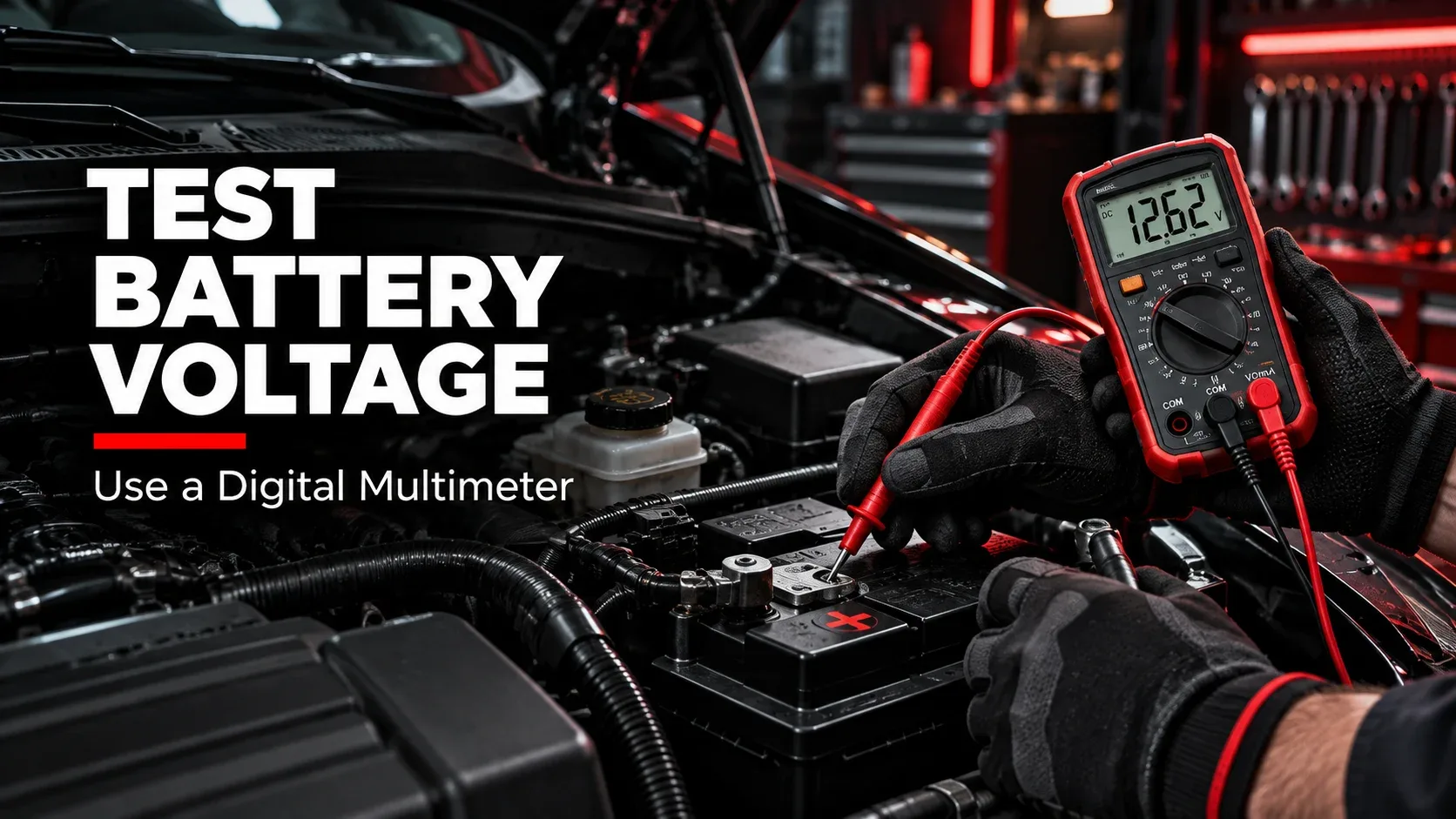
A digital multimeter measures the electrical potential between the battery’s positive and negative terminals. It is useful for a basic voltage check, but it does not replace a proper battery health or load test.
What You’ll Need
- A functional digital multimeter and test leads
- Access to approved battery test points
- Suitable eye protection
- A safely parked vehicle and its owner’s manual
Safety: Never connect a multimeter in current (amps) mode directly across battery terminals. Avoid sparks and flames, remove loose jewelry, and do not test a leaking, swollen or damaged battery. Keep leads and hands away from moving engine parts.
Switch Off the Engine and Accessories
Park safely, turn off electrical accessories, and let the battery rest before assessing charge level.
Set the Multimeter to DC Volts
Select DC voltage, commonly marked with a V and straight-line symbol. On manual-range meters, choose a suitable setting above 12V, such as 20V. Check that the leads are in COM and the voltage socket.
Connect the Probes Correctly
Place the red probe on the positive (+) terminal and the black probe on the negative (−) terminal, or the vehicle’s recommended test points. Never bridge the terminals with a probe or tool.
Read and Record the Voltage
Compare the measurement with the reference chart, taking battery type, temperature and recent charging into account.
Check Charging Voltage If Appropriate
Follow vehicle-specific directions for measuring voltage with the engine running. Do not approach belts, pulleys or fans if you cannot do so safely.
Diagnostic tip: A battery that repeatedly discharges or struggles to start the car despite a reasonable resting voltage may need a professional conductance or load test.
Signs of Low Car Battery Voltage
Low battery charge may contribute to starting and electrical problems, although similar symptoms can come from faulty connections, a starter fault or charging-system trouble.

1. Slow Engine Cranking
The starter may turn the engine more slowly than usual when the battery cannot deliver sufficient current. Cold weather can make this especially noticeable.
2. Clicking During Starting
Repeated clicking may occur when the starting circuit cannot sustain enough voltage under load. Poor cable connections can cause similar symptoms.
3. Dim or Flickering Lights
Unusual dimming during starting may indicate a large voltage drop, but mild temporary dimming can be normal.
4. Illuminated Battery Warning Light
The dashboard battery symbol often indicates a charging-system fault, not simply a low state of charge. Persistent illumination while driving should be addressed promptly.
5. Frequent Jump-Starts
Repeated jump-starts may indicate battery deterioration, insufficient charging or an abnormal electrical drain while parked.
Battery vs. Alternator: What Causes Voltage Problems?
The battery stores energy and supplies starting current. The alternator generates electrical power while the engine operates and helps replenish the battery.

| Component | Main role | Potential issue |
|---|---|---|
| Battery | Stores energy and powers starting | Discharge, weak current delivery, aging |
| Alternator | Generates power during engine operation | Insufficient or abnormal charging |
| Cables | Carry current between components | Corrosion, high resistance, looseness |
| Electrical loads | Use battery and charging-system power | Excessive current draw while parked |
How Can You Tell Which One Is Faulty?
A battery that is weak before starting but receives normal charging voltage afterward might need a battery health test or a review of its recent charging history. If the battery does not recharge as specified, the alternator, wiring and control system require investigation. A single voltage reading is not a definitive diagnosis.
Never disconnect a battery terminal while the engine is running to test the alternator. This outdated technique can cause voltage disturbances and damage electronics.
What to Do When Your Car Battery Voltage Is Too Low
Low voltage does not always mean the battery needs immediate replacement. Start by determining whether it is simply discharged or has an underlying fault.

Step 1: Inspect the Battery and Connections
Look for obvious damage, corrosion or looseness. Do not handle leaking or visibly damaged batteries yourself.
Step 2: Recharge With a Compatible Charger
Use equipment and charge settings suitable for the battery’s chemistry. Follow manufacturer charging and safety instructions.
Step 3: Let the Battery Rest and Retest
After charging, allow the battery to settle before repeating the resting-voltage measurement.
Step 4: Get a Battery Health Test
If symptoms continue, a conductance or load test can reveal starting-current problems that a voltage reading may miss.
Step 5: Inspect the Charging System
Persistent discharge can result from charging faults or excessive electrical draw while the car is parked.
- Inspect for damage and poor connections.
- Measure rested, engine-off voltage.
- Recharge with appropriate equipment.
- Retest after the battery has settled.
- Arrange health and charging-system checks if problems persist.
Do All Cars Use the Same Battery Voltage?
Most conventional passenger vehicles are described as having 12V electrical systems, but battery technology and vehicle architecture vary.

Conventional Flooded Lead-Acid Batteries
Widely used starter batteries with a nominal 12V rating. Rested, fully charged voltage is typically around 12.6V or a little higher.
AGM Batteries
Absorbent Glass Mat batteries are also nominally 12V, but their operating and charging requirements can differ from flooded batteries.
Start-Stop Vehicles
Vehicles with frequent automatic engine restarts may use AGM or Enhanced Flooded Batteries (EFB) and may require battery management or registration procedures during replacement.
Hybrid and Electric Vehicles
Many hybrids and EVs have a separate low-voltage system in addition to a much higher-voltage traction battery. Some modern vehicles use alternative auxiliary battery chemistries and voltages.
High-voltage caution: Never attempt to inspect or measure a hybrid or EV traction battery using ordinary 12V battery methods. These systems require specialized training and equipment.
Classic Cars and 48V Systems
Some classic vehicles use 6V systems, while certain mild-hybrid models incorporate 48V technology. Always identify the system before interpreting measurements.
When Should You Replace a Car Battery?
Battery life varies with temperature, driving habits, charge cycles and chemistry. Many conventional starter batteries last roughly three to five years, but age alone is not a sufficient replacement test.

Consider Replacement When:
- It fails an appropriate professional battery health or load test.
- Starting remains unreliable after suitable charging and connection checks.
- It repeatedly loses charge because of internal deterioration.
- It has significant physical damage requiring safe replacement.
- A qualified technician confirms it no longer meets vehicle specifications.
Choose a replacement with the manufacturer-specified group size, chemistry, terminal configuration and starting-current rating. Some vehicles also require battery registration.
Frequently Asked Questions About Car Battery Voltage
Is a car battery 12 volts or 12.6 volts?
It is nominally a 12V battery. A fully charged, rested conventional lead-acid battery often measures around 12.6–12.8V.
Is 12.2 volts a bad car battery?
Not necessarily. A rested 12.2V reading often suggests partial discharge; charge and test it before assuming failure.
Is 12.4 volts enough to start a car?
It may be, but starting depends on battery health, available current, temperature and cable condition—not resting voltage alone.
Is 14.7 volts too high for a car battery?
Not always. Charging voltage varies with temperature, chemistry and vehicle design. Check the manufacturer’s specified limits.
How many volts does a car battery need to start?
No universal resting-voltage threshold guarantees a start. Adequate current and voltage under load both matter.
Can a battery show 12 volts and still be bad?
Yes. It may show voltage but be unable to deliver sufficient current to crank the engine. A health or load test helps confirm.
Does the alternator charge the battery while idling?
Generally yes, although charging output depends on alternator design, electrical demand and control strategy.
Do electric cars have 12-volt batteries?
Many have separate low-voltage electrical systems, but the chemistry and nominal voltage depend on the model.
Final Thoughts: Understanding Your Car Battery Voltage
Most conventional cars use a 12V battery, but a fully charged rested lead-acid starter battery usually reads closer to 12.6–12.8V. Many traditional charging systems produce approximately 13.5–14.5V when active.
Voltage is only one part of diagnosis. Battery health, available starting current, charging-system function and vehicle-specific specifications all matter. If low voltage or starting trouble continues after proper charging, professional testing can help determine the real cause.