Learn how a cam and follower converts rotary motion into controlled movement, why its motion cycle matters, and how engineers select the right cam profile and follower arrangement.
A cam and follower mechanism converts the shaped rotation or movement of a cam into a controlled reciprocating or oscillating motion of a follower. As the cam moves, the follower tracks its profile.
What is a cam and follower mechanism?
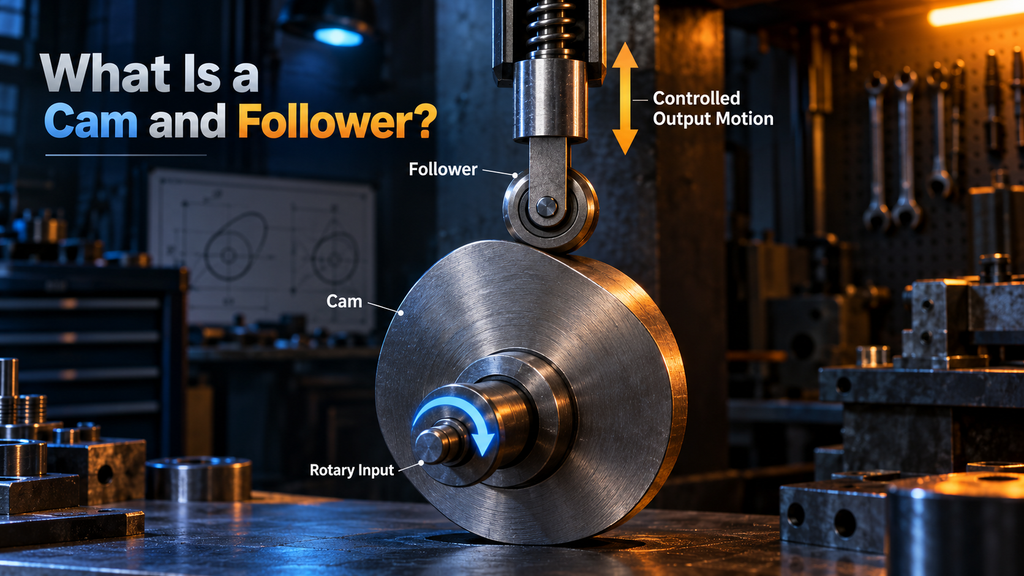
A cam is a specially shaped machine element that drives another element, called the follower, through direct contact. In most common arrangements, the cam rotates about a shaft while the follower moves in a straight line or pivots about a fixed point.
A cam with follower is used when a machine needs a prescribed sequence of movement rather than simple continuous rotation. The profile of the cam determines how far, how fast, and when the follower rises, holds position, or returns.
The main parts of a cam and follower
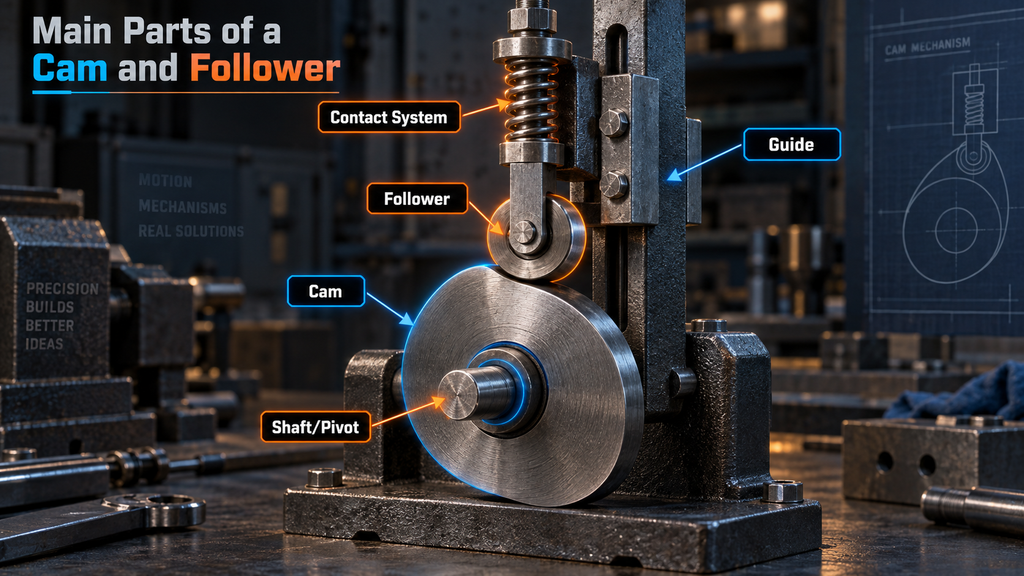
The exact assembly changes between machines, but most cam mechanisms include a cam, follower, support or guide, and a method of keeping the contact surfaces engaged.
The cam profile
The cam is the driving member. Its outer contour, groove, or track is designed to produce a planned follower displacement. The physical profile is created from a desired displacement diagram and must account for follower geometry.
The follower
The follower is the driven member that remains in contact with the cam. It may translate in a guide or oscillate about a pivot. Roller, flat-faced, knife-edge, and spherical followers use different contact geometries.
Contact and constraint system
Many mechanisms are force-closed, using a spring or gravity to maintain contact. Others use positive mechanical constraint, such as a grooved or conjugate arrangement. Not every cam system relies on a spring.
How does a cam and follower work?
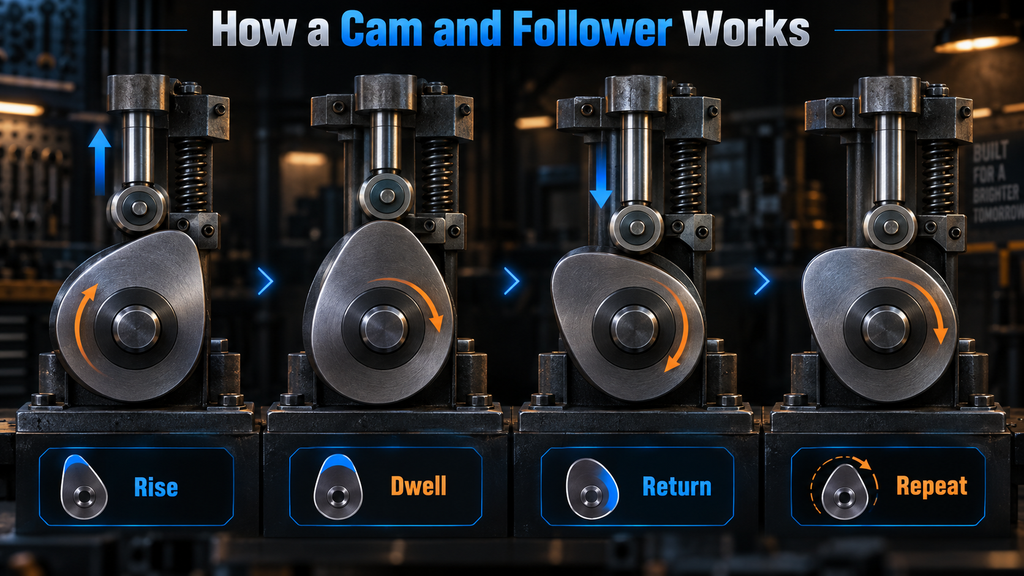
The working principle is easiest to understand as one repeating cycle. A rotating cam presents changing radii or a shaped track to the follower, causing the follower to move according to the profile.
- During rise, the increasing portion of the cam profile lifts or swings the follower through a defined stroke.
- During dwell, the cam may continue rotating while the follower remains at the same displacement.
- During return, the profile allows the follower to move back to its starting position in a controlled way.
- The sequence repeats each revolution or cycle, provided the contact system maintains follower engagement.
Common types of cams
Cam type describes the form of the driving member. It is separate from follower type, which describes the driven contact element and its motion.
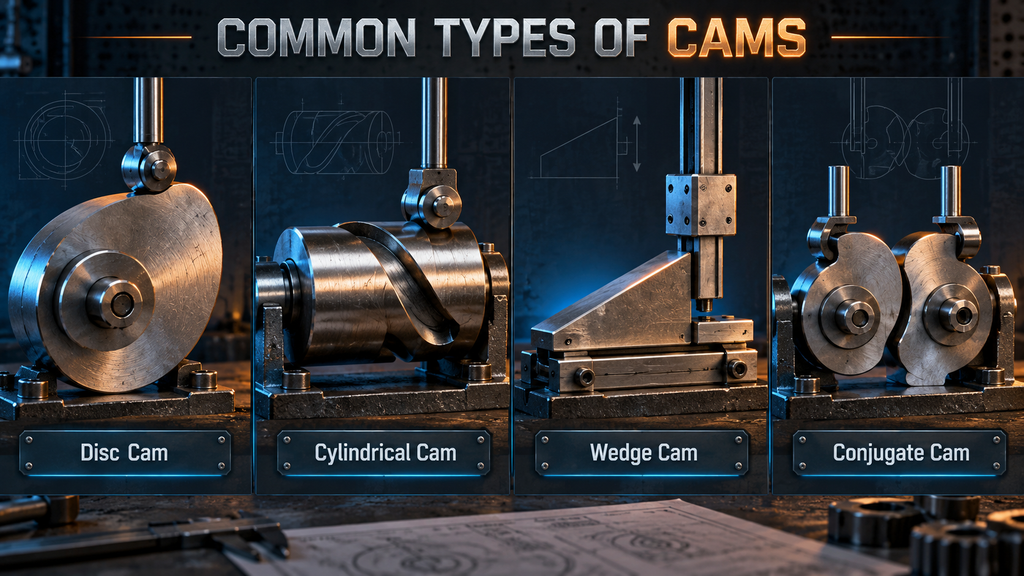
Disc or radial cam
A flat rotating cam with a shaped edge. The follower motion is generated by the changing radial distance from the cam centre to its profile.
Cylindrical or barrel cam
A groove is cut around a cylindrical surface. A follower pin or roller travels in the groove, often creating controlled axial or oscillating movement.
Wedge or translating cam
Instead of rotating, the cam moves in a straight line. Its inclined or shaped surface drives the follower and is useful for simple reciprocating arrangements.
Conjugate cam
Two matching cam profiles positively constrain the follower. This can improve control at speed but increases manufacturing complexity and component count.
Types of followers and follower motion
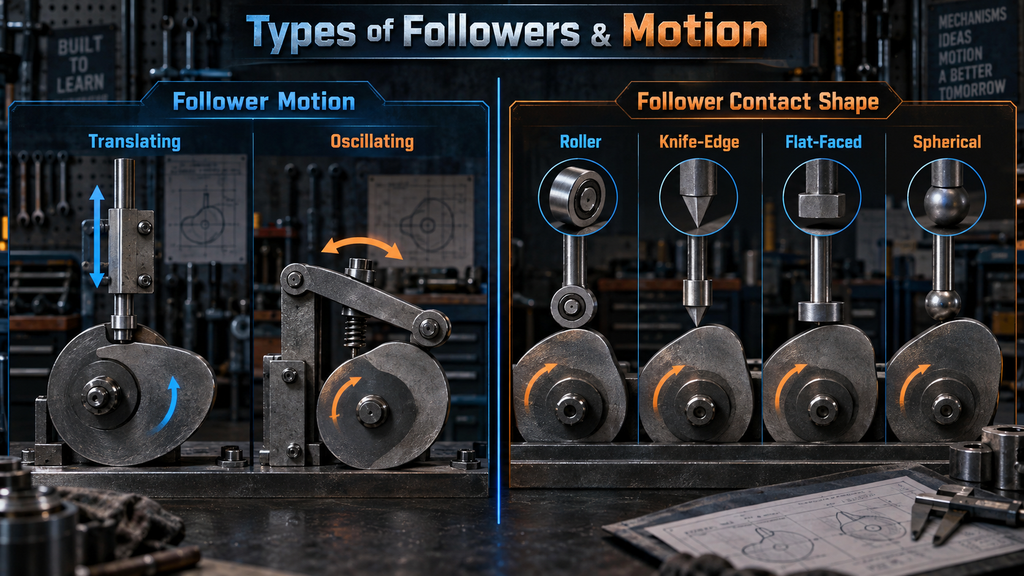
Follower classification can refer to contact shape or motion. A translating follower travels along a guide, while an oscillating follower pivots through an angle.
- Roller follower: uses a rotating roller to reduce sliding friction, though bearing condition and contact stress still matter.
- Knife-edge follower: has point contact and is mainly used for light-duty or theoretical study because wear can be high.
- Flat-faced follower: provides a broad contact face and can suit certain high-speed applications when the profile is designed correctly.
- Spherical-faced follower: uses a curved contact face that can help manage edge contact in some arrangements.
Where are cam and follower mechanisms used?
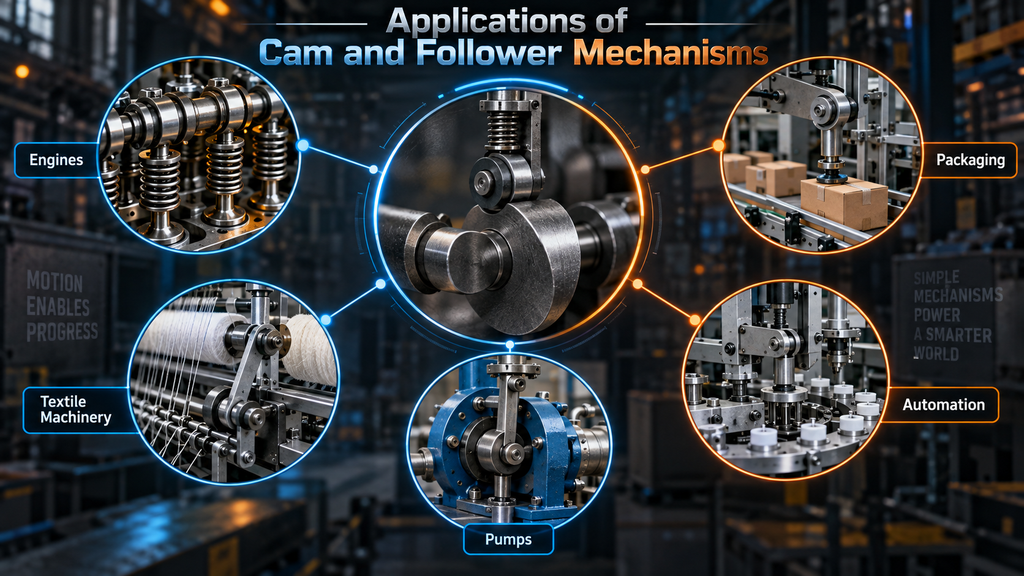
Cam mechanisms are valuable wherever a machine needs repeatable timing and a carefully programmed pattern of displacement from a compact mechanical input.
- Internal-combustion engines, where camshafts control the opening and closing of valves.
- Textile, printing, packaging and filling equipment that needs repeated timed actions.
- Automatic machinery, indexing mechanisms and assembly equipment with sequenced movements.
- Mechanical pumps, switches, instruments and specialized production fixtures.
Advantages and limitations
A well-designed cam and follower can produce a highly repeatable motion sequence. However, performance depends on the complete system rather than on a single follower style or profile feature.
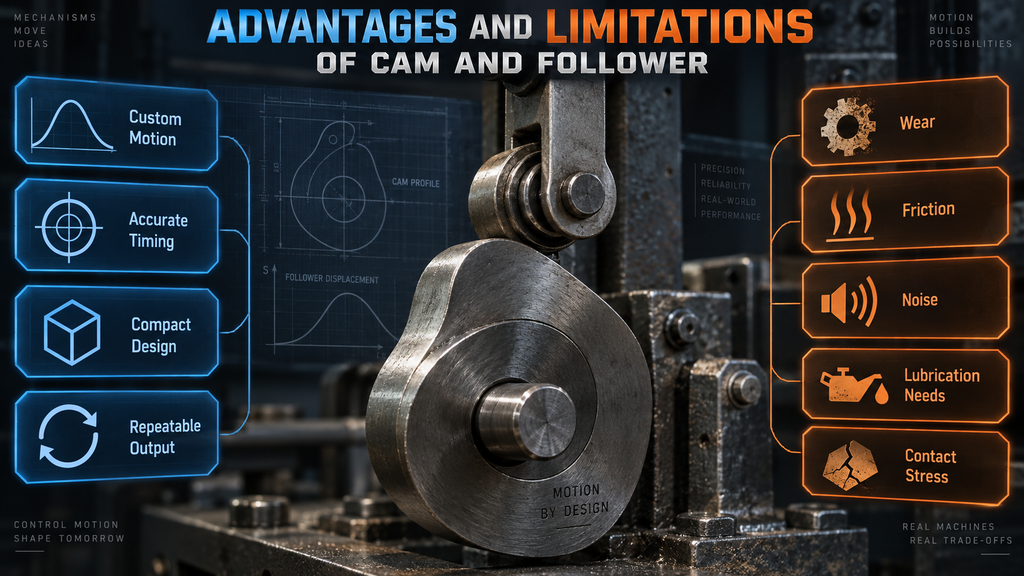
Why engineers use cams
They can create custom motion programs, combine rise and dwell in one rotation, repeat accurately, and package complex mechanical timing into a compact mechanism.
What designers must manage
Sliding friction, wear, noise, pressure angle, contact stress, lubrication needs, vibration and manufacturing accuracy can all limit performance.
Design values are not universal
Do not use a generic pressure-angle limit, spring force, acceleration value or allowable contact stress as a final design rule. Check relevant machine-design references, material data, bearing information, lubrication requirements and the manufacturer specification for the intended duty cycle.
How to select a cam and follower design
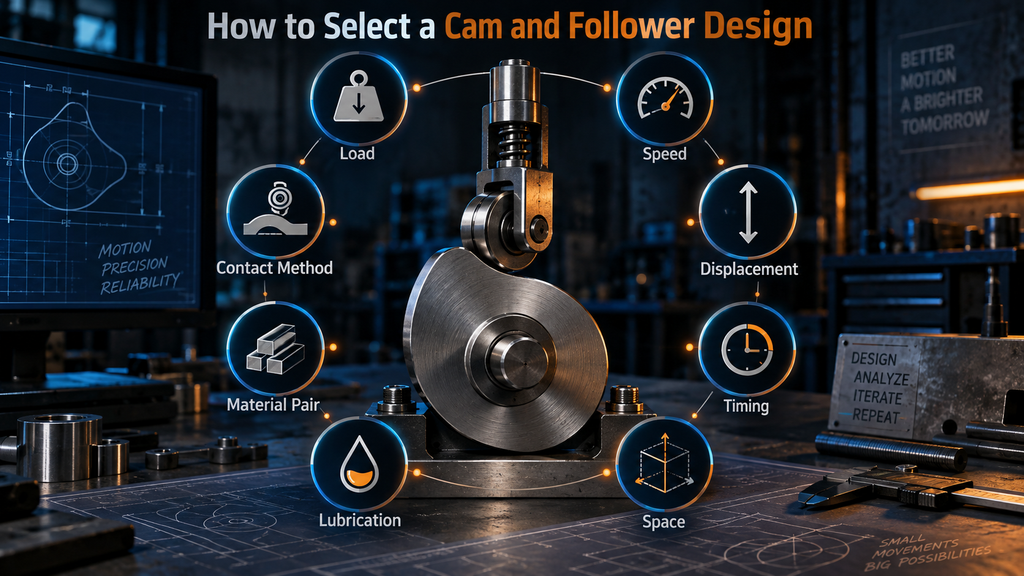
Start with the required follower displacement, timing, load and speed. Then consider the follower motion, available space, pressure angle, contact stresses, lubrication method, material pair, manufacturing capability and how contact will be maintained. A roller follower may reduce sliding friction, but it is not automatically the best solution for every machine.
Cam and follower FAQ
What is the difference between a cam and a follower?
The cam is the driving element with the shaped profile or track. The follower is the driven element that contacts and follows that profile to create the required output motion.
What is dwell in a cam mechanism?
Dwell is the portion of the cam cycle during which the cam continues to move but the follower stays at a constant position. It is often used when another machine operation needs time to occur.
Why is lubrication important for cam followers?
Cam-follower contact can involve substantial load and sliding or rolling contact. Correct lubrication helps reduce friction, wear and heat, but the lubricant choice and delivery method must match the machine speed, materials, environment and manufacturer guidance.