A beginner-friendly guide to the components of an automobile engine — what they are, where they sit, how they work together, and what common trouble can look like.
What are the main components of an automobile engine?
The main components of an automobile engine include the engine block, cylinders, pistons, connecting rods, crankshaft, cylinder head, valves, camshaft, timing system, fuel system, lubrication system, and cooling system. Together, they turn fuel energy into rotational force that can drive the vehicle.
Car engine anatomy: a simplified engine diagram
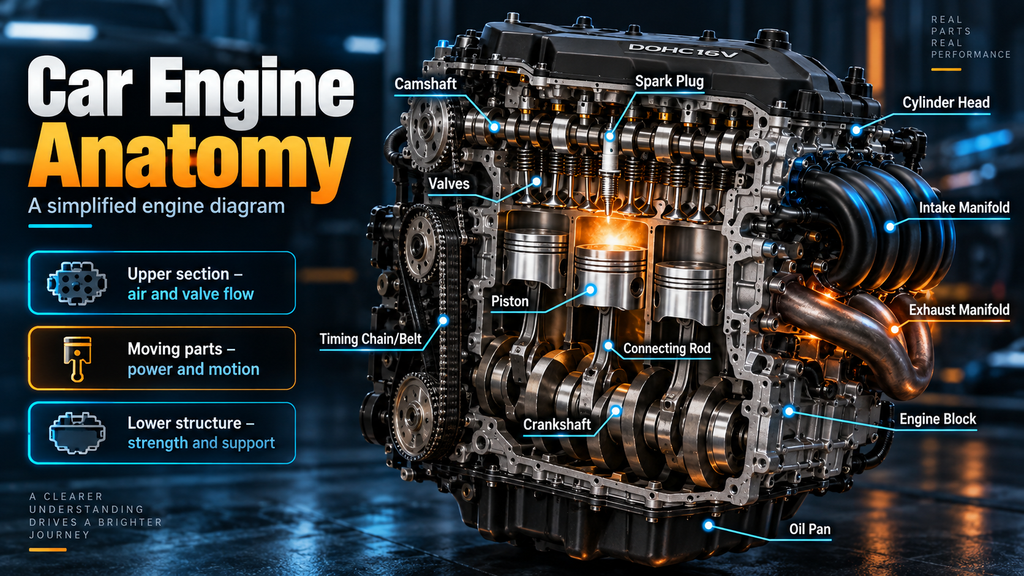
Think of an engine as a coordinated machine with a strong lower structure, a gas-flowing upper section, and a set of moving parts between them. The illustration below shows where several important parts of a car engine are generally located.
How engine and engine parts work together
In a typical gasoline engine, the same sequence repeats hundreds or thousands of times per minute. Diesel engines use compression ignition rather than spark ignition, but their core moving parts follow a similar pattern.
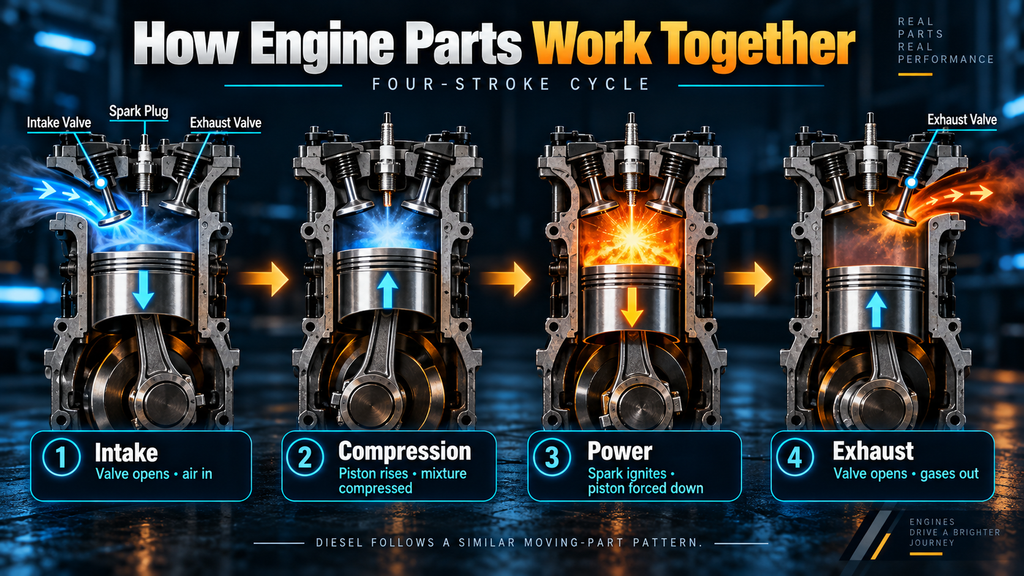
Intake
The intake valve opens and the descending piston draws air in; fuel is added by an injector.
Compression
Both valves close as the piston rises and compresses the air-fuel mixture.
Power
A spark plug ignites the mixture in a gasoline engine, forcing the piston downward.
Exhaust
The exhaust valve opens and the rising piston pushes spent gases into the exhaust system.
The structural and moving parts inside an engine
These are the core components of an automobile engine. Most are internal parts, meaning they are enclosed by the engine block, cylinder head, and oil pan while the engine runs.
Engine block & cylinders
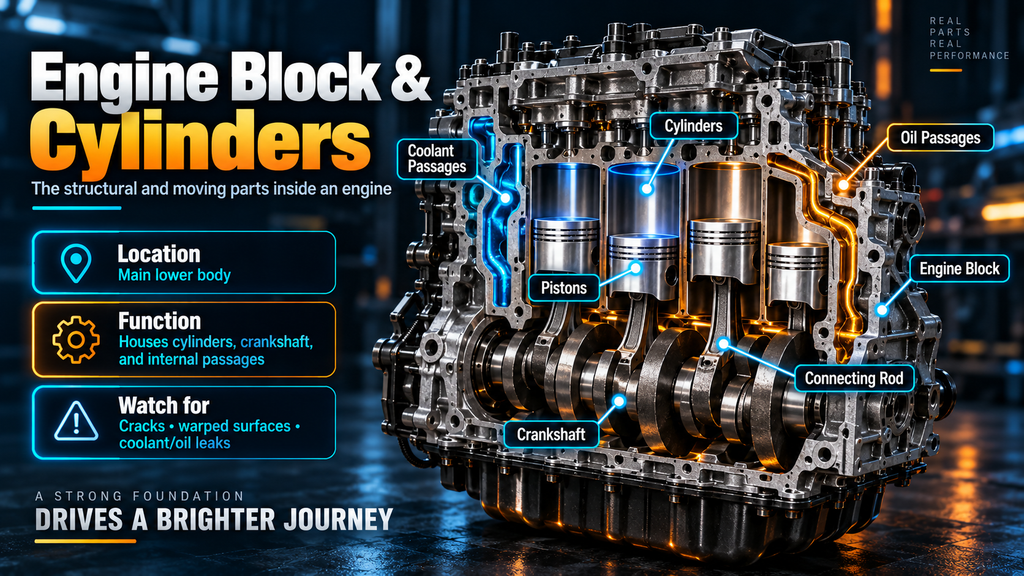
LocationThe main lower body of the engine.FunctionHouses the cylinders, crankshaft passages, coolant channels, and much of the rotating assembly.Watch forCracks, warped sealing surfaces, or coolant/oil leaks can lead to serious engine damage.
Pistons & connecting rods
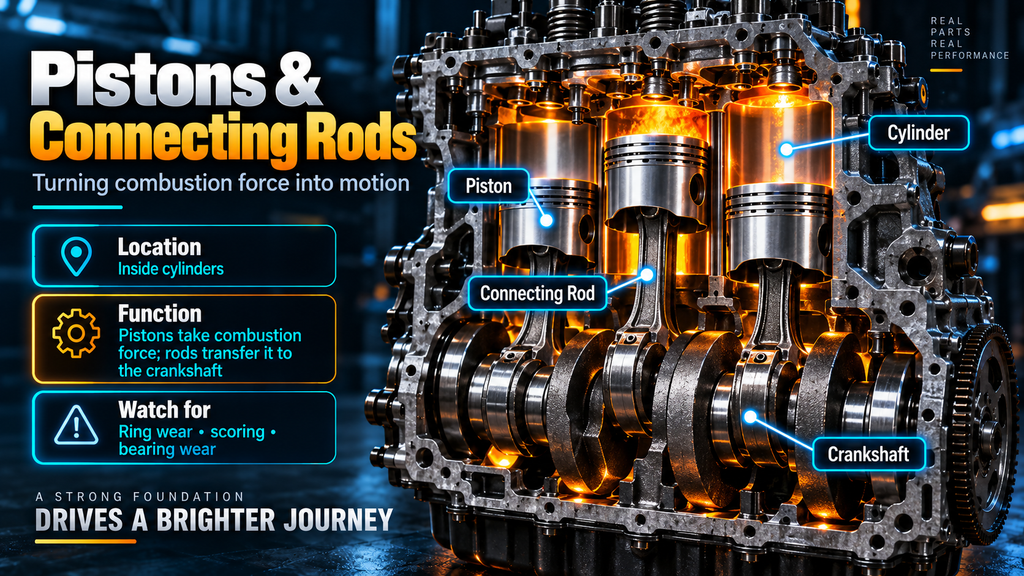
LocationPistons slide inside the cylinders; rods link them to the crankshaft.FunctionPistons receive combustion pressure. Connecting rods transfer that force to the crankshaft.Watch forRing wear, piston scoring, or rod-bearing wear may cause smoke, noise, or low compression.
Crankshaft
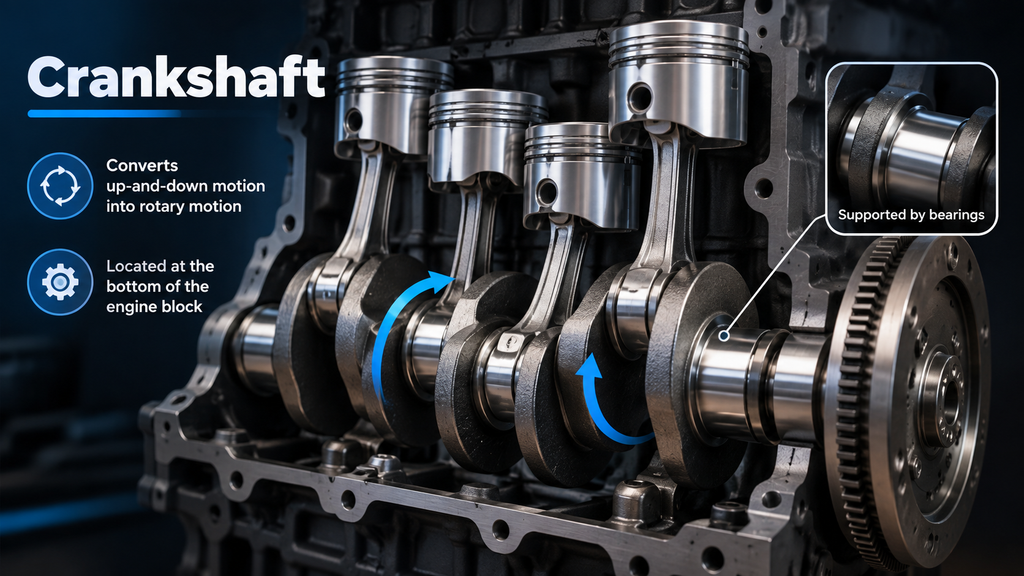
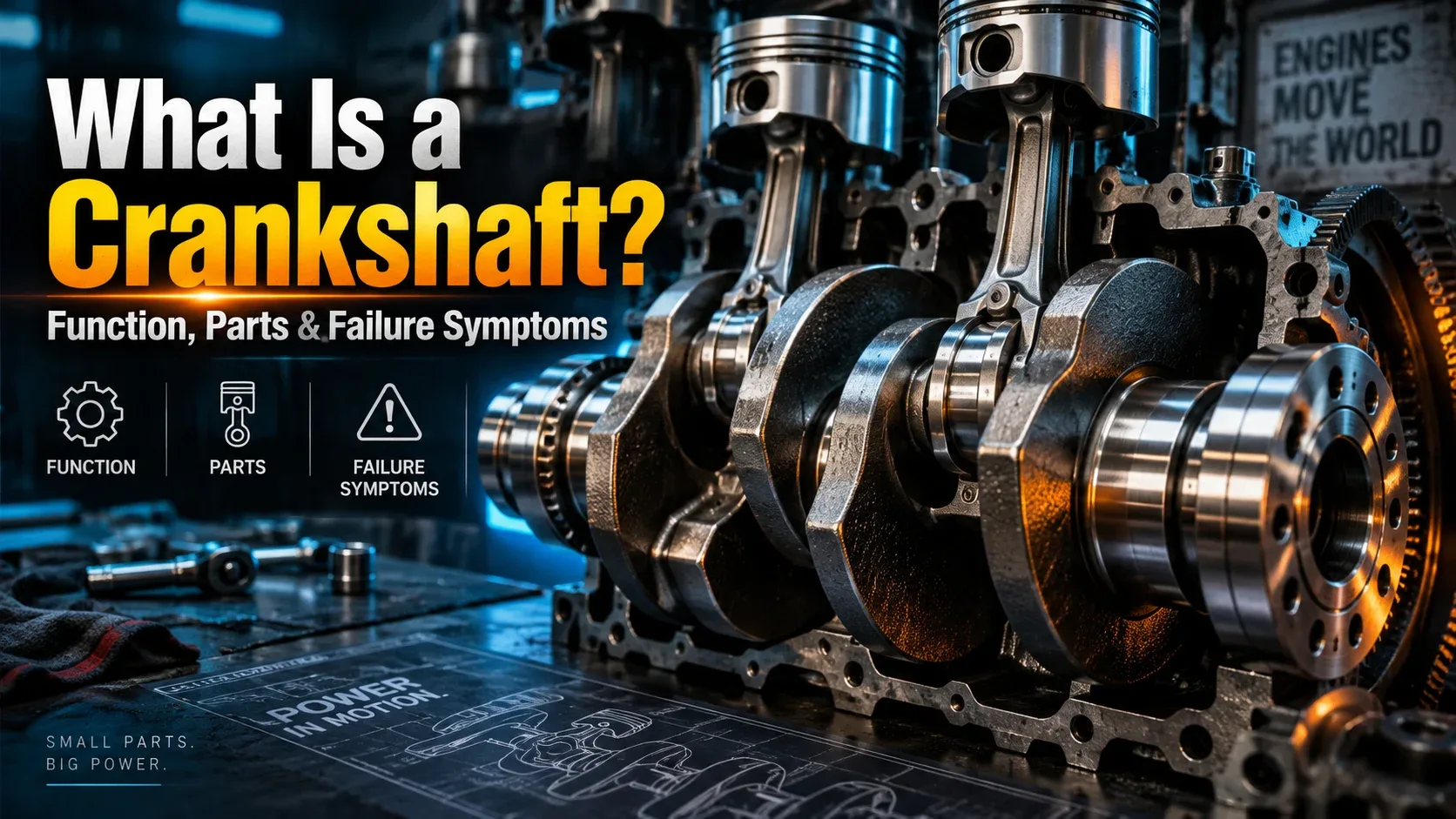
LocationAt the bottom of the engine block, supported by bearings.FunctionConverts the pistons’ up-and-down movement into the rotary motion used by the drivetrain.Watch forLow oil pressure and bearing damage can cause a deep knocking sound and require urgent attention.
Cylinder head
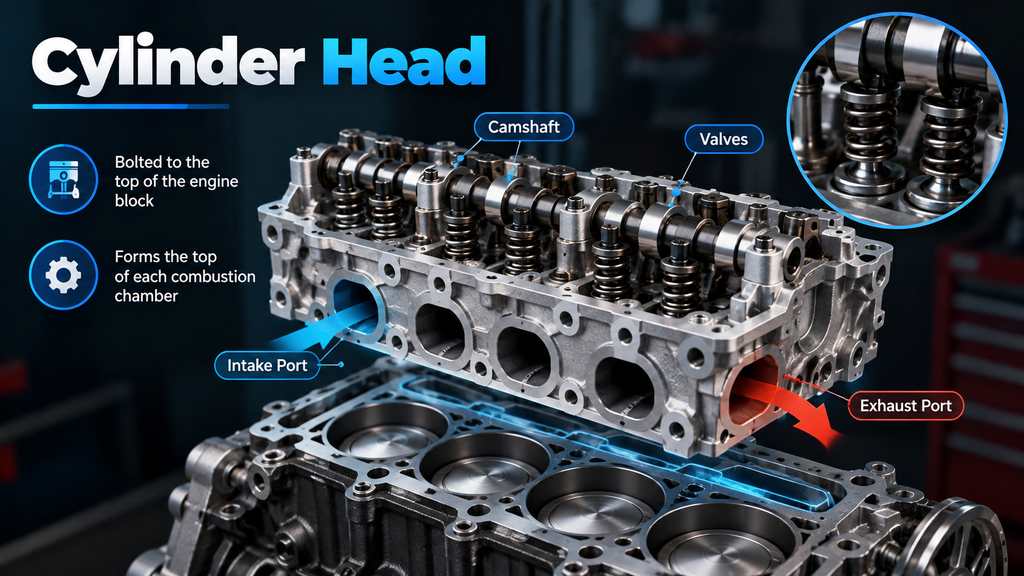
LocationBolted to the top of the engine block.FunctionForms the top of each combustion chamber and carries valves, ports, and often camshafts.Watch forOverheating can warp the head or damage its gasket, sometimes mixing coolant and oil.
Essential car engine parts beyond the block
The parts of the engine in a car do more than move. They must precisely control air, fuel, combustion, heat, lubrication, and the connection to the transmission.
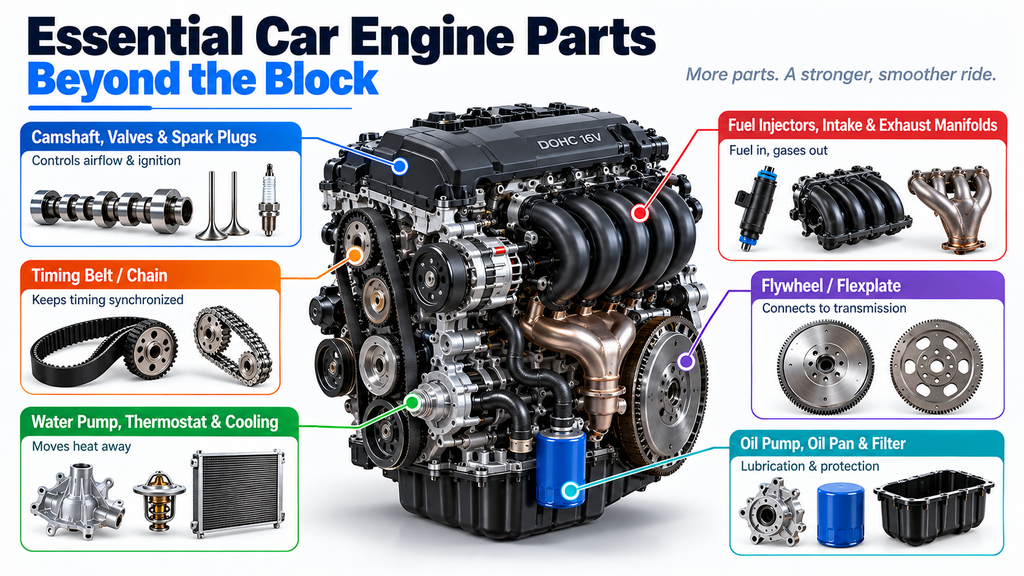
Camshaft, valves & spark plugs
The camshaft opens intake and exhaust valves at the right moment. Intake valves admit air; exhaust valves release spent gases. Gasoline engines use spark plugs to ignite the compressed mixture. Diesel engines generally ignite fuel through compression and may use glow plugs for cold starting.
Timing belt or timing chain
This system synchronizes the camshaft with the crankshaft. A slipped or broken timing belt or chain can cause rough running, no-start conditions, or internal damage in many interference engines. Always follow the vehicle maker’s service interval.
Fuel injectors, intake & exhaust manifolds
Fuel injectors meter fuel into the intake air stream or directly into the cylinder. The intake manifold distributes air to the cylinders, while the exhaust manifold gathers combustion gases and routes them toward the exhaust system.
Oil pump, oil pan & filter
The oil pan stores engine oil. The oil pump sends pressurized oil through passages to bearings and moving components, while the filter traps contaminants. Correct oil level and timely oil changes are fundamental to engine longevity.
Water pump, thermostat & cooling passages
Coolant flows through channels in the engine block and cylinder head to carry heat away. The water pump circulates coolant, and the thermostat regulates flow as the engine warms up. Persistent overheating needs prompt diagnosis.
Flywheel or flexplate
At the rear of the crankshaft, a flywheel in manual cars or flexplate in many automatics connects engine rotation to the transmission. It also helps smooth power pulses; its ring gear works with the starter motor.
Common symptoms and the engine parts worth checking
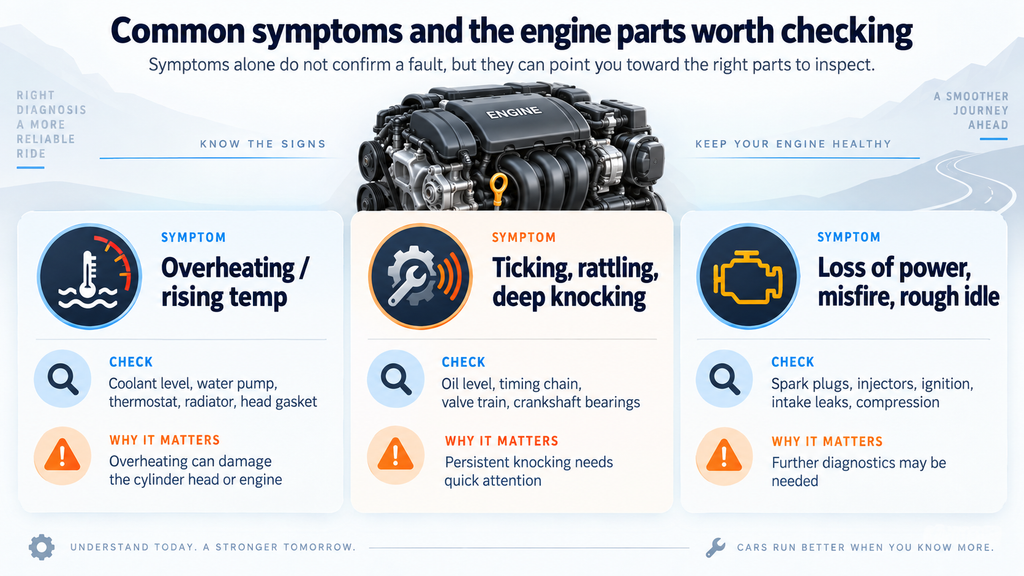
Symptoms alone cannot confirm a fault, but understanding the related engine components can help you describe a problem clearly and ask informed questions at a workshop.
| What you notice | Related parts to inspect | Why it matters |
|---|---|---|
| Overheating or a rising temperature gauge | Coolant level, water pump, thermostat, hoses, radiator, head gasket | Driving while overheated can warp the cylinder head or damage the engine. |
| Ticking, rattling, or deep knocking | Oil level, timing chain components, valve train, crankshaft bearings | Noises vary widely; a persistent knock should be assessed quickly. |
| Loss of power, misfire, or rough idle | Spark plugs, injectors, ignition components, intake leaks, compression | Electronic diagnosis and compression testing may be needed to pinpoint the cause. |
Frequently Asked Questions (FAQs)
What is the most important part of a car engine?
No single part is “most important” — an engine is a system where every component plays a critical role. However, the engine block, crankshaft, and pistons form the core mechanical foundation, while the lubrication and cooling systems protect all moving parts from damage.
How many parts does a typical car engine have?
A modern car engine contains hundreds to thousands of individual parts when you count every bolt, gasket, sensor, and component. The major assemblies described in this guide — block, pistons, crankshaft, cylinder head, valves, camshaft, and supporting systems — represent the essential functional groups.
What is the difference between a timing belt and a timing chain?
Both synchronize the camshaft and crankshaft, but a timing belt is a reinforced rubber belt that requires periodic replacement (typically every 60,000–100,000 miles), while a timing chain is metal and usually lasts the life of the engine, though it may need replacement if it stretches or the tensioner fails.
Can I drive with a small coolant leak?
It’s not recommended. Even a small leak can lead to low coolant levels, overheating, and serious engine damage. Have any coolant leak inspected and repaired promptly to avoid costly repairs.
What causes engine knocking or ticking sounds?
Knocking can result from low oil levels, worn bearings, incorrect fuel octane, carbon buildup, or pre-ignition. Ticking often points to valve train issues, lifter wear, or timing chain slack. Any persistent unusual noise should be diagnosed by a qualified mechanic.