Every build hits it eventually. The part you need was discontinued years ago, the aftermarket never made one, or the thing you want simply does not exist yet: an adapter plate for an engine swap, a bracket to relocate a component, a pulley with a different offset.
Not long ago the options were a local machine shop at a price that made your eyes water, or a welder and an angle grinder. Today, plenty of enthusiasts send a file overseas and get a precision billet part delivered to the garage. Here is how it works, and what to know before you try it.
Yes, and it is more accessible than you think
Precision machine shops in China have spent years building online quoting systems aimed at engineers and product designers. The same systems work for a car guy with a one-off part.
Many shops now accept single-piece orders with no minimum order quantity, turn prototypes around in about a week, and hold tolerances that match or beat what the factory held on the original part. For anyone looking into CNC machining China services, the better shops also carry automotive quality certifications such as IATF 16949, which tells you they already make parts for the car industry at production level.
Step one: you need a file
A machine shop cannot quote a part from a photo. It needs a 3D CAD model, usually a STEP file, and ideally a 2D drawing showing the dimensions that matter.
If you have the original part, even a worn one, it can be measured or 3D scanned. Plenty of freelance CAD designers will model a bracket or spacer for a modest fee. If you are handy with software, free and hobby-licence CAD tools are more than capable of simple parts.
On the drawing, mark the dimensions that actually need to be precise: bolt hole spacing, bores for bearings, mating faces. Leaving everything else at a standard tolerance keeps the price down.
Step two: pick the right material
For most brackets, spacers and mounts, 6061-T6 aluminium is the default. It is strong, light, easy to machine and takes anodising well.
For high-stress parts, 7075 aluminium is considerably stronger. For anything near exhaust heat, or carrying heavy loads, steel or stainless is the safer choice because aluminium loses strength when hot.
Finish matters too. Anodising gives that classic coloured billet look and protects the surface. Powder coating is tougher against stone chips. Bead blasting gives a clean matte factory appearance.
What enthusiasts actually get made
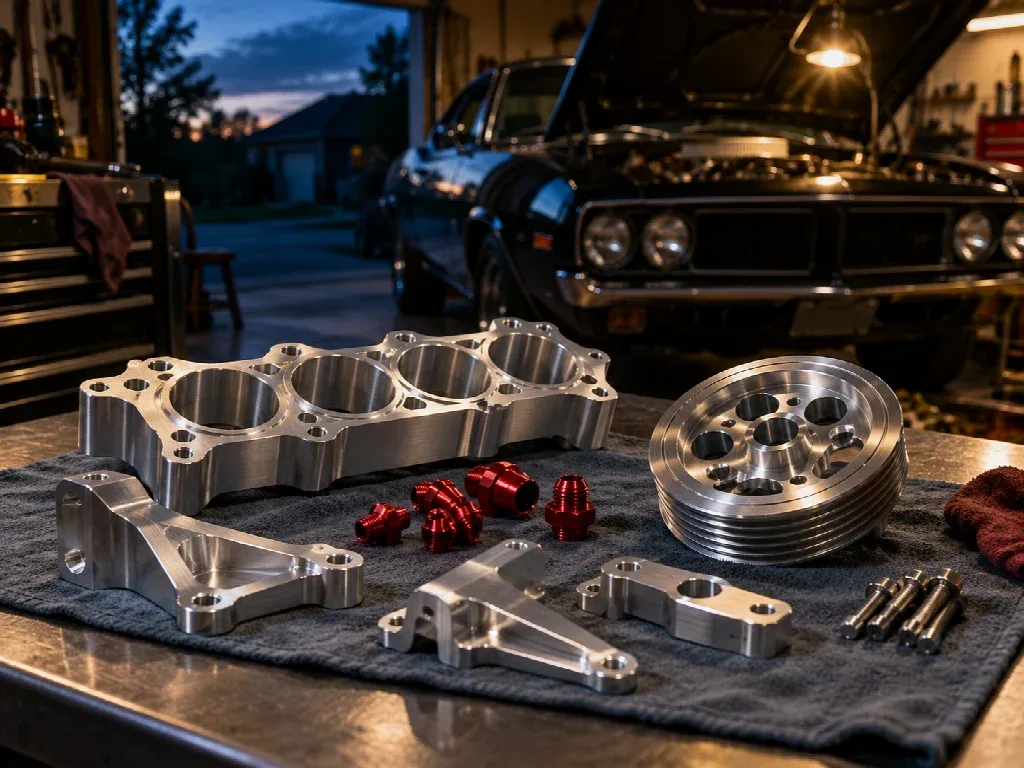
The most popular custom parts are the unglamorous ones that make a project possible. Engine swap adapter plates and motor mounts that let a modern powertrain sit in an older chassis. Alternator, power steering and A/C relocation brackets for tight engine bays. Pulley spacers that fix belt alignment after a swap.
Then come the parts that simply are not sold anymore: shifter linkage pieces, trim clips and brackets for classics whose reproduction market dried up long ago.
And finally the fun stuff. Billet valve cover accents, gauge pods, fuel rail brackets, throttle body adapters and custom fittings that turn an engine bay from functional into something worth opening the hood to show off.
What drives the price
Setup is the big cost. Programming the machine and fixturing the part costs about the same whether you order one piece or ten, so the price per part drops sharply as quantity rises. Going in with a couple of friends on the same part is a classic way to cut costs.
Complexity and precision are next. Parts that need five-axis machining, deep pockets or very tight tolerances take longer. A simple flat bracket costs very little; a complex manifold costs considerably more.
Then add shipping, and check the import duties and tariffs that currently apply to parts from China in your country. They can make a real difference to the final cost.
Tips for a smooth first order
Ask for design feedback. Good shops review your file and point out features that are difficult or expensive to machine, often suggesting a small change that halves the cost.
Request photos and an inspection report before the parts ship, so any problem is caught while it is still cheap to fix.
Order one first. Test the fit on the car before ordering a batch or a second version.
A word on safety
Machining a part accurately is not the same as engineering it correctly. For anything in the steering, braking or suspension systems, or anything whose failure could hurt someone, get the design checked by a qualified engineer and be aware of the rules on modifications where you live. Save the DIY design experiments for brackets, trim and engine bay dress-up parts.
The takeaway: the part that stalled your build does not have to stay a dead end. With a decent CAD file, sensible material choice and a reputable shop, a billet part that nobody sells can be on your workbench within a couple of weeks.