MODEL-YEAR CLARIFICATION
The V8 Charger and Challenger Scat Pack ended after the 2023 model year. The 2024 Charger Daytona Scat Pack is an AWD EV, while the 2025 Charger Sixpack Scat Pack uses a twin-turbo inline-six. Always identify the year and powertrain before comparing specifications.
THE BASICS
What is a Scat Pack?
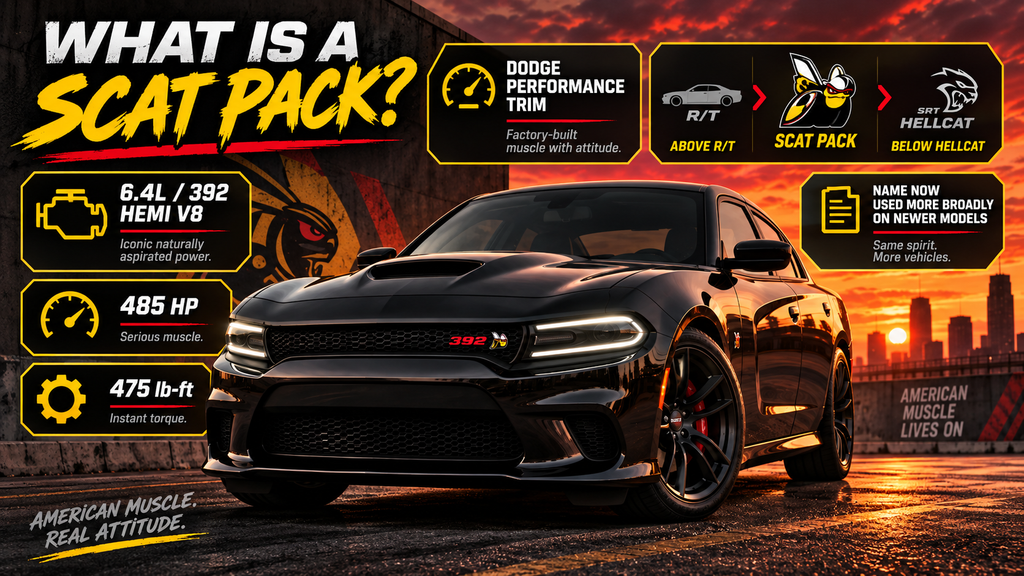
Historically, Scat Pack was Dodge’s step-up performance identity: more serious than an R/T, but below the supercharged Hellcat family. For the 2015–2023 Charger and Challenger, the name usually means the naturally aspirated 6.4-liter, or 392-cubic-inch, HEMI V8. That setup made 485 horsepower and 475 lb-ft of torque in the final V8 cars.
The term scatpack is now less mechanically specific. Dodge reused it for the all-wheel-drive Charger Daytona EV and for the 2025 Charger Sixpack. Those newer models are not simply faster versions of the old 392—they are fundamentally different vehicles with different maintenance, weight, sound, complexity, and long-term ownership questions.
AT A GLANCE
Scat Pack specifications: compare the right cars
These figures illustrate why online comparisons can be misleading. Acceleration estimates vary with tire, weather, testing method, vehicle configuration, and battery state. Reserve hard acceleration for legal track or controlled environments.
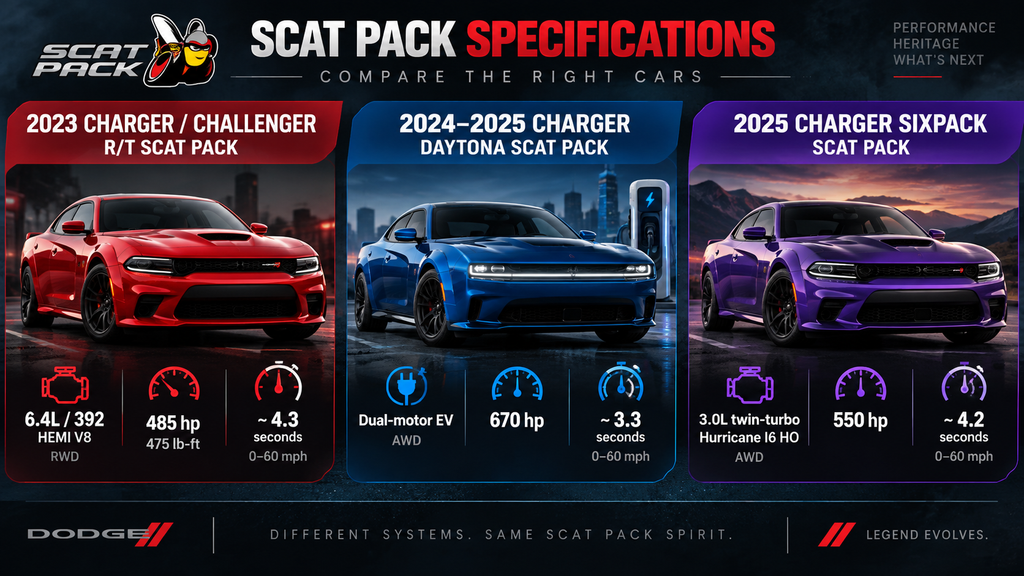
| Model | Powertrain | Output | Approx. 0–60 mph |
|---|---|---|---|
| 2023 Charger / Challenger R/T Scat Pack | 6.4L / 392 HEMI V8, rear-wheel drive | 485 hp · 475 lb-ft | About 4.3 seconds |
| 2024–2025 Charger Daytona Scat Pack | Dual-motor EV, all-wheel drive | 670 hp | About 3.3 seconds |
| 2025 Charger Sixpack Scat Pack | 3.0L twin-turbo Hurricane I6 HO, AWD | 550 hp | About 4.2 seconds |
DEDICATED CHARGER GUIDE
What makes a Scat Pack Charger different?
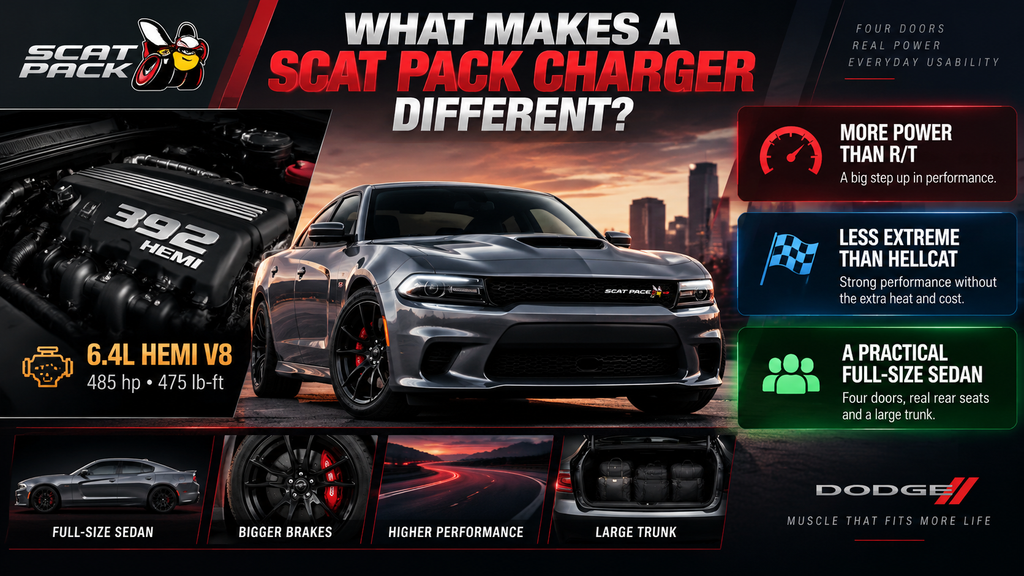
The Dodge Charger Scat Pack gave buyers full-size sedan practicality with big-displacement V8 performance. In the final V8 generation, it combined the 485-hp 6.4L HEMI with rear-wheel drive and an eight-speed automatic transmission. It is the configuration most shoppers mean when searching for a scat pack charger.
Compared with an R/T, the Scat Pack brings a substantial power increase, bigger performance expectations, and typically higher tire, brake, fuel, and insurance bills. Compared with a Hellcat, it gives up supercharged output but avoids the added heat, traction challenge, and some of the purchase-price premium that come with that extreme step.
For daily use, the sedan body is a genuine advantage: four doors, useful rear seating, and a large trunk. The trade-off is that a high-output, rear-drive sedan needs mature throttle inputs, especially in poor weather or on worn tires.
ENGINE & RELIABILITY
The old 392 HEMI is proven—but condition matters more than mileage
A stock, maintained 6.4L HEMI and ZF eight-speed automatic can be durable. The biggest used-car risk is not the badge itself; it is buying a car with a history of abuse, poor maintenance, questionable modifications, theft recovery, or hard track use that was never disclosed.
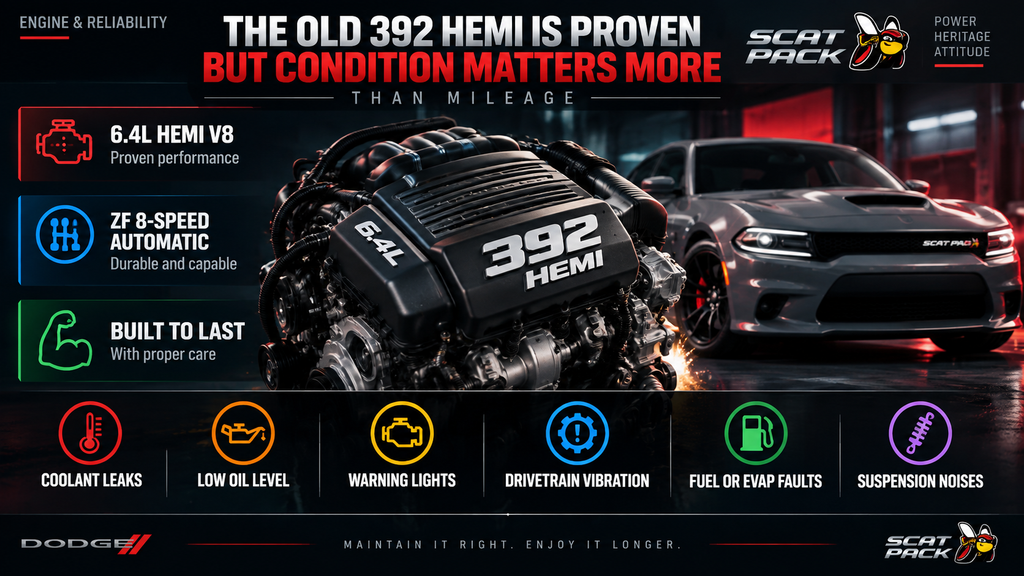
Ownership reports and repair experience point to coolant leaks around water pumps or thermostats, exhaust-manifold ticking, battery or electrical issues, fuel or EVAP faults, suspension noises, and interior wear. A persistent tick, low oil level, warning light, drivetrain vibration, coolant loss, or delayed shifting deserves a specialist inspection—not a guess from a listing photo.
The cost of owning the performance
The V8 Scat Pack is not an inexpensive commuter. Premium fuel is recommended for best performance, and fuel use rises quickly in city traffic, on short trips, and with aggressive driving. Insurance can also be notably higher than a mainstream sedan, particularly for younger drivers or in high-theft markets.
For 2024–2025 Daytona EV models, oil and spark-plug servicing disappear, but owners should budget for tires, insurance, charging setup, collision repairs, and potentially expensive proprietary electronics. The 2025 Sixpack is also too new for a meaningful long-term reliability record, and its twin turbos plus AWD add complexity compared with the old naturally aspirated V8.
USED-CAR CHECKLIST
What to inspect before buying a used Scat Pack
The best used Scat Pack is usually a clean, mostly stock example with complete records—not necessarily the lowest-priced or lowest-mileage car. Arrange a pre-purchase inspection with a shop that understands late-model performance Mopars.
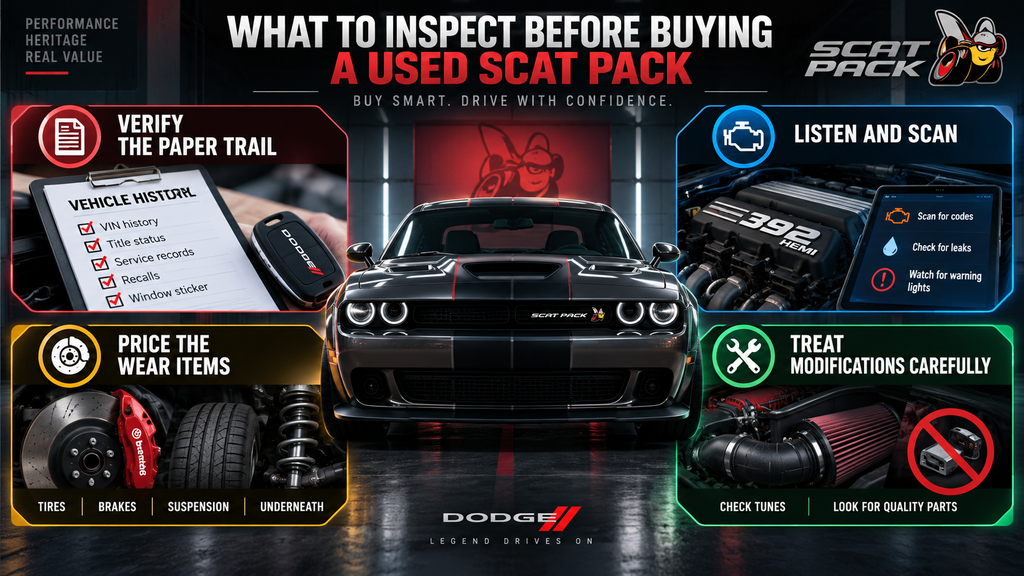
Verify the paper trail
Review VIN history, title status, recall completion, service invoices, oil-change intervals, and the original window sticker where possible.
Listen and scan
Start the engine cold, scan for stored codes, and investigate ticks, coolant loss, transmission behavior, drivetrain whine, and warning lights.
Price the wear items
Measure tire tread, inspect brake rotors and pads, check suspension components, and look underneath for impact damage, leaks, or uneven wear.
Treat modifications carefully
Avoid poorly documented tunes, forced induction, wiring changes, emissions tampering, and mismatched parts. Stock is often the safer value.
Scat Pack FAQs
What does Scat Pack mean?
It is Dodge’s performance designation. On 2015–2023 Charger and Challenger models, it most often refers to the naturally aspirated 6.4L HEMI V8 configuration.
Is a Scat Pack Charger a good daily driver?
It can be, thanks to four doors, useful rear seating, and a large trunk. Expect higher fuel, tire, brake, insurance, and maintenance costs than a conventional sedan.
Which used Scat Pack should I buy?
Prioritize a mostly stock example with a clean title, complete service records, recall completion, and an independent pre-purchase inspection over simply chasing the lowest price or mileage.
Are newer Scat Packs the same as the old V8?
No. The Daytona Scat Pack is an all-wheel-drive EV, while the Sixpack uses a twin-turbo inline-six. They differ substantially in sound, weight, maintenance, and ownership considerations.
THE BOTTOM LINE
Which Scat Pack is right for you?
Choose a clean 2021–2023 V8 Charger or Challenger Scat Pack if you want classic HEMI character, simpler mechanical ownership, and used-market value. Choose the Daytona Scat Pack if all-weather traction and explosive EV performance matter most. Choose the Sixpack if you want a new gasoline Charger with more power than the old 392, while accepting first-year uncertainty. Whichever route you take, budget for the whole ownership picture—not just the purchase price.