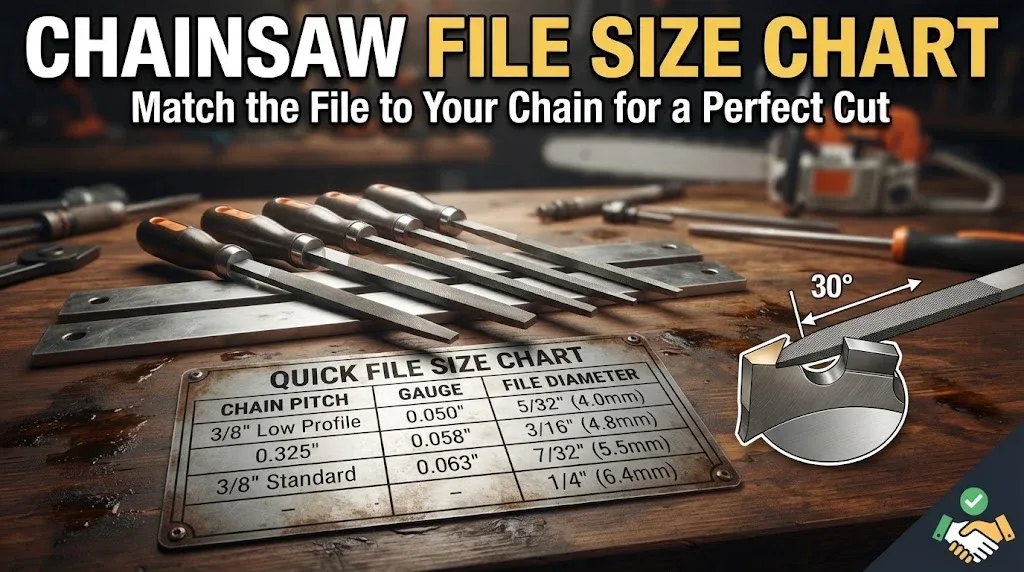
Use this chainsaw file size chart as a quick starting point—then verify the exact file diameter for your chain model before you sharpen.
Many .325 chains use a 3/16 in. file, many 3/8 in. low-profile chains use 5/32 in., and many standard 3/8 in. chains use 7/32 in. But pitch is not the whole story: confirm the recommendation for your exact chainsaw chain model.
Chainsaw file size chart: common starting points
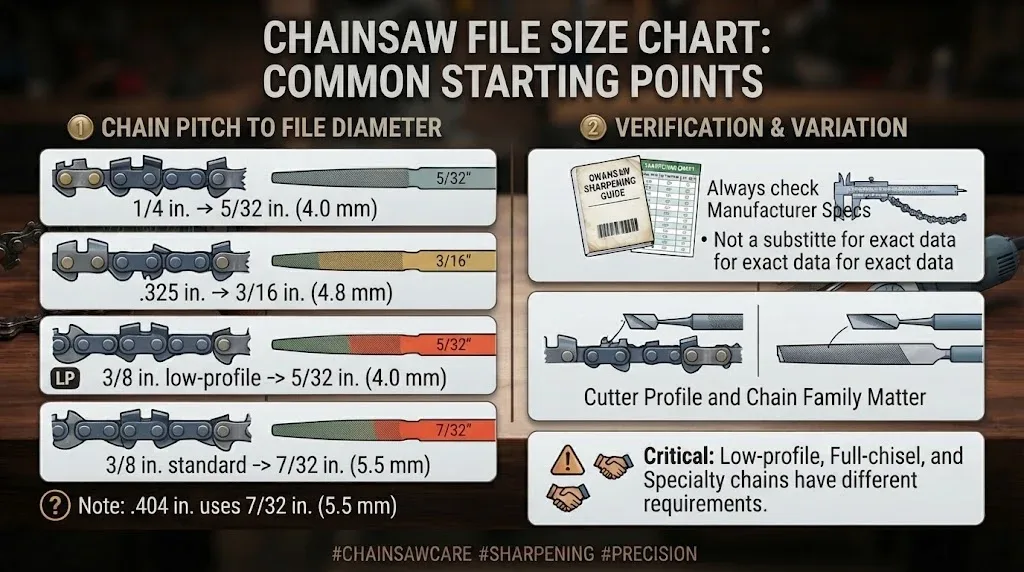
A round file shapes the cutting edge and side plate of each cutter. The chart below lists commonly published pairings, not a substitute for the specification from Oregon, STIHL, Husqvarna, or the maker of your particular replacement chain.
| Chain pitch | Common round file | Metric equivalent | Important verification note |
|---|---|---|---|
| 1/4 in. | 5/32 in. | 4.0 mm | Often seen on small carving or specialty chains; check the chain model. |
| .325 in. | 3/16 in. | 4.8 mm | A common pairing, but cutter profile and chain family still matter. |
| 3/8 in. low-profile | 5/32 in. | 4.0 mm | Common on many homeowner saws; do not confuse it with standard 3/8 in. chain. |
| 3/8 in. standard | 7/32 in. | 5.5 mm | A widely used reference size; some chain designs specify another diameter. |
| .404 in. | 7/32 in. | 5.5 mm | Often used on larger professional chains; confirm the manufacturer chart. |
Why charts can differ: a chain’s pitch helps narrow the choice, but low-profile, full-chisel, semi-chisel, and specialty cutters can carry different recommendations. The chain manufacturer’s current specification wins.
Identify the chain before choosing a file
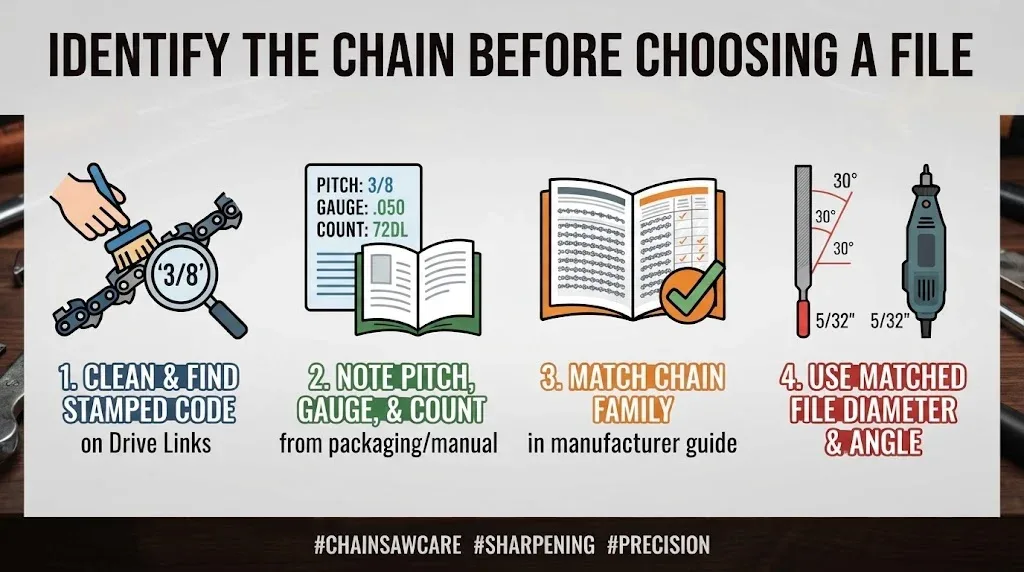
The best file-size answer starts with the chain, not the guide-bar length or the chainsaw brand. Look for identifying information on the chain packaging, the receipt, the saw manual, or stamped markings on the drive links—the small links that sit inside the bar groove.
- Clean a section of chain and look for a maker name, code, or marking on the drive links.
- Note the chain pitch, gauge, and drive-link count if the bar or packaging lists them.
- Find the exact chain family in the manufacturer’s chain-identification or sharpening guide.
- Match the listed file diameter, top-plate angle, and depth-gauge setting before removing metal.
Pitch, gauge, and file diameter are not the same thing
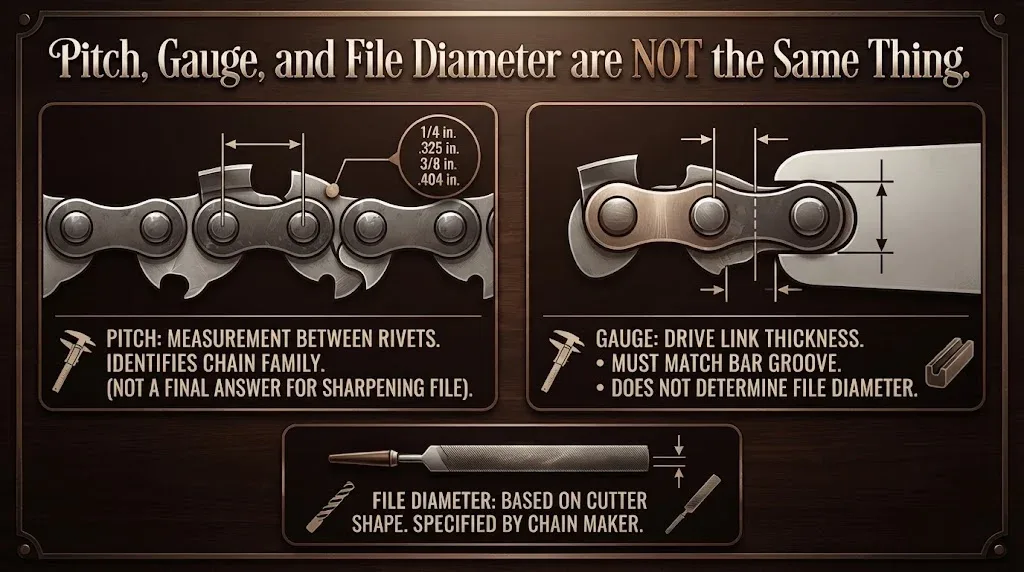
Pitch
Pitch is the spacing between chain rivets. It helps identify the chain family and is often printed as 1/4 in., .325 in., 3/8 in., or .404 in. Pitch is useful for narrowing down a file, but it does not always supply the final answer by itself.
Gauge
Gauge is the thickness of each drive link where it fits into the guide bar. It must match the bar groove, but it does not determine round-file diameter. File diameter is chosen for the cutter shape specified by the chain maker.
How the file should fit the cutter
With the correct file and a compatible filing guide, a portion of the file usually projects above the cutter’s top plate. Follow the guide and the manufacturer specification rather than trying to copy a universal height by eye. The goal is to preserve the intended cutting-edge geometry consistently across every cutter.
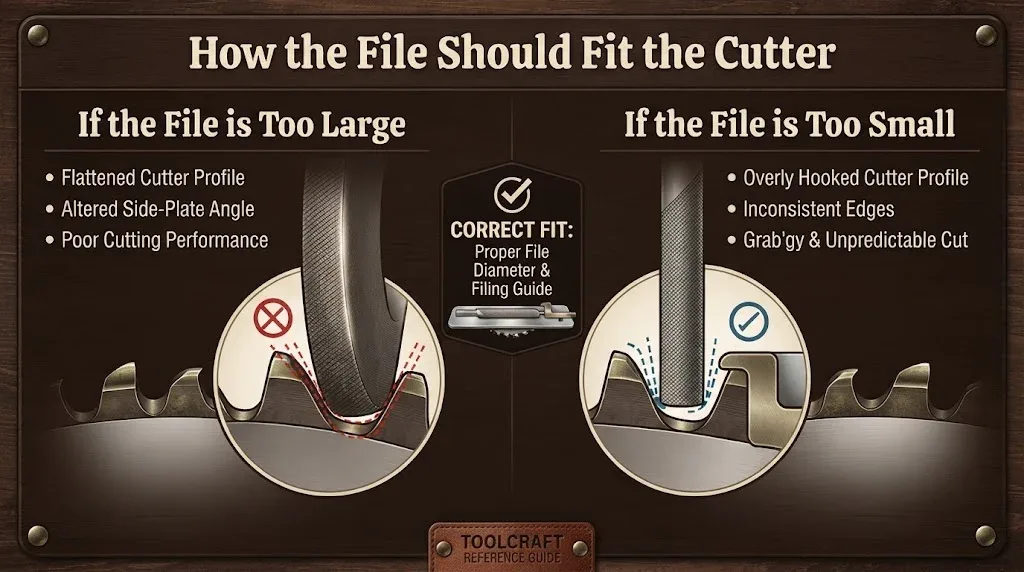
If the file is too large
It can flatten or reshape the cutter incorrectly, alter the side-plate angle, and remove useful cutter material. The chain may cut poorly even when it appears sharp.
If the file is too small
It can create an overly hooked cutter profile and inconsistent edges. That geometry can make a chainsaw feel grabby, dull quickly, or cut less predictably.
Safe, consistent chainsaw filing basics
Once you have confirmed the proper file size, secure the saw and use a filing guide if you are learning. A guide helps control the filing angle and file position; it is especially useful when cutter lengths or sharpening experience are uneven.
- Mark your starting cutter with a wax pencil so you know when you have completed the loop.
- File from the inside of each cutter toward the outside using steady, controlled strokes.
- Keep left and right cutters close to the same length to reduce the chance of the saw pulling sideways.
- Check depth gauges with the correct tool after repeated sharpening, and do not lower them by guesswork.
Do not treat 3/8 in. chain as one universal category
3/8 in. low-profile chain commonly uses a different file diameter from standard 3/8 in. chain. This is one of the easiest ways to select the wrong file. Read the chain identification carefully and follow the exact maker recommendation.
When to ask a professional or replace the chain
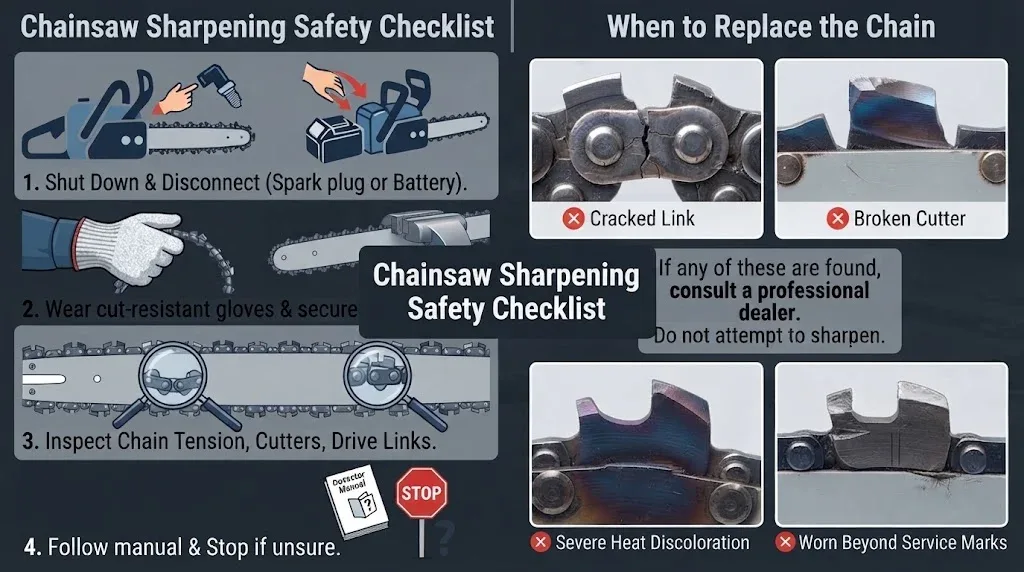
Pause and get qualified help if the chain is unidentified, has cracked or damaged links, broken cutters, severe heat discoloration, or cutters worn to their service marks. A dealer or service technician can identify an uncertain chain and assess whether it is still safe to sharpen. Replace a chain that cannot be restored within the manufacturer’s wear limits.
Chainsaw sharpening safety checklist
- Shut the chainsaw off completely. Disconnect the spark plug lead where appropriate, or remove and isolate the battery on cordless models.
- Wear suitable cut-resistant gloves when handling the chain, and secure the guide bar before filing.
- Inspect chain tension, lubrication, cutters, drive links, and the guide bar before putting the chainsaw back into service.
- Follow the chainsaw and chain manufacturer’s current instructions. Stop if you are unsure about the chain type, file fit, or damage.
Frequently asked questions
What size file do I need for a .325 chainsaw chain?
A 3/16 in. (4.8 mm) round file is a common starting point for .325 in. chain. Confirm the exact chain model because cutter geometry can change the manufacturer’s recommendation.
Is 5/32 in. or 7/32 in. right for 3/8 chainsaw chain?
Many 3/8 in. low-profile chains use 5/32 in. files, while many standard 3/8 in. chains use 7/32 in. files. Identify whether your chain is low-profile and then check its exact manufacturer documentation.
Can I use chain gauge to choose a chainsaw file?
This guide is educational and does not replace the operating or service instructions for your chainsaw and chain. Use appropriate protective equipment and follow the manufacturer’s current documentation before sharpening or operating a chainsaw.