
The simple long-handle tool that helps you loosen stubborn automotive fasteners—without risking your ratchet.
The quick answer
A 1/2-inch drive, 18–24 inch breaker bar is the useful all-rounder for most car owners.
Start here
What is a breaker bar?
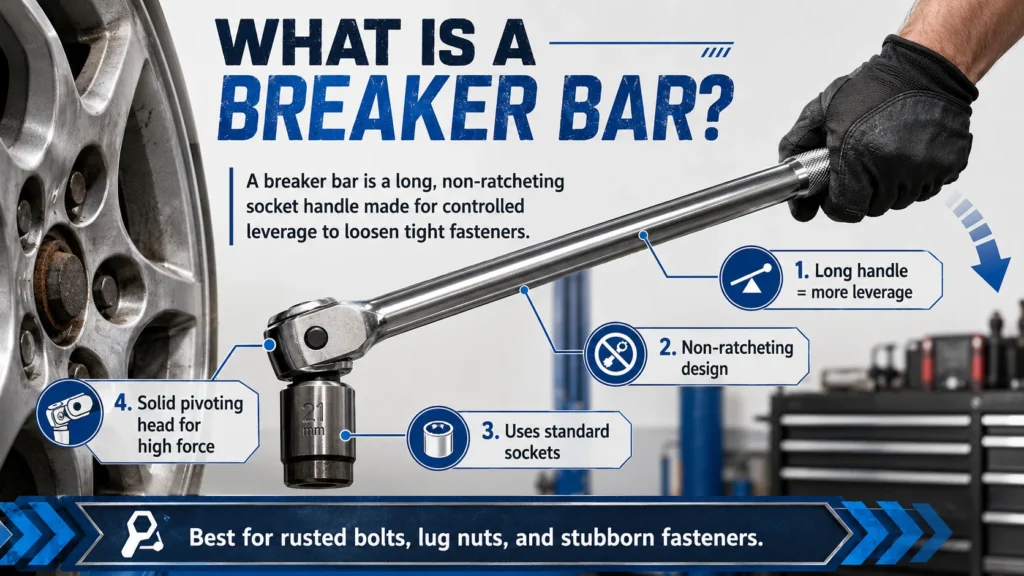
A breaker bar is a long, non-ratcheting socket handle made for one job: applying controlled leverage to break loose a tight fastener. It uses the same sockets as your ratchet, but its solid pivoting head and long handle are built to handle more force.
Why it works
Length turns your effort into torque
Torque is twisting force. With the same push from your hands, a longer handle creates more torque at the socket. That extra leverage is why a breaker bar can move a rusted bolt that a short ratchet cannot.
Simple leverage rule
Torque = Force × Handle Length
Double the handle length and you roughly double the torque from the same steady pull.
Choose your drive
What size breaker bar should you get?
Drive size determines the sockets the bar accepts and hints at its intended workload. Handle length matters too—but longer is not automatically better when space is tight or the bolt is delicate.
| Drive size | Typical length | Best for | Practical note |
|---|---|---|---|
| 3/8 in | 10–15 in | Engine-bay bolts, smaller brackets, tight spaces | Useful when access matters more than maximum force. |
| 1/2 in | 18–24 in | Lug nuts, suspension bolts, brake hardware | The best first breaker bar for most DIY automotive work. |
| 3/4 in | 24–40 in | Large trucks, heavy equipment, very large axle hardware | Usually overkill for routine passenger-car maintenance. |
Buying tip: choose a bar that matches the drive size of the impact-rated sockets you already use most often.
Where it earns its place
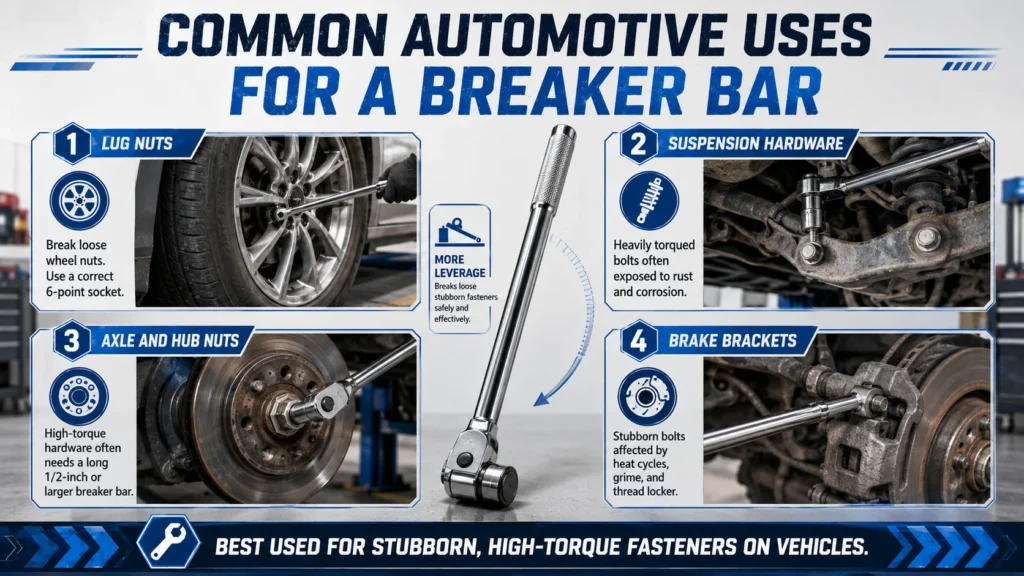
Common automotive uses for a breaker bar
Lug nuts
Break loose wheel nuts while the tire is still firmly on the ground. Use the correct six-point socket.
Suspension hardware
Control-arm, shock, and subframe fasteners can be heavily torqued and exposed to corrosion.
Axle and hub nuts
High-torque axle hardware often needs a long 1/2-inch or larger breaker bar and the correct socket.
Brake brackets
Caliper bracket bolts can be stubborn after years of heat cycles, road grime, and thread locker.
Use the right tool
Breaker bar vs. ratchet, torque wrench & impact tool
| Tool | Use it for | Its advantage | Watch out for |
|---|---|---|---|
| Breaker bar | Loosening stubborn fasteners | Long-handle leverage and a simple, strong head | Not for final tightening to specification. |
| Ratchet | Removing and installing already-loose hardware | Fast repeated turns without repositioning | Heavy force can damage its internal gear mechanism. |
| Torque wrench | Final tightening to the manufacturer specification | Measured, repeatable tightening force | Never use it as a breaker bar unless its maker permits it. |
| Impact wrench | Fast removal and installation | Powered impacts can free difficult fasteners quickly | Can over-tighten or damage hardware without control. |
Technique matters
How to use a breaker bar safely
Do not use a cheater pipe on a bar not designed for it.
Extra pipe length can overload the socket, fastener, tool, or your footing. If a fastener will not move, reassess: use penetrating oil, verify thread direction, apply heat only where appropriate, or get professional help.
- Use a snug six-point socket—avoid a worn or loose twelve-point socket on stubborn hardware.
- Keep the socket squarely seated and pull smoothly; avoid sudden jerks that can slip or round the fastener.
- For lug nuts, break them loose before lifting the vehicle. Never rely on a jack alone while working underneath.
- Use a torque wrench for final tightening. A breaker bar tells you nothing about the torque you applied.
Bottom line
Is a breaker bar worth having?
Yes if you do your own wheel, brake, or suspension work. It is a low-cost, durable way to get safe mechanical leverage when a ratchet is not enough. For most home garages, a quality 1/2-inch drive breaker bar paired with impact-rated sockets is the practical starting point.