
A puller or extractor can remove a seized, press-fit, rounded, or hard-to-grip part, but only when its force is applied in the right place. Use this guide to match the tool to the job before something bends, slips, or breaks.
The quick answer
A puller usually draws a part off a shaft, hub, taper, or bearing seat with controlled mechanical force. An extractor is a broader term for tools that remove damaged, recessed, seized, or difficult-to-grip parts, such as rounded bolts, seals, or blind bearings.
What are puller and extractor tools?
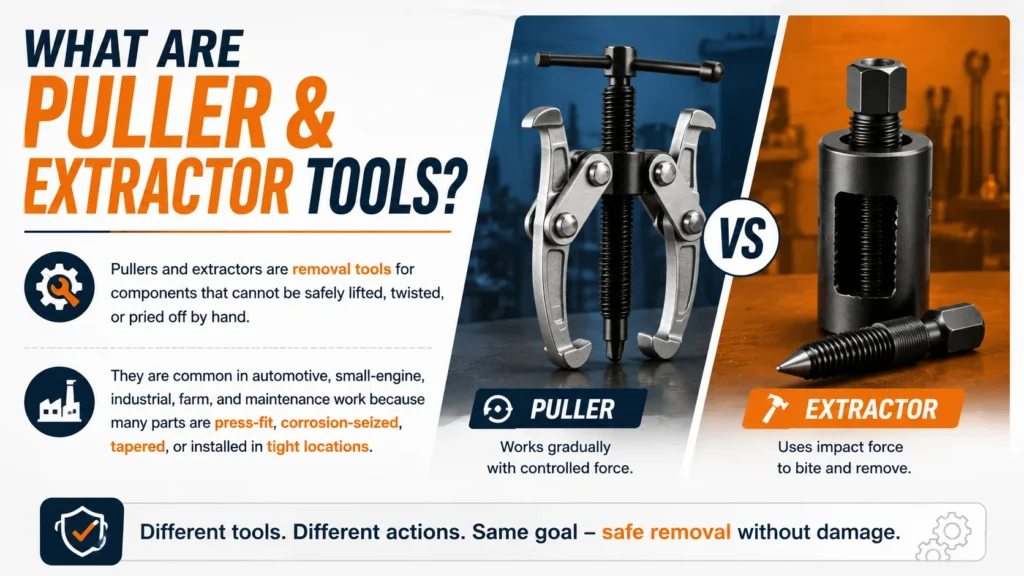
Pullers and extractors are removal tools for components that cannot be safely lifted, twisted, or pried off by hand. They are common in automotive, small-engine, industrial, farm, and maintenance work because many parts are press-fit, corrosion-seized, tapered, or installed in tight locations.
The terms overlap in everyday use, and manufacturers do not always use them in exactly the same way. The useful distinction is how the tool gets purchase and how it delivers force: a screw-type puller works gradually, while a slide hammer uses repeated impact and an extractor socket bites into a damaged fastener.
Practical rule
Before increasing force, clean exposed threads, confirm the attachment points, and check that the tool is centered. If jaws begin walking off, a crossbar bends, or the component does not move as expected, stop rather than simply pulling harder.
How a screw-type puller works
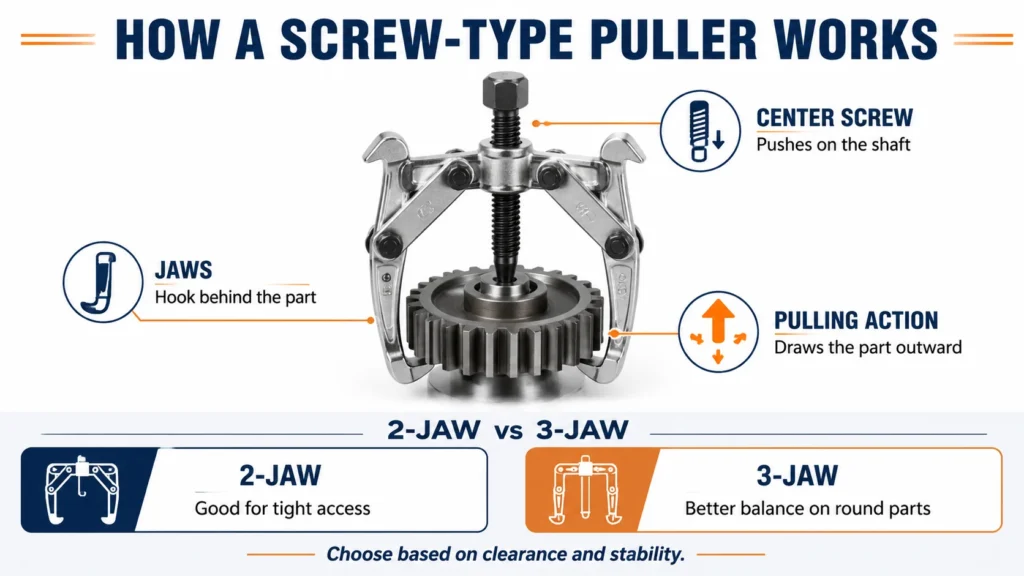
A typical puller has jaws or attachment arms, a body or crossbar, and a center forcing screw. The jaws hook behind a component while the screw bears against the end of the shaft. Tightening the screw creates opposing forces: the screw pushes on the shaft while the jaws draw the component outward.
Two-jaw vs three-jaw pullers
A 2-jaw puller and a three-jaw puller can both remove gears and pulleys. The better choice depends on clearance, component shape, and whether the tool can stay centered under load—not on a rule that one design is always superior.
2-jaw puller
Useful when access is limited or only two strong contact points are available. Keep the jaws opposite each other and watch for the component tilting as force increases.
Three-jaw puller
Often centers more naturally around round components and spreads the load across three contact points. It still needs enough room for every jaw to engage a strong area.
Gear pullers and pulley removal tools
A general-purpose gear or pulley puller is appropriate only when its jaws can safely reach behind a robust hub or reinforced section. Do not pull against a thin pulley lip, plastic fan, belt groove, or bonded outer ring unless the equipment procedure specifically permits it.
Bearing pullers, bearing splitters, and separators
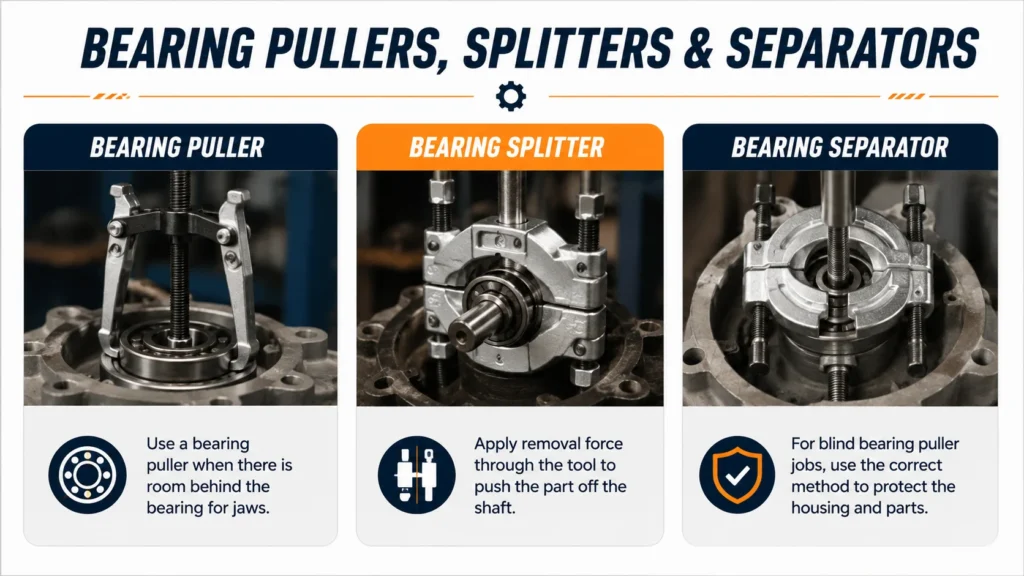
Bearing removal is where tool geometry matters most. An external bearing puller hooks behind an exposed bearing; an internal or blind bearing puller grips inside a bearing that sits in a bore. A bearing splitter—also called a bearing separator—clamps behind a thin bearing or gear and gives the main puller a firm surface to pull from.
- Use a bearing separator when there is too little shoulder behind the bearing for ordinary puller jaws.
- Apply removal force through the race that is press-fit on the part being removed whenever possible.
- For wheel bearing puller jobs, check the service manual: ABS sensors, snap rings, axle splines, and press-fit housings change the correct method.
Slide hammers and axle pullers
A slide hammer puller uses a weighted handle that strikes a stop along a shaft, creating repeated impact extraction force. With the correct attachment, a slide hammer can pull hubs, axles, seals, bearings, and body-repair tabs. It is particularly useful when a steady center-screw puller has no practical way to brace itself.
Impact is not automatically better. A slide hammer can shock surrounding components, distort threads, or damage a delicate housing if its attachment is incorrect. Use a screw puller where gradual, measurable force is safer, and use an axle puller plate or vehicle-specific adapter when the axle design requires one.
When a specialty puller is the right answer
Universal pullers are useful, but they cannot safely replace every dedicated removal tool. Specialty designs use the component’s intended threaded holes, hub shape, or installation geometry to apply force without loading fragile edges.
Harmonic balancer puller
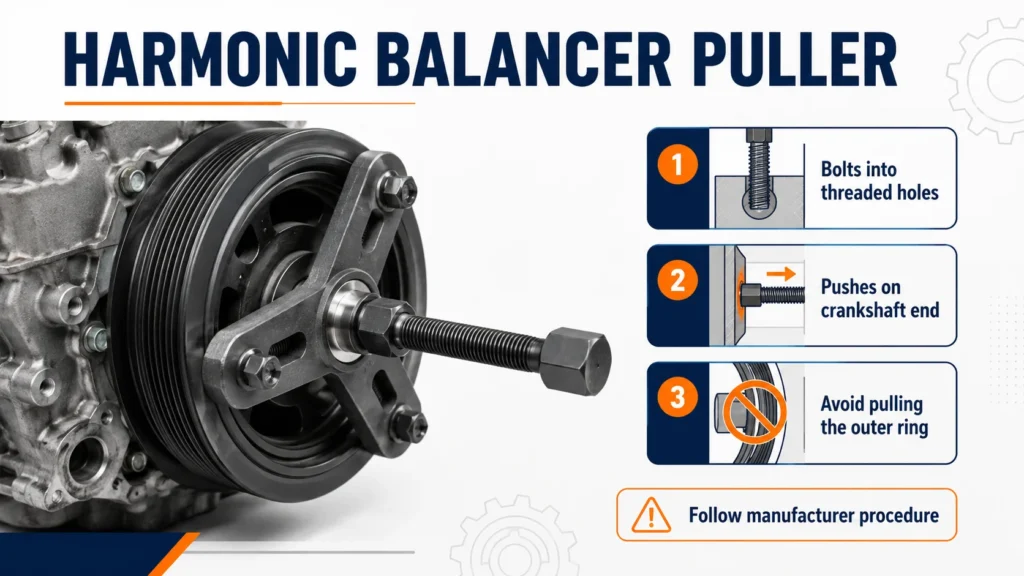
A harmonic balancer puller commonly bolts into threaded holes in the balancer and pushes against the crankshaft end. Do not pull on the outer ring unless the manufacturer procedure explicitly allows it; some balancers use bonded construction that can be damaged by incorrect jaw placement.
Flywheel puller
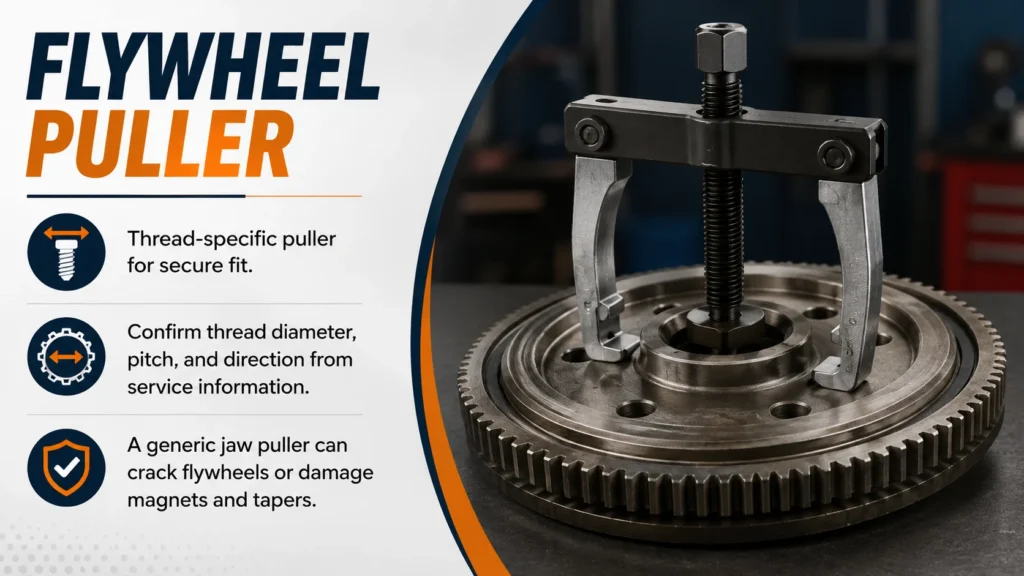
Motorcycle, powersports, and small-engine flywheels often require a thread-specific flywheel puller. Confirm the thread diameter, pitch, and direction from service information before buying. A generic jaw puller can crack a flywheel or damage magnets and tapers.
Hub puller and wheel bearing puller
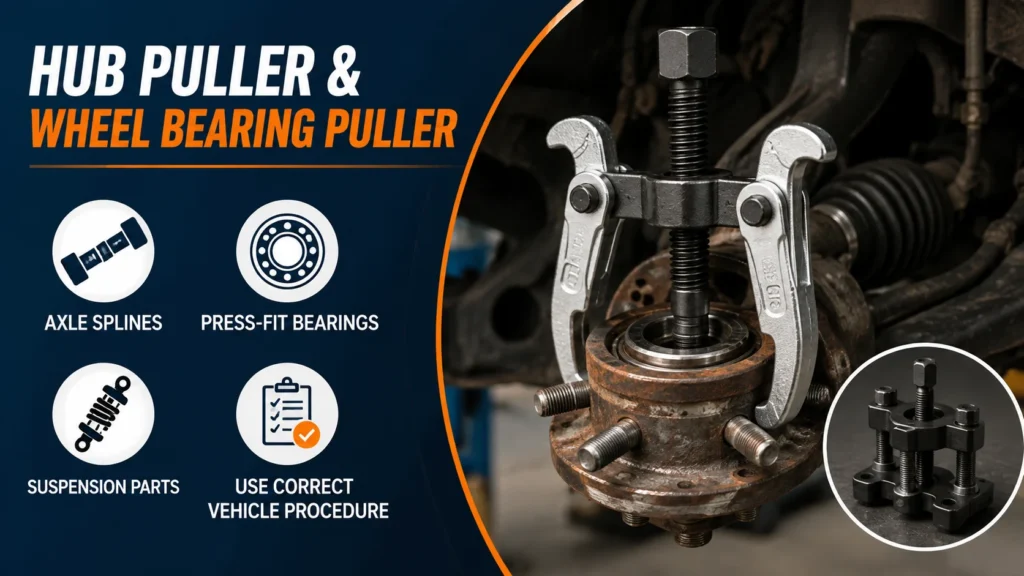
Wheel hub puller and wheel puller jobs may involve axle splines, press-fit bearings, and suspension parts. Use the correct vehicle procedure instead of adding leverage. Some hubs come out with a bolt-on puller, while others require a press, bearing kit, or knuckle removal.
Power steering pump pulley pullers
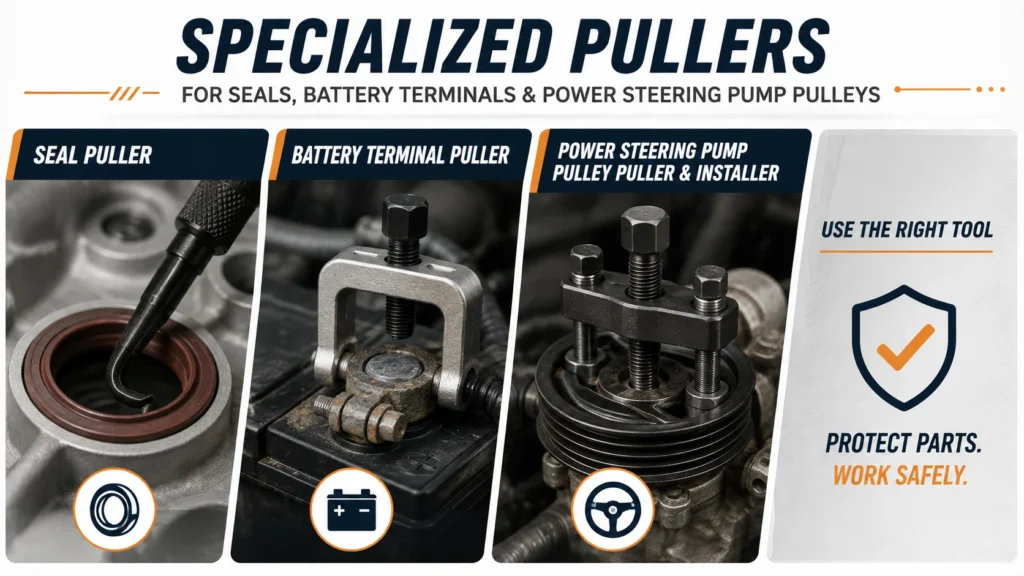
A seal puller tool hooks a seal out of its bore, but the sealing surface must not be scratched. A battery terminal puller lifts a corroded terminal evenly from the battery post instead of twisting it off. A power steering pump pulley puller and installer set is designed for press-fit pulleys; prying can bend the pulley or damage the pump shaft.
Bolt extractor sockets and extractor bits
Bolt extractor sockets are not pullers. They are bolt removal tools with reverse or spiral gripping flutes that bite into a rounded, rusted, or damaged bolt head as turning torque is applied. Choose a socket that fits tightly, drive it on squarely if instructed, and use steady control rather than sudden side loading.
Extractor bits are commonly used after a broken screw or bolt has been drilled. Spiral extractors, straight-flute extractors, and left-hand drill bits all work differently. They can be effective, but a broken hardened extractor inside the fastener can make the job substantially harder, so drill accurately and avoid excessive twisting force.
How to choose the right puller tool
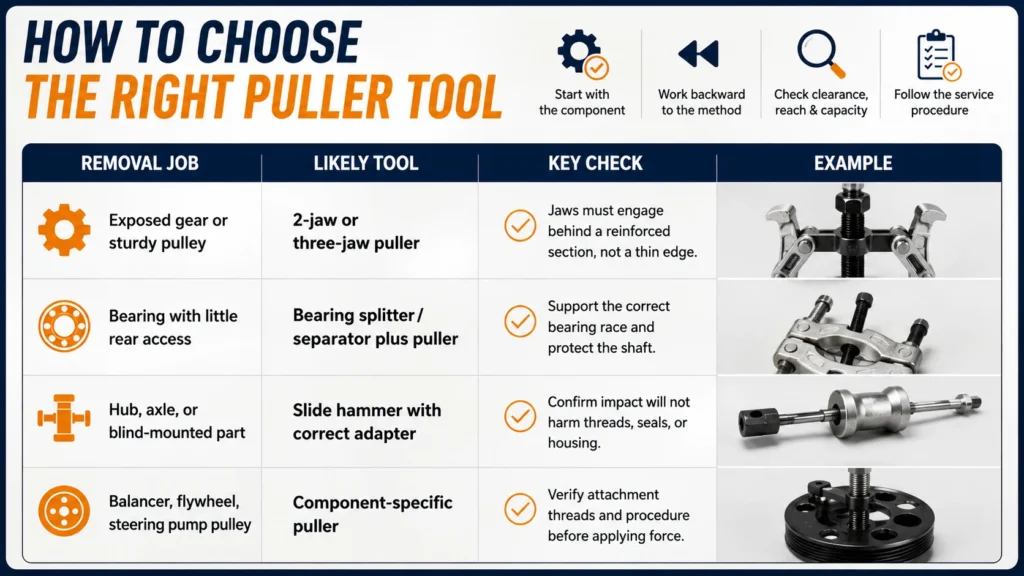
Start with the component, then work backward to the attachment method. Consider whether you need an outside grip, an internal grip, a threaded adapter, or impact force. Also check available clearance, jaw reach, puller capacity, shaft diameter, and the service procedure for the exact equipment.
| Removal job | Likely tool | Key check |
|---|---|---|
| Exposed gear or sturdy pulley | 2-jaw or three-jaw puller | Jaws must engage behind a reinforced section, not a thin edge. |
| Bearing with little rear access | Bearing splitter / separator plus puller | Support the correct bearing race and protect the shaft. |
| Hub, axle, or blind-mounted part | Slide hammer with correct adapter | Confirm impact will not harm threads, seals, or housing. |
| Balancer, flywheel, steering pump pulley | Component-specific puller | Verify attachment threads and procedure before applying force. |
Common puller mistakes to avoid
Most damage happens when a tool is close enough to fit but wrong for the load path. Controlled force only helps when the part, tool, and support points are all aligned.
- Pulling on a weak pulley lip, seal bore edge, or bearing cage instead of a strong support surface.
- Running the forcing screw off-center and damaging shaft threads or causing the component to cock.
- Using heat, impact tools, or a cheater bar without knowing the component’s limits or tool rating.
- Continuing after jaws start slipping, a separator shifts, or the puller body visibly flexes.
When to stop
For harmonic balancers, flywheels, wheel bearings, axles, and power-steering pump pulleys, use current vehicle or equipment service information. These jobs can have model-specific fasteners, puller threads, torque steps, and safety precautions that a universal tool guide cannot replace.
Frequently asked questions
Is a three-jaw puller always better than a 2-jaw puller?
No. A three-jaw puller often gives balanced contact on round parts, but a 2-jaw puller may be the only safe option when access is limited. The correct choice is the one that can engage securely, stay centered, and pull from a strong part of the component.
Can a universal puller remove any pulley?
No. Some pulleys require a dedicated tool, especially harmonic balancers and press-fit power steering pump pulleys. A universal jaw puller may bend a thin pulley or damage a bonded or threaded component.
What is the difference between an extractor socket and an extractor bit?
An extractor socket grips the outside of a damaged bolt head. An extractor bit is generally used after drilling into a broken fastener so the tool can turn it out from inside. Both require controlled alignment to avoid making the repair harder.