
BMW’s largest SUV combines standard three-row seating, all-wheel drive, and serious performance. Here is what families and luxury buyers should know before adding the 2025 BMW X7 to a shortlist.
The 2025 BMW X7 is BMW’s answer for shoppers who need more than a two-row luxury SUV. It has a standard third row, available seating for six or seven, and a choice of smooth inline-six or powerful V8-based drivetrains. It is especially compelling for buyers who want a family-capable cabin without giving up the confident highway performance and premium feel associated with BMW. The key question is not whether the X7 is luxurious, it is whether its seating layout, cargo tradeoffs, size, and price fit the way your household actually travels.
2025 BMW X7 at a glance
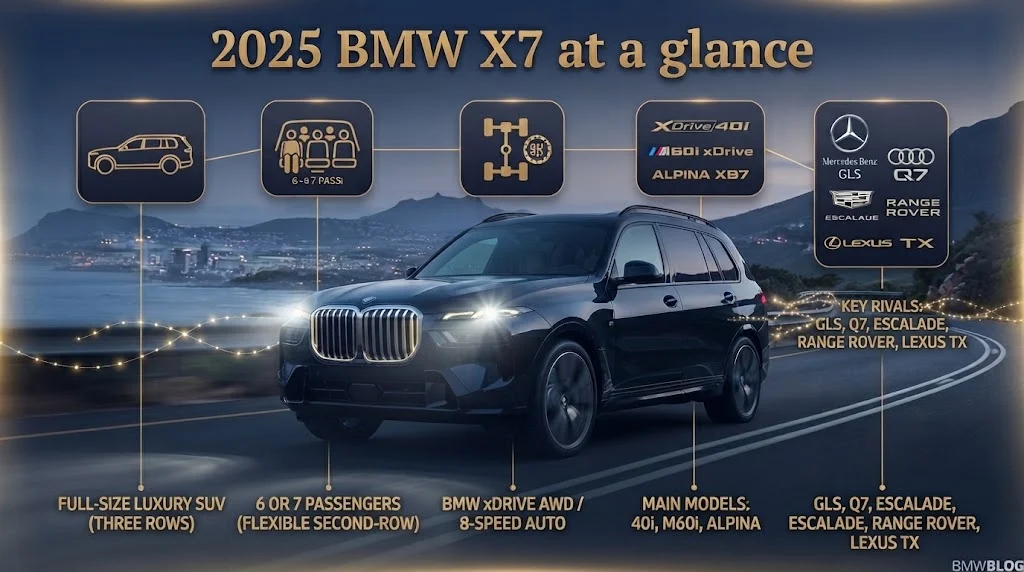
| Vehicle type | Full-size luxury SUV with three rows |
| Seating | Six or seven passengers, depending on second-row configuration |
| Drivetrain | BMW xDrive all-wheel drive and 8-speed automatic transmission |
| Main models | xDrive40i, M60i xDrive, and ALPINA XB7 |
| Key rivals | Mercedes-Benz GLS, Audi Q7, Cadillac Escalade, Range Rover, and Lexus TX |
What’s new for the 2025 BMW X7?
The 2025 X7 largely carries forward the modernized design, curved-display cabin, mild-hybrid powertrains, and standard three-row format introduced with the current generation’s facelift. For shoppers, the most important year-specific checks are not cosmetic headlines but current package availability, standard-feature changes, paint and wheel availability, and MSRP on the exact build.
2025 BMW X7 trims explained
All X7 versions use all-wheel drive, an 8-speed automatic transmission, and three rows. The real decision is how much performance, luxury equipment, and V8 running cost you want to take on.
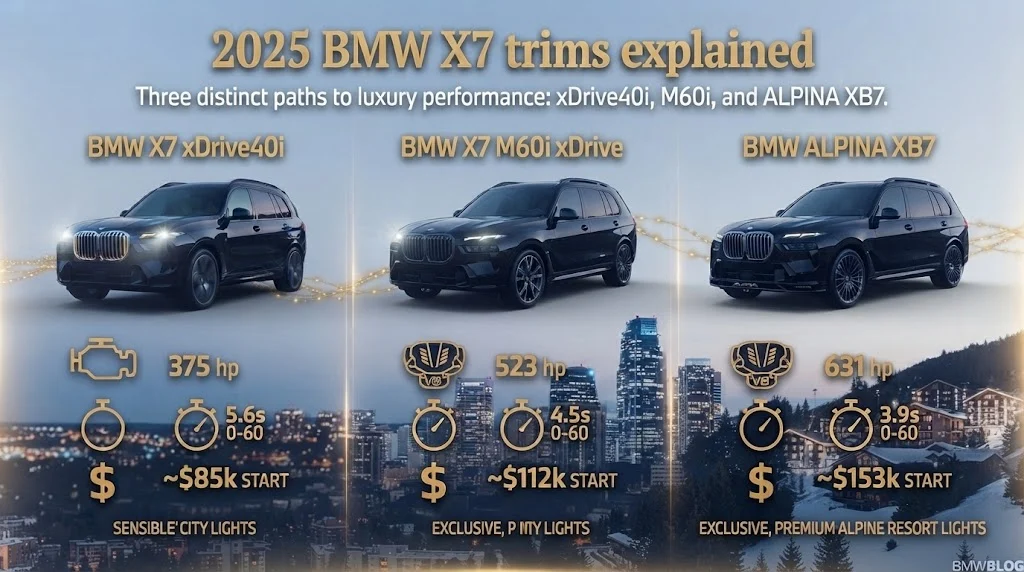
| Specification | xDrive40i | M60i xDrive | ALPINA XB7 |
|---|---|---|---|
| Engine | 3.0L turbo inline-six with 48V mild hybrid | 4.4L twin-turbo V8 with 48V mild hybrid | ALPINA-tuned 4.4L twin-turbo V8 |
| Horsepower | 375 hp | 523 hp | 631 hp |
| 0–60 mph | About 5.6 seconds | About 4.5 seconds | About 3.9 seconds |
| Starting MSRP | Around $85,000 before destination and options | Around $112,000 before destination and options | Around $153,000 before destination and options |
BMW X7 xDrive40i
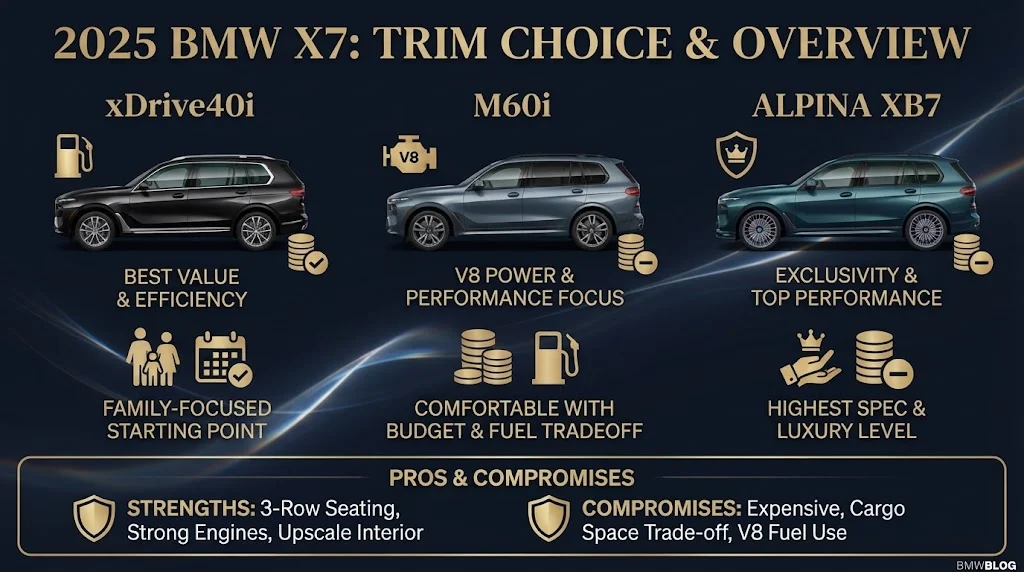
The xDrive40i is the sensible starting point for most households. Its turbocharged inline-six provides strong passing power and a more favorable fuel-cost outlook than the V8 models, while retaining the X7’s core three-row practicality and luxury character.
BMW X7 M60i xDrive
The M60i adds V8 urgency, M-oriented visual details, and a more performance-focused personality. It suits buyers who want the X7’s size but do not want it to feel slow or purely comfort-led. The tradeoff is a much higher purchase price and greater fuel use.
BMW ALPINA XB7
The ALPINA XB7 sits at the top of the broader X7 family. It is aimed at buyers who want exceptionally quick acceleration, distinctive ALPINA tuning, and a more exclusive luxury-performance experience. It is a niche choice rather than the practical value pick.
Is the BMW X7 a true 3-row SUV?
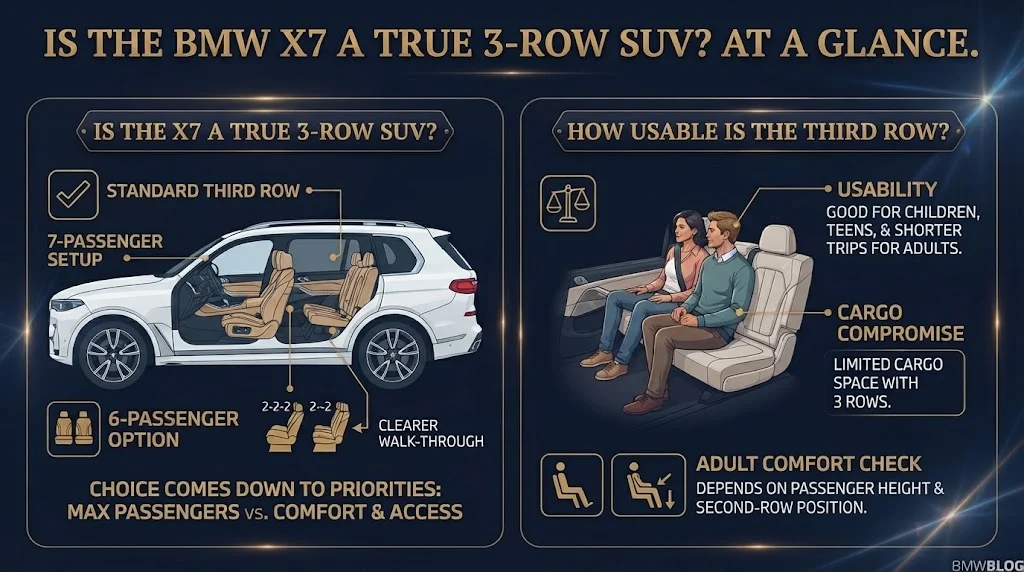
Yes. The X7 is BMW’s full-size three-row SUV, and its third row is standard. A seven-passenger setup uses a second-row bench; available second-row captain’s chairs reduce capacity to six but create a clearer walk-through route to row three.
For a family, the choice comes down to priorities. Choose the bench when maximum passenger count matters. Choose captain’s chairs when third-row access, separation between passengers, and second-row comfort matter more. Neither layout eliminates the need to test child-seat placement and your preferred entry routine.
How usable is the X7 third row?
The X7’s third row is more useful than the occasional-use rear seats in many midsize luxury SUVs, particularly for children, teenagers, and average-size adults on shorter trips. Adults should still sit in it before buying: comfort depends on second-row position, passenger height, and how often every seat will be occupied. With all three rows in use, cargo space becomes the bigger compromise.
Interior, cargo space, and dimensions
The X7’s appeal is not only its passenger count. It offers an upscale cabin, a broad dashboard display, a high seating position, and a more substantial second row than smaller BMW SUVs. Its cargo layout is flexible, but shoppers should plan around their most demanding use case rather than the maximum-cargo figure with the rear seats folded.
Cabin comfort
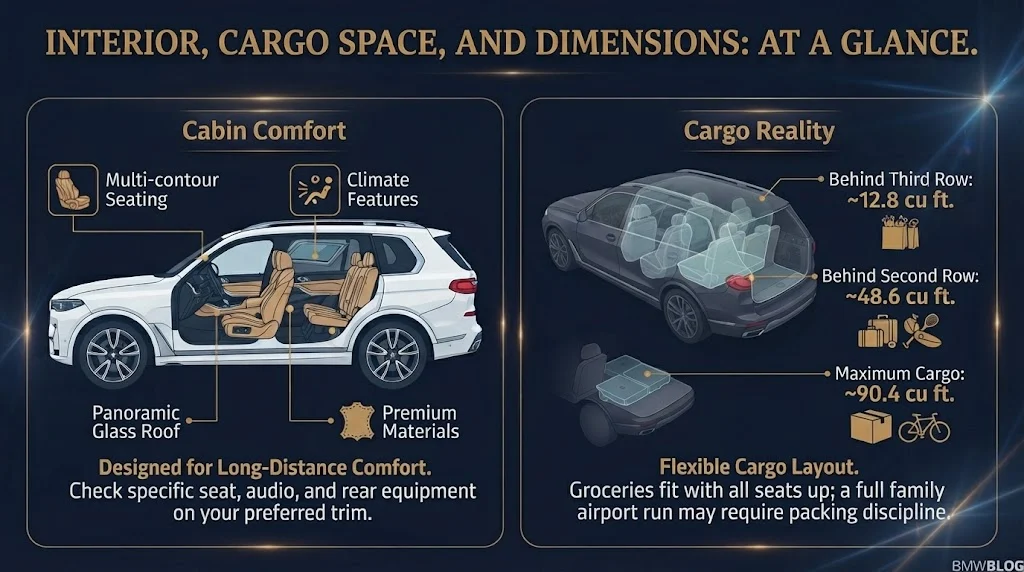
The X7 is designed for long-distance comfort, with premium materials, available multi-contour seating, climate features, and a panoramic glass roof. Check the precise seat, audio, and rear-cabin equipment on your preferred trim.
Cargo reality
BMW lists roughly 12.8 cubic feet behind the third row, 48.6 with row three folded, and up to 90.4 with both rear rows folded. Groceries fit with all seats up; a full family airport run may require packing discipline.
Will the X7 fit your everyday life?
At roughly 203.9 inches long and more than 78 inches wide without mirrors, the X7 is a large vehicle. Its size benefits passenger room and road-trip stability, but it can make older garages, tight parking decks, and narrow city streets more demanding. Measure your garage and usual parking space before committing.
Performance, fuel, towing, technology, and safety
Engines and ride quality
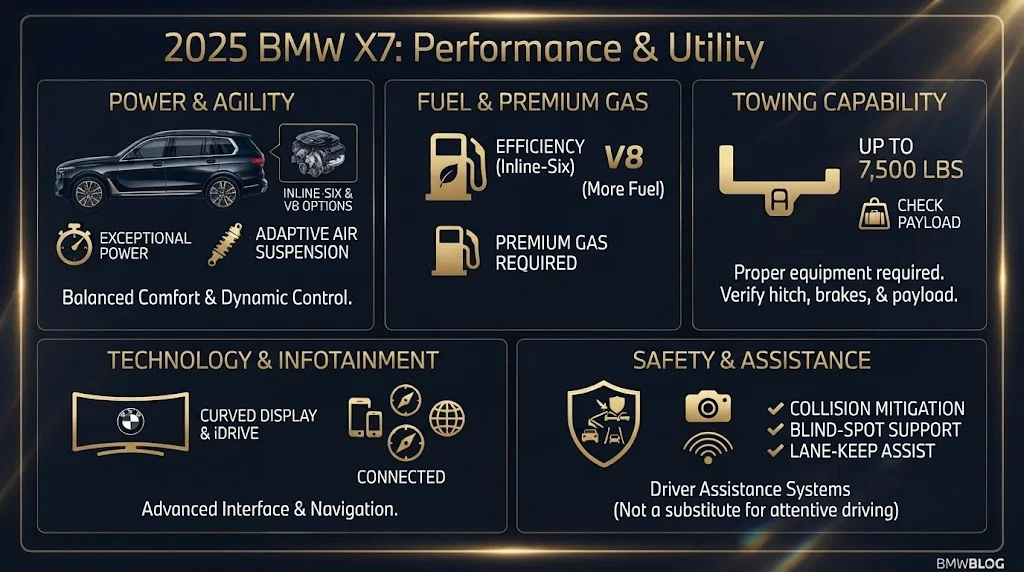
Even the xDrive40i has enough power for relaxed highway merging and loaded family travel. The M60i and XB7 deliver performance that is extraordinary for a three-row SUV. Adaptive air suspension helps the X7 balance comfort with body control, although wheel choice and performance-oriented specifications can affect ride feel.
Fuel economy and premium gasoline
Official EPA figures should be checked for the exact 2025 configuration, but the inline-six xDrive40i is generally the efficiency choice while V8 versions use more fuel. BMW specifies premium unleaded gasoline for optimum performance, so premium-fuel cost should be part of the ownership budget—not an afterthought.
Towing capacity
When properly equipped, the X7 can be rated to tow up to 7,500 pounds in the U.S. That maximum does not mean every trailer setup is equally suitable. Confirm the hitch equipment, your vehicle’s rating, trailer brakes, payload, passenger load, and local towing requirements before relying on the headline figure.
Technology and infotainment
The X7 uses BMW’s Curved Display and iDrive interface, with smartphone integration, navigation-related functions, and connected services depending on specification. It is an impressive interface, but buyers should spend time using the menus and checking physical-control preferences during a test drive.
Safety and driver assistance
Driver-assistance equipment can include collision mitigation, blind-spot support, lane-related assistance, parking aids, cameras, and available advanced highway-assistance functions. Treat these as assistance systems rather than substitutes for attentive driving, and verify which features are standard versus package-dependent.
2025 BMW X7 price: what buyers should budget for
The X7 begins in luxury-SUV territory and can climb quickly as performance, seating, driver-assistance, audio, wheel, paint, and interior options are added. Starting MSRP is not the out-the-door price: account for destination charges, options, taxes, registration, insurance, financing, premium fuel, and maintenance when comparing it with a GLS or other large luxury SUV.
Which BMW X7 trim should you choose?
xDrive40i:
Best starting point for families who want the X7’s seating, luxury, and everyday performance with comparatively lower fuel and purchase costs.
M60i:
Best for buyers who want a V8 and a stronger performance edge, and are comfortable with a larger budget and fuel tradeoff.
ALPINA XB7:
Best for the niche buyer seeking the highest level of X7 performance, exclusivity, and luxury specification.
2025 BMW X7 pros and compromises
Strengths include standard three-row seating, strong engines, an upscale interior, and a composed driving character for a large SUV. The compromises are just as important: it is expensive, physically large, option costs add up, V8 models consume more fuel, and cargo room behind the third row is modest when every seat is occupied.
BMW X7 vs. BMW X5 and Mercedes-Benz GLS
X7 vs. X5:
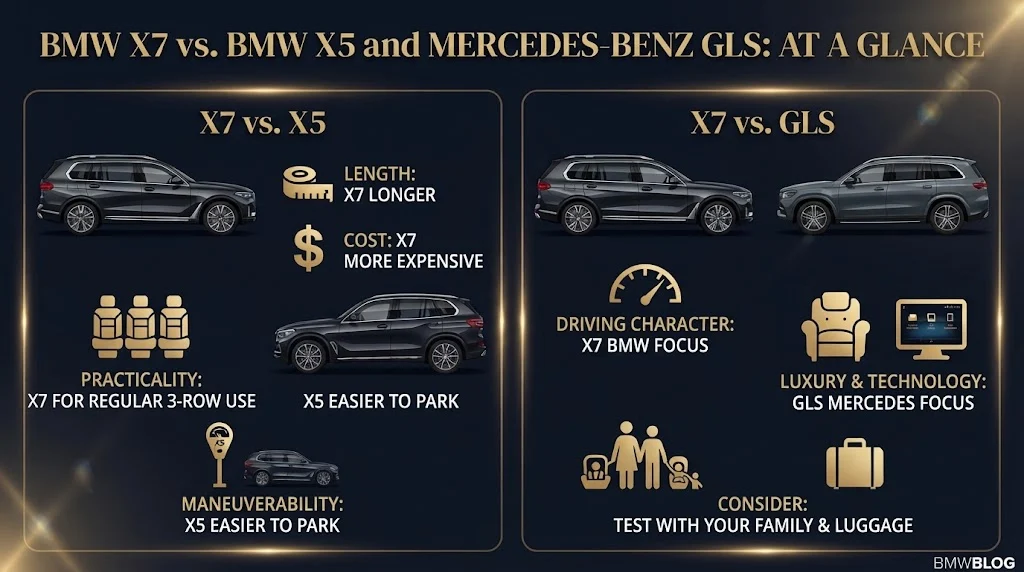
The X7 is longer, more expensive, and substantially more practical for buyers who regularly need a third row. The X5 is easier to park and may be the smarter fit if row three is rarely needed. Existing BMW owners moving up from an X5 should view the X7 as a meaningful space upgrade, not simply a larger version of the same use case.
X7 vs. GLS:
Both are premium three-row SUVs with strong powertrains and upscale cabins. The X7 tends to appeal to buyers who place a high value on BMW’s driving character, while the GLS is a natural cross-shop for shoppers focused on spacious luxury and the Mercedes-Benz approach to comfort and technology. Test both with your family, child seats, and regular luggage.
Is the 2025 BMW X7 worth it?
The X7 is worth shortlisting if you need a genuinely useful third row, want a premium road-trip vehicle, and value BMW performance enough to justify luxury-SUV ownership costs. Consider alternatives if maximum cargo volume, a lower purchase price, or lower fuel consumption is your top priority. The best answer comes after testing the third row, measuring your garage, and pricing the exact configuration you would actually buy.
Frequently asked questions
Is the 2025 BMW X7 a 3-row SUV?
Yes. The BMW X7 is BMW’s full-size luxury SUV with a standard third row and available seating for six or seven people.
Does the BMW X7 seat seven people?
Yes, when equipped with the second-row bench. Models with second-row captain’s chairs generally seat six, trading one passenger position for easier third-row access and more individual second-row space.
Is the BMW X7 third row suitable for adults?
It can work for average-size adults on shorter journeys, but it is best assessed in person. The comfort of row three depends on passenger height, the position of row two, and whether the vehicle is being used for occasional guests or regular full-capacity travel.
How much can a BMW X7 tow?
Properly equipped U.S.-spec X7 models can be rated for up to 7,500 pounds of towing. Always check the rating and equipment for the specific vehicle, as trailer setup and payload affect real-world suitability.