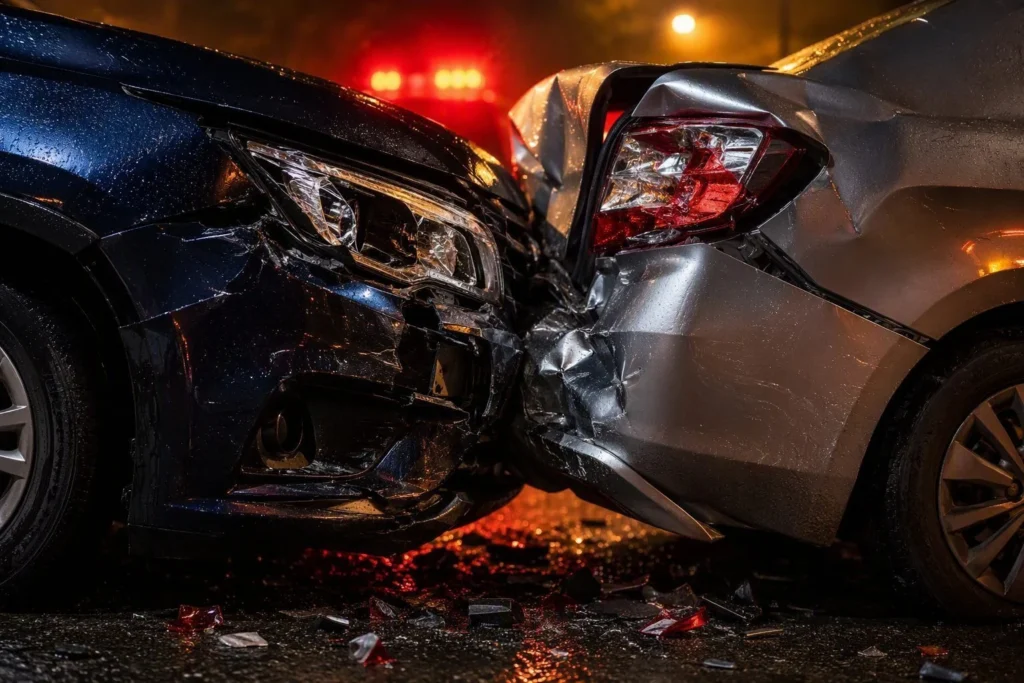
You stop behind traffic. A driver slams into your rear bumper and shoves your car into the vehicle ahead. Now two damaged drivers and multiple insurers are all circling the same question: who pays?
If another driver rear-ends you and pushes your stopped car into the vehicle ahead, the driver who caused the first impact may be responsible for both collisions. You are not automatically at fault for the front-end impact. However, payment can be divided if evidence shows that you or another driver also contributed, and state liability rules affect the result.
Before anyone pays, investigators have to establish one thing: whether the middle car was already moving, or had already made contact with the lead vehicle, before it was pushed.
What Is a Chain-Reaction Car Accident?
A chain-reaction car accident is a collision in which one impact triggers at least one additional impact involving another vehicle. The term covers a simple three-car rear-end crash, an intersection collision that redirects one vehicle into another, or a larger pileup. The common thread is sequence. One collision leads to another.
Here is the distinction that matters most: vehicle position does not prove collision sequence. A car found in the middle may be a victim of the initiating impact, a contributing driver, or both at once.
Picture three cars. Car A stops. Car B stops behind Car A. Car C hits Car B and pushes it into Car A. From the outside, the wreckage may look nearly identical in two very different scenarios:
- Car C hits Car B, and Car B is pushed into Car A.
- Car B hits Car A first, and Car C then hits Car B.
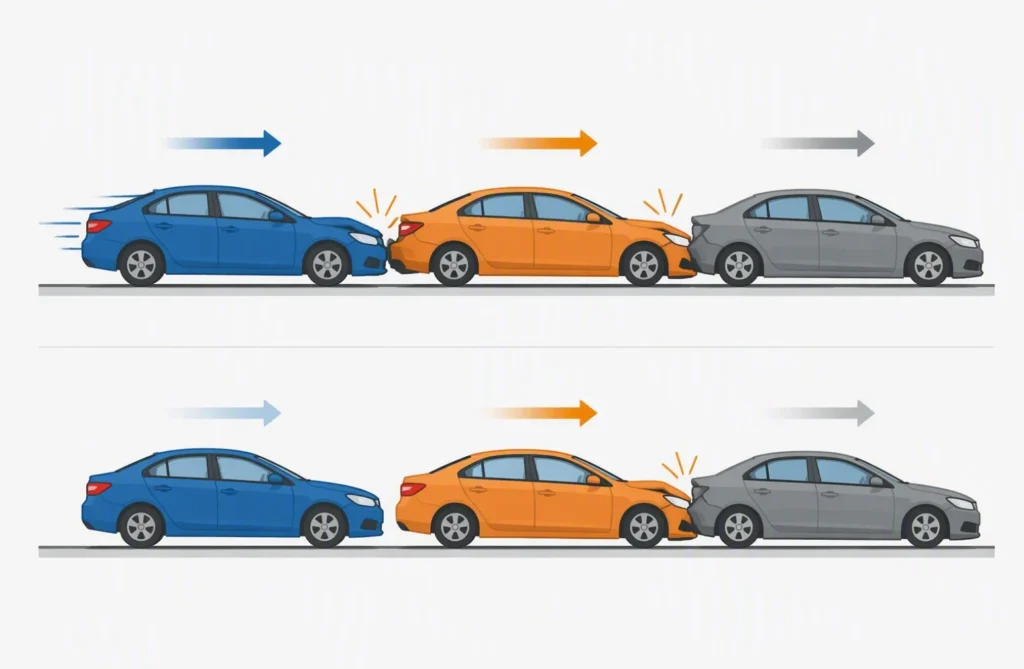
Similar wreckage can involve different fault. That is why insurers and officers examine damage patterns and video before assigning blame.
How Is Chain Reaction Accident Fault Determined?
Deciding who is at fault in a chain reaction accident starts with identifying which impact set the sequence in motion.
The driver who started the chain reaction often carries the largest share of fault, but the first impact does not automatically settle responsibility for every collision. Fault becomes a question of evidence, not vehicle order.
When the rear driver may be responsible
A driver who fails to stop and propels a stationary vehicle forward may be responsible for damage to both vehicles ahead. Say Car B is fully stopped with its brake lights working, Car C strikes it, and Car B has no realistic chance to avoid Car A. Video and consistent front-and-rear damage patterns support that sequence, and Car C may be liable for both impacts.
Be careful with the word “presumed.” Some states recognize a rear-end presumption that may shift a burden to the rear driver, but the rules for rebutting that presumption vary. Check claims that a particular driver is always or never at fault against the applicable state law.
When the pushed driver may share fault
Certain fact patterns change the result. Car B may have already contacted Car A before Car C’s impact, or it may have been following too closely, with the later impact only worsening an existing collision. An unsafe lane movement by the middle driver can contribute as well. And sometimes a separate driver forces an evasive maneuver that starts the whole sequence.
A brake-light defect or a short following distance does not automatically establish legal fault. Those are facts to investigate, not conclusions.
Who pays for the damage?
“Who pays” can mean different things. An at-fault driver’s liability insurer may pay covered claims. You may use your own collision coverage first, subject to a deductible, while your insurer seeks repayment from the at-fault driver’s insurer through a process called subrogation. Uninsured or underinsured motorist coverage may also matter depending on the state, the policy, and the type of loss.
Check your declarations page and every claim letter before assuming what is covered. For context on how crashes begin, NHTSA’s 2008 National Motor Vehicle Crash Causation Survey assigned the critical reason to the driver in about 94% of the crashes studied. NHTSA warned that “critical reason” is not the same as legal cause or fault, so that figure does not decide an individual claim.
How Police Determine Fault in a Multi Car Accident
Police document the scene and may record contributing factors or issue citations, but insurers and courts can make their own liability decisions. That distinction matters when a police report does not support your account.
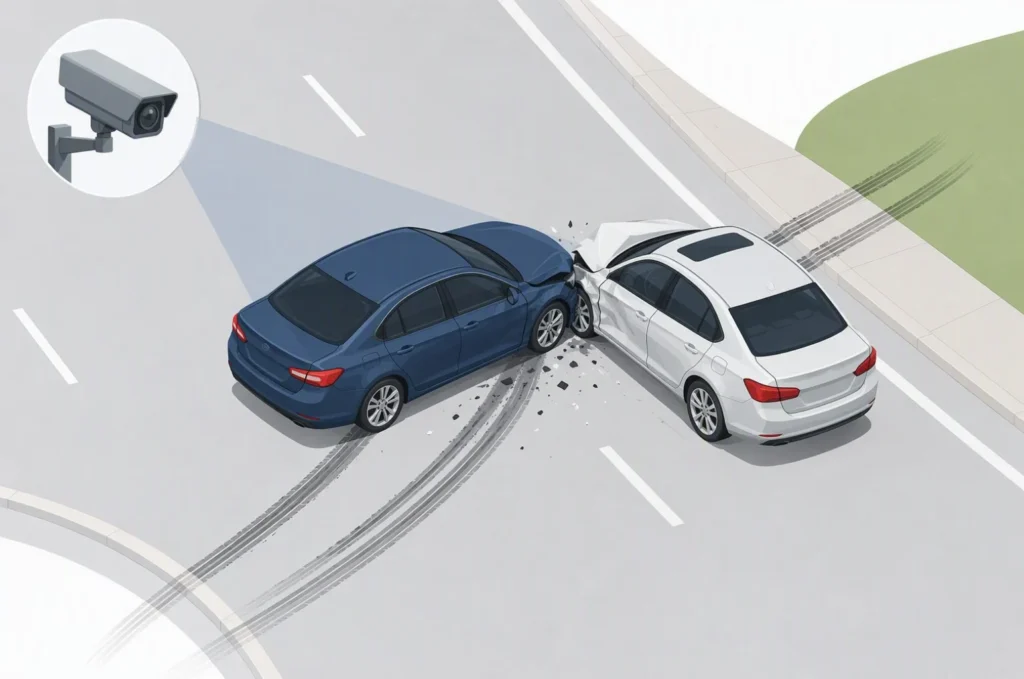
Officers work from the available scene evidence. They note final vehicle positions, the location and crush direction of the damage, skid marks, debris fields, and fluid trails. They collect driver and witness accounts, request available traffic-camera or dashcam footage, and record road, weather, and visibility conditions. Citations for suspected violations may also appear in the report.
A police report can be influential without being the final legal ruling. If the officer did not witness the crash, parts of the report may summarize statements rather than firsthand observations. How much weight a report carries in court varies by jurisdiction.
How insurance companies decide who is at fault
Insurers compare available accounts with the physical evidence, apply the policy and state fault rules, and then assign liability for claim-handling purposes. That process typically includes recorded statements, vehicle inspections, photo review, adjuster interviews, and retrieval of available video. In disputed cases, an insurer may hire a crash reconstructionist. Two insurers can review the same file and initially reach different conclusions, which is when thorough documentation becomes especially important.
Evidence Needed to Prove Order of Impact
Dashcam video with a reliable timestamp is often the clearest proof of impact order, but damage patterns, event data, witness accounts, scene photographs, and the police report can help establish the sequence when no video exists. If you are assembling evidence, consider what each item can and cannot show.
| Evidence | What it may show | Important limitation |
| Dashcam or traffic video | Which impact happened first; vehicle movement | Clips can be overwritten or lack a clear angle |
| Damage and crush patterns | Direction and relative force of impacts | Similar damage can support more than one account |
| Event data recorder | Speed, braking, throttle, and restraint data near a crash | Availability and recorded fields vary by vehicle |
| Witness account | Timing and vehicle behavior from an outside view | Position, attention, and memory affect reliability |
| Scene photos | Vehicle placement, debris, lanes, and road conditions | Photos taken after vehicles move lose context |
| Police report | Statements, diagram, citations, and officer observations | The officer may not have witnessed the impacts |
A rear impact followed by a front impact can produce two distinct jolts, and feeling both is useful information. A driver’s memory alone may not settle the sequence, though, especially after the stress of a crash.
Modern vehicle data, including information from an event data recorder, should be preserved quickly because it may capture pre-crash details such as speed and braking. Downloading it properly may require a qualified professional. Do not attempt to retrieve data from another person’s vehicle without consent or lawful authority.
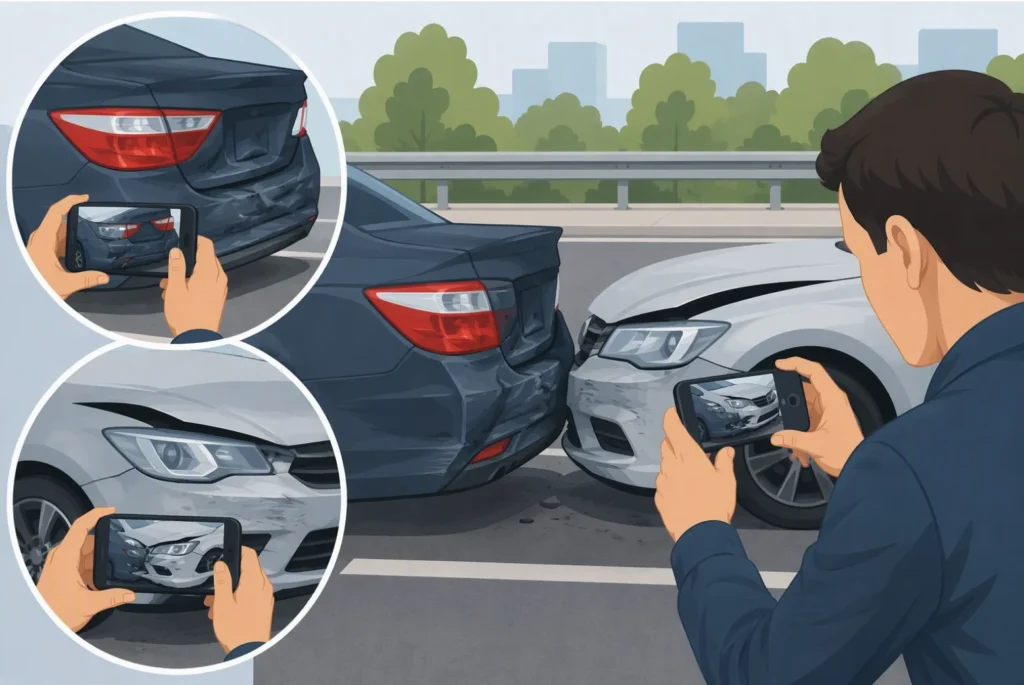
Preserve files carefully. Save the originals, do not crop or edit them, and record who created each file and when.
Can Fault Be Shared in a Chain Reaction Crash?
Yes. Multiple drivers can share responsibility when separate acts contributed to the same chain-reaction crash, but the financial effect depends on the state’s liability rules. Whether fault can be shared is ultimately a question of the law where the crash occurred.
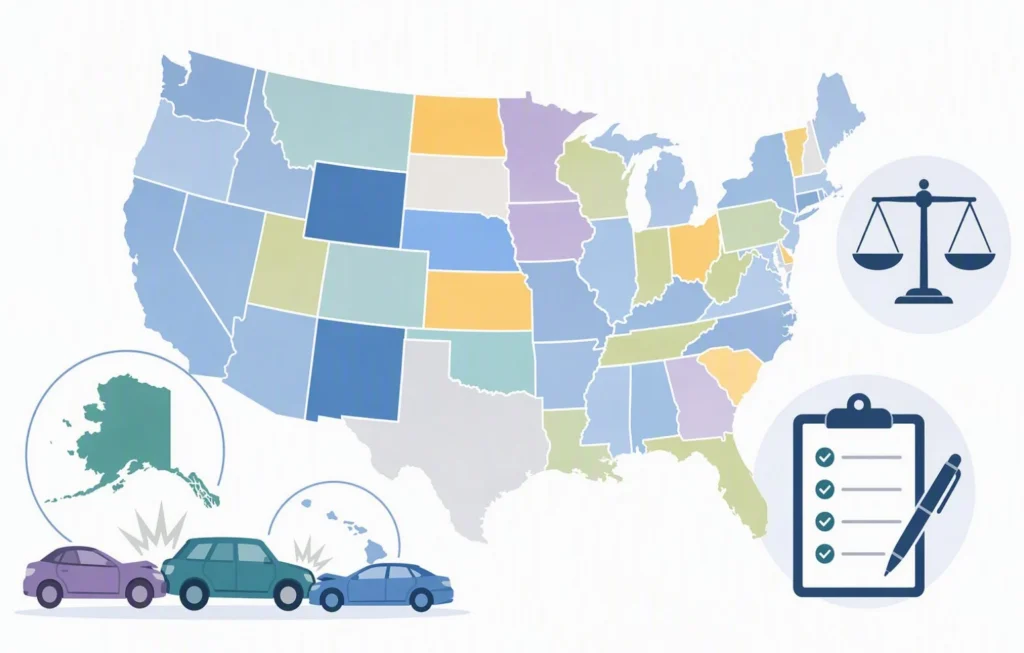
Three concepts drive many of the differences. Under contributory negligence, which remains in a small number of jurisdictions, a claimant’s own negligence can sharply limit or bar recovery. Under comparative fault, damages are reduced by the claimant’s percentage of responsibility, with state-specific thresholds that may block recovery entirely. State law also controls whether defendants generally pay only their assigned shares or whether broader joint-and-several collection rules apply.
There is no single nationwide rule here. Liability standards vary by state.
Alaska example: percentage-based allocation
State rules can differ substantially. Alaska Statutes sections 09.17.080 and 09.17.900 address the allocation of fault, define fault to include negligent, reckless, or intentional conduct, and impose a several-liability approach under which a defendant generally pays according to that defendant’s percentage of fault. Read the statutes directly to see the operative language. When a pushed-car crash involves three drivers and two impacts, sorting out who is liable in a multi vehicle crash under Alaska law comes down to each driver’s conduct and the order of the impacts.
What Should You Say to the Insurance Company?
Report the crash promptly and describe only what you directly observed, including each impact you felt, without guessing about speed, legal fault, or events you could not see. Precise statements are easier to evaluate and less likely to create inconsistencies.
When considering what not to say to your insurance company after an accident, do not speculate, exaggerate, or accept blame merely to be polite. Do not state that you are uninjured if symptoms are still developing. Do not present a guess as fact, such as claiming the other driver was texting unless you actually saw it.
A brief statement can help you report only what you observed:
“I was stopped behind the first vehicle. I felt an impact from behind, then my car moved forward and contacted the vehicle ahead. I’m providing what I observed, and I’ll share the original photos and video files.”
You may ask for a liability or coverage decision in writing, request the policy basis for a coverage decision, and correct factual errors. You may also contact your state insurance regulator when appropriate. Keep meeting the cooperation requirements in your own policy, because failing to comply with them may affect coverage.
What Makes an Insurance Adjuster Take Notice?
Insurance adjusters take notice of credible evidence that challenges the claim file’s current account of the crash. Original video, consistent witness statements, documented damage patterns, and a clear impact timeline can make a disputed position harder to maintain. Threats or exaggeration are less useful than organized evidence and precise written communication.
What Claim Information Might Insurers Not Volunteer?
Insurance companies may not proactively explain every potentially available coverage, deadline, or reason behind a claim decision. The policy and applicable state law control your rights, so ask for coverage decisions and their policy basis in writing. Review your declarations and coverage forms rather than relying only on a brief phone explanation.
Quick Questions About Pushed-Car Collisions
What Happens If Someone Pushes You Into Another Car?
Not automatically. If you were stopped and had no practical opportunity to prevent the second collision, the evidence may support assigning fault to the driver who pushed your vehicle. Evidence that you hit the first car earlier or independently contributed can lead to shared responsibility under applicable state law. The Alaska example above shows how one state allocates fault by percentage.
Who pays when another vehicle shoves my car forward?
The initiating driver’s liability insurer may pay for the resulting damage if that driver is found responsible and the policy covers the loss. Your collision coverage may pay first, less any deductible, while your insurer later seeks recovery. Your policy’s declarations and coverage forms control what your insurer must pay.
Can the middle driver be blamed for both impacts?
Yes, if the evidence supports that conclusion. The middle driver, for example, may have hit the lead vehicle first and then been struck from behind, creating two separate liability questions. The result depends on the impact sequence and the applicable state fault rules.
What if the police report gets the sequence wrong?
Provide the insurer with original photos and video, witness details, and a concise written explanation of the disputed facts. Ask the reporting agency about its amendment or supplemental-statement process, because procedures vary by department. A correction request does not guarantee that the agency will change the original report.
Protect Your Position After the Crash
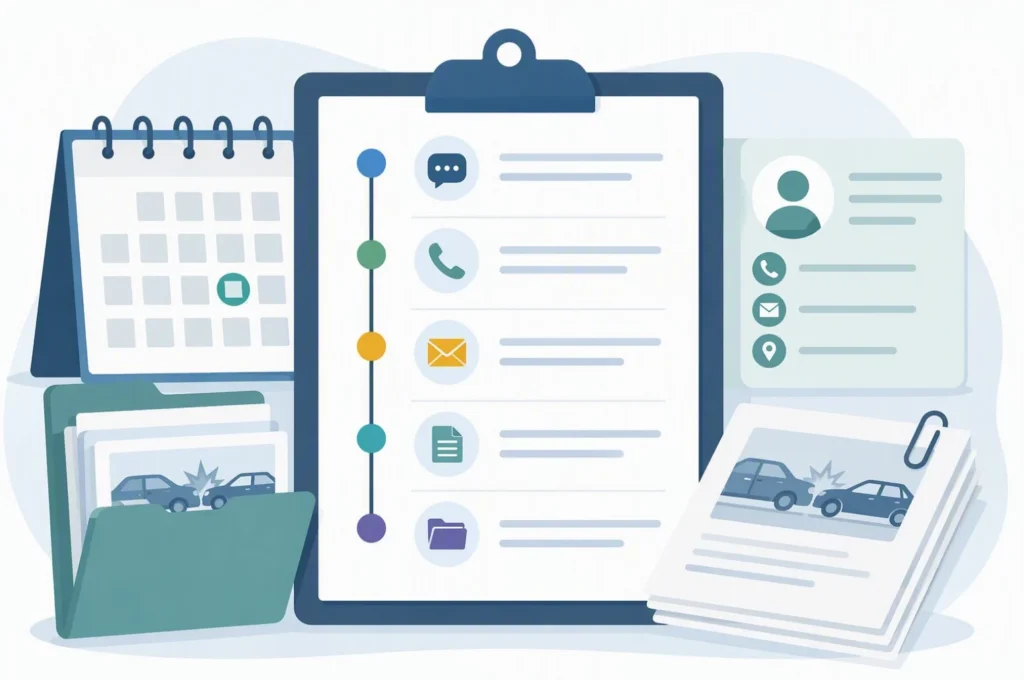
Get to safety first, seek medical care when needed, report the crash, preserve original evidence, request the police report, and track every claim communication with dates. If fault or injuries are seriously disputed, contact a licensed attorney in the state where the collision occurred, because that state’s rules govern the claim.
Before your next insurer call, write down the impact sequence in plain language. Save the original photos and videos in two secure locations.