
Learn to identify common types of nuts and bolts, understand where each fastener belongs, and match the right bolt and nut for automotive, construction, furniture, and machinery projects.
Nuts and bolts are threaded fasteners that clamp parts together. They are simple in principle, yet choosing the wrong bolt type, nut, grade, or thread can lead to stripped threads, loose joints, corrosion, or component damage. This guide focuses on visual identification and practical selection rather than treating one fastener as universally best.
What are nuts and bolts?
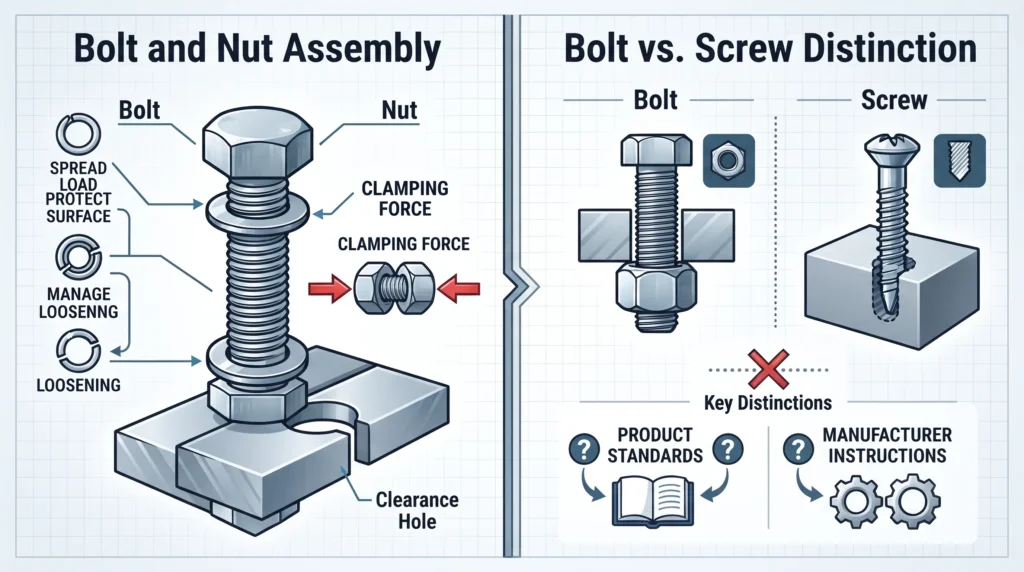
A bolt is an externally threaded fastener with a head at one end. It usually passes through a clearance hole and is tightened with a separate nut. A nut is the internally threaded partner that turns onto the bolt and creates clamping force. Washers are often added to spread load, protect a surface, or help manage loosening.
The line between a bolt and screw can blur because both have threads. In everyday use, a screw is often driven directly into a tapped hole or material, while a bolt is typically intended to work with a nut. Product standards and manufacturer instructions are the final authority for a particular application.
Nuts vs bolts vs screws
| Fastener | What identifies it | Typical use |
|---|---|---|
| Bolt | Head plus external threads; usually paired with a nut. | Joining machine parts, brackets, timber, frames, and assemblies. |
| Nut | Internal threads that mate with a compatible bolt or threaded rod. | Creates and holds clamping force on the opposite side of a joint. |
| Screw | Usually driven into a material or a tapped hole; may not use a nut. | Woodworking, sheet metal, trim, fixtures, and tapped machine parts. |
Common types of bolts and their uses
Bolt types are easiest to recognize by their head or overall shape. The use cases below are common examples, not a substitute for checking load, grade, thread engagement, corrosion exposure, and the relevant product specification.
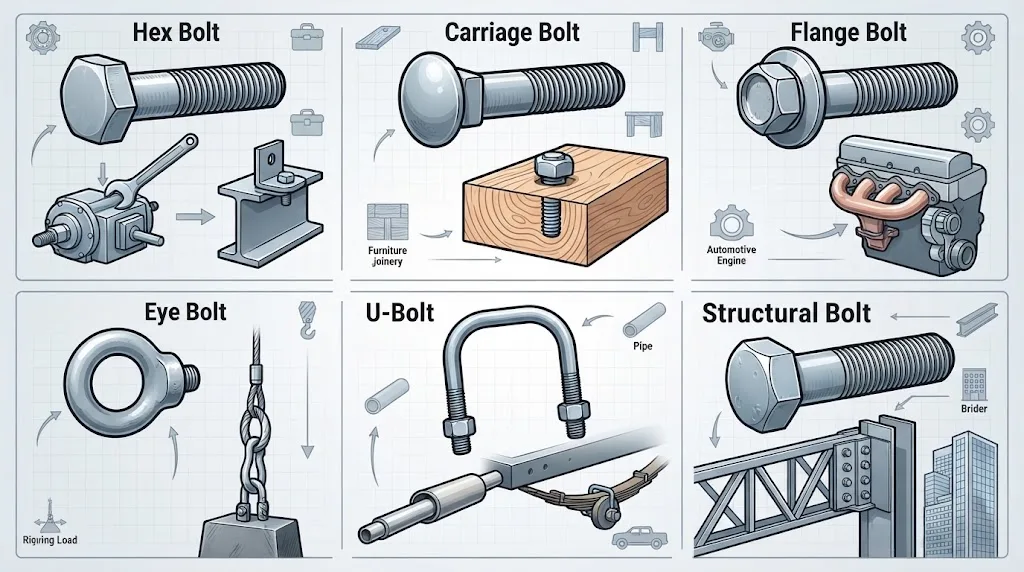
Hex bolt
Six-sided head for a wrench or socket. A common general-purpose choice for machinery, brackets, steelwork, and repairs.
Carriage bolt
Rounded head with a square shoulder below it. The shoulder bites into wood to resist turning; common in decks, furniture, and timber joints.
Flange bolt
Built-in washer-like flange spreads load under the head. Frequently found in automotive and equipment assemblies.
Eye bolt
A looped head provides an attachment point for cables, ropes, or lifting hardware. Only use rated lifting eye bolts for lifting, and follow their load-direction rules.
U-bolt
U-shaped threaded rod used to clamp pipes, axle components, tubing, and round objects to a support.
Structural bolt
High-strength bolt assemblies designed for specified structural connections. Selection and installation must follow the applicable engineering standard.
Common types of nuts and their uses
Different types of nuts solve different problems: basic clamping, vibration resistance, hand adjustment, thread protection, or joining long threaded parts. Always match the nut’s thread form and grade to the bolt or rod.
Hex nut
The standard six-sided nut. Used with a compatible bolt wherever a basic, wrench-tightened joint is needed.
Lock nut
Designed to resist loosening from vibration. Nylon-insert and all-metal designs behave differently in heat and reuse, so check the product guidance.
Wing nut
Two wings allow hand tightening and removal. Useful for fixtures, access panels, and adjustable assemblies that do not require high torque.
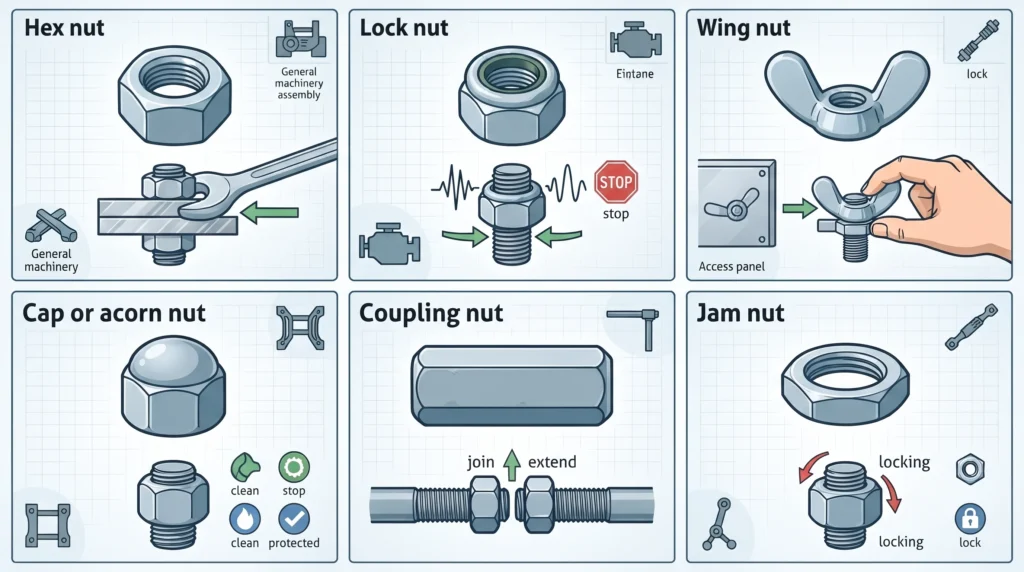
Cap or acorn nut
Closed domed end covers exposed bolt threads for a cleaner appearance and added protection from snags and corrosion.
Coupling nut
Long nut used to join two pieces of threaded rod or extend a threaded connection.
Jam nut
A thinner nut commonly tightened against another nut to help lock an adjustment or conserve thread space.
Bolt sizes, thread types, and matching basics
A bolt size is not just its length. You need the nominal diameter, thread pitch or threads-per-inch, thread standard, length, and sometimes the thread class or tolerance. Metric fasteners are commonly marked like M8 × 1.25 × 30, while inch-series fasteners may use a size and threads per inch, such as 1/4-20 × 1.
Coarse threads are often more forgiving in softer materials and quicker to assemble. Fine threads can offer more adjustment per turn and are common in some automotive and machinery applications. Do not force a nut that starts poorly: a mismatched pitch can damage both parts.
Diameter
Measured across the outside of bolt threads, such as M10 or 3/8 inch.
Pitch or TPI
Metric pitch is the distance between threads; inch-series uses threads per inch.
Length
Usually measured from under the head to the end, except for certain countersunk styles.
Bolt grades, strength markings, and materials
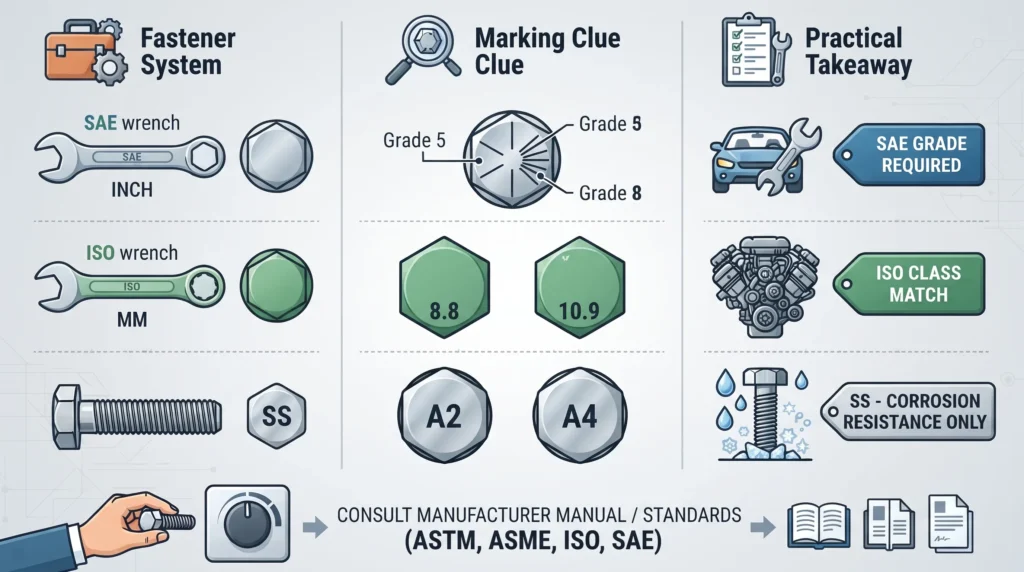
Strength markings vary by fastener system. SAE inch-series bolt head markings and ISO metric property classes communicate different specifications. Stainless steel markings also have their own system. Do not compare markings casually or substitute a higher-strength fastener without considering brittleness, corrosion, joint design, and manufacturer requirements.
| Example system | Typical marking clue | Practical takeaway |
|---|---|---|
| SAE inch-series bolts | Radial lines on many hex heads indicate grade. | Follow the required SAE grade for automotive or equipment repairs. |
| ISO metric bolts | Property classes such as 8.8 or 10.9 may be stamped on the head. | Match the metric property class specified for the assembly. |
| Stainless fasteners | May be marked A2, A4, or a related designation. | Useful for corrosion resistance, but not automatically stronger than alloy steel. |
For exact mechanical properties, torque values, and approved substitutions, refer to the fastener manufacturer, equipment service manual, or applicable standards such as ASTM, ASME, ISO, or SAE documents.
How to choose the right nut and bolt
Start with the joint rather than the hardware bin. The right fastener depends on what is being joined, whether the joint moves or vibrates, access for tools, exposure to moisture or chemicals, and the load path through the assembly.
A practical four-step selection check
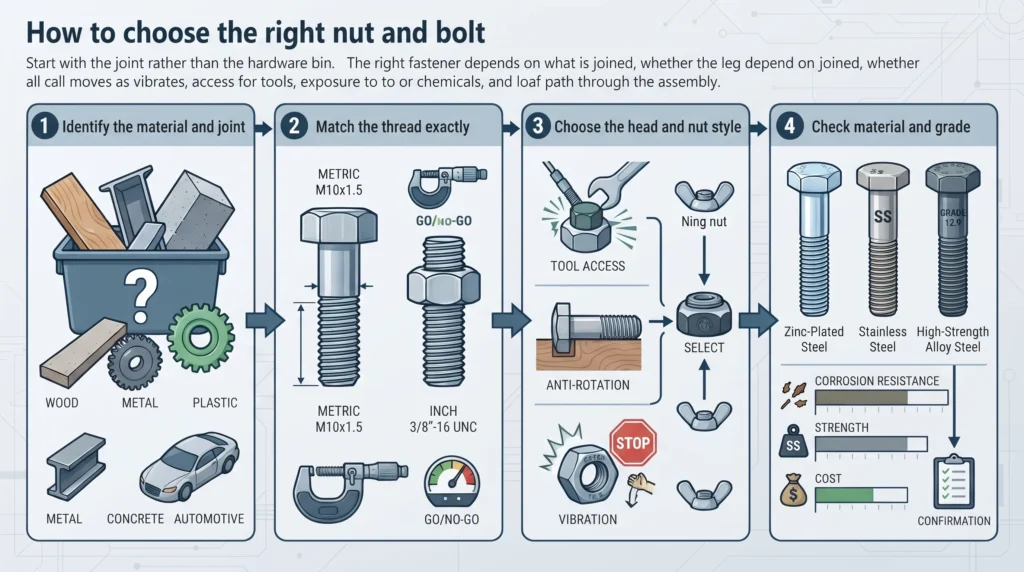
- Identify the material and joint: wood, metal, plastic, concrete, automotive component, or structural member all call for different solutions.
- Match the thread exactly: confirm diameter, metric or inch standard, and pitch or threads per inch before tightening.
- Choose the head and nut style for the job: consider tool access, appearance, anti-rotation, vibration, and whether hand adjustment is needed.
- Check material and grade: zinc-plated steel, stainless, and alloy steel each trade corrosion resistance, strength, cost, and suitability differently.
Types of nuts and bolts FAQs
What is the difference between a nut and a bolt?
A bolt has external threads and a head; a nut has internal threads and turns onto the bolt. Together they clamp parts between the bolt head and the nut. In common use, bolts are generally designed to work with nuts, while screws are often driven into a material or tapped hole.
Can I use any nut that fits a bolt?
No. The nut must match the bolt’s diameter, thread pitch or TPI, and thread standard. Its grade and material should also suit the job. A nut that seems to start but binds or feels rough may have incompatible threads.
Are lock nuts better than regular nuts?
Not universally. Lock nuts are useful where vibration could loosen a joint, but the correct type depends on heat, reuse requirements, load, corrosion exposure, and the assembly instructions. A standard nut may be the correct choice in many fixed joints.
How do I identify a bolt size?
Measure the outside thread diameter, determine the pitch or threads per inch with a gauge, and measure the length according to the bolt-head style. A fastener gauge board or checker is especially helpful for sorting mixed hardware.