
A pulley is a simple machine that uses a grooved wheel and rope to lift or move a load. Learn how it works, the main types, and where you see pulleys every day.
A pulley is one of the six classic simple machines. You may see one lifting a flag, raising a window blind, moving a crane hook, or helping gym equipment glide. Its basic job is to guide a flexible rope or cable around a wheel so a force can be applied in a more useful way.
What is a pulley?
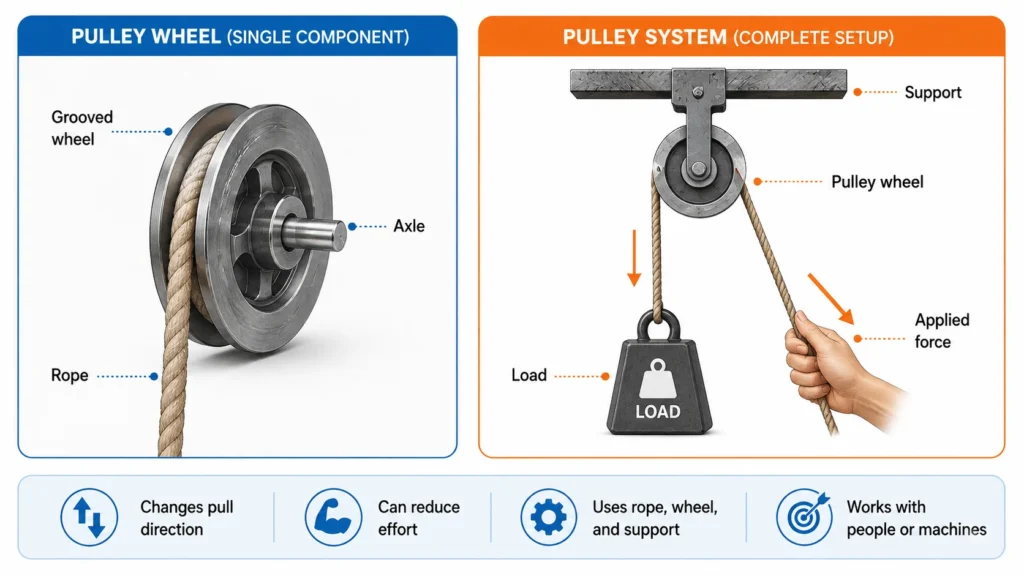
The definition of a pulley is a grooved wheel that turns on an axle and is used with a rope, cable, chain, or belt. In a lifting system, the rope sits in the wheel’s groove so it stays on track while the wheel rotates.
A single pulley wheel is only one component. A pulley system includes the wheel or wheels, the rope, the object being moved (the load), and the force a person or machine applies. The arrangement determines whether the system changes the direction of the pull, reduces the force required, or does both.Applied forceLoad
Pulley wheel vs. pulley system
People often use “pulley” for both the wheel and the whole setup. More precisely, the pulley wheel is the grooved wheel; the pulley system is the complete arrangement of wheel(s), rope, load, and support.
How does a pulley work?
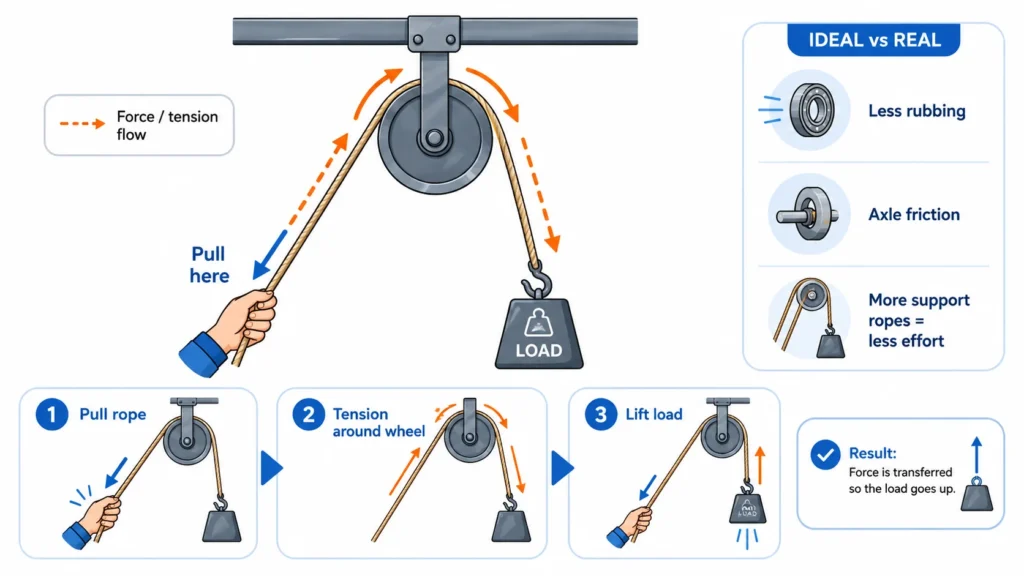
When you pull one end of a rope, tension travels through the rope. The pulley wheel changes the rope’s path while allowing it to move with less rubbing than if the rope slid over a fixed edge.
In an idealized physics model, the rope is weightless, the wheel has no friction, and the tension is the same along the rope. Real pulleys are not perfect: friction in the axle, bending of the rope, and the weight of equipment all mean a real system needs somewhat more effort than the ideal calculation suggests.
Follow the force in three steps
- Pulling the free end of the rope creates tension in the rope.
- The rope transfers that tension around the pulley wheel.
- The rope pulls on the load. More supporting rope sections can share the load’s weight.
The 3 main types of pulleys
The most useful way to classify pulley systems is by whether the pulley is attached to a fixed support, moves with the load, or combines both arrangements.
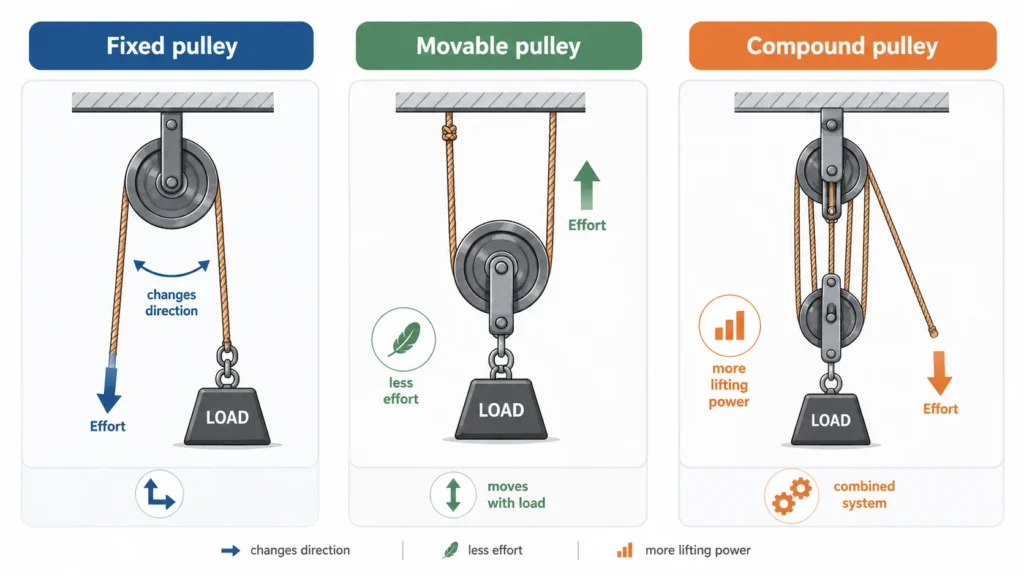
Fixed pulley
The wheel stays in one place. A fixed pulley usually changes the direction of your force, such as pulling down to lift a flag up.
Movable pulley
The pulley moves with the load. In an ideal setup, two supporting rope sections can cut the lifting force needed roughly in half.
Compound pulley
A combination of fixed and movable pulleys. It can change pulling direction and provide mechanical advantage. A block and tackle is a common example.
Mechanical advantage: the simple explanation
Mechanical advantage means a machine lets you use less input force to move a load. With pulley systems, the ideal mechanical advantage is often found by counting the rope sections directly supporting the moving load.
For example, if two rope sections support a movable pulley, each section can ideally carry about half the load. You use about half the force, but you must pull about twice as much rope. The system trades force for distance; it does not create energy.
Everyday examples of pulleys
Pulleys appear in many familiar tools and machines. Some are simple fixed pulleys, while others use several wheels to safely move much heavier loads.
Where you may see pulley systems
- Flagpoles: a fixed pulley at the top lets a person pull down on the rope to raise a flag.
- Wells: a simple pulley can guide a bucket rope and make lifting more convenient.
- Cranes and hoists: multiple pulleys form compound systems for lifting heavy construction materials.
- Sailboats, theatre rigging, window blinds, elevators, and gym machines all use pulleys or pulley-based cable systems.
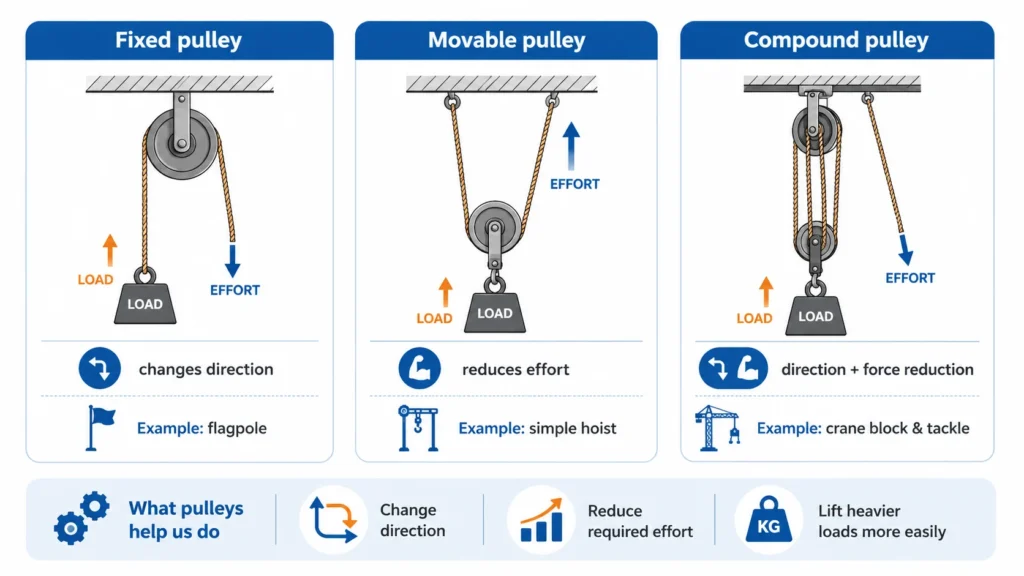
Fixed vs. movable vs. compound pulleys
This comparison uses simplified ideal models. In practice, friction and equipment weight reduce the actual mechanical advantage.
| Type | What it mainly does | Example |
|---|---|---|
| Fixed pulley | Changes direction of force; ideal mechanical advantage is about 1. | Flagpole |
| Movable pulley | Moves with the load; can reduce ideal lifting force. | Simple lifting hoist |
| Compound pulley | Combines direction change and force reduction. | Crane block and tackle |
Pulley FAQs
What does pulley mean?
A pulley is a grooved wheel used with a rope, cable, chain, or belt. It can redirect a force, help lift a load with less effort, or do both depending on the arrangement.
Is an elevator an example of a pulley?
Yes. Many traction elevators use steel cables running over a large grooved drive wheel called a sheave. The arrangement works with a motor and counterweight, so it is more complex than a classroom pulley example but uses the same core principle.
What is a block and tackle?
A block and tackle is a compound pulley system with multiple pulley wheels arranged in blocks. It increases mechanical advantage, allowing a person or machine to lift a heavy load using less force over a longer pulling distance.