Compare the best adjustable wrench options by jaw fit, adjustment quality, opening capacity, access, durability, and real-world usefulness, so you can choose the right tool for plumbing, automotive, maintenance, or DIY work.
How these adjustable wrench reviews are assessed
What matters more than a marketing label
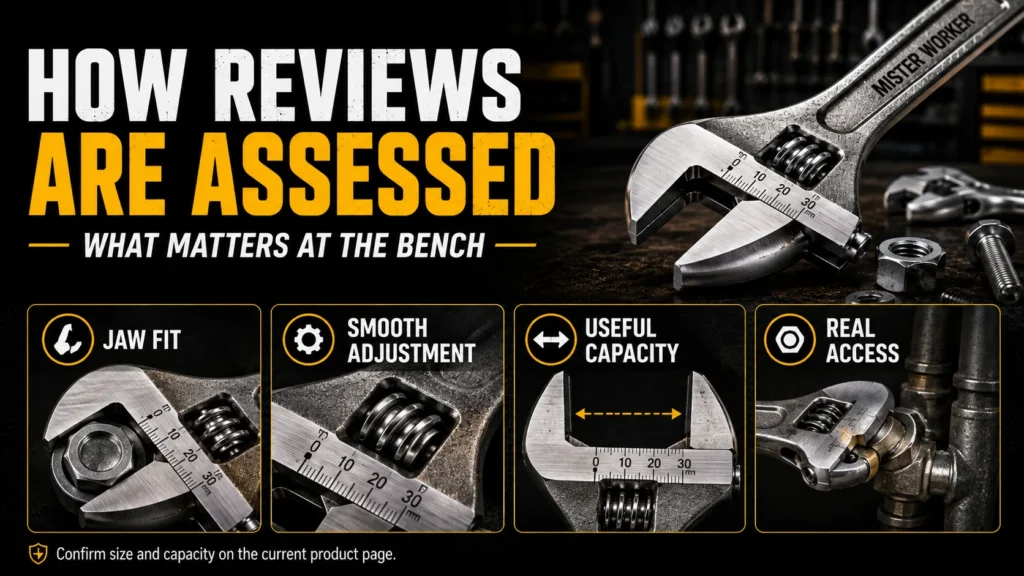
The recommendations below focus on the things you notice at the bench: how closely the movable jaw can be set, whether the worm screw adjusts cleanly, how much capacity you get for the handle length, and whether the head can actually reach the fitting. Listed size and capacity figures should always be confirmed against the current manufacturer product page before purchase, because regional variants can differ.
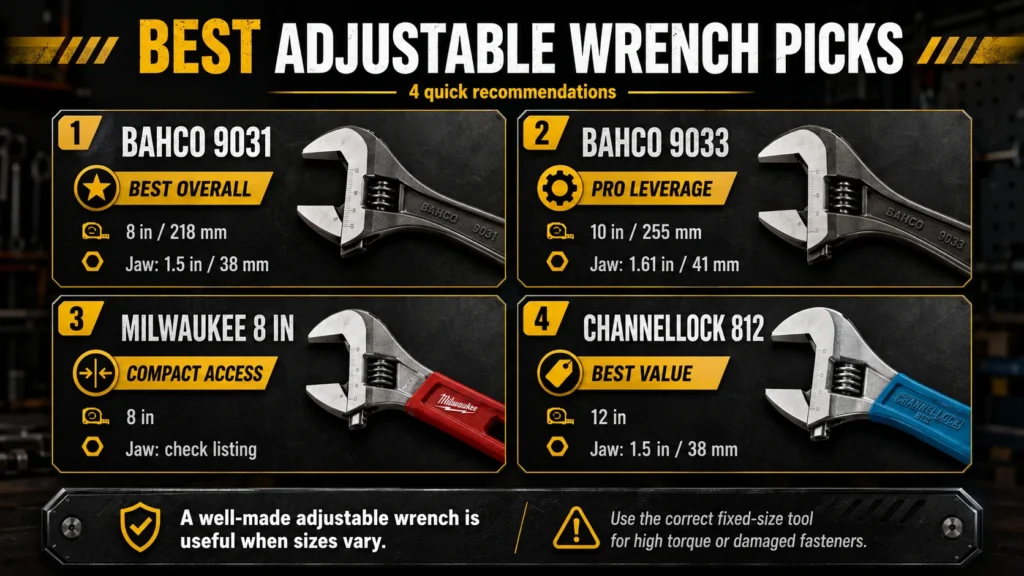
Best adjustable wrench picks at a glance
No adjustable wrench replaces a correctly sized combination wrench or socket for high-torque, damaged, or precision fasteners. But a well-made adjustable model is extremely useful when fastener sizes vary and carrying a full set is impractical.
| Wrench | Best for | Nominal length | Listed jaw opening |
|---|---|---|---|
| Bahco 9031 | Best overall for maintenance, plumbing fittings, and versatile workshop use. | 8 in / 218 mm | 1.5 in / 38 mm |
| Bahco 9033 | Professional users needing added leverage and pipe-friendly jaw geometry. | 10 in / 255 mm | 1.61 in / 41 mm |
| Milwaukee 8 in Adjustable Wrench | Compact access around automotive, appliance, and panel hardware. | 8 in | Check current model listing |
| Channellock 812 | Value-minded DIY, general repair, and a dependable longer-handle option. | 12 in | 1.5 in / 38 mm |
Bahco 9031
The 9031 is the sensible all-round choice when you want wide capacity without jumping to a bulky 12-inch wrench. Its short handle is easier to control beside machinery, under sinks, and around appliance fittings. For repeated size changes, the important benefit is the practical balance between compactness and useful jaw range.
Manufacturer-listed reference: 218 mm length and 38 mm maximum opening.
Limitation: the compact handle cannot provide the leverage of a 10- or 12-inch wrench on stubborn fittings.
Bahco 9033
For frequent maintenance and plumbing work, the extra handle length gives more usable leverage while staying manageable in a tool bag. The reversible jaw design can be helpful for round workpieces, although an adjustable wrench should still be used carefully on pipe to avoid marking the surface.
Manufacturer-listed reference: 255 mm length and 41 mm maximum opening.
Limitation: its longer head and handle are less convenient where there is little room to swing the tool.
Milwaukee 8 in Adjustable Wrench
An 8-inch adjustable wrench is often the more useful choice for automotive work, bicycle hardware, appliance repairs, and crowded service panels. A shorter handle reduces leverage, but it also makes controlled repositioning easier when a wall, hose, or component blocks a full swing.
Check the exact Milwaukee model: number for current opening capacity, finish, and warranty details.
Limitation: compact models are not the right answer for seized plumbing nuts or other jobs that genuinely require more leverage.
Channellock 812
The Channellock 812 suits buyers who want a traditional long adjustable wrench for household plumbing, outdoor equipment, and general workshop use. The 12-inch pattern provides useful leverage and a broad opening for common fittings without requiring a specialty tool.
Manufacturer-listed reference: 12 in length with a 1.5 in maximum jaw opening.
Limitation: its length and head size can make it awkward inside cabinets, engine bays, and tight mechanical assemblies.
What to look for in a professional adjustable wrench
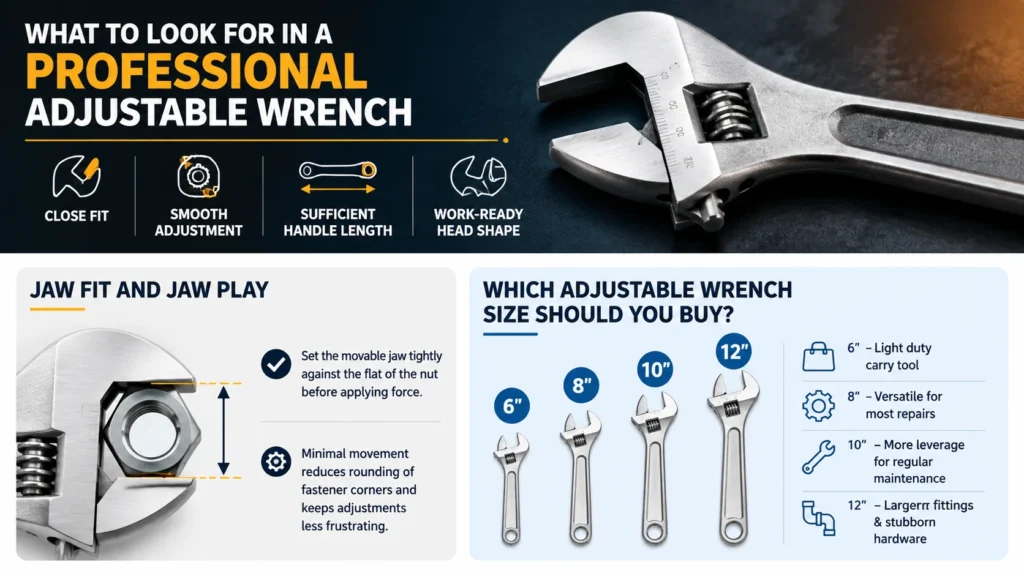
A good adjustable wrench has a fixed jaw, a movable jaw, and a worm screw or thumb wheel that brings the movable jaw close to the fastener. The goal is not simply a large opening: it is close fit, controlled adjustment, enough handle length for the task, and a head shape that reaches the work.
Jaw fit and jaw play
Set the movable jaw tightly against the flat of the nut before applying force. Excessive movement between the movable jaw and the body can make the wrench feel vague and increases the chance of rounding fastener corners. A smooth thumb wheel with limited backlash makes repeated adjustments less frustrating.
Which adjustable wrench size should you buy?
A 6-inch model is a light-duty carry tool. An 8-inch wrench is a versatile starting point for repair and mechanical work. A 10-inch model adds useful leverage for regular maintenance, while a 12-inch wrench suits larger plumbing fittings and stubborn hardware. Many users get the best coverage from an 8-inch and a 12-inch pair.
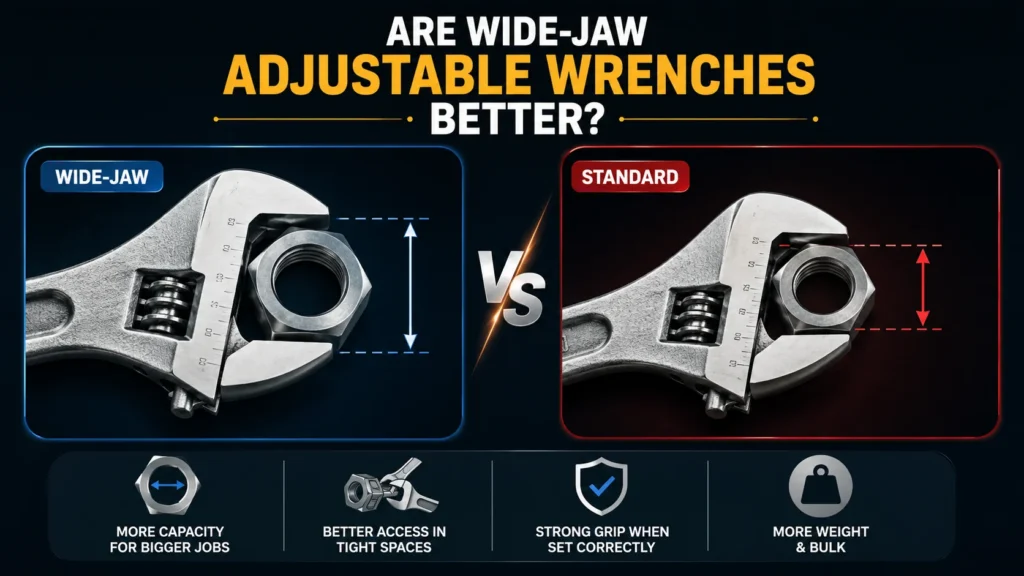
Are wide-jaw adjustable wrenches better?
A wide-jaw adjustable wrench can cover a larger nut without carrying a much longer tool, which is genuinely helpful for plumbing and maintenance kits. But capacity is only one dimension. Check jaw thickness and head width too: a wrench with an impressive opening may still fail to fit behind a fitting or beside a wall. For tight spaces, a slimmer 8-inch model may be the better working tool even when a wide-jaw wrench has the larger number on its specification sheet.
Adjustable wrench FAQs
What causes an adjustable wrench to slip?
Common causes are leaving a gap between the jaws and the fastener, applying load at an angle, using a worn or damaged wrench, or trying to turn a rounded nut. The thumb wheel should be adjusted close to the fastener flats before force is applied. If the nut is seized or already damaged, a fixed-size wrench, socket, locking tool, or specialist extraction method may be safer.
Which adjustable wrench is best for plumbers?
For many plumbing fittings, a 10-inch or 12-inch adjustable wrench gives a useful balance of reach and leverage. A reversible-jaw design can be useful for round workpieces, but a pipe wrench is usually the more appropriate tool for gripping pipe. Use smooth jaws carefully on plated fittings, because even a quality wrench can mark soft finishes when overloaded.
Are expensive adjustable wrenches worth it?
For frequent users, premium models can be worthwhile when they offer tighter jaw control, more consistent adjustment, better corrosion resistance, and a shape that improves access. For occasional DIY jobs, a reliable mid-priced wrench may be the better value. Spend more when poor fit, repeated adjustment, or tool downtime would affect your work; do not pay extra simply for a brand name.