
Both saws cut curves, but they solve very different woodworking jobs. Here is how to choose the right saw for intricate detail, thick stock, furniture parts, and crafts.
The core difference is the blade motion

A scroll saw uses a very thin blade that moves up and down. That reciprocating motion trades speed for control, making it especially useful when you are following a detailed pattern or turning through tiny curves in thin material. On a name sign or wooden puzzle, you can slow down, pivot carefully, and watch the line closely.
A band saw uses a continuous loop blade that travels in one direction around wheels. It removes material much faster and can handle substantially larger stock, but its blade and table arrangement make enclosed interior cuts impractical without leaving an access cut. Actual results depend on blade condition, tension, feed rate, material, and the specifications of your saw.
What each saw does best
Scroll saw: precision on small work
The blade can commonly be released, threaded through a drilled starter hole, and reattached. That makes internal decorative cutouts possible without cutting in from the edge of the board.
Ideal jobs: fretwork, ornaments, intarsia, signs, toys, and puzzle pieces.
Band saw: power through bigger stock
With the right blade and setup, a band saw can cut broad curves efficiently, shape blanks, and resaw a thick board into thinner boards. It is often a more versatile machine for general furniture work.
Ideal jobs: chair parts, curved rails, boxes, blanks, and resawn lumber.
Scroll saw vs. band saw at a glance
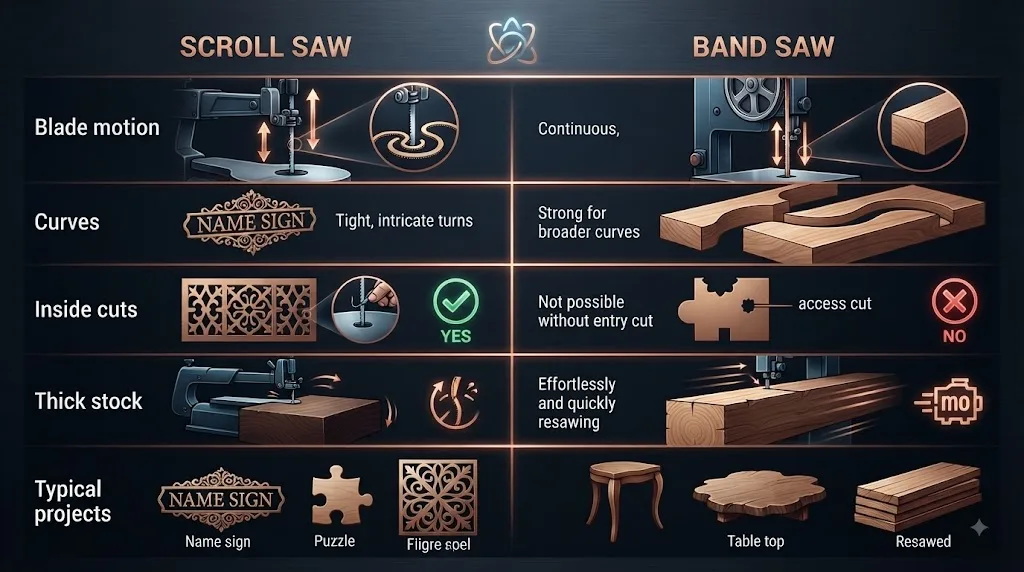
Use this table as a starting point rather than a promise of model-specific performance. Check the manual for your exact saw’s cutting height, throat depth, blade range, and recommended setup.
| Feature | Scroll saw | Band saw |
|---|---|---|
| Blade motion | Thin reciprocating blade moving up and down. | Continuous loop blade moving in one direction. |
| Curves | Excellent for tight, intricate turns and detailed pattern work. | Strong for broader curves; a narrower blade generally turns tighter. |
| Inside cuts | Excellent: thread the blade through a starter hole. | Generally not possible without an entry or access cut from an edge. |
| Thick stock | Limited; thick hardwood cuts are slow and blade-stressing. | Much better, subject to the saw’s cutting height, motor, and blade. |
| Typical projects | Crafts, signs, decorative panels, puzzles, and fine detail. | Furniture components, curved parts, rough shaping, and resawing. |
What the difference feels like on real projects
Cutting letters from a sign
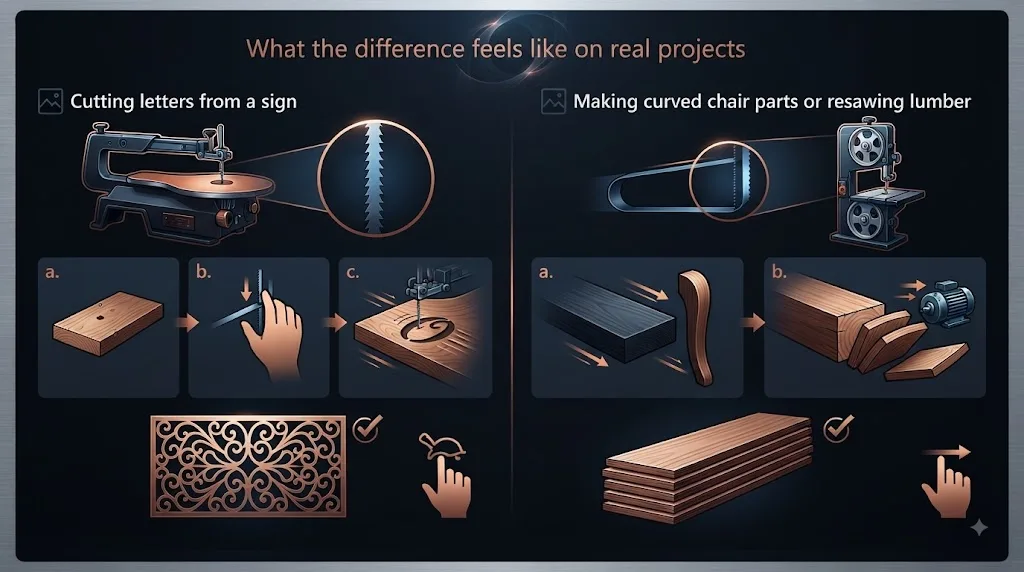
A scroll saw shines when cutting the center from an “O” or making lace-like details in a decorative panel. Drill a starter hole, release and thread the blade, then reconnect it. You work patiently at a light feed rate, letting the blade follow the pattern instead of forcing the wood.
Making curved chair parts or resawing lumber
A band saw is the more natural choice for cutting a curved chair leg from a thick blank or slicing a thick board into thinner pieces. Use a blade width suited to the curve or resaw cut, keep the work supported, and feed steadily. Pushing too fast can make the blade wander.
Blade width, throat capacity, and cutting height matter
Do not choose only by motor rating. A scroll saw’s throat depth limits how far a cut can reach from an edge, while its cutting-height rating limits the thickness it can safely cut. On a band saw, cutting height determines the maximum board thickness under the guides, and throat capacity affects the width of material you can pass beside the blade.
A practical blade rule
For band saws, narrower blades generally make tighter curves, while wider blades offer greater stability for straight cuts and resawing. For scroll saws, tooth pattern and blade size affect cut finish, turning ability, and how quickly sawdust clears. Always follow your manufacturer’s blade and tension guidance.
Which saw should a beginner buy first?
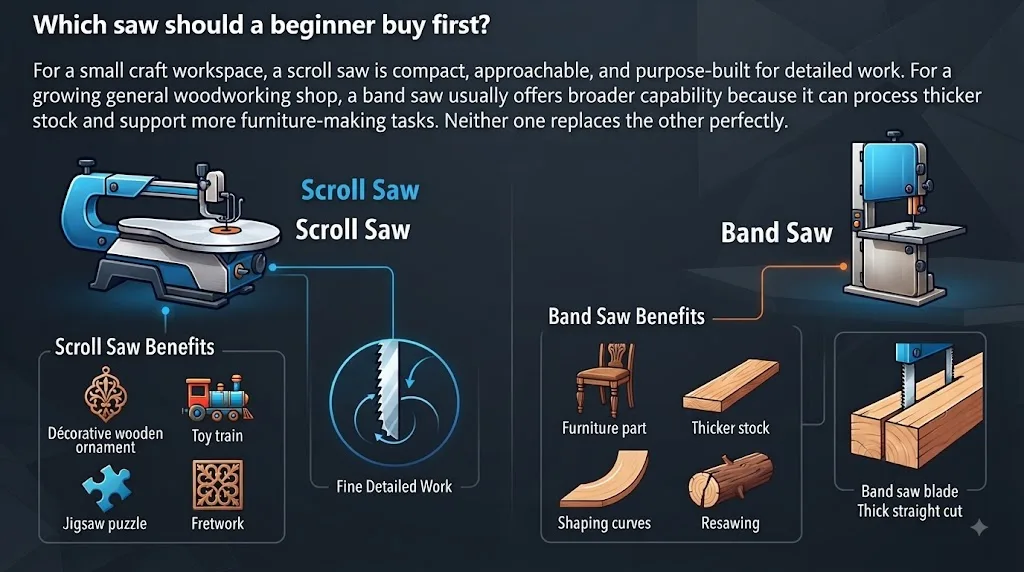
For a small craft workspace, a scroll saw is compact, approachable, and purpose-built for detailed work. For a growing general woodworking shop, a band saw usually offers broader capability because it can process thicker stock and support more furniture-making tasks. Neither one replaces the other perfectly.
Buy a scroll saw first if…
Your projects are mainly ornaments, signs, toys, fretwork, puzzles, or intricate decorative pieces—and you need true inside cuts.
Buy a band saw first if…
You want to make furniture parts, cut thicker boards, shape curves quickly, or resaw lumber into thinner stock.
Safety notes for both saws
Wear appropriate eye protection, keep fingers clear of the blade path, use the right blade for the material, and adjust guards or hold-downs according to the manufacturer’s instructions. On a band saw, keep the upper guide close to the work. On a scroll saw, avoid forcing tight turns or feeding so fast that the blade deflects or breaks. Disconnect power before blade changes or adjustments.
Scroll saw vs. band saw FAQs
Is a scroll saw better than a band saw?
Neither is universally better. A scroll saw is the better specialist for intricate shapes and inside cutouts. A band saw is generally better for thicker material, larger parts, faster curved cuts, and resawing.
Can a scroll saw cut thick wood?
It can cut material within its rated capacity, but thick hardwood is slower and demands the correct blade, tension, and feed rate. A band saw is usually the more efficient and practical option for thick stock.
Can a band saw make intricate cuts?
A band saw with a narrow blade can cut relatively tight curves, but it does not match a scroll saw for tiny detail or enclosed internal shapes. The continuous blade cannot normally be detached and threaded through a drilled starter hole.
Do I need both tools?
You may eventually want both if you make a mix of fine decorative work and larger woodworking projects. Start with the saw that matches your next several projects, available workspace, and material thickness—not just the tool with the bigger motor.