Choose the right bit for wood, metal, concrete, tile, glass, and more—without buying a set full of bits you will never use.
Match the bit to the material first.
A general-purpose twist bit can handle many small jobs, but a material-specific bit gives you cleaner holes, less wandering, less heat, and a much better chance of finishing without ruining the workpiece. Start with the material, then choose the hole shape and size you need.
Which drill bit should you use?
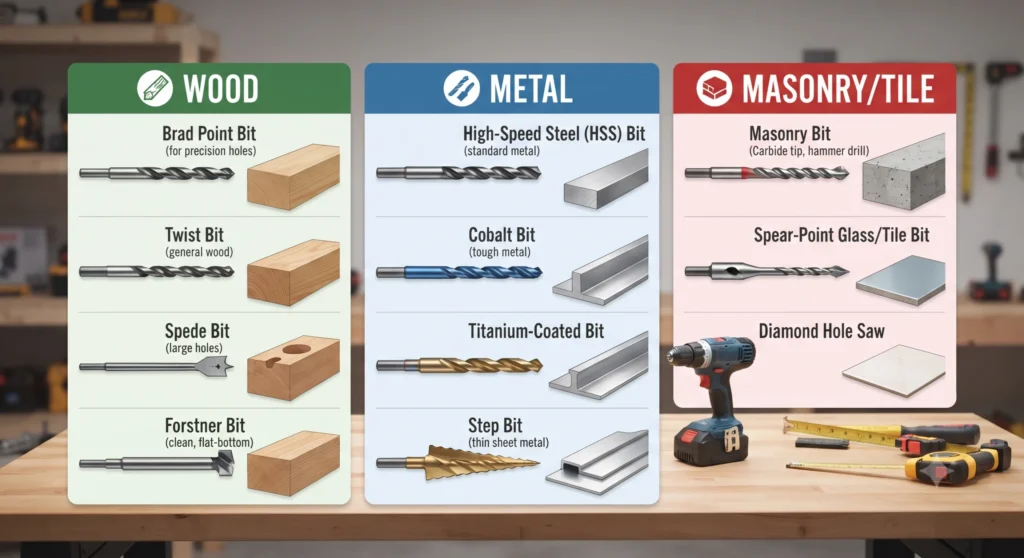
| Material or job | Best drill bit type | Practical note |
|---|---|---|
| General drilling | Twist bit | Useful starter bit for wood, plastic, and light metal. |
| Clean holes in wood | Brad-point bit | Center spur prevents the bit from skating across the surface. |
| Large, quick holes in wood | Spade bit | Fast and affordable, but the exit side can splinter. |
| Deep holes in timber | Auger bit | Threaded tip pulls the bit through thick stock. |
| Flat-bottom holes | Forstner bit | Ideal for concealed hinges, cabinetry, and overlapping holes. |
| Steel and metal | HSS or cobalt bit | Use slower speed, firm pressure, and cutting fluid when appropriate. |
| Brick and concrete | Masonry bit | Use hammer mode only where the drill and material allow it. |
| Tile or glass | Tile, glass, or diamond bit | Low speed, light pressure, and cooling help prevent cracking. |
| Large diameter holes | Hole saw | Works in wood, drywall, plastic, and some metals with the correct saw. |
Drill bit anatomy in plain English
PointThe cutting end. Its shape helps identify the bit and determines how it starts a hole.FlutesThe spiral grooves that carry chips and dust out while you drill.ShankThe end held by your drill chuck. It may be round, hex, or SDS.CoatingA surface treatment that can reduce friction, but does not change the core metal.
Drill bit types explained
You do not need every type of drill bit. These are the bits most DIYers encounter, what they look like, and when they earn a place in your toolbox.
1. Twist drill bits
The familiar spiral-fluted bit. A standard HSS twist bit is the best all-round starting point for small holes in wood, plastic, and many metals. It is not the cleanest choice for visible woodworking, but it is versatile.
2. Brad-point bits
Look for a sharp center spur with cutting edges on either side. Brad-point bits start precisely and cut cleaner holes in wood, especially in furniture parts, shelves, and visible trim.
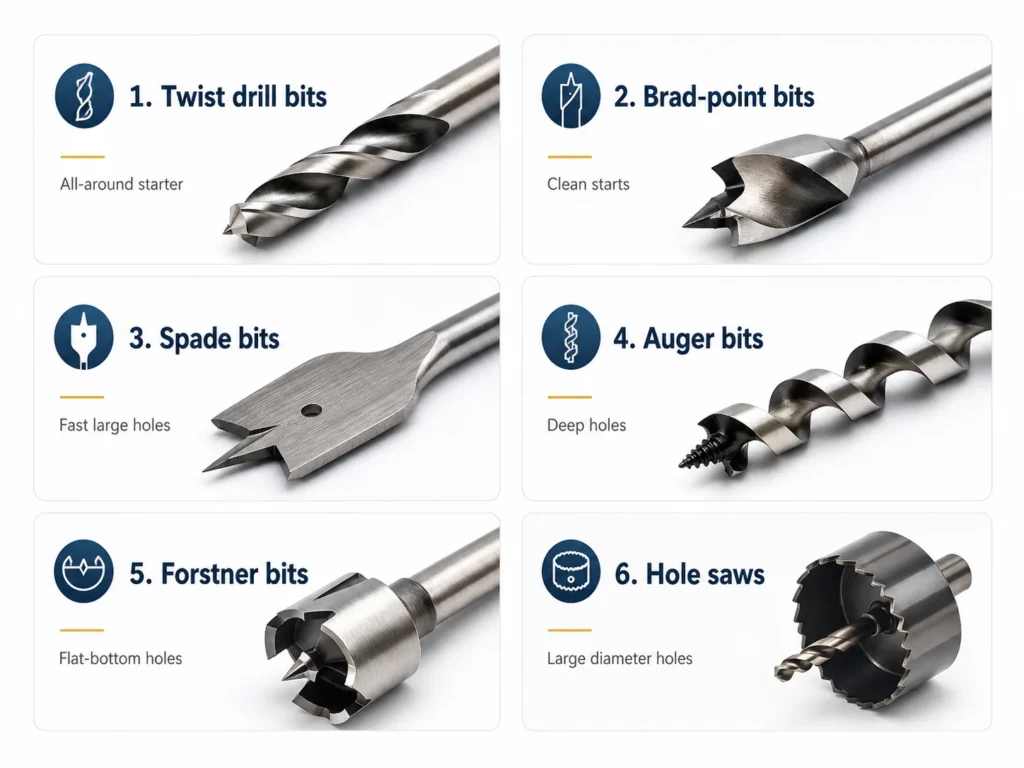
3. Spade bits
Flat, paddle-shaped bits for fast large holes in framing lumber. They are inexpensive and quick, but can tear out the back edge. Put scrap wood behind finished work when possible.
4. Auger bits
Long bits with a screw-like lead point and deep flutes. The threaded tip pulls the bit through thick timber, making auger bits useful for joists, posts, and repeated deep holes.
5. Forstner bits
Recognizable by their circular cutting rim. Forstner bits make smooth, flat-bottom holes and can drill partial-depth or overlapping holes—excellent for cabinet hinges and tidy woodworking.
6. Hole saws
A cylindrical cup with teeth and a pilot bit in the middle. Choose the tooth style for the material: wood/drywall, bi-metal for mixed jobs, or carbide-grit/diamond for harder surfaces.
7. Masonry bits
Usually identified by a wider, blunt-looking carbide cutting tip. They are made for brick, block, stone, and concrete—not metal. Clear dust regularly so the bit does not bind or overheat.
8. Step bits
Cone-shaped bits with marked diameter steps. They are especially useful for thin sheet metal, plastic, electrical boxes, and enlarging an existing hole without grabbing aggressively.
HSS vs cobalt vs titanium vs carbide
HSS:
High-speed steel is the sensible default for occasional drilling in aluminum, mild steel, plastic, and wood. It is widely available and economical.
Cobalt:
Cobalt is mixed into the bit material, not just applied to the surface. It handles higher heat better, making it a strong pick for stainless steel and repeated metal work.
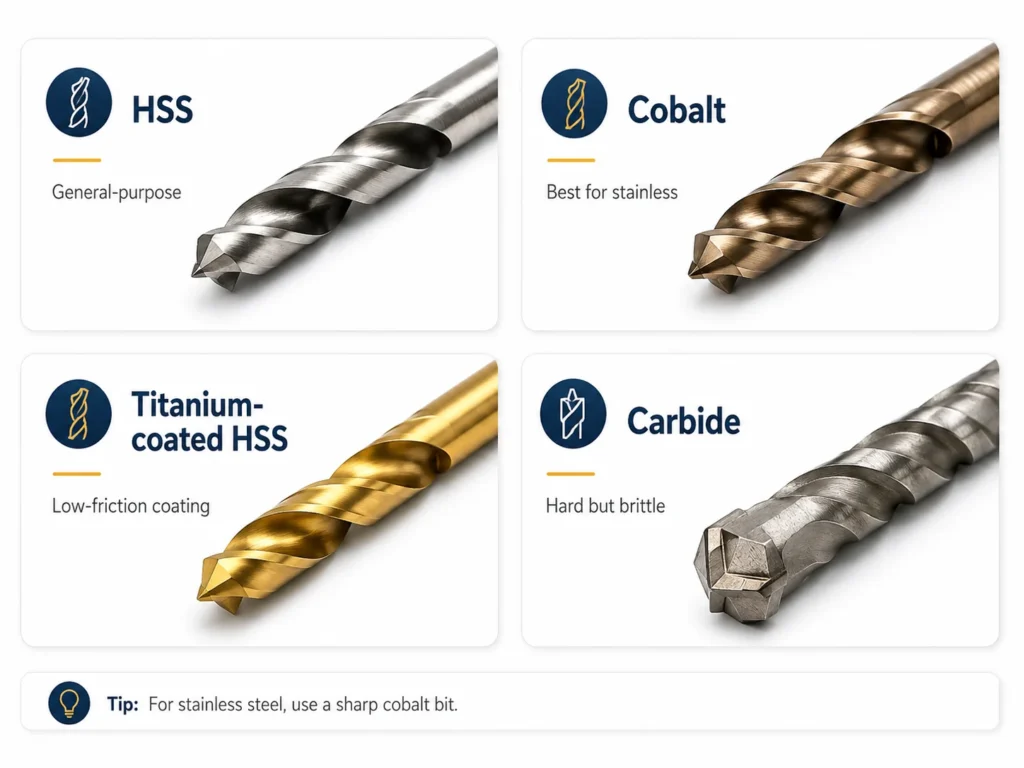
Titanium-coated HSS:
This is an HSS bit with a low-friction coating. It can last well in light work, but once the cutting edge is sharpened, the coating at that edge is gone.
Carbide:
Very hard and heat-resistant, but more brittle. Carbide is common on masonry tips and specialist cutters; it is not automatically the best choice for every home metal job.
Workshop tip: stainless steel is where speed matters most. Use a sharp cobalt bit, slower RPM, steady pressure, and suitable cutting fluid. Spinning too fast creates heat and can dull the edge quickly.
What works best for each job?
Wood
Use brad-point bits for clean small holes, spade bits for rough large openings, augers for deep timber holes, Forstner bits for flat-bottom cabinet work, and hole saws for large circles. A twist bit works, but may leave a rougher entry and exit.
Metal
Use HSS for mild steel and aluminum; upgrade to cobalt for stainless steel, hardened steel, or frequent use. Center-punching helps stop the bit wandering. For thin sheet metal, a step bit often gives the smoothest result.
Brick, block, and concrete
Use a carbide-tipped masonry bit. A hammer drill makes anchor holes faster in masonry; a rotary hammer and compatible SDS bit are for frequent or larger holes in tough concrete.
Tile, glass, and plastic
Use a tile/glass spear bit or diamond bit for brittle surfaces, with hammer action off. For plastic, a sharp twist or step bit works well; back off pressure near breakthrough to prevent grabbing and cracks.
Will the bit work with your drill?
- Standard drill/driver: accepts most round-shank and hex-shank bits that fit its chuck size.
- Impact driver: best with impact-rated 1/4-inch hex-shank bits. It can drill, but it is not the first choice for delicate or large precision holes.
- Hammer drill: can use ordinary bits in drill-only mode and masonry bits in hammer-drill mode.
- Rotary hammer: uses SDS-Plus or SDS-Max bits depending on the machine. These shanks are not compatible with a standard chuck.
- Drill press: gives better control for metal, Forstner work, and repeated accurate holes.
Individual bits or a drill bit set?
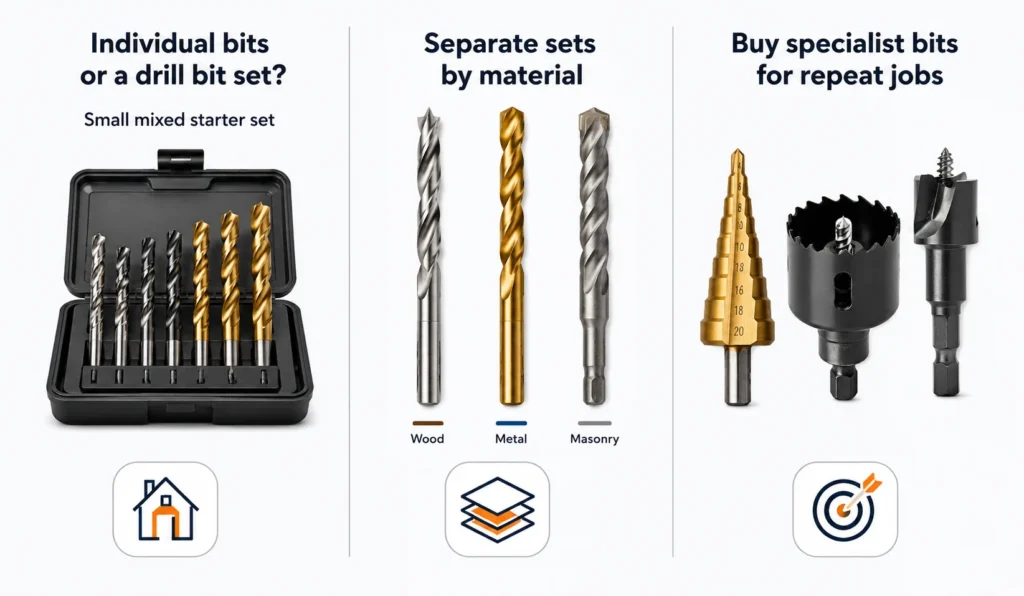
Small mixed starter set
Buy a compact HSS twist-bit set plus a few masonry sizes that match common wall plugs. Add individual wood bits only when a project demands cleaner or larger holes.
Separate sets by material
Keep a good HSS or cobalt metal set, a brad-point wood set, and a masonry set. You will work faster and spend less replacing worn general-purpose bits.
Buy specialist bits for repeat jobs
Choose cobalt for regular steel work, quality augers for framing, and SDS bits for concrete. Match the shank and bit system to the drill you actually own.
Four mistakes that destroy drill bits early
- Using a wood or masonry bit on metal.
- Running a metal bit too fast and turning the cutting edge blue from heat.
- Forcing a dull bit instead of replacing or sharpening it.
- Using hammer mode on tile, glass, or a bit not designed for impact.
Drill bit types FAQ
Can I use one drill bit for everything?
Not reliably. A standard twist bit is versatile, but material-specific bits give cleaner, safer results. Use masonry bits for concrete, tile bits for tile, and wood bits when finish quality matters.
How can I identify a masonry drill bit?
Look at the tip. A masonry bit has a wider, blunt carbide insert that looks different from the sharp pointed tip of a metal twist bit. Its cutting end is built to crush and cut mineral material.
Are titanium drill bits better than cobalt?
They solve different problems. Titanium-coated HSS is a useful value option for lighter work. Cobalt is generally better for sustained heat and harder metals because the cobalt is part of the bit material itself.
Do SDS bits fit a regular drill?
No. SDS-Plus and SDS-Max bits need a matching rotary hammer chuck. They have grooves in the shank that lock into the tool, so they are not made for a conventional three-jaw drill chuck.