A practical guide to different types of saws, the cuts they make, the materials they handle, and the safety habits that help you choose the right tool with confidence.
Choose the saw for the cut before choosing it for the material.
Use a circular saw or table saw for long straight cuts, a miter saw for repeatable crosscuts and angles, a jigsaw or band saw for curves, and a reciprocating saw when speed and access matter more than a polished finish. The correct blade, stable material support, and guard setup matter just as much as the saw itself.
Saw terms that make buying and cutting easier
A saw works as a system: the blade removes material, while the shoe, fence, guide, or work support keeps the cut controlled. Learn these few terms before comparing models or blades.
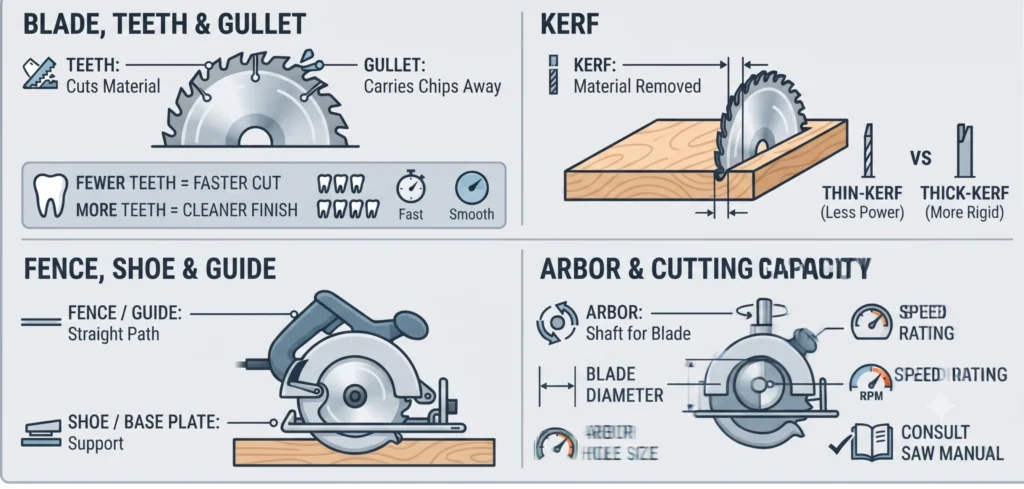
Blade, teeth, and gullet
Teeth cut the material; gullets carry chips away. Fewer, larger teeth cut faster, while more teeth generally leave a cleaner finish in wood.
Kerf
The width of material removed by the blade. A thin-kerf blade needs less power but can deflect more easily if pushed.
Fence, shoe, and guide
A fence or guide controls a straight path. A shoe, also called a base plate, supports a handheld saw on the workpiece.
Arbor and cutting capacity
The arbor is the shaft that holds a circular blade. Match blade diameter, arbor hole, speed rating, and saw manual exactly.
Hand saws offer quiet control and a low-cost starting point
Hand saws are slower than power saws, but they are often easier to use for a single cut, a delicate repair, or a location without power. Keep the blade sharp and let the teeth do the work.
Traditional hand saw
A general-purpose push saw for lumber and panels. Crosscut teeth leave a cleaner end-grain cut; rip teeth remove wood quickly along the grain.
Back, tenon, and dovetail saws
A stiffened spine supports accurate joinery cuts. Best for trim, tenons, miters, and fine furniture work; limited by the blade depth.
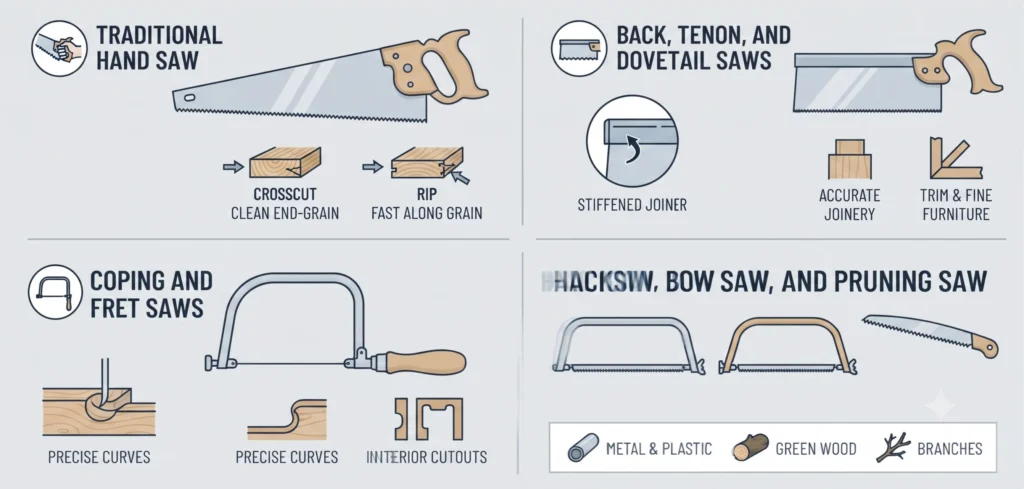
Coping and fret saws
Thin blades turn tightly for curves, interior cutouts, and coping trim. They are precise but slow, and the blade can break if twisted.
Hacksaw, bow saw, and pruning saw
Use a hacksaw for metal and plastic, a bow saw for green wood, and a pruning saw for branches. Match tooth pattern to the material.
The most useful power saws and what they really do best
Circular saw
Best portable choice for straight cuts in lumber and plywood. A clamped guide rail improves accuracy dramatically; unsupported sheet goods can pinch the blade.
Jigsaw
Best for curves, cutouts, and interior openings. Use a narrow blade for tight curves; blades can wander in thick stock, especially when forced.
Miter saw
Best for fast, repeatable crosscuts, miters, and bevels in framing lumber and trim. It is not designed for ripping long boards lengthwise.
Table saw
Best workshop saw for accurate rips and repeatable sizing. Kickback can develop when wood binds between blade and fence; use the guard, riving knife, and push stick.
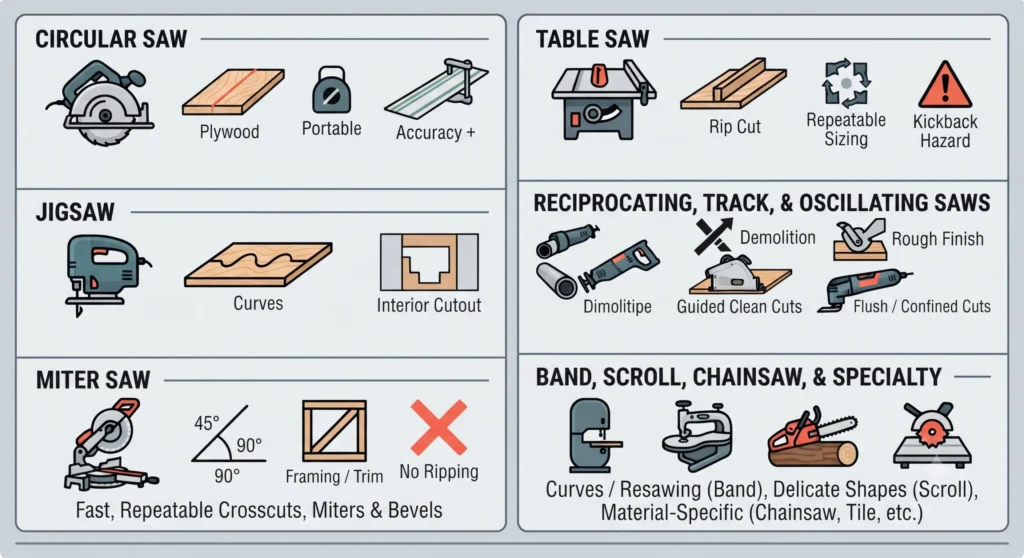
Reciprocating, track, and oscillating saws
A reciprocating saw excels at demolition and pipe cuts but leaves a rough finish. A track saw makes clean guided sheet cuts. An oscillating tool reaches flush or confined cuts.
Band, scroll, chainsaw, and specialty saws
Band saws handle curves and resawing; scroll saws make delicate shapes. Chainsaws, tile saws, cut-off saws, and concrete saws are material-specific tools.
Which saw fits the job?
| Saw | Best for | Materials / cut type | Beginner suitability |
|---|---|---|---|
| Circular saw | Portable straight cuts | Lumber and plywood; rip, crosscut, bevel | Good with a guide and safe support |
| Jigsaw | Curves and cutouts | Wood, plastic, light metal; curved cuts | Good for controlled light-duty work |
| Miter saw | Trim and repeated length cuts | Wood; crosscut, miter, bevel | Good after setup instruction |
| Table saw | Workshop ripping and sizing | Wood sheet goods and boards; straight cuts | Intermediate; requires strict safety habits |
A sensible first saw depends on what you build most often
There is no universal best saw. The right choice is the one that performs your common cut safely, with a blade you can source and a setup you can support.
- For home repairs and plywood: choose a circular saw plus a straightedge or guide rail.
- For decorative shapes, sink cutouts, and curved lines: start with a jigsaw.
- For trim, framing crosscuts, and angles: choose a miter saw with proper work supports.
- For a small furniture workshop: add a table saw or track saw only when your space and safety setup support it.
A good blade can improve a saw more than extra motor power
Use low tooth counts for faster ripping in solid wood and higher tooth counts for cleaner plywood, veneers, and crosscuts. Metal, masonry, tile, and plastic require blades rated for those materials. Dull or damaged blades burn wood, tear fibers, vibrate, and increase the chance of binding.
Never assume a blade fits because its diameter looks right. Check the saw manual for arbor size, approved blade diameter, thickness, speed rating, and material compatibility before installation.
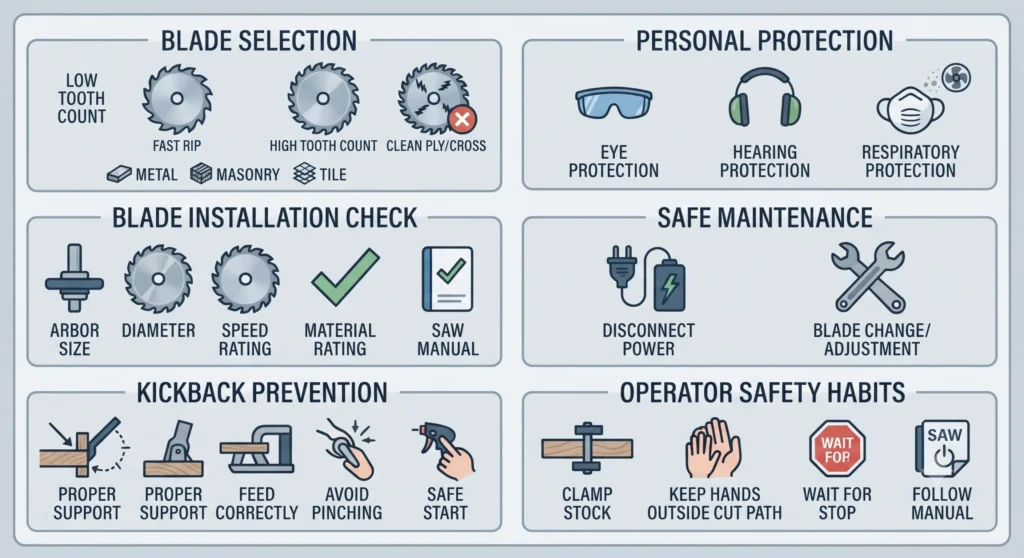
Control the material, the blade, and your body position
Kickback is usually a binding problem: the blade catches material that is poorly supported, twisted, pinched, or fed incorrectly. The safest cut begins before the trigger is pressed.
- Wear appropriate eye and hearing protection; use suitable respiratory protection when dust requires it.
- Disconnect power or remove the battery before changing a blade, adjusting a fence, or clearing jams.
- Inspect blades, guards, cords, switches, and bases. Do not use damaged equipment or a blade with cracks, missing teeth, or warping.
- Clamp or support stock, keep hands outside the cut path, wait for the blade to stop, and follow the manufacturer manual for every saw
Types of saws FAQs
Which saw is best for straight cuts?
For portable work, a circular saw used with a straightedge or track is an excellent option. In a workshop, a table saw is often best for repeated straight rips, while a miter saw is best for repeated crosscuts to length.
What is the difference between a circular saw and a miter saw?
A circular saw travels across the material and is highly portable. A miter saw is fixed to a base and brings the blade down onto stock, making fast, repeatable crosscuts and angled cuts easier.
Can one saw blade cut several materials?
Some blades are marketed for multiple materials, but the best results and safest use come from a blade designed for the material and saw. Always follow the blade and tool manufacturer ratings.
What saw is safest for a beginner?
A sharp hand saw is the lowest-risk place to learn basic cutting control. For powered work, many beginners find a jigsaw approachable for light work, but every power saw requires instruction, PPE, stable support, and attention to its manual.