

A practical, model-aware guide to Goodyear tires—covering where the brand fits, what to compare, and how to make a confident choice for your vehicle.
Goodyear is a strong mainstream choice—when the model matches the mission.
Generally, yes. Goodyear offers a broad lineup for commuters, family vehicles, SUVs, performance-oriented cars, and selected all-terrain needs. The strength of that range is also the reason to shop carefully: ride quality, wet grip, noise, wear, and price can vary substantially from one product line to another.
Where Goodyear tends to stand out
Goodyear’s practical advantage is breadth. It is a recognizable replacement-tire option for many common passenger-car and SUV fitments, which can make it easier to compare available sizes, find a local installer, and choose a tire that suits a specific driving priority.
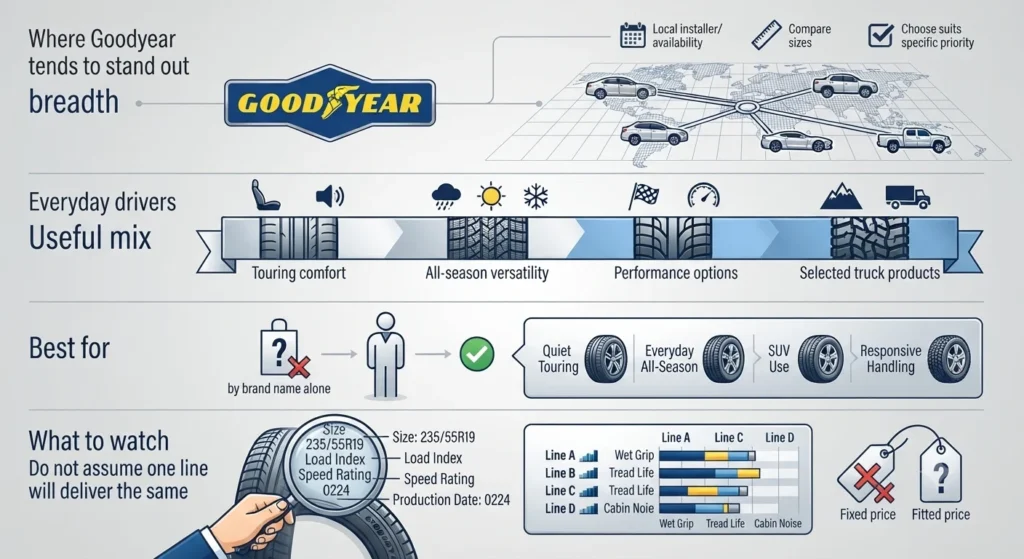
For everyday drivers, that can mean a useful mix of touring comfort, all-season versatility, performance options, and selected truck or crossover products. A wide catalogue does not make every tire identical, but it does give shoppers more ways to match tread design and intended use to their road conditions.
Best for
Drivers who want a familiar, widely available brand and are willing to choose by category—such as quiet touring, everyday all-season driving, SUV use, or more responsive handling—instead of buying by brand name alone.
What to watch
Do not assume one Goodyear line will deliver the same wet grip, tread life, cabin noise, or warranty as another. Compare the exact size, load index, speed rating, production date, and real fitted price before committing.
The brand badge is only the start of the comparison
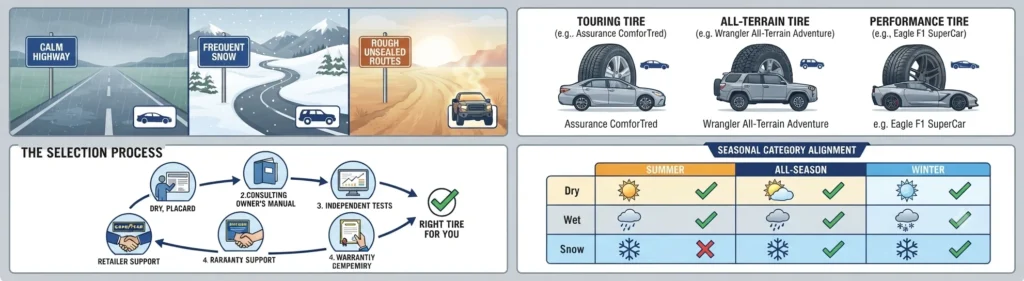
The most useful question is not simply “Are Goodyear tires good?” but “Is this specific Goodyear tire right for my roads, climate, vehicle, and mileage?” A touring tire built around calm highway driving may not be the best answer for frequent snow, rough unsealed routes, or spirited summer driving.
Before buying, narrow your shortlist using the vehicle placard and owner manual first. Then compare independent tests where available, the warranty documentation, local retailer support, and how the tire’s seasonal category aligns with the conditions you actually drive in.
Key buying considerations
These are editorial guideposts, not laboratory scores. Specific tire models can differ significantly.
| Consideration | Editorial take |
|---|---|
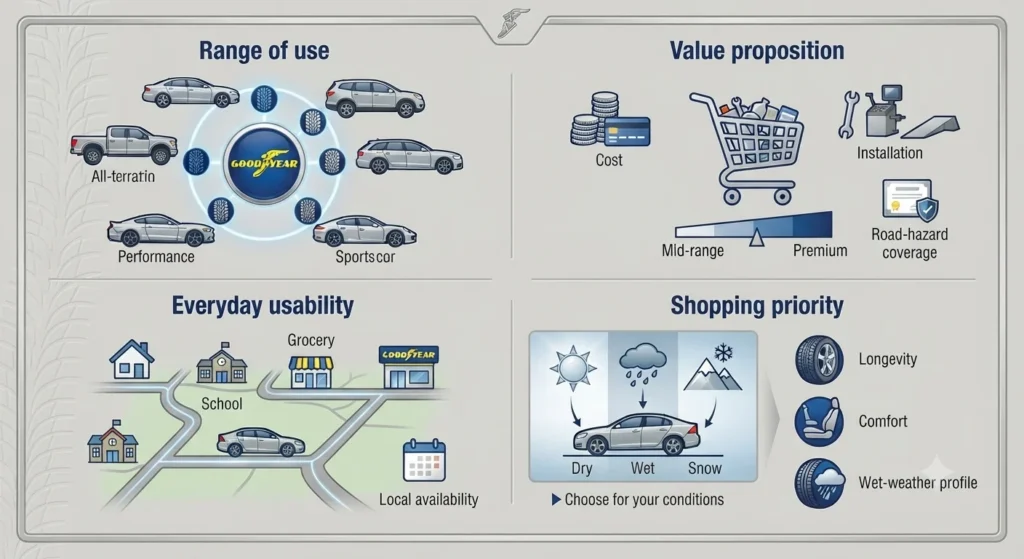
| Range of use | Strong: Goodyear has options across passenger, SUV, touring, performance, and selected all-terrain applications. |
| Value proposition | Typically mid-to-premium depending on tire line and size. Compare the installed price, including balancing, alignment checks, and road-hazard coverage. |
| Everyday usability | A practical option for many routine replacement scenarios, especially when local availability and established fitments are important. |
| Shopping priority | Choose for your driving conditions rather than assuming every model has the same longevity, comfort, or wet-weather profile. |
Four checks worth making before choosing a Goodyear tire

A little comparison work can matter more than the logo on the sidewall. Use this short list to keep the decision grounded in fitment and real-world use.
- Confirm tire size, load index, and speed rating against the vehicle placard and owner manual.
- Match the tire category to your dominant conditions: hot dry roads, seasonal rain, winter weather, long highway miles, or mixed surfaces.
- Compare the exact model’s wet braking, noise, warranty terms, and expected tread life where independent information is available.
- Ask the installer about production date, total fitted price, balancing, alignment, rotation support, and local warranty handling.