A beginner-friendly visual guide to every major car body part — learn the correct names, locations, and functions of exterior and interior car components.
What Are the Main Parts of a Car?
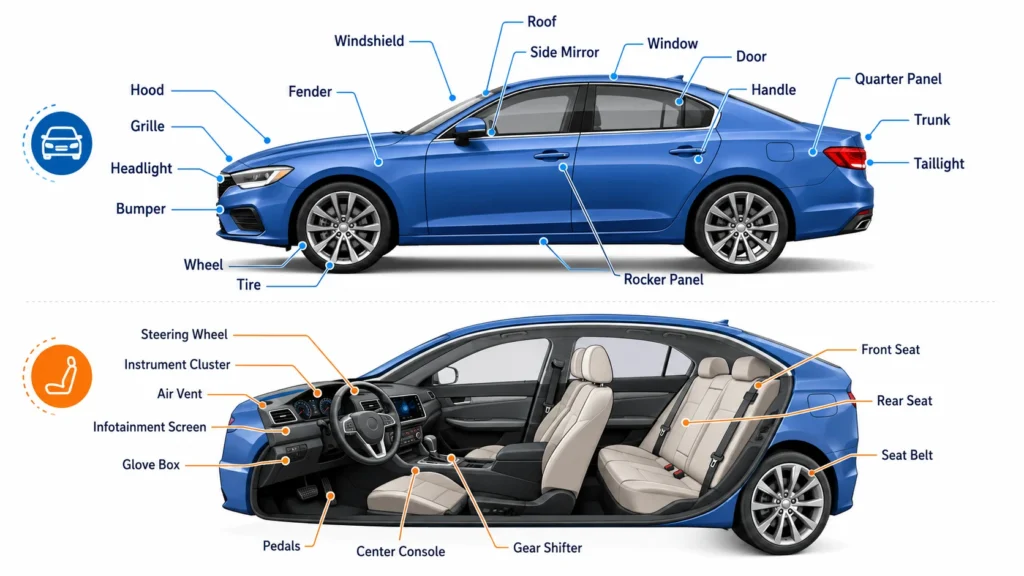
Every vehicle — from a compact sedan to a full-size SUV — is made up of hundreds of individual components. These car body parts can be grouped into exterior body panels, interior components, mechanical systems, lighting, glass, and safety equipment. The exact design varies by manufacturer and model year, but most passenger cars share the same basic categories of parts.
This guide focuses on the parts of a car that you can see and touch — the exterior panels that form the car’s shape and the interior car parts you interact with every time you drive. Whether you need to describe damage to a mechanic, order a replacement online, or simply learn car part names for a class or exam, this article gives you a clear, labeled reference.
Exterior Car Body Parts — Diagram & Names
The exterior of a car includes every panel, light, and trim piece visible from outside. These car body parts protect the vehicle’s mechanical components, provide aerodynamic shape, and define the car’s appearance. Below is a reference showing the major exterior parts of a car from a side view.
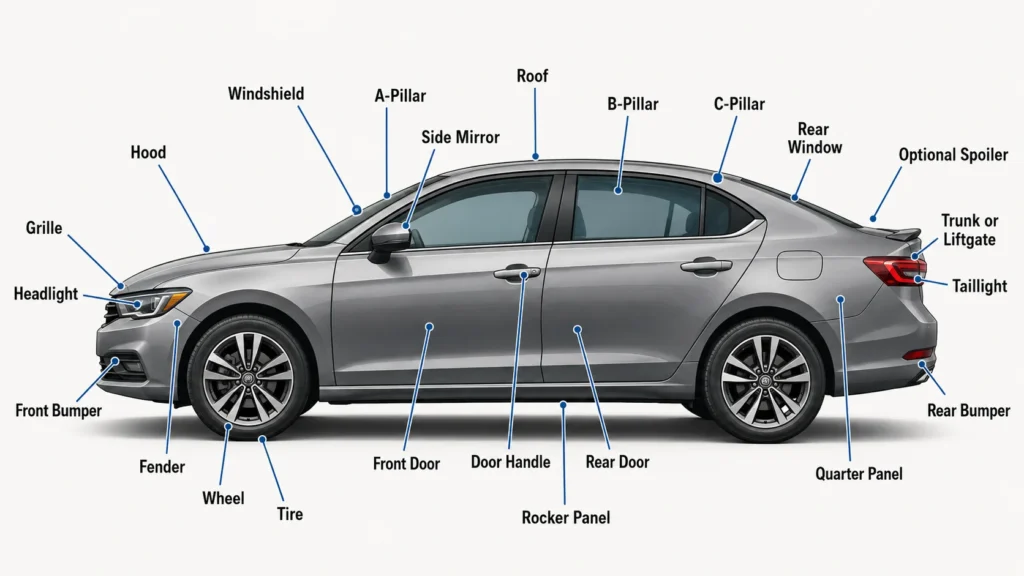
Starting from the front: the hood covers the engine bay, the front bumper absorbs minor impacts, and the grille allows air to reach the radiator. Headlights sit at the front corners. Moving along the side, the fenders wrap above the front wheels, and the doors provide entry. The A-pillar, B-pillar, and C-pillar are the vertical supports around the windows. Below the doors, the rocker panel connects the front and rear of the body.
At the rear, the quarter panel forms the body around each rear wheel (unlike a fender, a quarter panel is welded in place and cannot be unbolted). The trunk lid or liftgate covers the cargo area. Taillights, the rear bumper, and sometimes a spoiler complete the rear profile. The roof spans the top, and the windshield and rear window are the main glass panels.
Exterior Car Parts Names — Quick Reference Table
| Part | Location | Function |
|---|---|---|
| Hood | Front upper body | Covers the engine compartment |
| Front Bumper | Front lowest section | Absorbs minor front impacts |
| Grille | Front center | Allows airflow to radiator |
| Headlight | Front corners | Illuminates the road ahead |
| Fender | Above front wheels | Contains road spray and debris |
| Windshield | Front glass | Protects occupants from wind and debris |
| Roof | Top of vehicle | Covers passenger compartment |
| Side Mirror | Mounted on doors | Provides rear/side visibility |
| Door | Vehicle sides | Entry and exit for occupants |
| Rocker Panel | Below doors | Connects front and rear body sections |
| Quarter Panel | Rear sides | Forms body around rear wheel area |
| Trunk Lid | Rear upper | Covers cargo area |
| Taillight | Rear corners | Signals braking and turns to other drivers |
| Rear Bumper | Rear lowest section | Absorbs minor rear impacts |
| Wheels & Tires | Four corners | Support and move the vehicle |
Interior Car Parts — Names & Diagram
The interior of a car — everything inside the cabin — includes dozens of components you interact with daily. Knowing the correct car parts names inside helps when reporting issues, ordering trim replacements, or understanding your owner’s manual. Below is a reference of common interior car parts from the driver’s perspective.
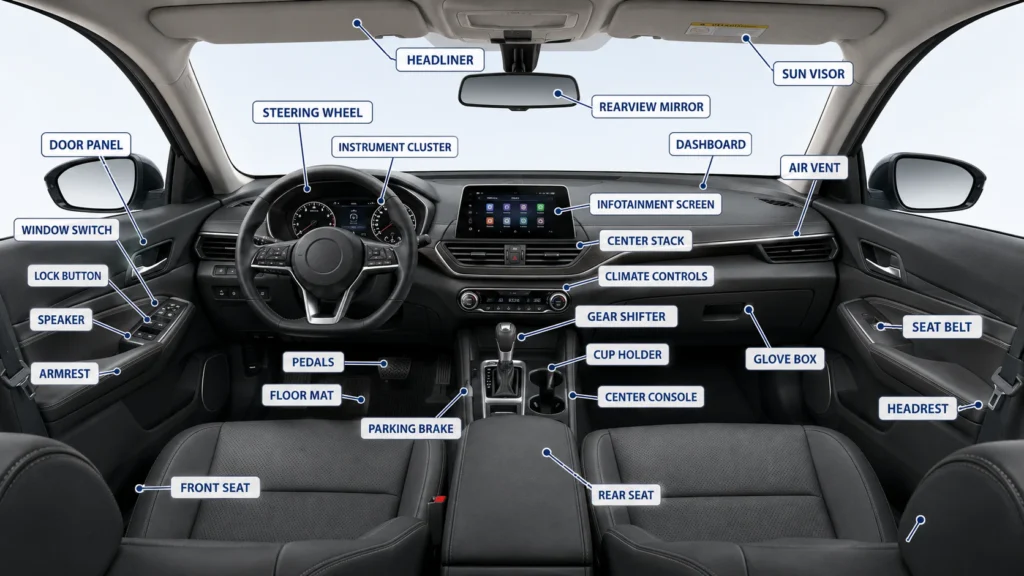
The dashboard (also called the dash) is the wide panel stretching across the front of the cabin. Behind the steering wheel sits the instrument cluster — the panel displaying your speedometer, tachometer, fuel gauge, and warning lights. The center stack is the vertical section in the middle of the dashboard that typically holds the infotainment screen and climate controls.
Between the front seats, the center console provides storage, cup holders, and often the gear selector or electronic parking brake. The headliner is the fabric-covered interior roof surface. Door panels line the inside of each door and house window switches, lock buttons, and speakers. Sun visors fold down to block sunlight, and the rearview mirror sits at the top center of the windshield.
Interior Parts Name of Car — Quick Reference Table
| Part | Location | Function |
|---|---|---|
| Dashboard | Front panel facing driver/passenger | Houses instruments and controls |
| Instrument Cluster | Behind steering wheel | Displays speed, fuel, RPM |
| Steering Wheel | Driver’s front | Controls vehicle direction |
| Center Console | Between front seats | Storage and armrest area |
| Infotainment Screen | Center stack | Navigation, music, and settings |
| Climate Controls | Center stack below screen | Adjusts AC, heat, fan speed |
| Gear Selector | Center console or column | Selects drive, reverse, park |
| Glove Compartment | Passenger side dashboard | Enclosed storage |
| Door Panel | Inner surface of doors | Holds window/lock controls |
| Headliner | Interior roof surface | Insulates and finishes roof interior |
| Sun Visor | Above windshield | Blocks sunlight |
| Rearview Mirror | Top center of windshield | Shows view behind vehicle |
| Pedals | Driver’s footwell | Accelerate, brake, clutch |
| Seat Belt | Each seating position | Restrains occupants in a crash |
Under-the-Hood Components

While not visible from outside, the components under the hood are essential car components names every owner should recognize. Opening the hood reveals the engine, battery, radiator, coolant reservoir, alternator, air-filter housing, fuse box, brake-fluid reservoir, windshield-washer reservoir, and engine-oil dipstick.
Your owner’s manual typically includes a labeled diagram specific to your vehicle. Familiarizing yourself with these components helps you perform basic checks — like verifying oil level, inspecting coolant, or locating a blown fuse — without needing a mechanic for every small task.
Wheels, Tires & Related Parts
A common point of confusion: the wheel is the metal disc (often called a rim), while the tire is the rubber component mounted on the wheel. Together they support the vehicle and provide grip. Behind each wheel sits the brake rotor and caliper. Lug nuts secure the wheel to the hub. Understanding this distinction helps when ordering replacements — a “wheel” and a “tire” are separate purchases.
Commonly Confused Car Parts
Bumper vs. Bumper Cover: The bumper is a structural metal or plastic beam hidden behind the exterior panel. What you see and touch is the bumper cover — a cosmetic shell. When people say “my bumper is scratched,” they usually mean the bumper cover. • Fender vs. Quarter Panel: A fender bolts on above the front wheel and can be unbolted for replacement. A quarter panel is welded to the body at the rear wheel and requires body-shop repair if damaged.
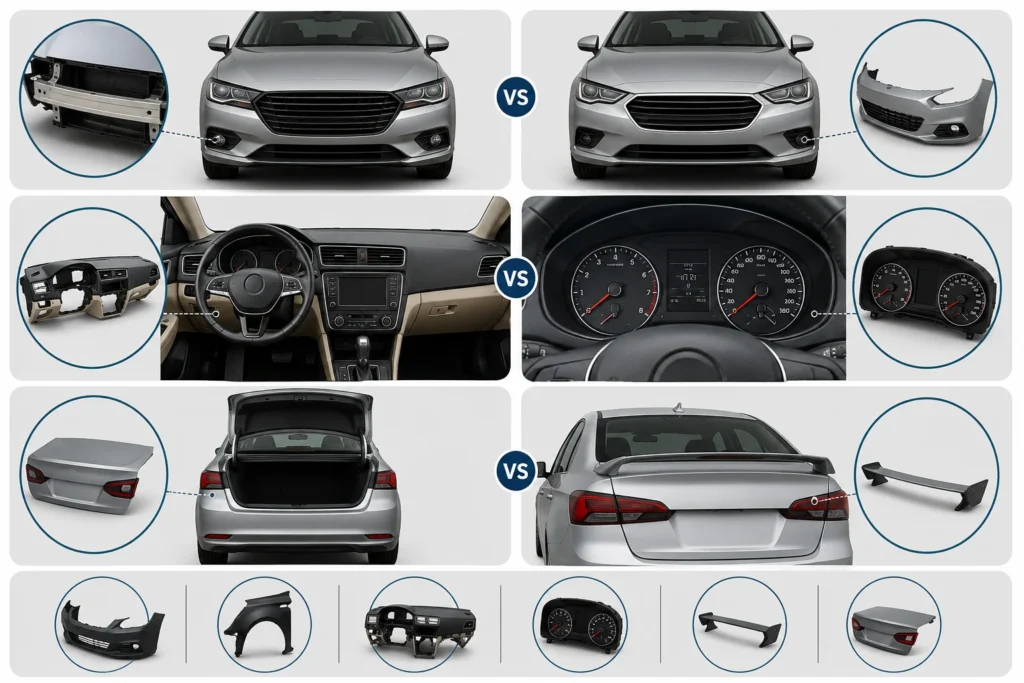
Dashboard vs. Instrument Cluster: The dashboard is the entire front panel of the cabin interior. The instrument cluster is specifically the gauge panel behind the steering wheel. • Center Console vs. Center Stack: The center stack is the vertical panel in the middle of the dashboard (screen, vents, climate). The center console is the horizontal compartment between the front seats (storage, armrest, cup holders).
Spoiler vs. Wing: A spoiler is a lip or extension that “spoils” airflow to reduce lift — it mounts flush to the trunk. A wing is raised on supports and creates downforce. Most sedans have spoilers; race cars have wings. • Trunk Lid vs. Liftgate: A trunk lid hinges at the rear of the roof and opens only the cargo cover. A liftgate (on SUVs and hatchbacks) includes the rear window and swings up as one piece.
🌐 US vs UK Car Part Names
Some car part names differ between American and British English. Hood = Bonnet, Trunk = Boot, Windshield = Windscreen, Fender = Wing, Turn signal = Indicator, Tire = Tyre. This guide uses American English terminology throughout. If you’re in the UK or Australia, keep these equivalents in mind when searching for parts online.
How to Identify an Unknown Car Part
If you notice a damaged, loose, or missing component but don’t know its name: 1) Note the part’s location on the vehicle (front/rear, left/right, interior/exterior). 2) Photograph it from multiple angles. 3) Record your vehicle’s year, make, model, and trim level. 4) Look for a visible part number stamped or printed on the component. 5) Use the VIN when consulting a dealer parts catalog or online parts store.
Remember: left and right sides are identified from the perspective of sitting inside the car facing forward. “Driver side” and “passenger side” vary by country (left-hand vs right-hand drive). When ordering online, always confirm the side, position (front/rear), and model year — visually similar parts from different years may use different mounting clips or connectors.
⚠️ Important: Always Verify Fitment
A car parts diagram provides general identification — not guaranteed fitment. Parts can differ by manufacturer, model year, trim level, body style, and engine type. The safest way to confirm compatibility is to use your Vehicle Identification Number (VIN) or the OEM part number when ordering. Never rely on appearance alone.
Frequently Asked Questions About Car Parts
What is the front plastic part of a car called?
The plastic piece across the front is usually the bumper cover. It’s a cosmetic shell that covers the structural bumper beam beneath. The grille — the slatted or mesh opening — is a separate component that allows airflow to the radiator.
What is the panel below a car door called?
The panel running below the doors is called the rocker panel (or sill panel). It’s a structural piece connecting the front and rear of the car’s body. A side skirt is a cosmetic trim piece that covers the rocker panel on some vehicles.
What is the interior roof of a car called?
The fabric or material covering the inside of the roof is called the headliner (or headlining). It provides insulation, reduces road noise, and gives a finished appearance to the cabin ceiling.
What is the difference between a fender and a quarter panel?
A fender is a bolt-on panel above the front wheel that can be removed and replaced relatively easily. A quarter panel is a welded body panel surrounding the rear wheel — repairing it usually requires cutting and welding at a body shop, making it more expensive to fix.
What are the pillars around the windows called?
The vertical supports around the windows are called pillars, labeled from front to rear: A-pillar (beside the windshield), B-pillar (between front and rear doors), and C-pillar (beside the rear window). SUVs and wagons may also have a D-pillar at the very rear.
What information do I need when ordering replacement car parts?
At minimum, you need the vehicle’s year, make, model, and trim level. For guaranteed fitment, use the Vehicle Identification Number (VIN) or the OEM part number printed on the original component. Also confirm the side (left/right) and position (front/rear) to avoid ordering the wrong piece.