Your tire pressure light just came on. Here’s everything you need to know about the tire pressure monitoring system — what it means, why it’s flashing, how to reset it, and what replacement costs in 2026.
You glance at your dashboard and see the low tire pressure light — that horseshoe-shaped symbol with an exclamation mark. Is it safe to keep driving? Does your tire need air, or is the TPMS sensor itself failing?
In this guide, we explain what a TPMS sensor is, how the tire pressure monitoring system works, what the different warning lights mean (solid vs. flashing), step-by-step reset instructions, when tire pressure sensor replacement is necessary, and transparent cost breakdowns. Whether you’re dealing with a blinking tire pressure light or a persistent “service tire monitor system” message, you’ll find clear answers below.
What Is a TPMS Sensor?
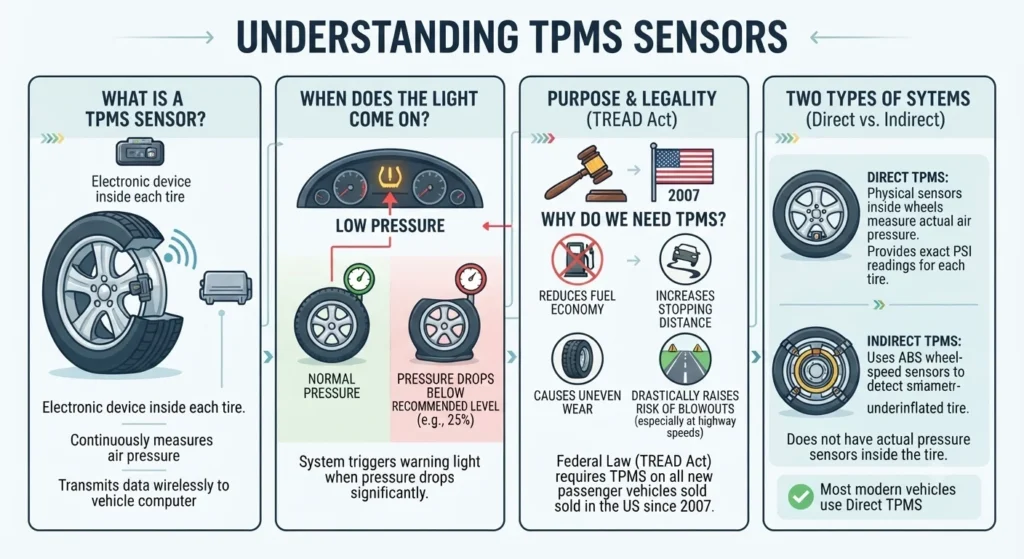
TPMS stands for Tire Pressure Monitoring System. A TPMS sensor is a small electronic device mounted inside each tire (on the valve stem or banded to the wheel rim) that continuously measures tire pressure and transmits readings wirelessly to your vehicle’s computer. When pressure drops below the manufacturer-recommended level — typically 25% below the placard value — the system triggers the low tire pressure light on your dashboard.
Since 2007, all new passenger vehicles sold in the United States are required by federal law (the TREAD Act) to include a tire pressure monitoring system. The purpose is simple: underinflated tires reduce fuel economy, increase stopping distances, cause uneven wear, and dramatically raise the risk of blowouts — especially at highway speeds.
There are two types of systems. Direct TPMS uses physical sensors inside each wheel that measure actual air pressure. Indirect TPMS has no pressure sensors — it uses the vehicle’s ABS wheel-speed sensors to detect a smaller-diameter tire (which spins faster when underinflated). Most modern vehicles use direct TPMS because it provides exact PSI readings and identifies which specific tire is low.
How Does the Tire Pressure Monitoring System Work?
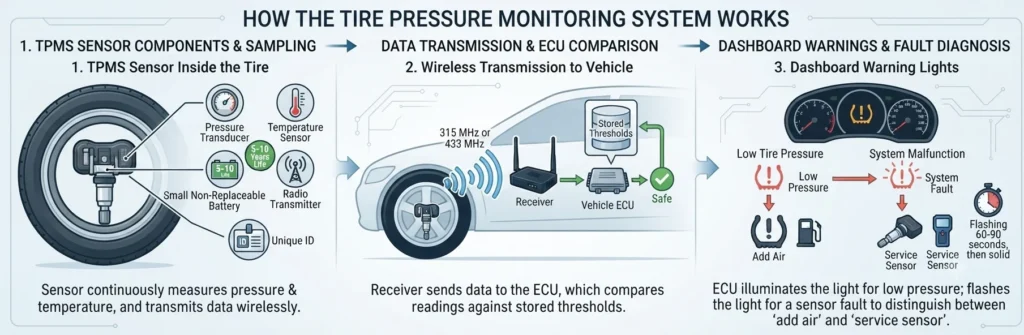
Each direct TPMS sensor contains a pressure transducer, a temperature sensor, a small battery (non-replaceable, lasts 5–10 years), a radio transmitter, and a unique ID programmed to your vehicle. The sensor samples tire pressure every few seconds and transmits data at 315 MHz or 433 MHz to a receiver module in the car. The vehicle’s ECU compares readings against stored thresholds.
If any tire drops below the safe threshold, the ECU illuminates the tire pressure light. If the system detects a fault with the sensor itself — dead battery, lost signal, or internal malfunction — it flashes the TPMS light for 60–90 seconds and then stays solid. This flashing pattern specifically means a system malfunction rather than low pressure, and it’s how you distinguish between ‘add air’ and ‘service the sensor.’
TPMS Warning Signs: What Each Light Means
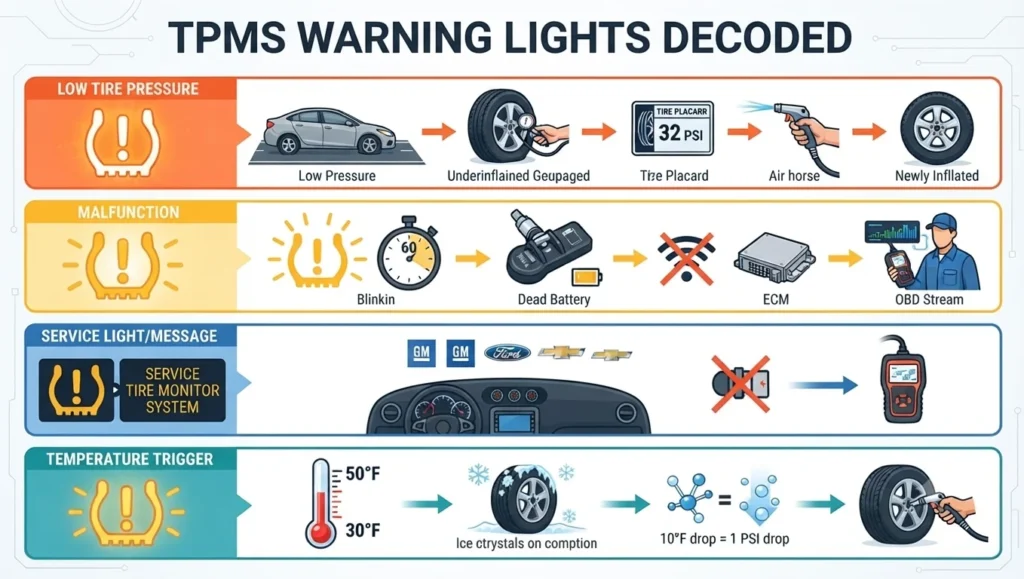
Solid TPMS light (low tire pressure light stays on): At least one tire is significantly underinflated. Pull over safely, visually inspect all four tires for obvious flats, and check pressures with a gauge. Inflate to the PSI listed on the driver’s door placard — not the maximum printed on the tire sidewall. After inflating, drive for 5–10 minutes; the light should turn off.
Flashing TPMS light (tire pressure monitoring system light flashing): The light blinks for about 60–90 seconds each time you start the car, then stays solid. This indicates a system malfunction — a dead sensor battery, a sensor not communicating, or an unprogrammed sensor (common after tire rotation or new tire installation). This requires diagnosis, not just air.
“Service Tire Monitor System” message: Some GM, Ford, and Chevrolet vehicles display this text instead of (or alongside) the TPMS light. It means the same thing as a flashing light — the tire monitor system has detected a fault with one or more TPMS sensors or the receiver module. A diagnostic scan will identify the specific sensor.
TPMS light on but tires are fine: This is common after temperature drops. For every 10°F decrease in ambient temperature, tire pressure drops about 1 PSI. A cold morning can trigger the light even though the tires appeared fine yesterday. Inflate to spec and the light should clear. If it doesn’t, the sensor may need a reset or replacement.
Is It Safe to Drive With the TPMS Light On?
If the light is solid, your immediate action is to check and correct tire pressure. Driving on a significantly underinflated tire is dangerous — it causes excessive sidewall flexing, heat buildup, and potential blowout. Once properly inflated, you can drive normally. Do not ignore a solid light for more than a day.
If the light is flashing (system malfunction), the car is still safe to drive — but you’ve lost your early-warning system. You won’t be alerted if a tire loses pressure. Drive carefully, check pressures manually each week, and schedule sensor diagnosis soon. The underlying tire isn’t necessarily the problem — the electronic sensor is.
How to Reset the TPMS Sensor
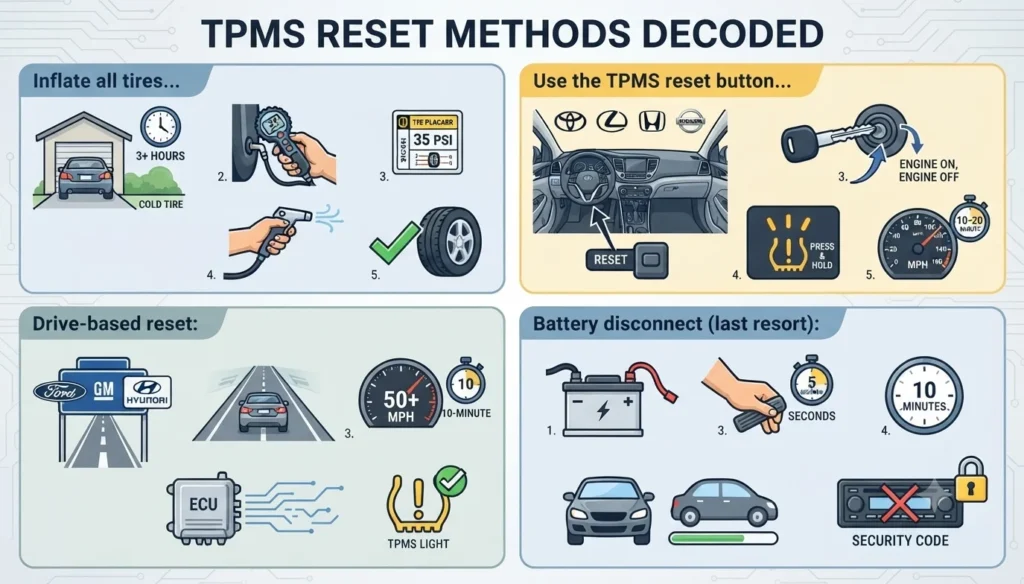
Inflate all tires to the correct PSI:
The TPMS light will not reset if any tire is still low — including the spare (some vehicles monitor the spare). Use a reliable gauge, not the gas station display alone. Check cold pressures (car parked 3+ hours).
Use the TPMS reset button:
Many Toyota, Lexus, Honda, and Nissan vehicles have a physical TPMS reset button — usually located under the steering column or inside the glove box. With the ignition on (engine off), press and hold until the TPMS light blinks three times. Then drive for 10–20 minutes above 15 mph to complete the relearn.
Drive-based reset:
Many Ford, GM, and Hyundai vehicles reset automatically after correct inflation. Drive at 50+ mph for about 10 minutes. The ECU re-reads sensor data and clears the light once all readings are within range. If the light remains after 20+ minutes of driving, a manual relearn with a TPMS scan tool may be required.
Battery disconnect (last resort):
Turn off the vehicle, disconnect the negative battery terminal, press the brake pedal for 5 seconds (to discharge residual power), wait 10 minutes, reconnect. This forces all modules to reinitialize. Note: you’ll lose radio presets and may need to re-enter a security code on older vehicles.
When Does a TPMS Sensor Need Replacement?
TPMS sensor batteries typically last 5–10 years or 60,000–100,000 miles. The battery is sealed inside the sensor housing and cannot be replaced separately — when it dies, the entire TPMS sensor must be replaced. If your vehicle is 7+ years old and you’re getting a flashing TPMS light, battery failure is the most likely cause.
Other replacement triggers include: physical damage from pothole impacts or tire mounting, corroded valve stems (especially on aluminum stems), a sensor that has lost its programmed ID, or repeated “service tire monitor system” warnings after successful relearn attempts. A TPMS diagnostic tool can read each sensor’s battery voltage and signal strength to confirm whether replacement is needed.
Should you replace one sensor or all four? If one sensor has died from battery exhaustion, the others are likely the same age and will fail soon. Many technicians recommend replacing all four TPMS sensors at once — especially if the vehicle is over 7 years old. This avoids multiple shop visits and repeated tire dismounting. However, if only one sensor was physically damaged, replacing just that one is reasonable.
TPMS Sensor Replacement Cost (2026)
Tire sensor replacement cost varies by vehicle, sensor type (OEM vs aftermarket), and labor rates. Here are typical ranges across US shops in 2026.
Single TPMS Sensor (Aftermarket)
$50 – $100
Single TPMS Sensor (OEM)
$80 – $180
All Four Sensors + Programming
$250 – $600
How to Extend TPMS Sensor Life
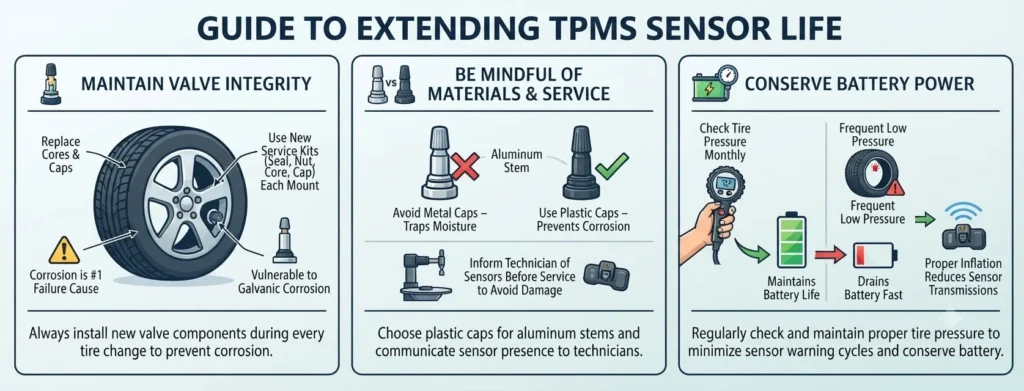
Replace valve stem cores and caps during every tire change. Corrosion is the #1 preventable cause of premature TPMS sensor failure. Aluminum valve stems are especially vulnerable to galvanic corrosion — ask your tire shop for new service kits (seal, nut, cap, core) each time tires are mounted.
Avoid using metal valve caps on aluminum TPMS stems. Metal-on-metal contact traps moisture and accelerates corrosion. Use plastic caps. Also, inform your tire technician that TPMS sensors are present before any tire service — sensors can be damaged by careless tire machine operation.
Check tire pressures monthly. Keeping tires properly inflated reduces the number of warning cycles the TPMS sensors must transmit, which conserves battery life. Frequent low-pressure events force the sensors into high-alert transmission mode, draining the battery faster.
Frequently Asked Questions
What does TPMS mean?
TPMS stands for Tire Pressure Monitoring System. It’s a safety feature that monitors the air pressure inside your tires and alerts you via a dashboard warning light when pressure drops below a safe level. All US vehicles manufactured after 2007 are required to have this system.
Why is my tire pressure monitoring system light flashing?
A flashing (blinking) TPMS light indicates a system malfunction — not just low pressure. This typically means a sensor battery has died, a sensor signal is lost, or a sensor wasn’t reprogrammed after tire service. The light flashes for 60–90 seconds at startup then stays solid. You need diagnosis, not just air.
Where is the TPMS reset button?
On most Toyota and Lexus vehicles, it’s under the steering column to the left. On some Honda models, it’s accessible through the infotainment system (Settings > Vehicle > TPMS Calibration). Many Ford and GM vehicles don’t have a physical button — they use a drive-based auto-reset or require a TPMS scan tool. Check your owner’s manual for your specific model.
Can I drive with the low tire pressure light on?
Briefly, yes — but only to reach a safe location where you can check and inflate the tire. Do not drive extended distances on a significantly underinflated tire. Low pressure causes excessive heat buildup in the sidewall, which can lead to tire failure. Check all four tires (and the spare) as soon as possible.
How much does tire pressure sensor replacement cost?
A single TPMS sensor replacement typically costs $50–$180 depending on OEM vs aftermarket and your vehicle make. Labor adds $20–$50 per sensor since the tire must be dismounted. Replacing all four sensors with programming usually runs $250–$600 total. Luxury vehicles and dealer pricing sit at the higher end.
How long do TPMS sensors last?
Most TPMS sensors last 5–10 years or approximately 60,000–100,000 miles. The limiting factor is the internal lithium battery, which cannot be replaced separately. Once the battery dies, the entire sensor unit must be replaced. Harsh climates and frequent low-pressure events can shorten battery life.
What does ‘service tire monitor system’ mean?
This message (common on GM, Chevrolet, and Ford vehicles) means the tire pressure monitoring system has detected a fault — a sensor isn’t communicating, has a dead battery, or wasn’t relearned after tire rotation. It’s the text equivalent of a flashing TPMS light. A diagnostic scan identifies which sensor has failed.
Do I need new TPMS sensors when I buy new tires?
Not necessarily, but it’s the ideal time to replace them if they’re over 5 years old. Since the tire is already off the wheel, there’s no additional labor cost for sensor access. At minimum, always replace the TPMS service kit (valve core, seal, nut, cap) during any tire change to prevent corrosion.
Can I replace a TPMS sensor myself?
Physically replacing the sensor requires dismounting the tire from the wheel, which needs a tire machine. However, if you have access to equipment, the sensor swap itself is straightforward. The bigger challenge is programming — new sensors must be registered to your vehicle’s ECU using a TPMS activation/relearn tool, which costs $30–$200 for a DIY unit.
Why does my TPMS light come on in cold weather?
Air contracts when cold. For every 10°F (5.5°C) drop in temperature, tire pressure decreases about 1 PSI. A tire inflated to 32 PSI in summer may read 28 PSI on a cold winter morning — enough to trigger the low tire pressure light. Inflate to the recommended PSI (found on the driver’s door jamb) when tires are cold, and the light will turn off.