
Wondering how much is a muffler delete? This guide covers real-world pricing, performance expectations, sound changes, legal considerations, and whether it’s worth your money.
If you’ve been searching “how much is a muffler delete” before visiting an exhaust shop, you’re in the right place. A muffler delete is one of the most popular — and most debated — exhaust modifications among car enthusiasts.
In this guide, we break down the muffler delete price for different vehicles, explain exactly what is a muffler delete, cover the pros and cons honestly, and help you decide whether this mod is right for your car and driving situation. No fluff, no upselling — just practical information based on real shop experience.
How Much Is a Muffler Delete?
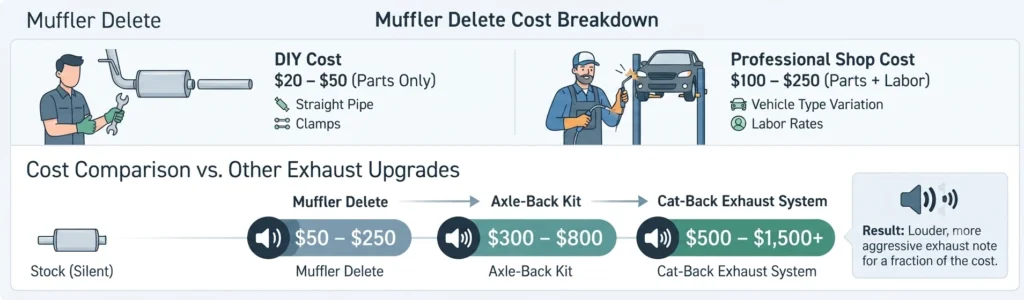
On average, a muffler delete costs between $50 and $250. If you do it yourself (DIY), you’ll spend $20–$50 on a straight pipe section and clamps. At a professional exhaust shop, expect to pay $100–$250 including parts and labor. The wide range depends on your vehicle type, exhaust complexity, and local labor rates.
Compared to a full cat-back exhaust system ($500–$1,500+) or an axle-back kit ($300–$800), a muffler delete is significantly cheaper. That’s a big part of its appeal — you get a louder, more aggressive exhaust note for a fraction of the cost of a complete aftermarket system.
What Is a Muffler Delete?
A muffler delete is an exhaust modification where the muffler (silencer) is physically removed from the exhaust system and replaced with a straight pipe section. The muffler’s job is to reduce exhaust noise using internal baffles and chambers. Removing it allows exhaust gases to flow out with less restriction — and significantly less sound dampening.
It’s important to understand that a muffler delete does NOT remove the catalytic converter. Your catalytic converter (which handles emissions) remains in place. A muffler delete only affects the sound-dampening component further downstream in the exhaust. This distinction matters for emissions testing and legality.
How Much Does a Muffler Delete Cost?
Here’s a realistic breakdown of muffler delete price based on whether you do it yourself or hire a professional. Prices are in USD and reflect 2026 averages across the US.
DIY Muffler Delete
$20 – $50
Professional Shop
$100 – $250
Factors That Affect Muffler Delete Price
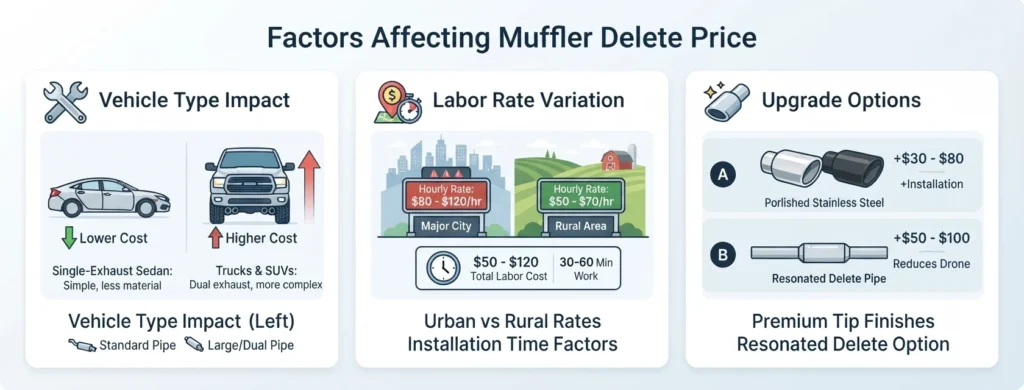
Vehicle type is the biggest variable. A simple single-exhaust sedan (like a Honda Civic or Toyota Camry) costs less because there’s only one muffler and the pipe diameter is standard. Trucks and SUVs with dual exhaust or larger diameter pipes cost more due to additional materials and labor time.
Labor rates vary significantly by region. A shop in a major city may charge $80–$120/hour, while a rural mechanic might charge $50–$70/hour. The actual cutting and welding takes 30–60 minutes for most vehicles, so labor is typically $50–$120 of your total bill.
Exhaust tip upgrades add cost. If you want a polished stainless steel or black-coated tip instead of a plain cut pipe, expect to add $30–$80 for the tip plus installation. Some drivers opt for a resonated delete pipe (adds a small resonator) which costs $50–$100 more but reduces cabin drone.
Pros of a Muffler Delete
Aggressive exhaust sound. This is the #1 reason people get a muffler delete. You’ll hear a deeper, louder exhaust note — especially during acceleration. The exact sound depends on your engine (V8s sound dramatically different from 4-cylinders), but most drivers notice a significant change immediately.
Low cost. At $50–$250 total, a muffler delete is one of the cheapest exhaust modifications available. It’s far less expensive than aftermarket exhaust systems while delivering a noticeable sound difference. For budget-conscious enthusiasts, it’s an attractive entry point.
Slight weight reduction and simple reversibility. A muffler typically weighs 15–30 lbs, so removing it saves some weight (though the performance impact is negligible). The modification is also reversible — a shop can weld a muffler back on if you change your mind or need to pass inspection.
Cons of a Muffler Delete
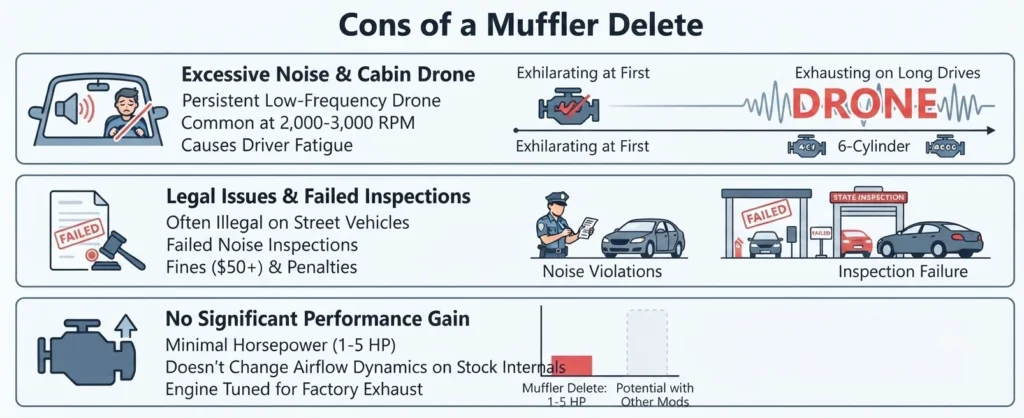
Excessive noise and cabin drone. What sounds exciting at first can become exhausting on long highway drives. Many owners report a persistent low-frequency drone at cruising speeds (2,000–3,000 RPM) that causes fatigue. This is especially common on 4-cylinder and 6-cylinder engines.
Legal issues and failed inspections. In many US states and countries, removing the muffler is illegal for street-driven vehicles. You may fail noise inspections, receive tickets, or be unable to register the car. Penalties range from $50 fines to mandatory equipment corrections.
No significant performance gain. Despite common claims, a muffler delete provides minimal horsepower improvement on most stock vehicles — typically 1–5 HP at most. Modern engines are tuned with the factory exhaust in mind, and simply removing the muffler doesn’t meaningfully change airflow dynamics on stock internals.
Does a Muffler Delete Increase Horsepower?
Technically yes, but the gains are minimal. On most stock vehicles, a muffler delete adds 1–5 horsepower. The muffler creates some backpressure, and removing it allows slightly freer exhaust flow. However, this gain is barely noticeable during normal driving and won’t show up meaningfully on a dyno for most stock engines.
Where a muffler delete makes more sense performance-wise is on already-modified vehicles with upgraded intakes, headers, and a tune. In those setups, the muffler becomes a more significant bottleneck. But if your car is otherwise stock, you’re doing a muffler delete for sound — not speed. Be honest with yourself about that.
Is a Muffler Delete Legal?
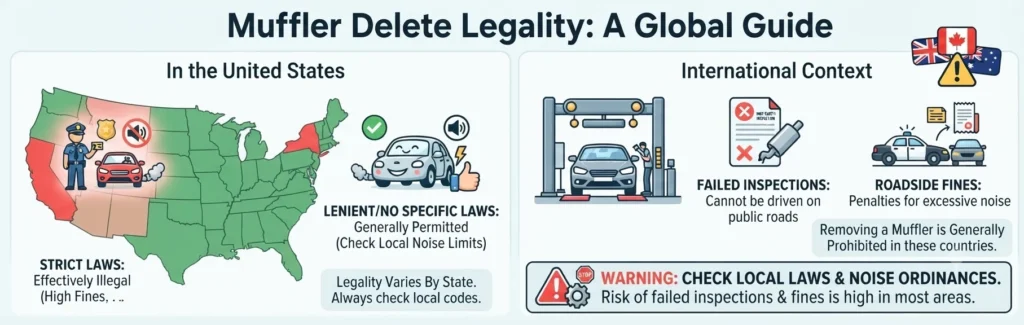
It depends entirely on where you live. In the United States, muffler delete legality varies by state. States like California and New York have strict noise and equipment laws that effectively make muffler deletes illegal on public roads. Other states have no specific muffler requirement or have lenient noise limits.
In the UK, Canada, and Australia, removing the muffler can result in failed MOT/safety inspections and roadside fines. Before getting a muffler delete, check your local vehicle equipment laws and noise ordinances. If your state requires periodic inspections, consider whether you’re willing to reinstall a muffler before each test — or risk a failed inspection.
Should You Get a Muffler Delete?
A muffler delete makes sense if: you want a louder exhaust note on a budget, you live in an area without strict noise laws, you don’t do long highway commutes (drone is real), and you understand you’re doing it for sound — not performance. It’s an affordable, reversible mod that many enthusiasts enjoy.
Skip the muffler delete if: you live in a state with strict inspections, you commute long distances daily, you share a car with family members who prefer quiet, or you expect noticeable horsepower gains. In those cases, consider a quality axle-back or cat-back exhaust system instead — they offer better sound without the downsides.
Frequently Asked Questions
How much is a muffler delete on average?
A muffler delete costs $50–$250 on average. DIY costs $20–$50 for parts, while professional installation at an exhaust shop runs $100–$250 including labor and a straight pipe section.
How much does a muffler delete cost at an exhaust shop?
At a professional exhaust shop, expect to pay $100–$250 for a muffler delete. This includes cutting out the old muffler, welding in a straight pipe, and optionally adding an exhaust tip. Trucks and dual-exhaust vehicles cost more.
What is a muffler delete?
A muffler delete is an exhaust modification where the muffler (silencer) is removed and replaced with a straight pipe. It makes the car louder and slightly reduces exhaust restriction but does not remove the catalytic converter.
Is a muffler delete worth it?
It depends on your goals. If you want a louder exhaust sound on a budget and live somewhere without strict noise laws, it’s a great value mod. If you expect performance gains or have a long commute, the drone and legal risks may not be worth it.
Does a muffler delete increase horsepower?
Marginally. Most stock vehicles see 1–5 HP gains from a muffler delete — not enough to feel during normal driving. The primary benefit is sound, not performance.
Does a muffler delete make a car louder?
Yes, significantly. Removing the muffler eliminates the primary sound-dampening component in your exhaust. Expect a noticeably louder, more aggressive exhaust tone at idle, acceleration, and highway speeds.
Is a muffler delete legal in my state?
Legality varies by state and country. States like California, New York, and Massachusetts have strict noise/equipment laws that effectively prohibit muffler deletes on street vehicles. Check your local regulations before modifying.
Can a muffler delete affect fuel economy?
Generally no. A muffler delete has minimal impact on fuel economy — neither improving nor worsening it significantly. Any claims of better MPG from a muffler delete are largely myths.
Will a muffler delete cause a check engine light?
Usually no. Since a muffler delete doesn’t affect the catalytic converter or O2 sensors, it typically won’t trigger a check engine light. However, on some modern vehicles with rear O2 sensors positioned near the muffler, a light is possible.
What’s the difference between a muffler delete and a resonator delete?
A muffler delete removes the muffler (main silencer), making the car significantly louder. A resonator delete removes the resonator (which fine-tunes sound frequencies), producing a moderate volume increase with a raspier tone. Many enthusiasts combine both, but this often results in excessive drone.