
⚡ Quick Answer
A piston is a cylindrical metal component inside your car’s engine that moves up and down to convert fuel energy into the motion that turns your wheels. Think of it as the engine’s muscle — it does the heavy lifting.
Piston Definition — What Exactly Is It?
Here’s a simple definition of a piston: it’s a solid, cylindrical piece of metal that fits snugly inside a hollow tube called a cylinder. The piston slides up and down inside that cylinder, and this movement is what ultimately powers your car.
Every car piston is built to withstand extreme heat and pressure. In most everyday vehicles, pistons are made from aluminum alloy because it’s lightweight yet tough enough to handle thousands of up-and-down cycles every minute.
So when someone asks “what is a piston?” — the short answer is: it’s the moving part inside the piston cylinder that transforms explosive energy into mechanical motion. Without pistons, your engine simply wouldn’t run.
How Does an Engine Piston Function?
The function of a piston comes down to one job: converting pressure into movement. Here’s the basic sequence. Fuel and air enter the piston cylinder. The piston compresses this mixture by sliding upward. A spark plug ignites it, creating a small explosion. That explosion shoves the piston back down with tremendous force.
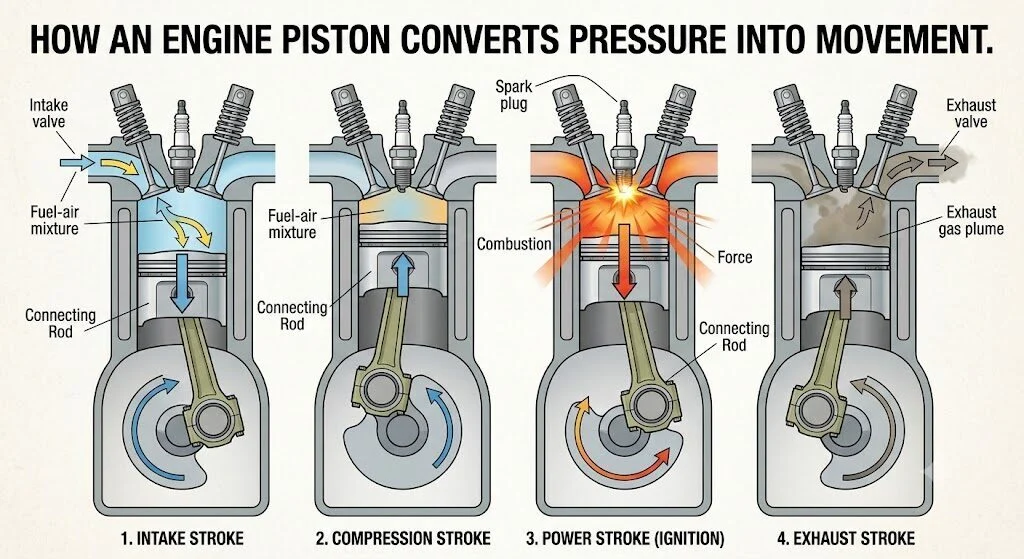
Inside an engine block — the piston moves within the cylinder bore
This downward push is the “power stroke” — it’s where the real work happens. The piston is connected to a rod that translates this straight-line motion into the spinning motion your wheels need. This cycle repeats hundreds of times per second at highway speeds.
What are pistons doing the rest of the time? They’re completing the other strokes — drawing in fresh air and fuel, and pushing out exhaust gases. It’s a four-step dance that never stops while your engine is running.
The Piston’s Role Inside Your Car Engine
A car piston doesn’t work alone. It’s part of a team. The piston sits inside the cylinder block, connected to the crankshaft below it by a connecting rod. When the piston pushes down, the connecting rod turns the crankshaft — and that rotation is what eventually reaches your wheels.
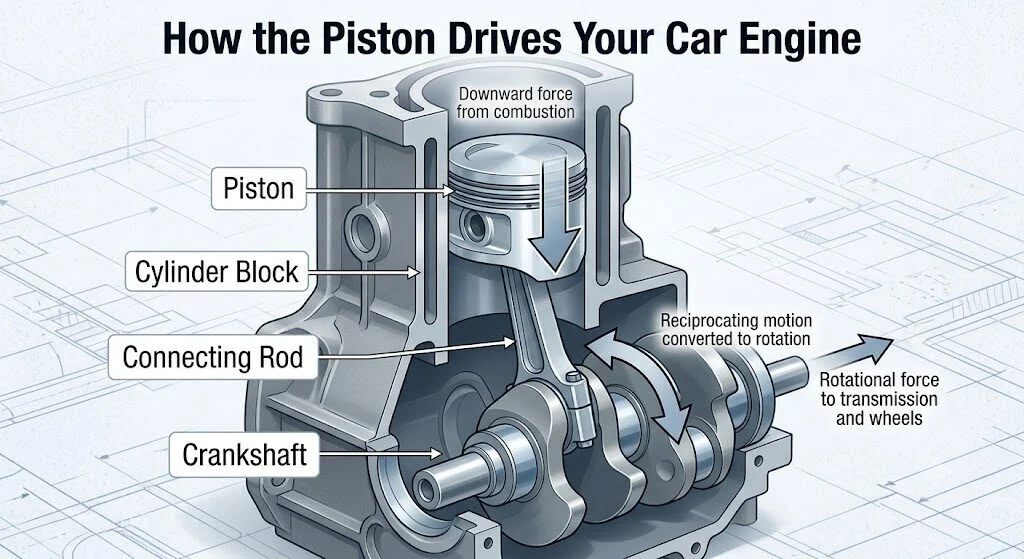
A modern engine block — multiple pistons work together to produce smooth power
Most daily-driver cars have four or six pistons (that’s what “4-cylinder” or “V6” refers to). More pistons generally means a smoother, more powerful engine. Each piston fires at a slightly different time so the engine delivers constant, balanced power.
The engine piston is the bridge between chemical energy (burning fuel) and kinetic energy (your car moving). Without it, there’s no way to harness those tiny explosions and turn them into something useful.
A Simple Analogy That Makes It Click
If you’ve ever used a bicycle pump, you already understand pistoning. The handle you push is the piston. The tube it slides inside is the cylinder. When you push down, you compress air — that’s exactly what happens during the compression stroke. The only difference? In your engine, fuel ignites and pushes the piston back up for you.
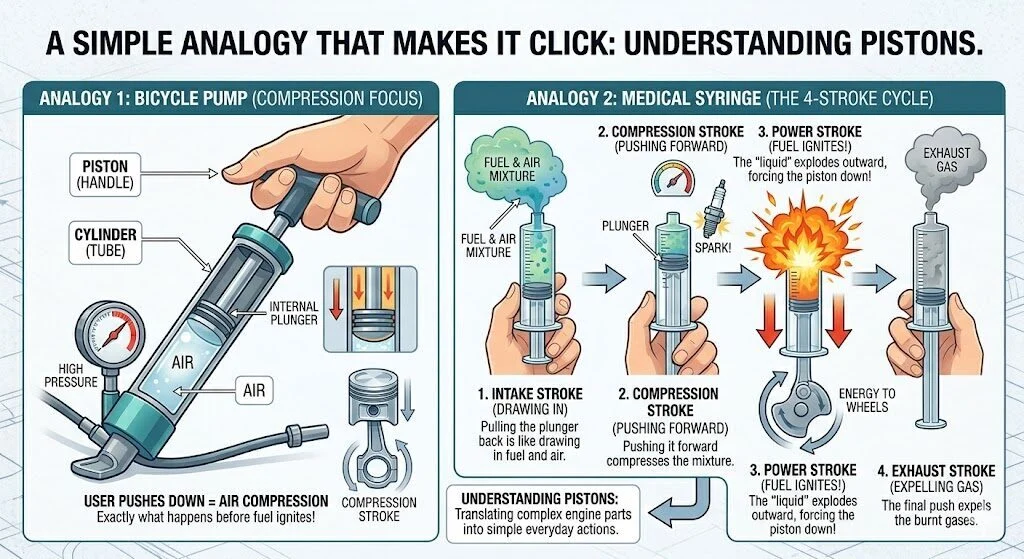
Another way to picture it: think of a syringe without the needle. Pull the plunger back (that’s the intake stroke drawing in fuel and air). Push it forward (that’s compression). Now imagine the liquid inside exploding outward — that’s the power stroke forcing the piston down. Simple as that.
Frequently Asked Questions
What does “pistoning” mean?
The pistoning definition refers to the repetitive back-and-forth or up-and-down motion that a piston makes inside its cylinder. It’s essentially the action of moving like a piston — a pumping, reciprocating motion.
How many pistons does a typical car have?
Most passenger cars have 4 pistons (a 4-cylinder engine). Some larger or performance vehicles have 6, 8, or even 12. Each piston sits in its own cylinder and fires in a precise sequence.
Can a piston wear out?
Yes. Over time, the rings around the piston can wear down, causing oil leaks and reduced compression. Regular oil changes and proper engine maintenance help your pistons last the lifetime of the vehicle — often 200,000+ miles.