
Your complete guide to understanding tire part numbers, width specifications, aspect ratios, and every number on your tire sidewall — explained in plain English.
What Are Part Number Width Specifications?
Part number width specifications refer to the standardized numeric codes molded into every tire’s sidewall that communicate its physical dimensions, construction type, and performance capabilities. The first number in a tire’s part number — such as the “225” in 225/65R17 — represents the tire’s section width in millimeters, measured from sidewall to sidewall when mounted on the recommended rim width. Understanding these part number width specifications is essential for selecting replacement tires that match your vehicle’s engineering requirements.
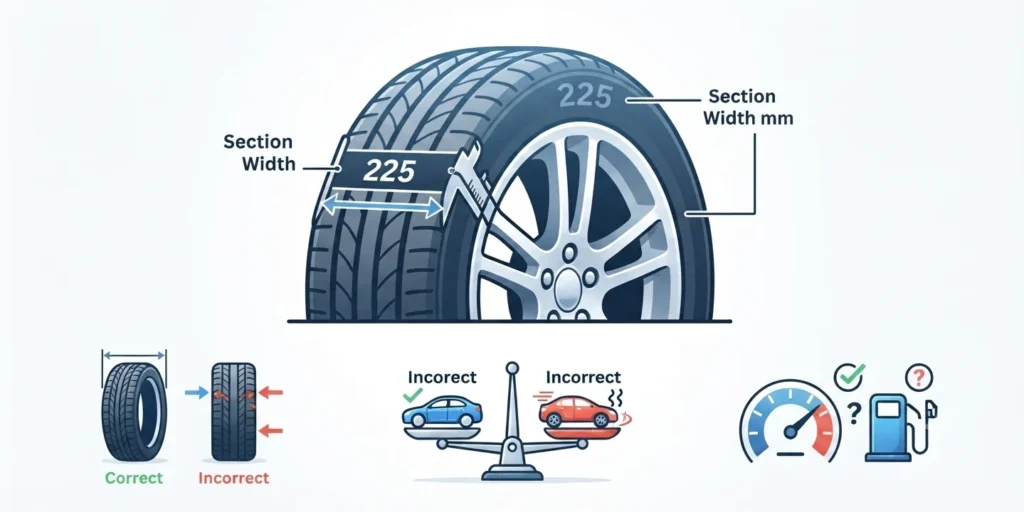
💡 Key Fact: Every tire sold in the U.S. and Canada must display standardized part number width specifications as defined by the Tire and Rim Association (TRA) and the U.S. Department of Transportation (DOT). These numbers aren’t arbitrary — they’re precise engineering measurements.
The tire size meaning encoded in these part numbers tells you exactly what will fit your vehicle safely. Installing incorrect tire dimensions can affect braking distance, speedometer accuracy, fuel economy, and overall driving safety. This guide will walk you through every component of the tire size explained in detail, so you can confidently choose the right tires.
How to Read a Tire Size: Complete Breakdown (225/65R17 102H)
Let’s decode a real-world example. The tire size 225/65R17 102H contains six distinct pieces of information. Here’s what each segment of this part number width specification means:
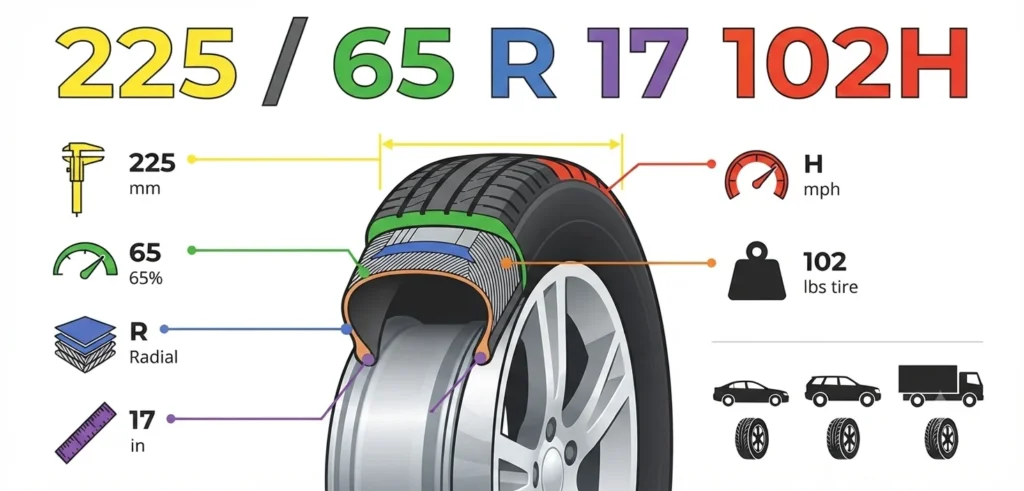
- 🟡 225 — Section width in millimeters (the tire’s width from sidewall to sidewall)
- 🟢 65 — Aspect ratio (sidewall height is 65% of the section width)
- 🔵 R — Radial construction (internal ply layout)
- 🟣 17 — Wheel diameter in inches (rim size this tire fits)
- 🟠 102 — Load index (maximum weight capacity: 1,874 lbs per tire)
- 🔴 H — Speed rating (safe up to 130 mph / 210 km/h)
Every tire you see — whether on a sedan, SUV, or truck — uses this same format. Once you understand how to read tire size numbers, you’ll never be confused at the tire shop again. The tire size meaning is universal across all major manufacturers including Michelin, Goodyear, Bridgestone, and Continental.
Tire Width Explained: What Part Number Width Specifications Tell You
The first number in any tire part number is the section width — the most critical of the part number width specifications. Measured in millimeters, this number represents the distance from the outermost point of one sidewall to the outermost point of the other, when the tire is mounted on its recommended rim width and properly inflated (but not under load).
For example, a tire marked 225 has a section width of 225mm (approximately 8.86 inches). Common passenger tire widths range from 155mm (subcompacts) to 315mm (performance sports cars). A wider tire provides a larger contact patch with the road, which generally improves grip and cornering stability — but also increases rolling resistance and may reduce fuel economy.
Important: The width specification in the part number assumes the tire is mounted on a specific rim width. A 225mm tire mounted on a rim that’s too narrow or too wide will measure differently. Always match tires to manufacturer-recommended rim widths for accurate part number width specifications.
Aspect Ratio Explained: The Second Number in Tire Size Meaning
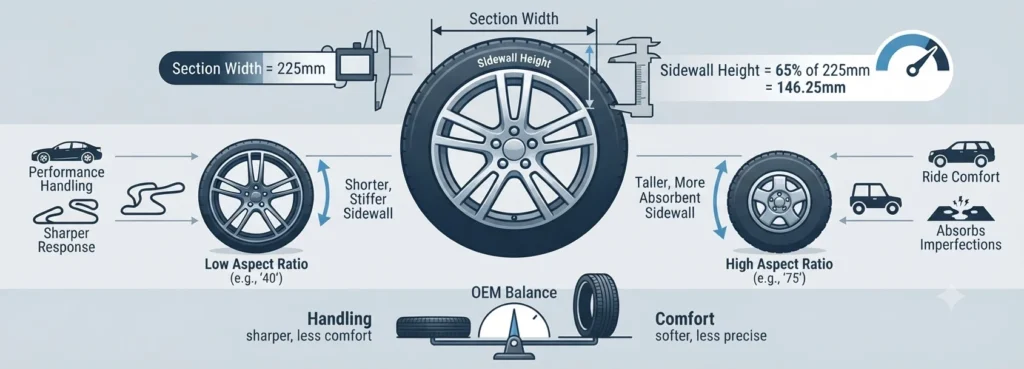
The number after the slash (/) is the aspect ratio — a percentage that tells you the sidewall height relative to the section width. In our 225/65R17 example, the aspect ratio is 65, meaning the sidewall height is 65% of 225mm = 146.25mm. A lower aspect ratio (like 40 or 45) means a shorter, stiffer sidewall — common on performance vehicles for sharper handling. A higher aspect ratio (65, 70, 75) means a taller sidewall that absorbs more road imperfections — preferred for SUVs and trucks.
When the tire size explained includes a very low aspect ratio (30–40), the ride will feel firmer and more road-connected but less forgiving over potholes. Conversely, high-profile tires (65–80) offer cushioning comfort but may feel less precise in corners. Your vehicle’s original aspect ratio was chosen to balance handling, comfort, and clearance — changing it significantly affects all three.
Construction Type: What Does the “R” Mean?
The letter between the aspect ratio and wheel diameter indicates the tire’s internal construction. This determines how the tire’s structural plies are arranged:
- R (Radial) — Plies run radially (perpendicular to the direction of travel). Over 98% of modern passenger tires are radial. They offer better fuel efficiency, longer tread life, and improved ride comfort.
- D (Diagonal/Bias) — Plies run diagonally at 30–45° angles. Found on some trailers, vintage vehicles, and specialty equipment. Stiffer sidewalls, shorter tread life.
- B (Belted Bias) — A bias-ply tire with additional stabilizer belts. Rare today; occasionally seen on older light trucks.
Wheel Diameter: Matching Tires to Your Rims
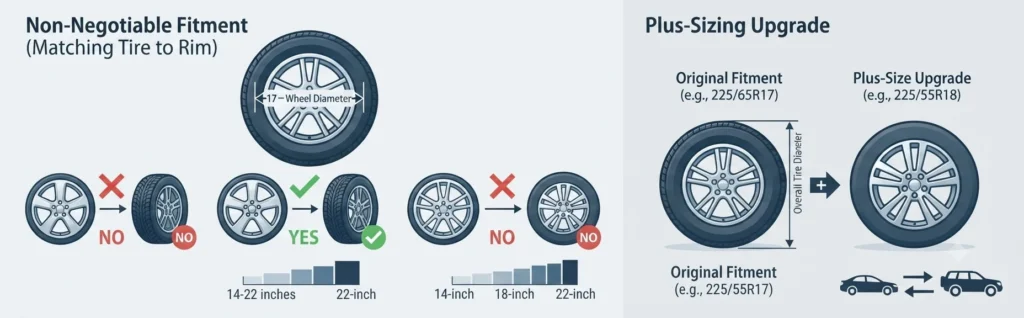
The number following the construction letter is the wheel diameter in inches — the size of the rim this tire is designed to fit. In 225/65R17, the tire fits a 17-inch wheel. This measurement is non-negotiable: a 17-inch tire will not physically mount on a 16-inch or 18-inch rim. Common passenger vehicle wheel diameters range from 14 to 22 inches.
When upgrading wheel sizes (known as “plus-sizing”), you increase the rim diameter while decreasing the aspect ratio to maintain approximately the same overall tire diameter. For example, moving from 225/65R17 to 225/55R18 keeps the overall diameter close while giving you a larger wheel with a lower-profile tire.
Load Index and Speed Rating: The Final Part Number Specifications
After the wheel diameter, you’ll find a number-letter combination like “102H.” The number (102) is the load index — a coded reference to the maximum weight each tire can safely carry at maximum inflation pressure. A load index of 102 means each tire supports up to 1,874 lbs (850 kg). Your vehicle requires a minimum load index specified in the owner’s manual — never go below it.
The letter (H) is the speed rating — the maximum sustained speed the tire is engineered to handle safely. Common speed ratings include S (112 mph), T (118 mph), H (130 mph), V (149 mph), W (168 mph), and Y (186 mph). Always match or exceed your vehicle’s original speed rating.
⚠️ Safety Warning: Never install tires with a load index or speed rating lower than your vehicle manufacturer’s specification. Doing so can lead to tire failure at highway speeds or when carrying heavy loads.
Why Tire Dimensions Matter for Safety and Performance
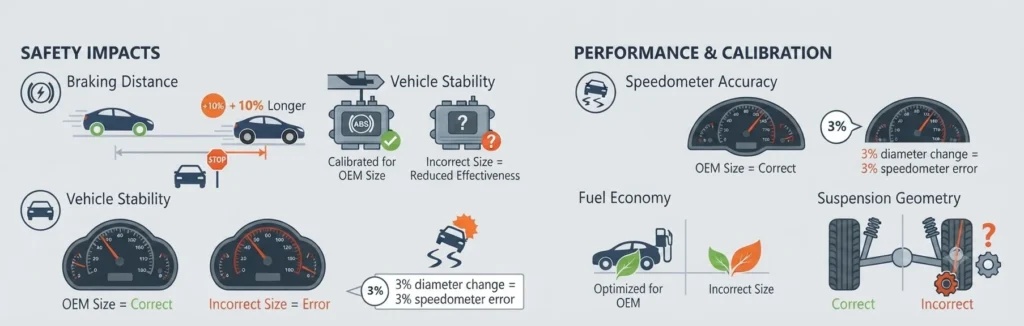
Understanding part number width specifications isn’t just academic — it directly impacts your safety. Incorrect tire sizes affect braking distance (up to 10% longer with wrong dimensions), speedometer accuracy (a 3% diameter change = 3% speedometer error), fuel economy, ABS and stability control calibration, and suspension geometry.
Modern vehicles are engineered with specific tire dimensions in mind. The electronic stability control, anti-lock braking, and traction control systems are calibrated to the OEM tire’s rolling circumference. Changing tire size without recalibrating these systems may reduce their effectiveness — particularly in emergency maneuvers.
Can You Change Tire Sizes? Rules and Recommendations
Yes, but with important constraints. The Tire and Rim Association recommends keeping overall tire diameter within ±3% of the original equipment size. Here are the key rules for safe tire size changes:
- Keep overall diameter within 3% of OEM — this minimizes speedometer error and maintains proper gearing
- Never go below the OEM load index — your vehicle’s weight requirements don’t change with tire choice
- Maintain or exceed the original speed rating — especially important for highway driving and emergency braking
Consult your vehicle’s owner manual or the tire placard on the driver’s door jamb for approved alternative sizes. Many manufacturers list 2–3 acceptable tire sizes for each vehicle trim level.
Common Tire Size Examples and What They Fit
Here are some of the most popular tire sizes in North America and the vehicles that typically use them:
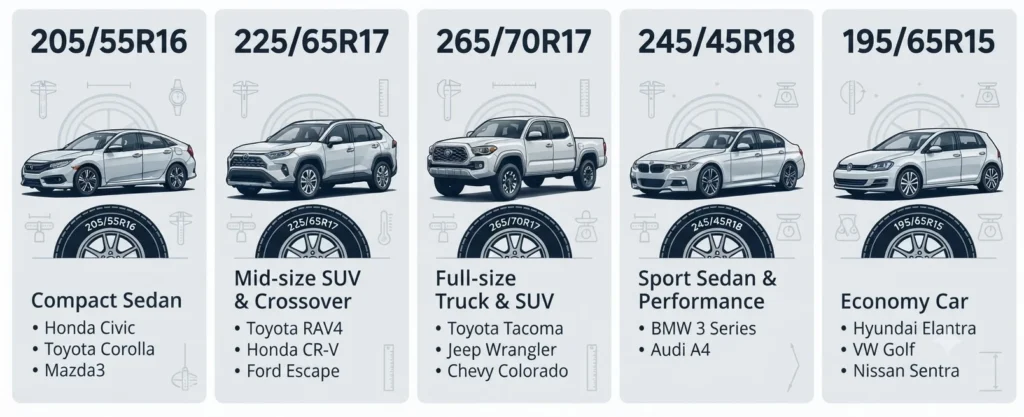
- 205/55R16 — Compact sedans (Honda Civic, Toyota Corolla, Mazda3). Width: 205mm, moderate aspect ratio for balanced comfort and handling.
- 225/65R17 — Mid-size SUVs and crossovers (Toyota RAV4, Honda CR-V, Ford Escape). Taller sidewall for light off-road capability.
- 265/70R17 — Full-size trucks and SUVs (Toyota Tacoma, Jeep Wrangler, Chevy Colorado). Wide width for load carrying.
- 245/45R18 — Sport sedans and performance vehicles (BMW 3 Series, Audi A4). Low profile for responsive handling.
- 195/65R15 — Economy cars (Hyundai Elantra, VW Golf, Nissan Sentra). Narrower width optimizes fuel efficiency.
Tire Size Comparison Table: Width, Height & Diameter
This table shows how part number width specifications translate into actual physical dimensions. The sidewall height is calculated as width × aspect ratio (e.g., 225 × 0.65 = 146.25mm):
| Tire Size | Width (mm) | Sidewall Height (mm) | Rim (in) | Common Vehicle |
|---|---|---|---|---|
| 205/55R16 | 205 | 112.75 | 16 | Honda Civic, Toyota Corolla |
| 225/65R17 | 225 | 146.25 | 17 | Toyota RAV4, Honda CR-V |
| 245/75R16 | 245 | 183.75 | 16 | Ford F-150, Chevy Silverado |
| 265/70R17 | 265 | 185.5 | 17 | Toyota Tacoma, Jeep Wrangler |
| 195/65R15 | 195 | 126.75 | 15 | Hyundai Elantra, VW Golf |
* Sidewall height = section width × aspect ratio ÷ 100. Overall diameter = (2 × sidewall height) + (rim diameter × 25.4mm). Values shown are nominal.
Frequently Asked Questions: Tire Size Explained
What do the numbers on a tire mean?
The numbers on a tire represent its part number width specifications: section width (mm), aspect ratio (%), construction type (R/D/B), wheel diameter (inches), load index (weight capacity), and speed rating (maximum safe speed). For example, in 225/65R17 102H, 225 is the width, 65 is the aspect ratio, R means radial, 17 is the rim size, 102 is the load index (1,874 lbs), and H is the speed rating (130 mph).
Where is the tire size printed on my tire?
The tire size is molded into the sidewall — the vertical surface between the tread and the rim. Look for a sequence like P225/65R17 102H. It appears on both sidewalls of the tire. You can also find your vehicle’s recommended tire size on the tire placard located on the driver’s door jamb, inside the fuel filler door, or in your owner’s manual.
Can I use a wider tire than what’s recommended?
You can go slightly wider (typically 10–20mm) if the rim width supports it and there’s adequate clearance in the wheel well. However, increasing width affects handling balance, may rub on suspension components during turns, and can trigger stability control warnings. Always stay within the manufacturer’s approved alternative sizes listed in your owner’s manual.
Will changing tire size affect my speedometer?
Yes. Your speedometer is calibrated to the original tire’s rolling circumference. If the overall diameter changes, your speedometer will read incorrectly. A tire that’s 3% larger in diameter means your speedometer will read 3% lower than your actual speed. Keep overall diameter within ±3% of OEM to minimize this effect.
What does the ‘P’ before some tire sizes mean?
The ‘P’ stands for P-Metric and indicates the tire is designed for passenger vehicles following U.S. standards. You may also see ‘LT’ (Light Truck) for heavier-duty tires, or no letter prefix (Euro-Metric sizing). P-Metric and Euro-Metric tires with the same numbers are dimensionally identical but may have slightly different load capacity calculations.
Do I need the exact same tire size as my OEM tires?
Ideally, yes — the OEM size is the safest and simplest choice. However, most vehicles have 2–3 approved alternative sizes listed by the manufacturer. If you deviate, keep overall diameter within 3% of original, never reduce load index or speed rating, and ensure adequate wheel-well clearance. When in doubt, consult a tire professional.
Expert Recommendations and Final Takeaways
Understanding part number width specifications empowers you to make safe, informed tire purchasing decisions. The tire size meaning encoded on your sidewall is a standardized language — once you learn to read it, you’ll never overpay for the wrong tire or compromise your vehicle’s safety. Always start with your vehicle’s door placard or owner’s manual for the recommended tire size, and use this guide to understand exactly what those numbers mean.
When shopping for replacement tires: match the OEM size whenever possible, never go below the specified load index or speed rating, and consider your driving conditions (highway commuting, off-road, winter) when choosing tread patterns within your correct size. If you’re considering a size change, consult a TRA-certified tire professional who can verify fitment and advise on any speedometer or calibration adjustments needed.