Don’t waste hundreds on wheels that won’t fit. Grab your tape measure — we’ll walk you through every measurement, step by step.
⚠️ The #1 Mistake: Measuring Lip-to-Lip
An “18-inch rim” actually measures close to 19 inches from outer lip to outer lip. The industry-standard measurement is taken where the tire bead sits — the inner barrel — NOT the decorative outer edges. If you measure lip-to-lip, you’ll order the wrong size. Keep reading to learn exactly where to place your tape.
Step 0: Check the Stamp First (The 30-Second Shortcut)
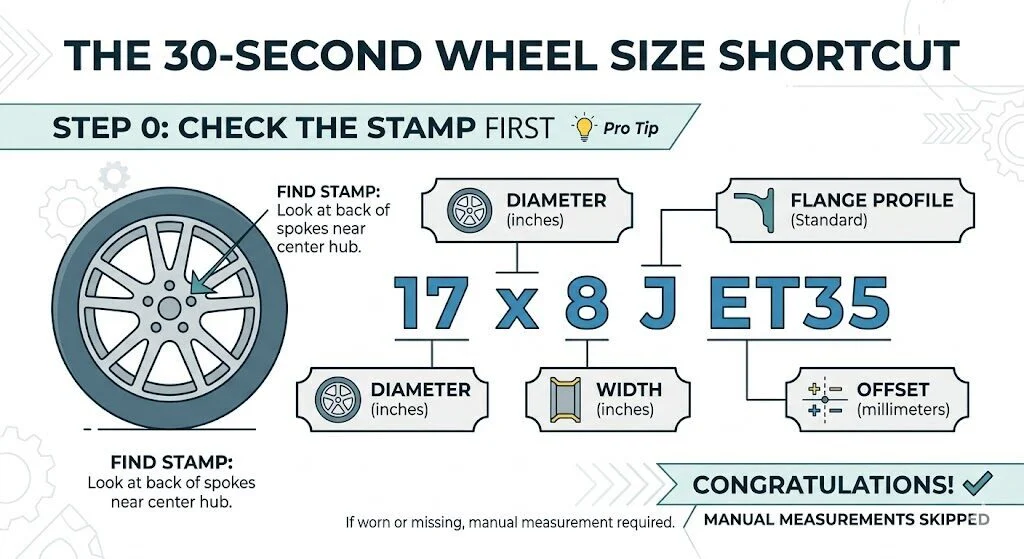
💡 Pro Tip: Before you grab a tape measure, flip your wheel over and look at the back of the spokes near the hub. Most aftermarket (and many OEM) wheels have the size stamped right there — something like “17x8J ET35” or “18×9.5 +40”.
That cryptic string is actually everything you need. Here’s how to decode it: the first number (17 or 18) is the diameter in inches. The second number (8 or 9.5) is the width in inches. “J” refers to the flange profile (standard for passenger cars). And ET35 or +40 is the offset in millimeters.
If you find that stamp, congratulations — you can skip the manual measurements for diameter and width entirely. But if the stamp is worn, missing, or you want to double-check, keep reading.
Step 1: How to Measure Rim Diameter
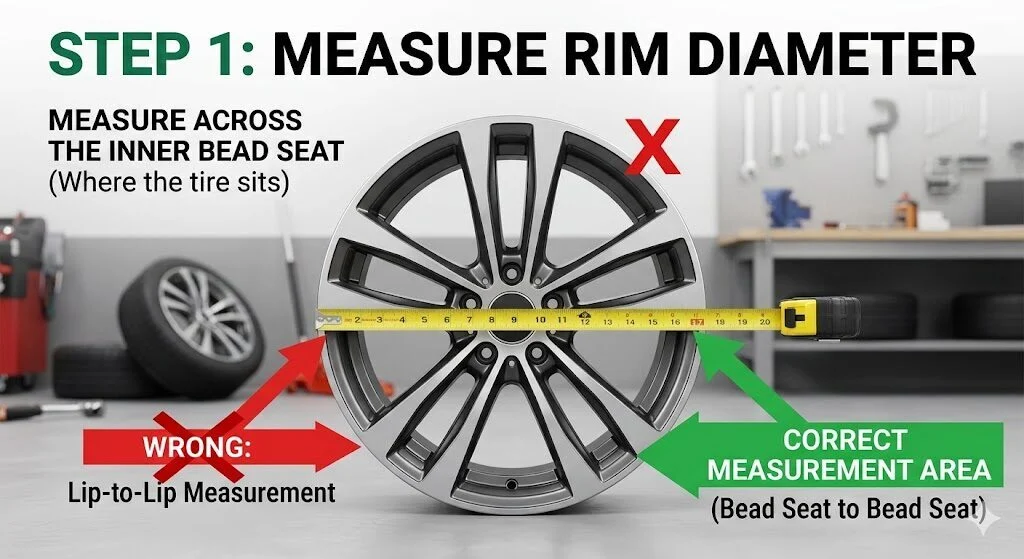
Rim diameter is the distance across the face of the wheel — but NOT from outer lip to outer lip. You need to measure from bead seat to bead seat, which is the flat shelf inside the rim where the tire actually hooks onto.
⚠️ Remember: The outer flanges (lips) add roughly 0.5–1 inch to the total. If your tape reads ~19 inches lip-to-lip, you likely have an 18-inch wheel.
For the most accurate reading, remove the tire completely. If the tire is still mounted, you can lay a straight edge across the face and measure from the inside edge where the tire bead contacts the rim on one side to the same point on the opposite side.
Quick Steps:
- Remove the tire if possible, or lay a straight edge across the wheel face.
- Hook your tape measure on the inner bead seat (the flat ledge) on one side.
- Stretch to the bead seat directly opposite. That measurement in inches is your rim diameter.
Step 2: How to Measure Rim Width
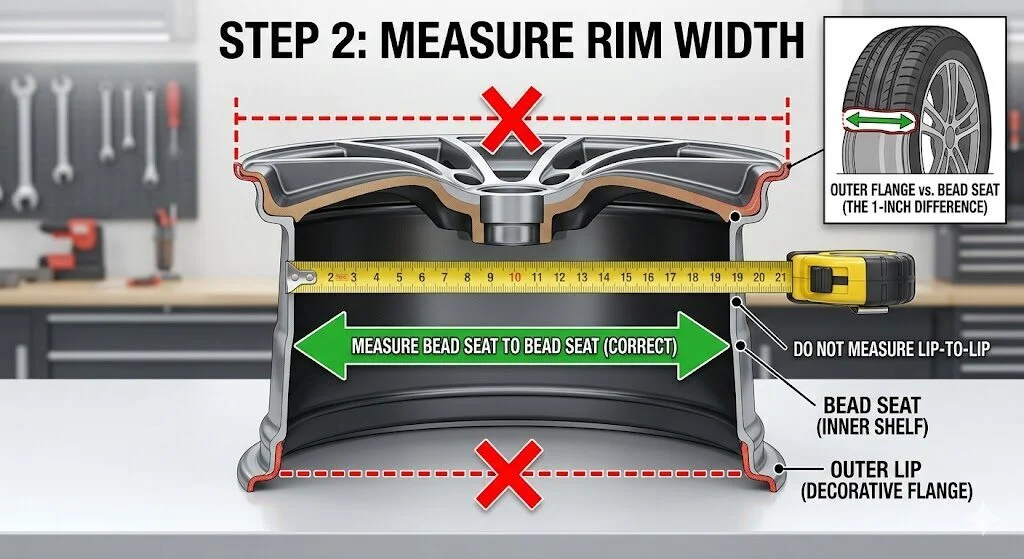
Width is measured from the inside of one bead seat to the inside of the opposite bead seat — across the barrel of the wheel. Again, you are NOT measuring the outermost lips. The outer flanges are there to keep the tire from sliding off, not to define the width.
If the tire is still mounted, you’ll need to reach behind the wheel with a tape measure or use a caliper tool. Alternatively, measure the total width lip-to-lip and subtract approximately 1 inch (0.5 inch for each flange) to get your bead-seat-to-bead-seat width.
Quick Steps:
- With the tire removed, place a straight edge across the back of the rim.
- Measure the distance between the two inner flanges (bead seats) where the tire contacts the barrel.
- If you measure lip-to-lip instead, subtract about 1 inch total for a close approximation.
Step 3: How to Measure Bolt Pattern (PCD)
Your bolt pattern (also called PCD — Pitch Circle Diameter) describes two things: the number of lug holes and the diameter of the invisible circle they form. A “5×114.3” pattern means 5 bolts on a 114.3mm circle. Getting this wrong means the wheel physically cannot mount to your hub.
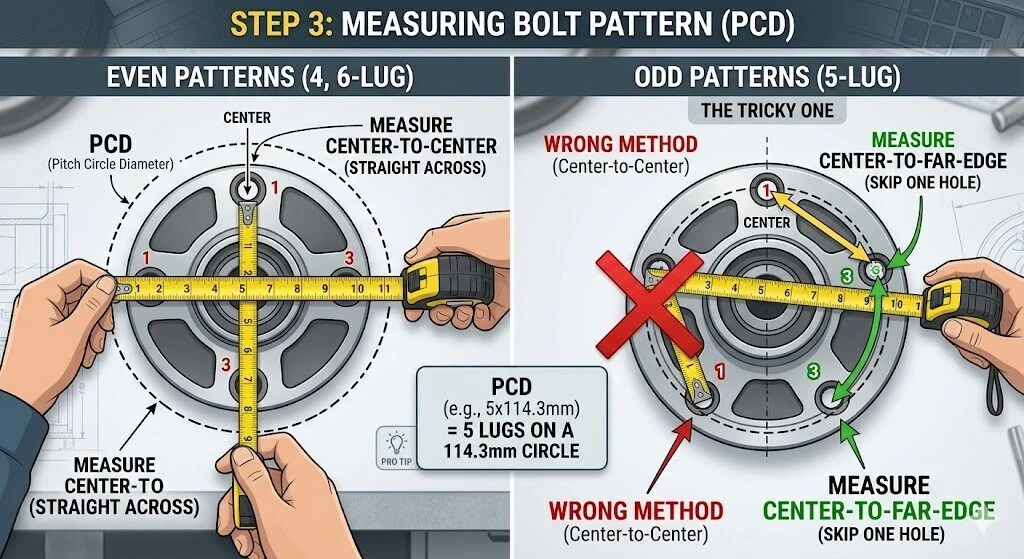
4-Lug or 6-Lug (Even Numbers):
Easy — measure from the center of one bolt hole straight across to the center of the hole directly opposite. That distance in millimeters is your PCD. For a 4-lug wheel, it’s directly across. For 6-lug, measure between two holes that are straight across from each other.
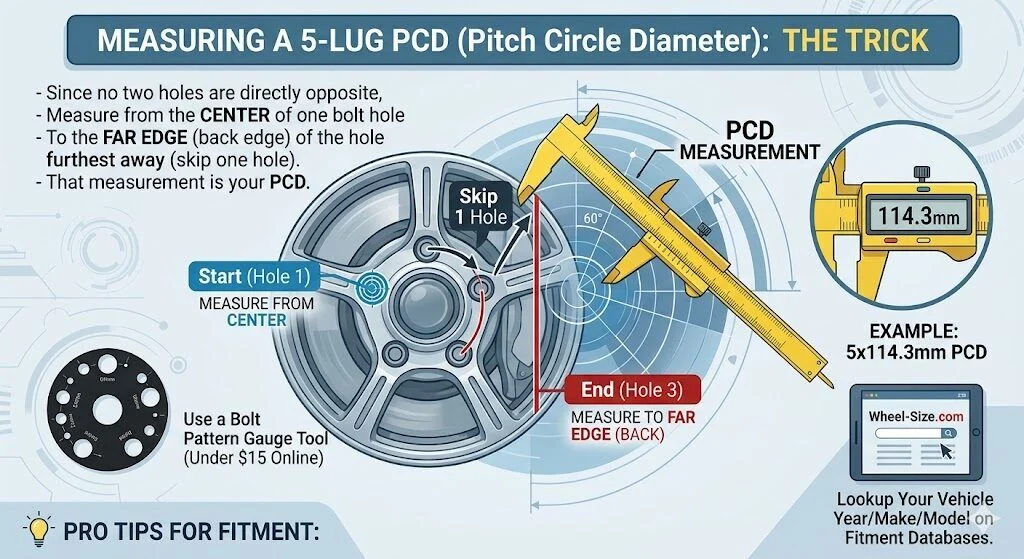
5-Lug (The Tricky One):
Since no two holes are directly opposite each other, use this trick: measure from the CENTER of any one bolt hole to the FAR EDGE (back) of the hole furthest away from it (skip one hole). That measurement is your PCD. For example, if you get about 114.3mm, your pattern is 5×114.3.
💡 Can’t measure accurately? Use a bolt pattern gauge tool (under $15 online) or look up your exact vehicle year/make/model on a fitment database like Wheel-Size.com.
Step 4: Understanding Offset & Backspacing
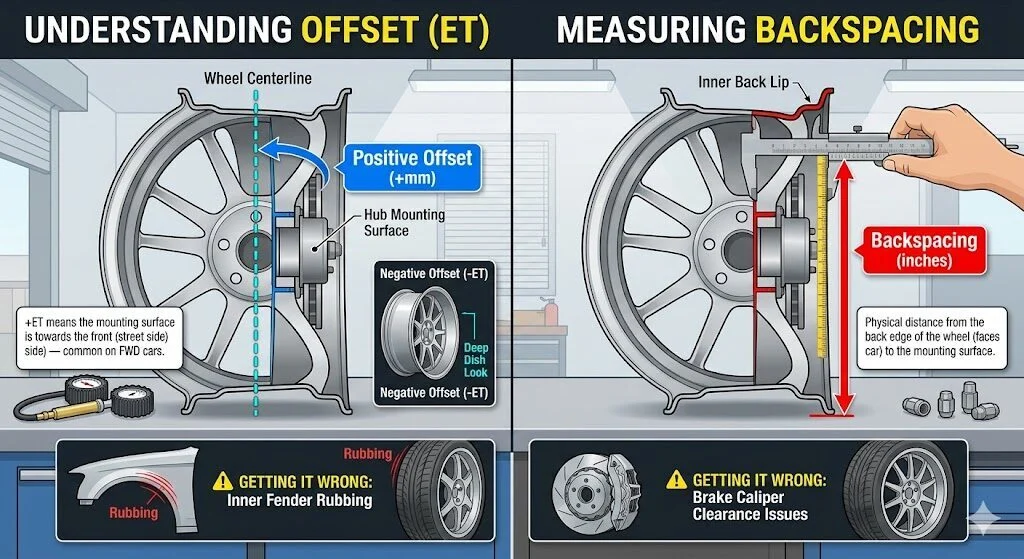
Offset and backspacing both describe how far the wheel sits inward or outward relative to the hub mounting surface. Getting this wrong causes rubbing against fenders or brake caliper clearance issues.
What is Offset?
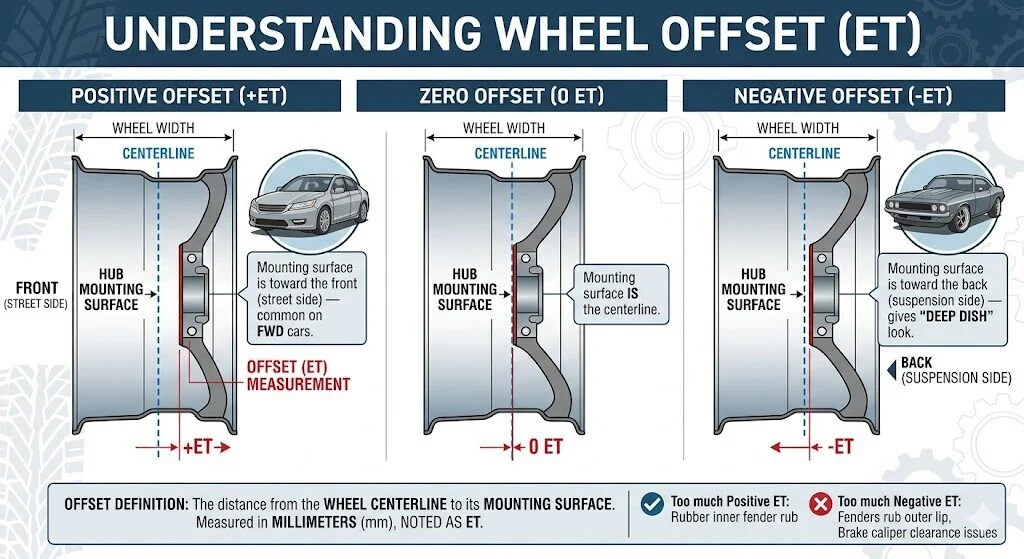
Offset (measured in millimeters, noted as ET) is the distance from the wheel’s centerline to its mounting surface. Positive offset (+) means the mounting surface is toward the front (street side) of the wheel — common on FWD cars. Negative offset (-) means it’s toward the back — giving that “deep dish” look. Zero offset means the mounting surface IS the centerline.
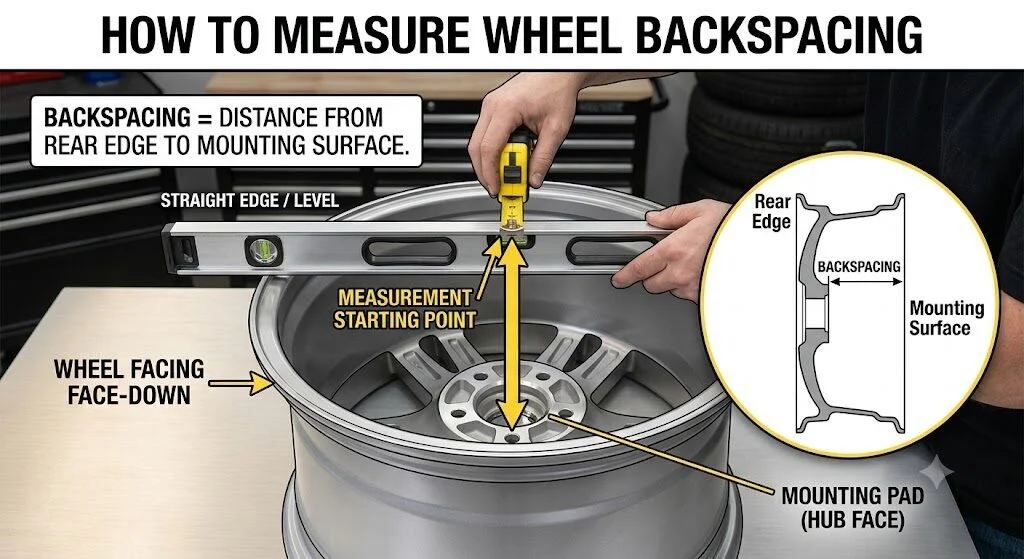
How to Measure Backspacing
Backspacing is simpler to measure physically. It’s the distance from the back edge of the wheel (the side that faces the car) to the mounting surface.
- Lay the wheel face-down on a flat surface. Place a straight edge across the back lip of the rim.
- Measure from the straight edge down to the flat mounting pad (where the hub touches). That distance is your backspacing.
Frequently Asked Questions
Do you measure rims lip to lip?
No. The industry-standard rim size is always measured from bead seat to bead seat — the inner ledge where the tire actually mounts. Measuring lip-to-lip will give you a reading approximately 1 inch larger than the true rim size.
Can I measure rim size with the tire still on?
For diameter, yes — you can measure across the face of the tire-mounted wheel from bead to bead. For width, it’s much harder with the tire on. Your best bet is to check the stamp on the back of the wheel or look up your OEM specs online.
Where do I find the rim size stamped on my wheel?
Check the back of the wheel spokes, near the center hub bore, or on the inner barrel. Common formats include “17x8J”, “18×9.5 ET35”, or “5×114.3”. On OEM wheels, you may also find a part number you can look up online.
What’s the difference between offset and backspacing?
Offset is the distance from the wheel’s centerline to the mounting surface (measured