
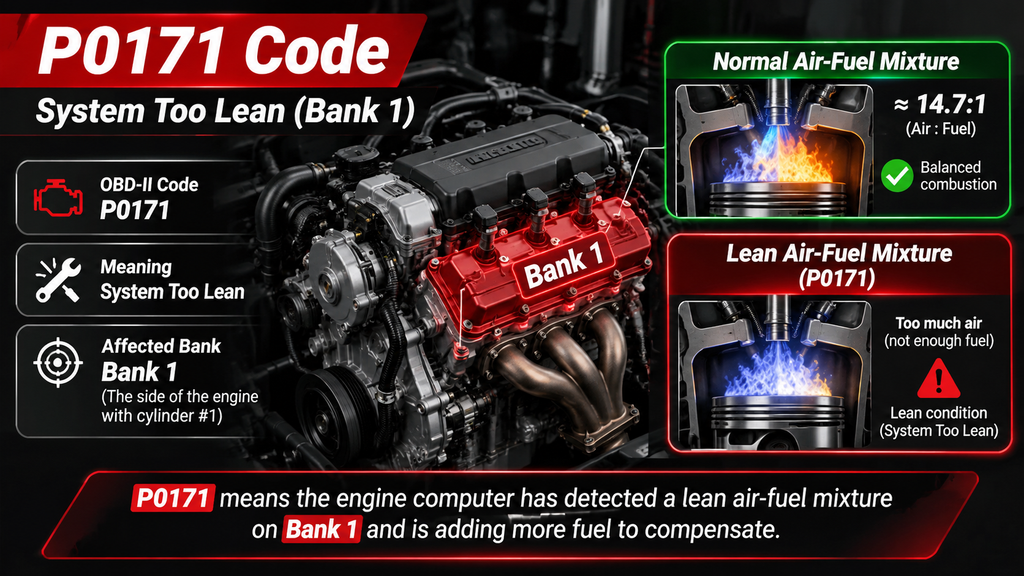
The P0171 code means System Too Lean (Bank 1). It indicates that the engine control module (ECM) has detected a lean air-fuel condition and exceeded its programmed fuel correction limits.
Common causes include vacuum leaks, faulty mass airflow sensors, low fuel pressure, restricted fuel injectors, and inaccurate oxygen sensor readings.
Although P0171 does not always indicate a serious engine problem, ignoring it can lead to poor performance, misfires, and potentially expensive repairs.
This guide explains the P0171 code, its symptoms, causes, diagnostic steps, repair costs, and effective solutions.
P0171 Code at a Glance
| Parameter | Details |
|---|---|
| Trouble code | P0171 |
| Meaning | System Too Lean (Bank 1) |
| Affected system | Engine air-fuel management |
| Severity | Depends on the underlying fault |
| Common causes | Vacuum leaks, MAF sensor issues, low fuel pressure |
| Common symptoms | Rough idle, check engine light, hesitation |
| Estimated repair cost | $50–$1,300+ |
| Related codes | P0174, P0101, P0300 |
What Does the P0171 Code Mean?
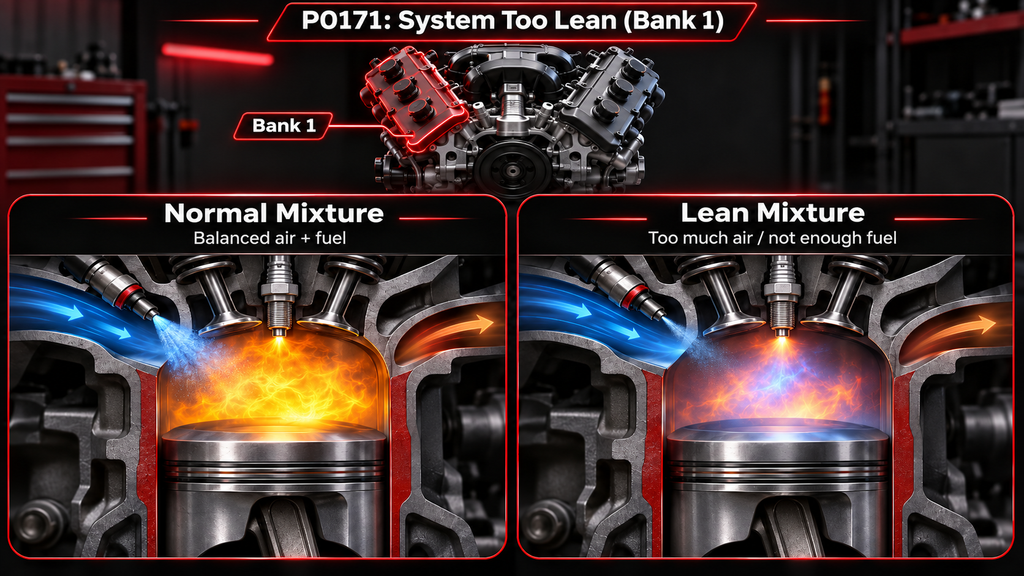
P0171 is a generic OBD-II diagnostic trouble code indicating that the engine computer has detected excessive lean fuel correction on Bank 1.
Modern gasoline engines require a controlled mixture of air and fuel for efficient combustion. When the computer detects a lean condition, it attempts to compensate by increasing fuel delivery.
If the required correction exceeds the manufacturer’s programmed limits, the computer may trigger P0171 and illuminate the check engine light.
What Does System Too Lean Mean?
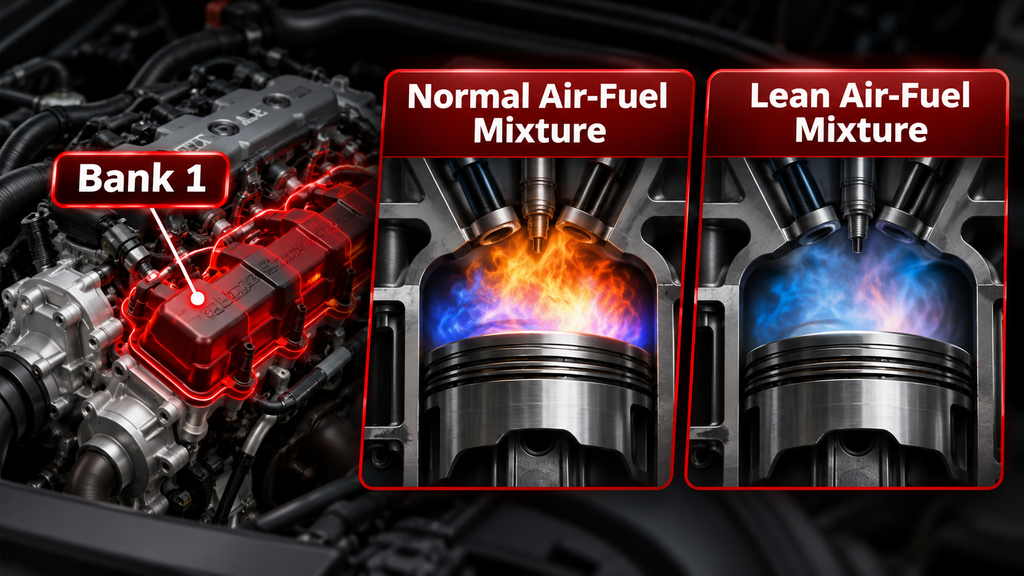
A lean condition occurs when there is too much air relative to the amount of fuel available for combustion.
For conventional gasoline, the theoretical stoichiometric air-fuel ratio is approximately 14.7:1, although the appropriate ratio varies depending on fuel composition and operating conditions.
A lean condition may result from excess intake air, insufficient fuel delivery, or incorrect sensor readings.
What Is Bank 1 in an Engine?
Bank 1 refers to the group of engine cylinders containing cylinder number one.
Most inline four-cylinder engines have only one cylinder bank, while V6 and V8 engines typically have two. The physical location of Bank 1 varies by engine design.
Common Symptoms of the P0171 Code
Some vehicles may display P0171 without noticeable symptoms, while others experience significant performance problems.
| Symptom | Possible explanation |
|---|---|
| Check engine light | Excessive fuel correction detected |
| Rough idle | Unstable engine combustion |
| Poor acceleration | Incorrect air-fuel mixture |
| Engine hesitation | Insufficient fuel or inaccurate airflow readings |
| Engine stalling | Severe combustion instability |
| Engine misfires | Inconsistent fuel combustion |
| Reduced fuel economy | Inefficient combustion or excessive fuel correction |
| Difficult starting | Air intake or fuel delivery problems |
These symptoms are diagnostic clues and do not necessarily confirm a specific component failure.
What Causes the P0171 Code?
Several mechanical and electrical problems can trigger the P0171 engine code. Here are eight potential causes worth investigating.
1. Vacuum Leaks
Vacuum leaks are among the first problems to investigate when diagnosing P0171.
Air entering downstream of the mass airflow sensor may not be included in the engine computer’s fuel calculations.
Common leak locations include:
- Cracked vacuum hoses
- Damaged intake boots
- Loose intake connections
- Leaking intake manifold gaskets
- Damaged PCV hoses
Vacuum leaks often have a greater effect on fuel trims at idle than at higher engine speeds.
2. Dirty or Faulty MAF Sensor
The mass airflow (MAF) sensor measures the amount of air entering the engine.
A contaminated or faulty sensor may underestimate airflow, causing the computer to deliver insufficient fuel.
Inspect the sensor, wiring, and intake connections before replacing it. If cleaning is appropriate, use a manufacturer-approved MAF sensor cleaner.
3. Low Fuel Pressure
Insufficient fuel pressure can prevent the engine from receiving enough fuel.
Possible causes include:
- Weak fuel pump
- Restricted fuel filter
- Faulty fuel pressure regulation
- Fuel pump electrical problems
A qualified technician should compare fuel pressure and delivery with manufacturer specifications.
4. Clogged Fuel Injectors
Fuel injectors deliver controlled amounts of fuel into the engine. Deposits or internal faults can restrict fuel delivery and contribute to a lean condition.
Restricted injectors may also cause rough idling, hesitation, and engine misfires.
Professional testing can determine whether cleaning or replacement is necessary.
5. Faulty Oxygen Sensor
Oxygen and air-fuel ratio sensors monitor exhaust gases and provide feedback to the engine computer.
A faulty sensor or damaged electrical circuit may provide inaccurate readings and trigger P0171.
However, a properly functioning sensor may also detect a genuine lean condition. Always test the sensor before replacing it.
6. Exhaust Leaks
An exhaust leak ahead of the relevant oxygen sensor can allow outside air to enter the exhaust stream.
This additional oxygen may cause misleading lean readings.
Inspect exhaust manifold gaskets, pipe connections, and damaged exhaust components.
7. Faulty PCV System
The positive crankcase ventilation (PCV) system regulates crankcase gases entering the intake system.
A damaged PCV valve, diaphragm, or hose can introduce unintended airflow, potentially causing rough idle and excessive positive fuel trims.
8. Stuck-Open EVAP Purge Valve
A malfunctioning EVAP purge valve can allow unintended flow into the intake manifold.
Depending on operating conditions, this can contribute to lean or rich fuel trim problems, unstable idle, and difficult starting after refueling.
Understanding Fuel Trims and P0171
Fuel trims represent adjustments the engine computer makes to fuel delivery.
Short-term fuel trim (STFT) represents immediate fuel adjustments, while long-term fuel trim (LTFT) represents learned corrections over time.
| Fuel trim reading | Possible interpretation |
|---|---|
| Close to zero | Minimal fuel correction |
| Positive fuel trim | Computer is adding fuel |
| Negative fuel trim | Computer is reducing fuel |
| High positive trim at idle | Possible vacuum leak |
| Increasing positive trim under load | Possible fuel delivery problem |
| High positive trims on both banks | Possible shared intake or fuel system problem |
Practical Diagnostic Example
Consider the following hypothetical scanner readings:
| Operating condition | STFT | LTFT |
|---|---|---|
| Warm idle | +12% | +20% |
| Steady 2,500 RPM | +2% | +5% |
The higher fuel correction at idle suggests that a vacuum leak may be worth investigating first.
These readings are diagnostic clues, not definitive proof. Acceptable fuel trim ranges and code-setting thresholds vary by manufacturer.
How to Diagnose the P0171 Code Step by Step
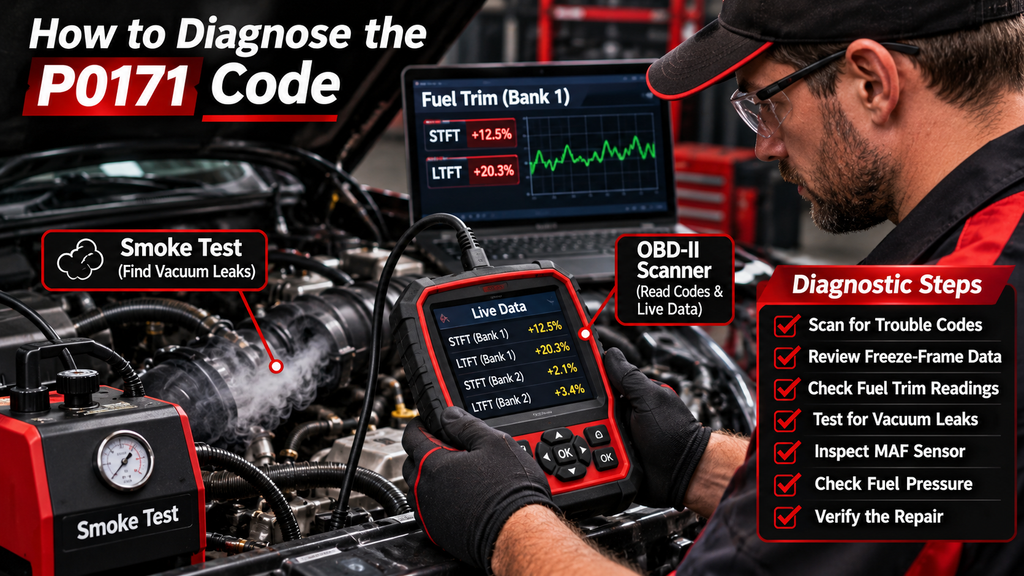
Follow a systematic diagnostic process to identify the underlying problem and avoid unnecessary component replacement.
Step 1: Scan for Trouble Codes
Connect an OBD-II scanner and record stored and pending trouble codes.
| Related code | Meaning |
|---|---|
| P0174 | System Too Lean (Bank 2) |
| P0101 | MAF sensor range or performance problem |
| P0300 | Random or multiple-cylinder misfire |
| P0131 | Low oxygen sensor circuit voltage |
| P0087 | Fuel rail or system pressure too low |
Additional codes may help identify the underlying problem.
Step 2: Review Freeze-Frame Data
Review engine speed, temperature, load, and fuel trim readings recorded when the fault occurred.
This information can help determine whether the problem developed at idle, during acceleration, or under other operating conditions.
Do not clear the codes before recording this data.
Step 3: Inspect the Air Intake System
With the engine switched off and cool, check for cracked hoses, loose clamps, damaged intake ducts, and disconnected vacuum lines.
Pay particular attention to recently serviced components.
Step 4: Check Fuel Trim Readings
Use a live-data scanner to compare fuel trims at idle and higher engine speeds under manufacturer-specified conditions.
Excessive positive corrections at idle may indicate an intake leak, while corrections that increase under load may suggest fuel delivery problems.
Step 5: Test for Vacuum Leaks
A professional automotive smoke test can help locate hidden leaks in intake hoses, manifold gaskets, and other connections.
Avoid using flammable sprays around a running engine.
Step 6: Inspect the MAF Sensor
Check the sensor for contamination, damaged wiring, and inaccurate airflow readings.
Clean or replace the sensor only when supported by inspection and testing.
Step 7: Check Fuel Pressure and Injector Performance
Have the fuel pressure, fuel pump operation, and injector performance tested if earlier inspections do not identify the problem.
Fuel pressure testing should follow vehicle-specific safety procedures and be performed by a qualified technician.
Step 8: Inspect Oxygen Sensors and Exhaust Components
Check for exhaust leaks upstream of the relevant oxygen sensor and evaluate sensor performance.
Replace faulty components only after confirming the problem.
Step 9: Verify the Repair
After completing the repair:
- Follow manufacturer procedures for clearing trouble codes.
- Monitor fuel trim readings.
- Check engine performance.
- Scan for returning or pending codes.
- Verify applicable emissions monitors.
A temporarily extinguished check engine light does not necessarily confirm a successful repair.
How to Fix the P0171 Code
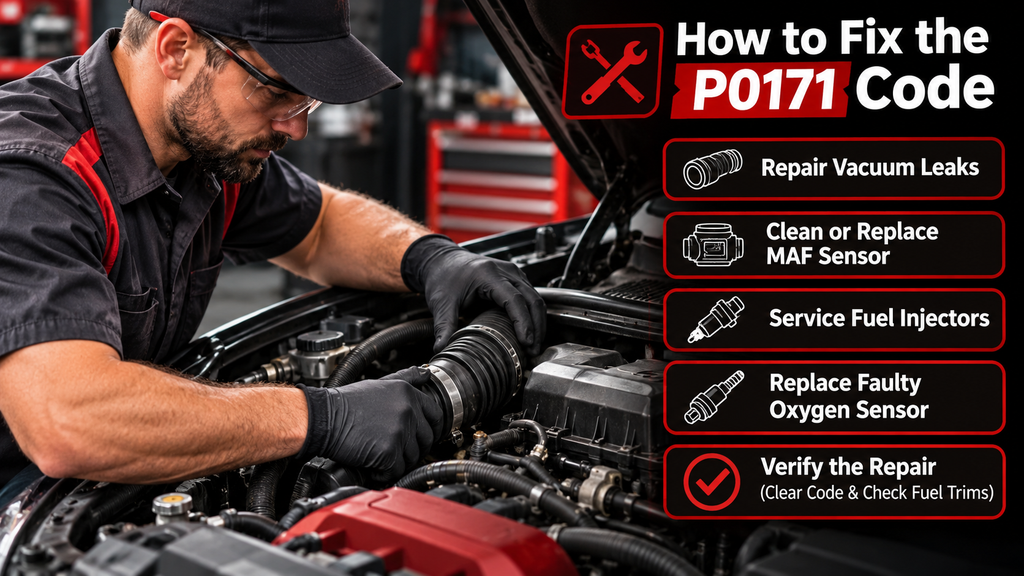
The correct P0171 fix depends on the confirmed cause.
| Confirmed cause | Recommended solution |
|---|---|
| Vacuum leak | Replace damaged hoses or repair connections |
| Intake manifold leak | Replace the affected gasket |
| Dirty MAF sensor | Clean using an approved cleaner |
| Faulty MAF sensor | Replace the confirmed faulty sensor |
| Low fuel pressure | Repair the affected fuel delivery component |
| Restricted fuel injectors | Service or replace injectors |
| Faulty oxygen sensor | Repair the circuit or replace the sensor |
| Exhaust leak | Repair the damaged exhaust component |
| Faulty PCV system | Replace the affected valve or hose |
| Faulty EVAP purge valve | Replace the confirmed defective valve |
Avoid replacing components simply because they are commonly associated with P0171. Proper diagnosis should always come first.
Can You Drive With a P0171 Code?
Whether you can continue driving with P0171 depends on the underlying fault, vehicle symptoms, and manufacturer’s recommendations.
An unresolved lean condition may contribute to engine misfires, poor performance, abnormal combustion, and additional engine or catalytic converter stress.
| Vehicle condition | Recommended action |
|---|---|
| Steady check engine light and normal performance | Arrange prompt diagnosis and consult the owner’s manual |
| Rough idle or mild hesitation | Avoid unnecessary driving and arrange inspection |
| Significant power loss | Stop safely and seek assistance |
| Repeated engine stalling | Stop driving safely |
| Severe engine knocking | Stop driving as soon as it is safe |
| Flashing check engine light | Stop safely and seek professional assistance |
Avoid long-distance driving, towing, and aggressive acceleration until the problem has been diagnosed.
How Much Does It Cost to Fix P0171?
The cost of fixing P0171 depends on the underlying problem. A damaged vacuum hose is generally less expensive to repair than a failed fuel pump.
| Repair or service | Estimated US cost |
|---|---|
| Professional diagnosis | $100–$200 |
| Vacuum or intake leak repair | $100–$450 |
| MAF sensor cleaning | $20–$100 |
| MAF sensor replacement | $150–$450 |
| PCV valve or hose replacement | $50–$300 |
| Fuel pump replacement | $500–$1,300+ |
These are approximate budgeting estimates, not verified local repair quotes. Actual prices vary depending on vehicle make, model, replacement parts, labor rates, and diagnostic complexity.
P0171 vs. P0174: What Is the Difference?
Both P0171 and P0174 indicate lean fuel control conditions. The main difference is the affected cylinder bank.
| Feature | P0171 | P0174 |
|---|---|---|
| Meaning | System Too Lean | System Too Lean |
| Affected bank | Bank 1 | Bank 2 |
| Cylinder location | Contains cylinder one | Opposite cylinder bank |
| Common causes | Intake leaks, fuel delivery, sensor issues | Intake leaks, fuel delivery, sensor issues |
When both codes appear together, investigate shared systems such as the MAF sensor, fuel supply, and common intake connections.
However, testing is necessary to determine whether both codes share the same underlying cause.
P0171 Code in Different Vehicle Brands
Although P0171 has the same generic meaning across manufacturers, diagnostic procedures may differ.
| Vehicle brand | Potential areas to investigate |
|---|---|
| Chevrolet | Intake leaks, PCV system, fuel pressure |
| Ford | Vacuum hoses, intake gaskets, MAF sensor |
| Toyota | Intake manifold sealing, MAF readings, fuel delivery |
| Honda | Air-fuel ratio sensor, intake leaks, fuel injectors |
| Nissan | Intake ducts, MAF sensor, fuel supply |
| Hyundai and Kia | Intake connections, injector performance, sensor feedback |
These are potential investigation areas, not confirmed brand-specific defects. Always consult service information for the specific model year and engine.
Common Mistakes When Diagnosing P0171
Avoid these common diagnostic mistakes:
- Replacing oxygen sensors without testing.
- Ignoring vacuum and intake leaks.
- Clearing codes before reviewing freeze-frame data.
- Ignoring additional trouble codes.
- Replacing the MAF sensor without evaluating its readings.
- Assuming every P0171 code has the same cause.
- Failing to verify the repair.
Proper testing can prevent unnecessary expenses and recurring engine problems.
How to Prevent the P0171 Code From Returning
Although not every P0171 fault is preventable, routine maintenance can reduce the risk of certain problems.
- Replace air filters according to manufacturer recommendations.
- Inspect vacuum hoses and intake connections regularly.
- Follow the recommended vehicle maintenance schedule.
- Address check engine lights promptly.
- Repair confirmed intake and fuel system problems.
- Ensure all connections are properly secured after servicing.
Frequently Asked Questions
What does the P0171 code mean?
P0171 means System Too Lean (Bank 1). It indicates that the engine computer has detected excessive lean fuel correction.
What is the most common cause of P0171?
Vacuum and intake air leaks are common causes. Other possibilities include inaccurate MAF readings, insufficient fuel pressure, and faulty sensor feedback.
Is P0171 a serious engine code?
P0171 can become serious when accompanied by misfires, stalling, significant power loss, or abnormal combustion. Prompt diagnosis is recommended.
Can a dirty air filter cause P0171?
A dirty air filter alone is not a typical cause. However, damaged intake connections, incorrectly installed filters, and MAF sensor contamination may contribute.
Can a bad oxygen sensor cause P0171?
Yes. A faulty oxygen or air-fuel ratio sensor may provide inaccurate readings. However, the sensor should be tested before replacement.
Can bad spark plugs cause P0171?
Faulty spark plugs can cause misfires that influence exhaust oxygen readings and fuel corrections. However, spark plugs are not a primary cause of every P0171 fault.
Can a loose gas cap cause P0171?
A loose gas cap typically triggers EVAP-related trouble codes rather than P0171. A faulty EVAP purge valve, however, may contribute to fuel trim problems.
Will P0171 clear itself?
The check engine light may turn off if the underlying fault disappears and the required monitoring conditions are met. Persistent problems will generally cause the code to return.
Can I fix P0171 myself?
Simple repairs, such as replacing accessible damaged vacuum hoses, may be suitable for experienced DIY car owners. Complex fuel delivery and electrical problems require professional diagnosis.
Why does P0171 keep coming back?
A recurring P0171 code usually indicates an unresolved fault, an incorrect diagnosis, or an additional problem affecting the engine’s fuel management system.
Can P0171 damage an engine?
A significant and unresolved lean condition can contribute to abnormal combustion, misfires, and engine damage under certain operating conditions.
How much does it cost to diagnose P0171?
A broad US budgeting estimate for professional diagnosis is approximately $100–$200, although complex diagnostic testing may cost more.
Final Thoughts
The P0171 code indicates a lean fuel control condition on Bank 1. Common causes include vacuum leaks, inaccurate airflow measurements, fuel delivery problems, and faulty sensor feedback.
Start by reviewing trouble codes, inspecting intake connections, and checking fuel trim readings before replacing components.
Always diagnose the underlying problem, repair the confirmed fault, and verify the results. This approach helps prevent unnecessary expenses, recurring trouble codes, and potential engine damage.