How Do You Drive a Manual Car?
To drive a manual car, press the clutch pedal fully, select first gear, and slowly raise the clutch until you feel the car reach its bite point. Add gentle throttle while continuing to release the clutch smoothly.
Once the car is moving, accelerate, press the clutch again, select the next gear, release the clutch smoothly, and continue driving. When stopping, brake normally and press the clutch before engine speed becomes too low or the vehicle comes to a complete stop.
Practice somewhere safe first. Learn in a large, flat, low-traffic area with an experienced licensed driver or qualified instructor where required. Do not practice new techniques in traffic until you can control the car reliably.
Learning how to drive a manual car can look complicated from the passenger seat. Your left foot controls the clutch, your right foot moves between the brake and accelerator, and your hand selects the gears.
The good news is that you do not need to master everything at once. Your first goal is simply learning how to make the car move from a stop without stalling. Once you understand clutch control, driving a stick shift becomes much easier.
What Makes a Manual Car Different?
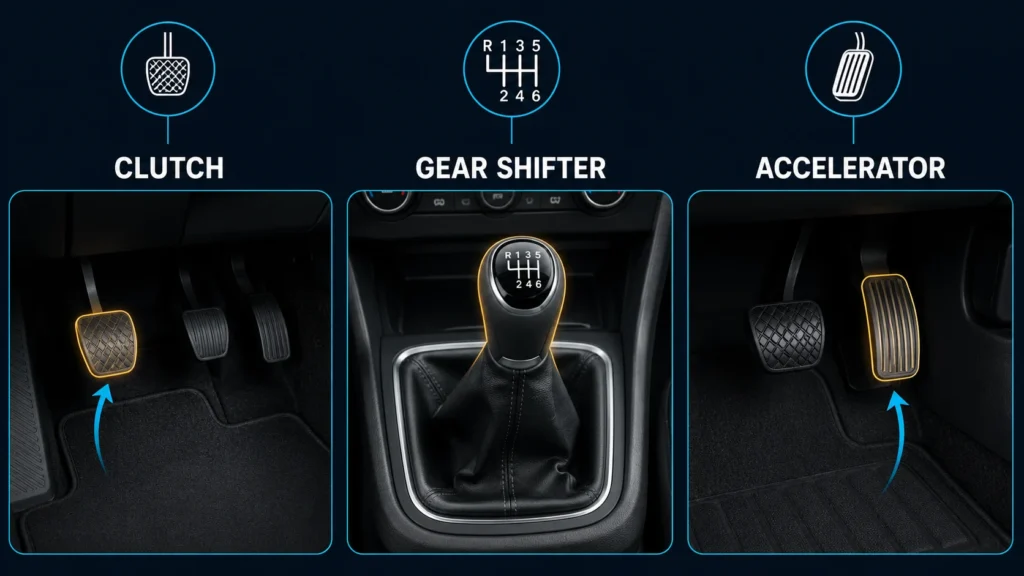
The biggest difference between a manual car and an automatic is that the driver controls both gear selection and clutch engagement.
In an automatic car, the transmission selects gears for you. In a manual transmission car, you use a clutch pedal to temporarily disconnect the engine from the transmission while selecting the gear you want with the gear shifter.
This means driving manual requires coordination between your hands and feet, especially when starting from a stop. After enough practice, these movements begin to feel natural.
Understanding the Three Pedals
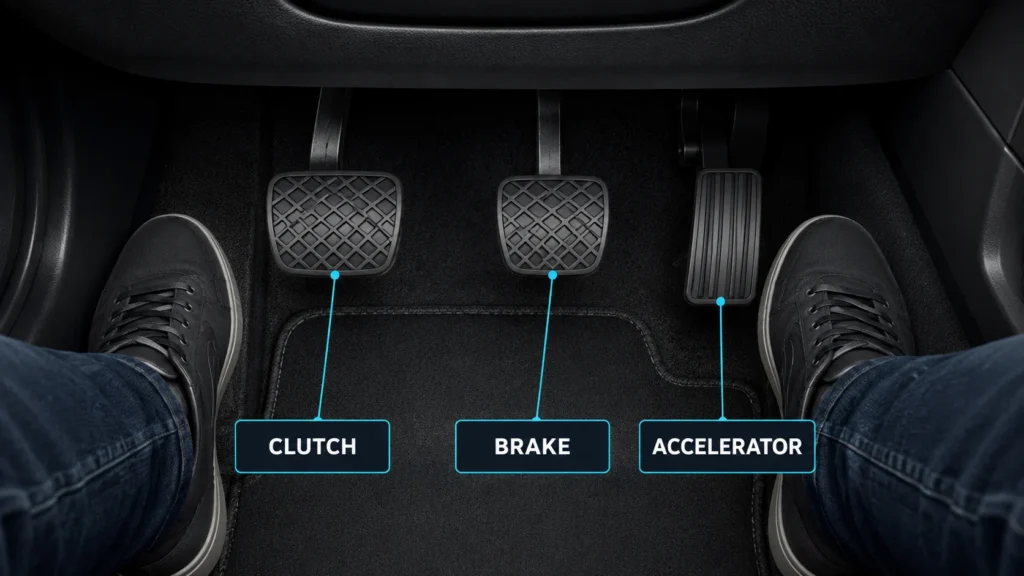
A manual transmission car has three pedals. From left to right, they are the clutch, brake, and accelerator.
Clutch Pedal
The clutch is operated with your left foot. Pressing it disconnects engine power from the transmission so you can start, stop, or change gears.
Brake Pedal
The brake is operated with your right foot and works the same way it does in an automatic vehicle.
Accelerator Pedal
The accelerator, or gas pedal, is also operated with your right foot. It controls engine speed and helps provide the power needed to move away smoothly.
Remember: Your left foot should normally be used only for the clutch, while your right foot moves between the brake and accelerator.
Understanding the Gear Shifter and H-Pattern
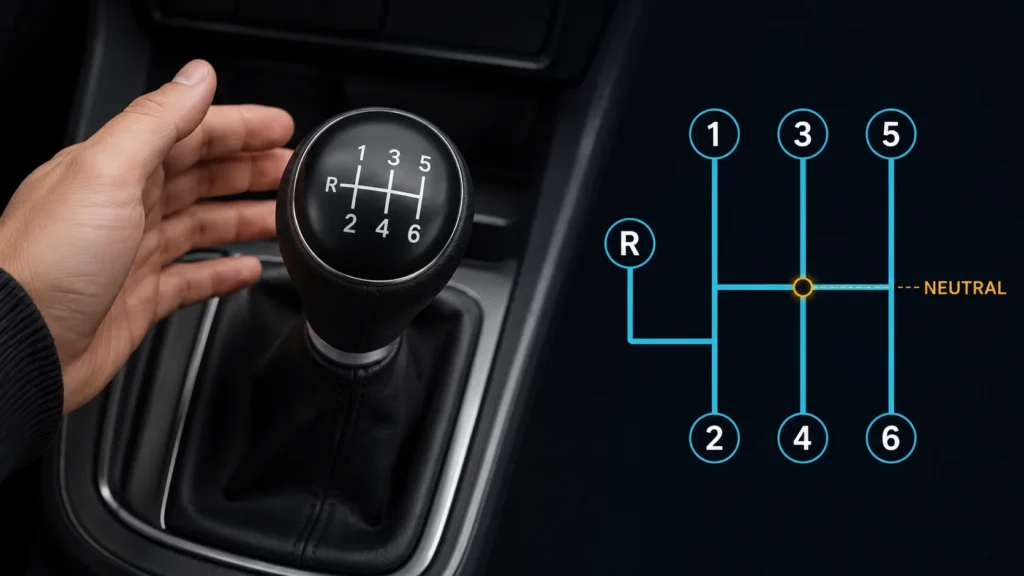
Most modern manual cars use an H-pattern gear shifter. Common configurations include five-speed and six-speed transmissions.
Before driving, study the shift pattern printed on top of the gear knob. The position of reverse can vary between vehicles, so never assume it is located in the same place on every manual car.
Practice the Shift Pattern While Stationary
With the engine off, parking brake applied, and clutch pressed, practice moving the shifter through the gears.
You should eventually be able to find first, second, third, and neutral without looking down at the gear lever.
Before Starting the Car
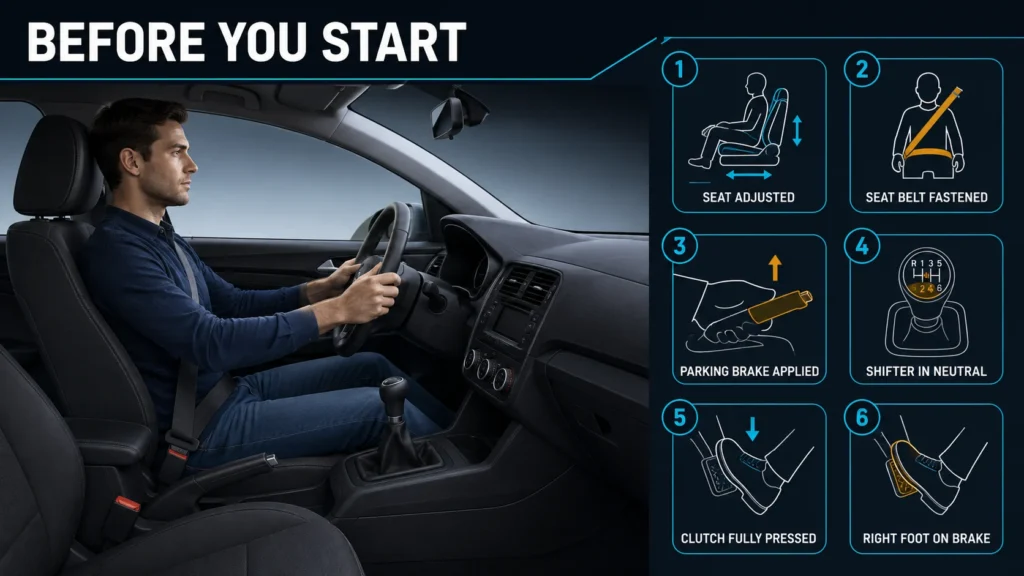
Before trying to move the vehicle, make sure you are comfortable with the seating position and controls.
- 1 Adjust the seat so you can fully press the clutch comfortably.
- 2 Fasten your seat belt.
- 3 Apply the parking brake.
- 4 Make sure the gear shifter is in neutral.
- 5 Press the clutch pedal fully.
- 6 Keep your right foot on the brake.
- 7 Start the engine.
Beginner tip: With the transmission in neutral, the shifter should normally move freely from side to side across the center gate.
How to Start Moving in First Gear
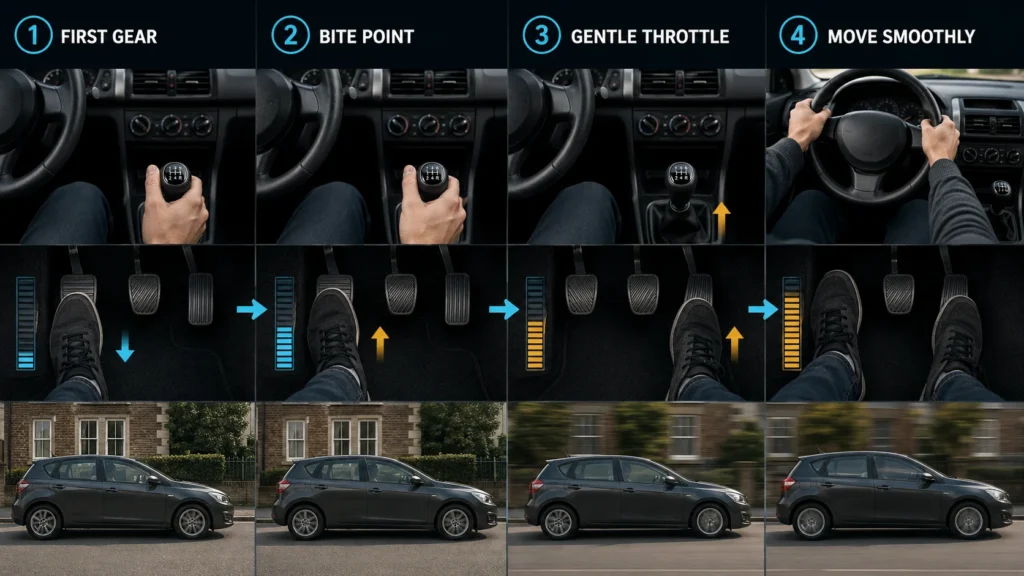
Learning how to move away smoothly is usually the first major challenge when learning how to drive stick shift.
Focus on smoothness: Avoid suddenly releasing the clutch or using excessive throttle. Controlled movements are more important than moving quickly.
How to Find the Clutch Bite Point
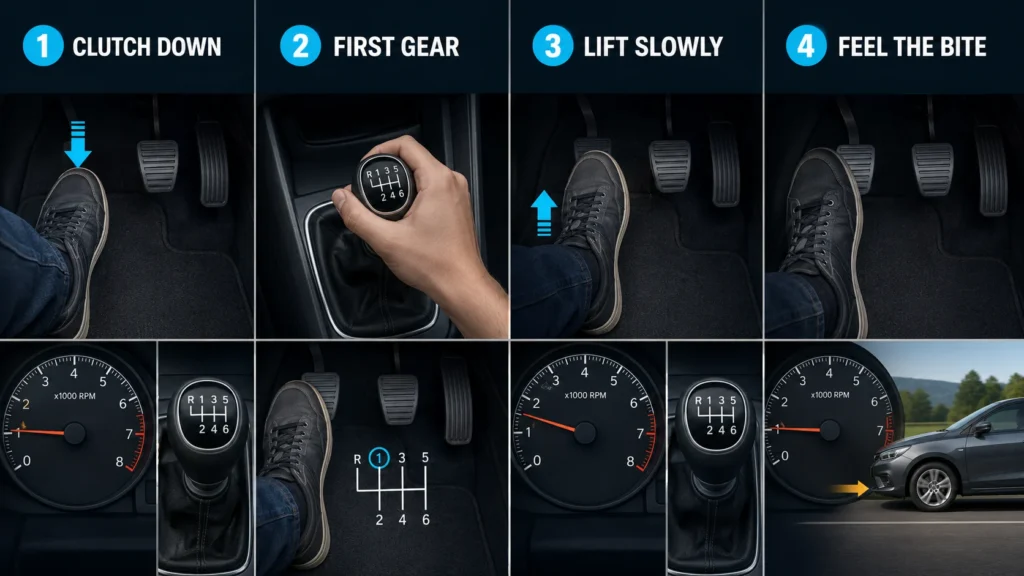
The clutch bite point, sometimes called the friction point, is the position where the clutch begins transferring engine power to the transmission.
Finding this point consistently is one of the most important skills when learning how to drive a manual transmission car.
- Press the clutch fully.
- Select first gear.
- Slowly begin lifting your left foot.
- Pay attention to changes in engine sound and vehicle movement.
- Pause when you feel the car beginning to pull forward.
At the bite point, engine speed may dip slightly and the vehicle may begin trying to move.
Practice reaching this position several times on flat ground before worrying about changing into higher gears.
How to Change Gears and Upshift
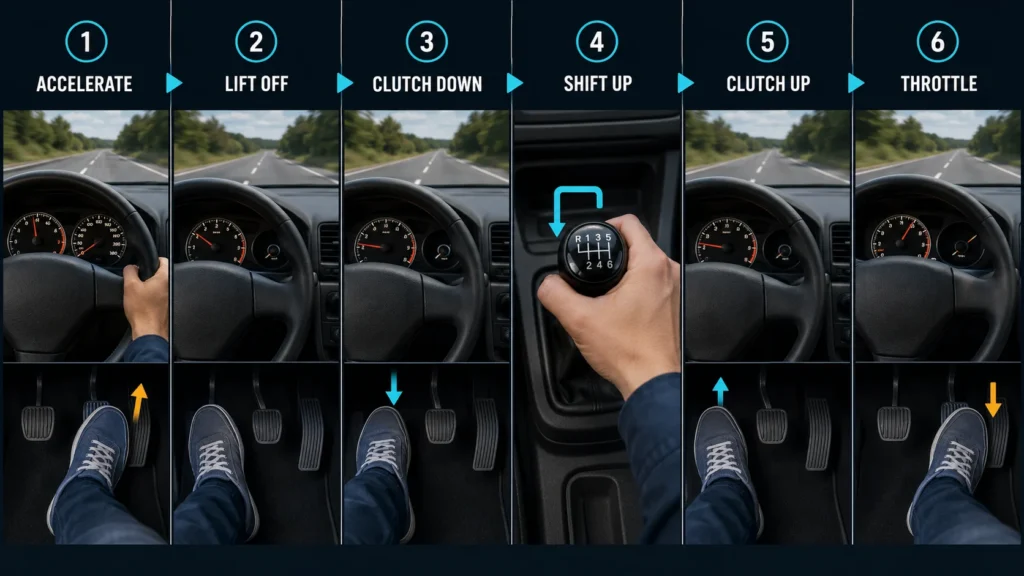
Once you are moving comfortably in first gear, the next step is learning how to shift into second and then into higher gears.
- Accelerate normally in your current gear.
- Release the accelerator.
- Press the clutch pedal fully.
- Move the gear shifter into the next gear.
- Release the clutch smoothly.
- Begin applying throttle again.
The same general sequence applies as you shift into progressively higher gears.
When Should You Change Gears?
There is no single RPM number that works for every manual car. The correct shift point depends on the engine, transmission gearing, road conditions, and how quickly you are accelerating.
With practice, you will learn to recognize when your engine is ready for the next gear through its sound, response, and RPM.
How to Slow Down and Stop
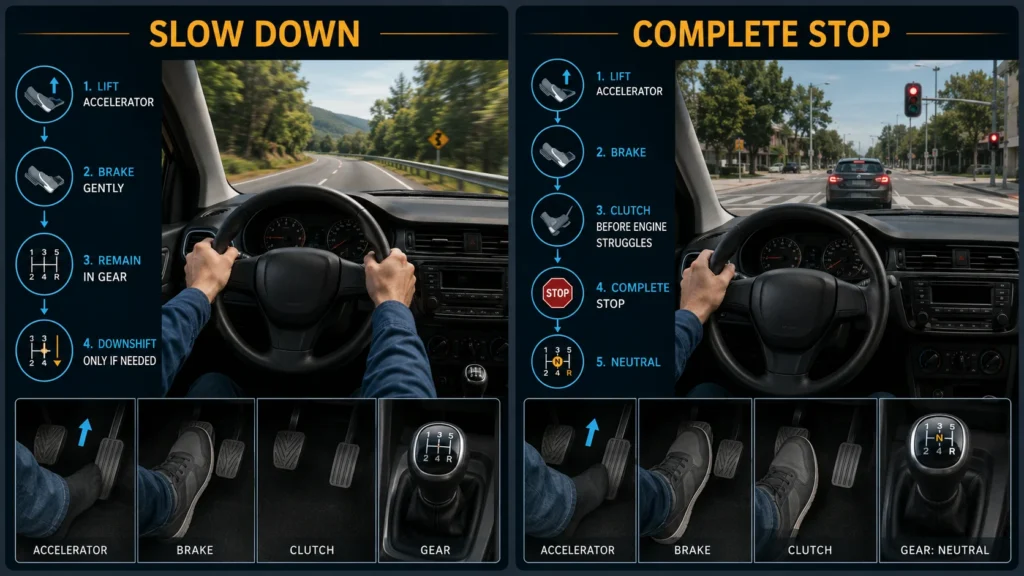
One common beginner misconception is that you must press the clutch every time you use the brake. You do not.
Slowing Down Without Stopping
- Release the accelerator.
- Apply the brake smoothly.
- Remain in gear while the engine is operating comfortably.
- Downshift if your new road speed requires a lower gear.
Coming to a Complete Stop
- Release the accelerator.
- Apply the brake smoothly.
- Press the clutch before engine speed becomes too low.
- Bring the vehicle to a complete stop.
- Select neutral if you will remain stopped.
How to Downshift
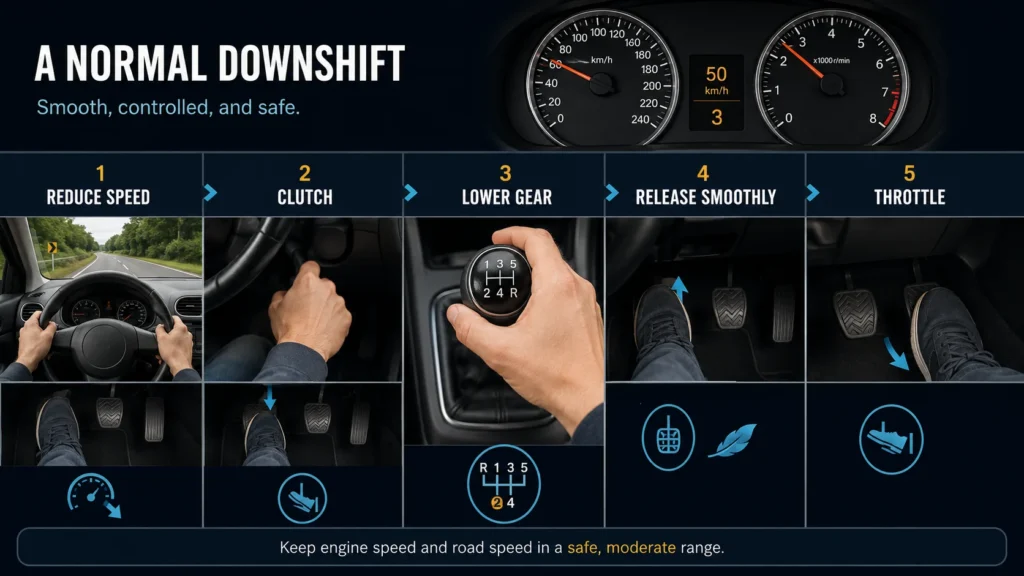
Downshifting means selecting a lower gear as the vehicle slows or when you need a lower gear for the current driving situation.
For a normal beginner downshift:
- Reduce your speed appropriately.
- Press the clutch fully.
- Select the appropriate lower gear.
- Release the clutch smoothly.
- Apply throttle as needed.
If the vehicle jerks noticeably when the clutch is released, engine speed and road speed may not have been well matched for the selected gear.
How to Perform a Hill Start
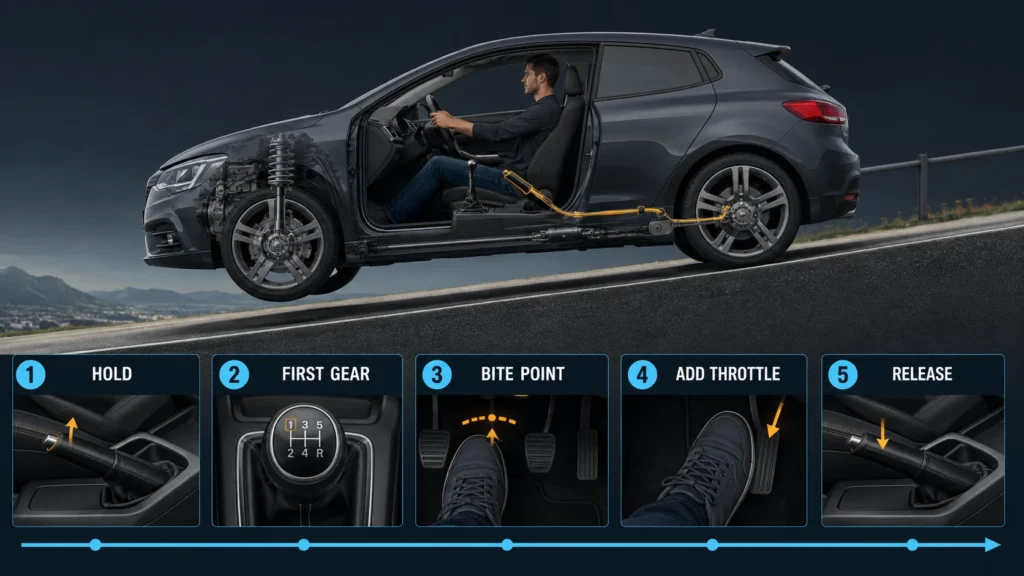
Hill starts can feel intimidating because the vehicle may roll backward while you move your right foot from the brake to the accelerator.
One beginner-friendly method is to use the parking brake to hold the vehicle while you establish clutch engagement.
- Apply the parking brake securely.
- Press the clutch and select first gear.
- Slowly release the clutch until you reach the bite point.
- Add controlled throttle.
- Release the parking brake as the car begins pulling forward.
- Continue releasing the clutch smoothly.
Some newer manual cars have hill-start assist that temporarily holds the vehicle’s brakes, but the exact system varies by vehicle.
What to Do When the Car Stalls
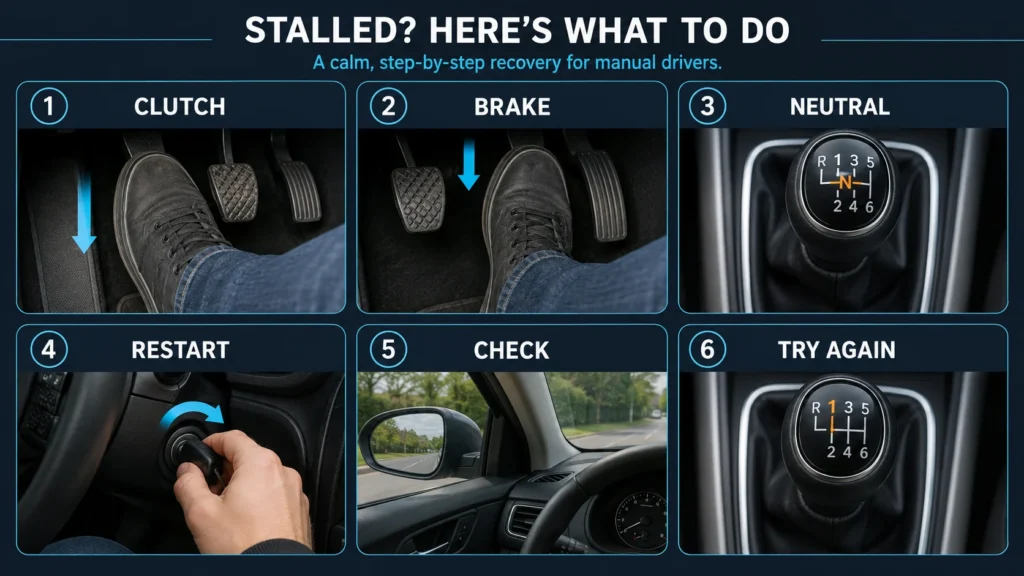
Almost everyone learning how to drive a stick shift stalls at some point. A stall usually means the clutch was released too quickly or the engine did not receive enough throttle.
If the engine stalls:
- Press the clutch fully.
- Apply the brake.
- Move the shifter into neutral.
- Restart the engine.
- Check your surroundings.
- Select first gear and try again.
Stay calm. Stalling is a normal part of learning clutch control. Focus on smoother clutch release and throttle timing on your next attempt.
Seven Common Beginner Mistakes
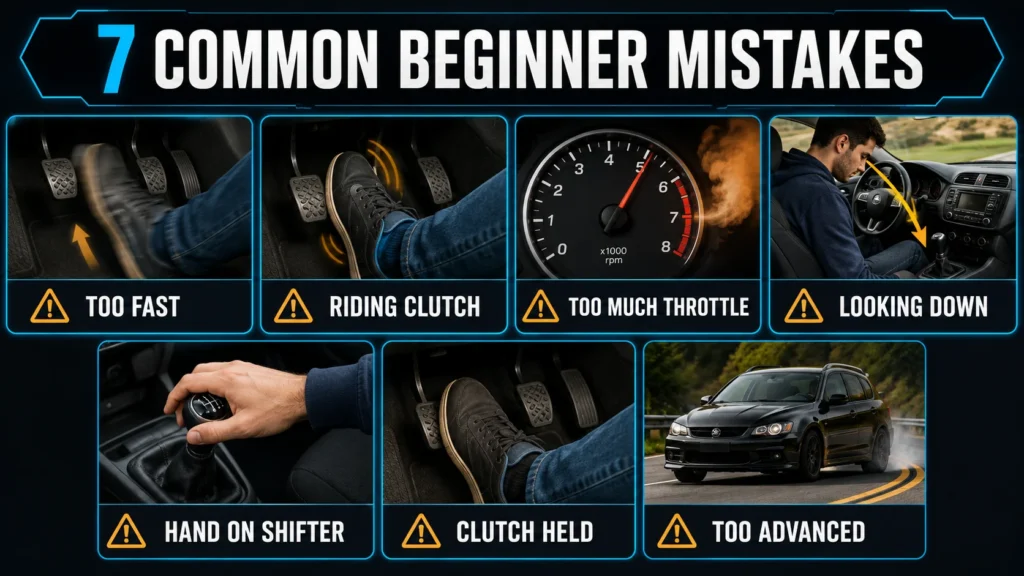
1. Releasing the Clutch Too Quickly
Suddenly releasing the clutch can make the car jerk or stall. Raise your left foot smoothly, especially when moving away from a stop.
2. Riding the Clutch
Resting your foot lightly on the clutch pedal can keep the clutch partially engaged and contribute to unnecessary wear.
3. Using Too Much Throttle
Beginners sometimes race the engine because they are afraid of stalling. Use only enough throttle to move away smoothly.
4. Looking Down at the Gear Shifter
Practice the shift pattern while stationary so you can keep your eyes on the road while driving.
5. Resting Your Hand on the Shifter
After changing gears, return your hand to the steering wheel rather than continuously resting it on the gear lever.
6. Holding the Clutch Down Unnecessarily
During longer stops, selecting neutral allows you to release the clutch instead of holding the pedal down continuously.
7. Trying Advanced Techniques Too Early
Master basic starting, stopping, clutch control, and ordinary gear changes before attempting more advanced performance-driving techniques.
What Is Rev Matching?
Rev matching is a technique used during a downshift to bring engine speed closer to the speed required by the lower gear.
The driver briefly increases engine RPM before reconnecting the clutch, reducing the speed difference between the engine and transmission. When performed correctly, this can make downshifts smoother.
For beginners: Rev matching is not the first skill you need to learn. Become comfortable starting, stopping, shifting, and controlling the clutch before practicing advanced techniques.
Does Driving a Manual Car Wear Out the Clutch?
The clutch is a friction component, so some wear is normal whenever a manual vehicle is driven. Good driving technique can help avoid unnecessary wear.
Habits worth avoiding include:
- Holding the vehicle on a hill using clutch slip
- Resting your foot on the clutch pedal
- Using excessive engine speed when pulling away
- Repeated aggressive launches
- Holding the clutch partially engaged longer than necessary
When Might You Need a Performance Clutch?
A factory clutch is generally designed around the vehicle’s original power output and intended use.
Drivers with substantially modified engines, competition vehicles, or applications that exceed the original clutch’s capacity may need a replacement clutch designed for greater torque and heat.
For someone simply learning how to drive a stock manual car, good clutch technique is far more important than upgrading components.
Beginner Manual Driving Practice Routine
Trying to learn everything in one session can make manual driving feel more difficult than it really is. Build your skills gradually.
Practice in This Order
- Learn the pedal and gear-shifter positions.
- Practice finding neutral.
- Practice finding the clutch bite point.
- Move forward smoothly in first gear.
- Practice stopping without stalling.
- Repeat first-gear starts until comfortable.
- Practice shifting from first to second.
- Add higher gears when conditions allow.
- Practice normal downshifts.
- Practice hill starts after basic clutch control feels natural.
Manual vs Automatic: Is Manual Harder to Drive?
A manual car initially requires more coordination because you control clutch engagement and gear selection yourself. An automatic transmission performs most of those tasks without direct driver input.
This makes manual driving more challenging during the learning stage, particularly when moving away from a stop or starting on a hill.
Once clutch control and gear changes become familiar, many of these movements become automatic through practice.
How Long Does It Take to Learn Stick Shift?
There is no fixed amount of time because every driver learns at a different pace.
Many beginners can understand the basic controls during their first practice session. Developing consistently smooth starts, gear changes, downshifts, traffic control, and hill starts usually requires more practice.
Focus on smoothness and consistency rather than trying to shift quickly.
Frequently Asked Questions
How do you drive a manual car for the first time?
Start on flat ground in a safe practice area. Press the clutch fully, select first gear, slowly release the clutch until you reach the bite point, then add gentle throttle while continuing to release the clutch.
How do you drive a stick shift without stalling?
Release the clutch gradually instead of suddenly. As you reach the bite point, add gentle throttle and continue releasing the clutch smoothly as the vehicle starts moving.
What is the bite point on a manual car?
The bite point is the part of clutch pedal travel where the clutch begins transferring engine power through the transmission and the vehicle starts trying to move.
Do you press the clutch every time you brake?
No. You can normally brake while remaining in gear. Press the clutch before engine speed becomes too low for the selected gear or before coming to a complete stop.
Which foot should operate the clutch?
Your left foot operates the clutch. Your right foot normally operates both the accelerator and brake.
Should you put a manual car in neutral at a red light?
During a longer stop, selecting neutral allows you to release the clutch rather than holding the pedal down continuously.
Is driving stick shift difficult?
It feels more complicated than driving an automatic at first because you control the clutch and gear selection yourself. With practice, the coordination becomes much more natural.
How do you stop a manual car without stalling?
Release the accelerator and brake normally. Before engine speed drops too low, press the clutch fully. Bring the vehicle to a complete stop and select neutral when appropriate.
When should a beginner learn rev matching?
Learn normal clutch control, starts, upshifts, downshifts, and stops first. Rev matching can be introduced after basic manual driving feels comfortable.
Can you learn manual driving without an instructor?
Written guides and videos can help you understand the controls and techniques, but learning to drive manual requires hands-on practice. Practicing with a qualified instructor or experienced licensed driver can help you develop correct habits safely where local laws permit.
Final Takeaway
The hardest part of learning how to drive a manual car is usually not changing gears. It is learning how the clutch feels.
Start by mastering the bite point and moving smoothly in first gear. Then add second gear, higher gears, downshifting, stopping, and eventually hill starts.
Do not rush. Smooth control is more important than shifting quickly. Once your feet and hands learn the sequence, driving a stick shift becomes much less complicated.