If your owner’s manual recommends SAE 0W-20 full synthetic motor oil, you may wonder what those numbers actually mean. Is 0W-20 too thin for hot weather? Does it protect an engine as well as thicker oil? And why do manufacturers recommend synthetic formulations?
SAE 0W-20 is a low-viscosity engine oil grade designed to flow readily in cold conditions while providing a specified level of protection when an engine reaches operating temperature. When your vehicle manufacturer recommends it, the correct 0W-20 oil can support efficient engine operation, cold-start protection, and long-term cleanliness.
However, the viscosity grade alone does not tell you everything about the oil’s quality or compatibility.
This guide explains how SAE 0W-20 works, why synthetic base oils matter, which vehicles may use it, what common myths get wrong, and how to recognize the correct certifications on the bottle.
What Is SAE 0W-20 Full Synthetic Motor Oil?
SAE 0W-20 full synthetic motor oil is engine oil formulated with synthetic base oils to meet the SAE 0W-20 viscosity grade.
In simple terms, it must flow well enough for cold starting while maintaining the required thickness when the engine is hot.

A typical bottle provides three different pieces of information:
| Bottle Label | What It Tells You |
|---|---|
| SAE 0W-20 | How thick the oil is under specified cold and hot test conditions |
| Full Synthetic | The general type of base-oil formulation |
| API SQ / ILSAC GF-7A | The engine-performance requirements the oil meets |
These descriptions are related, but they are not interchangeable.
For example, two bottles may both say SAE 0W-20, yet they may differ in their base-oil formulations, performance certifications, and manufacturer approvals.
The most important rule is to choose oil that meets your vehicle manufacturer’s viscosity and performance specifications.
What Does SAE 0W-20 Mean?
The SAE viscosity rating is one of the most useful details on a motor oil bottle.
SAE refers to SAE International, the organization responsible for the SAE J300 engine-oil viscosity classification system.
The rating divides into three easy-to-understand parts.
What Does SAE Mean?
SAE is the organization that establishes the viscosity grading system used on automotive engine oils.
Viscosity simply means how much a liquid resists flowing.
For example, honey resists flowing more than water. Motor oil also becomes thicker when cold and thinner when hot.
The SAE grading system helps describe how an oil behaves under standardized temperature conditions.
It does not, by itself, measure how well the oil prevents engine wear or controls deposits.
What Does 0W Mean?
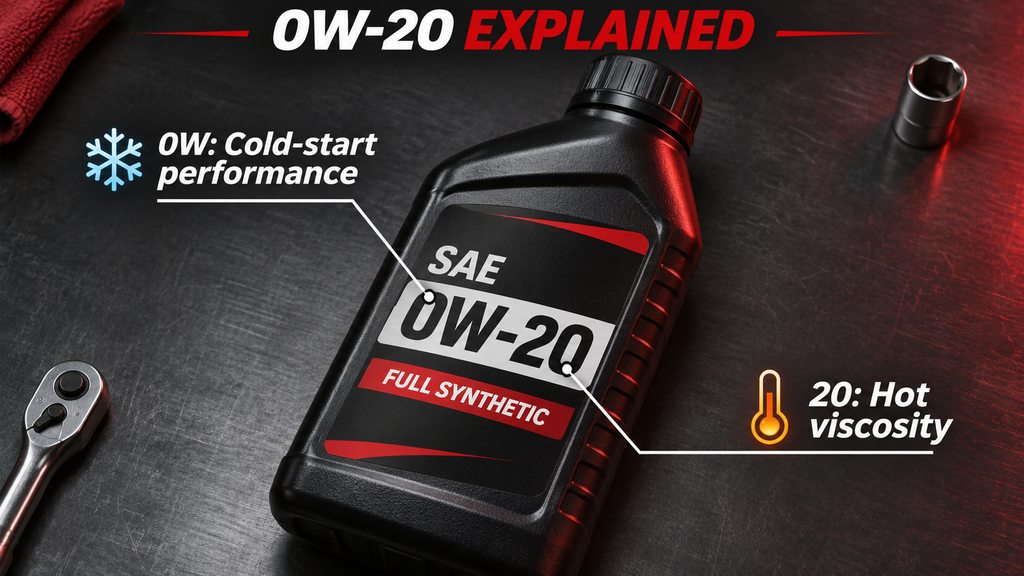
The 0W describes the oil’s low-temperature performance.
The letter W stands for winter, not weight.
A 0W oil must satisfy specific cold-cranking and cold-pumping requirements. This means it is formulated to remain sufficiently manageable for starting and oil circulation in very cold conditions.
Compared with an oil carrying a higher winter rating, 0W oil is designed to perform better under more demanding cold-temperature tests.
This matters because the engine needs oil to reach important components during startup.
Does 0W mean the oil is suitable only for 0°F weather?
No. The number is a viscosity grade, not an outdoor temperature setting.
It also does not mean the oil is as thin as water or has zero viscosity.
What Does 20 Mean?
The 20 describes the oil’s viscosity when it is hot.
More specifically, SAE 20 belongs to a defined viscosity range measured at 100°C (212°F), with an additional high-temperature, high-shear viscosity requirement.
Think of this as the part of the rating that describes the oil’s behavior after the engine has warmed up.
A grade ending in 20 is thinner at the standard hot-temperature test than grades ending in 30 or 40.
However, that does not automatically make it less protective.
Modern engines designed for SAE 0W-20 are engineered to operate with oil in that viscosity range.
How Does 0W-20 Behave During Startup and Highway Driving?
| Driving Condition | How SAE 0W-20 Behaves | Why It Matters |
|---|---|---|
| Cold morning startup | Meets demanding low-temperature flow requirements | Helps oil circulate during cold starts |
| Normal city driving | Becomes less viscous as the engine warms | Supports efficient lubrication |
| Highway driving | Operates within its specified hot-viscosity range | Helps protect components in an engine designed for the grade |
| Hot summer conditions | Meets SAE 20 requirements under standardized hot-viscosity testing | Can be suitable when the manufacturer specifies it |
One important detail: 0W-20 does not remain the same thickness at every temperature. Like other engine oils, it is considerably thicker when cold than when fully warmed up.
The purpose of a multigrade oil is to behave appropriately across changing temperatures.
Why Is SAE 0W-20 Usually Synthetic?
Producing an oil that performs well during extremely cold testing while maintaining the required viscosity and stability at operating temperature is challenging.
That is why SAE 0W-20 formulations generally rely on synthetic base oils.
Why Conventional Oil Is Not Normally Used for 0W-20
Traditional conventional motor oils are made primarily from refined mineral base oils.
Producing an SAE 0W-20 oil that meets modern cold-flow, oxidation-resistance, and automotive performance requirements typically requires more specialized base stocks.
Synthetic base oils are particularly suitable for this task because they can offer improved low-temperature behavior and greater control over performance characteristics.
As a result, conventional-only 0W-20 engine oils are not normally offered in the automotive market.
Important distinction: SAE J300 defines viscosity performance, not whether an oil must be labeled full synthetic. Some 0W-20 oils are sold as synthetic blends rather than full synthetic.
Therefore, 0W-20 generally relies on synthetic base-oil technology, but you should still check the formulation stated on the bottle.
How Synthetic Oil Handles High Temperatures
Engine oil faces heat, oxygen, pressure, and contamination during normal operation.
Over time, these conditions contribute to oil oxidation and deterioration.
Well-formulated synthetic oils can offer advantages such as:
- Improved resistance to oxidation and thermal degradation.
- More stable viscosity behavior across a wide temperature range.
- Reduced tendency to form certain deposits under high-temperature conditions.
- Good low-temperature flow characteristics.
However, synthetic oil is not indestructible.
Its performance still depends on the complete formulation, including additives and compliance with relevant standards.
Even excellent synthetic oil must be replaced according to the vehicle manufacturer’s maintenance recommendations.
What Are the Main Benefits of SAE 0W-20 Full Synthetic Motor Oil?
The advantages of SAE 0W-20 are most relevant when the engine was designed or approved to use this grade.

1. Supports Better Fuel Economy
SAE 0W-20 has relatively low viscosity at normal operating temperatures.
This can help reduce certain frictional and pumping losses inside an engine compared with using an unnecessarily thicker oil.
For manufacturers, these small efficiency improvements can contribute to better fuel economy.
For drivers, the benefit depends on the engine design, driving conditions, and the oil being compared.
Do not expect a guaranteed increase in miles per gallon simply because a bottle says 0W-20.
2. Provides Good Cold-Start Performance
During cold weather, engine oil becomes thicker.
An oil meeting the 0W requirement is designed to perform well during difficult low-temperature starting and pumping tests.
This helps the lubrication system circulate oil under cold conditions.
Cold-start behavior matters for drivers in winter climates, but it is also part of the overall viscosity performance required by the manufacturer.
3. Helps Control Deposits in Modern Engines
High-quality full synthetic motor oils use additives that help manage oxidation, sludge, varnish, and deposits.
Modern gasoline-engine oil standards also include performance testing related to engine cleanliness.
This is especially relevant in engines exposed to demanding operating conditions.
However, no oil can guarantee that an engine will remain completely free of deposits.
Correct oil selection and timely maintenance remain essential.
4. Can Suit Modern Turbocharged Engines
Turbocharged engines may expose engine oil to considerable heat.
An appropriately specified synthetic 0W-20 oil can provide the viscosity and performance characteristics required by a turbocharged engine designed for it.
Modern API SQ and ILSAC GF-7A requirements include protection against low-speed pre-ignition (LSPI), an abnormal combustion event that can affect certain turbocharged gasoline engines.
These standards also address areas such as timing-chain wear and high-temperature deposits.
Not every turbocharged engine uses SAE 0W-20. Some require another viscosity or additional manufacturer approval.
Always follow the specific engine’s requirements.
5. Works Well in Many Modern Hybrid Engines
Many hybrid vehicles use engines that stop and restart frequently.
A manufacturer-approved low-viscosity oil can support their lubrication requirements and fuel-efficiency goals.
However, hybrid vehicles do not all use the same viscosity grade.
Some hybrids specify SAE 0W-20, while others require different grades, including lower-viscosity alternatives.
The word hybrid alone is not enough to determine which oil to buy.
Which Vehicles Use SAE 0W-20 Full Synthetic Motor Oil?
SAE 0W-20 is recommended for a wide range of modern gasoline-powered vehicles, including certain sedans, SUVs, crossovers, and hybrid vehicles.
Manufacturers may specify it to balance fuel efficiency, lubrication, cold-start behavior, and compatibility with their engine designs.
Examples of Vehicles That May Specify SAE 0W-20
| Vehicle Category | SAE 0W-20 Compatibility |
|---|---|
| Modern gasoline sedans | Common in selected engines and model years |
| Compact SUVs and crossovers | Used by various manufacturer-approved engines |
| Turbocharged gasoline vehicles | Suitable only where specifically approved |
| Hybrid passenger vehicles | Used in some models, but not universally |
| Older passenger cars | Depends on the original engine specifications |
For one concrete example, the 2025 Honda CR-V owner’s manual specifies Honda Genuine Motor Oil 0W-20 or an appropriate API-certified 0W-20 alternative.
Some Toyota owner’s manuals likewise recommend SAE 0W-20 for particular engines.
However, these examples do not mean every Honda or Toyota engine requires the same oil.
How to Confirm Whether Your Vehicle Needs 0W-20
Check the engine-oil specifications section of your vehicle’s owner’s manual.
Look for three things:
- Viscosity grade: Does it specify SAE 0W-20?
- Performance standard: Does it require a particular API, ILSAC, or manufacturer specification?
- Manufacturer-specific conditions: Does the manual provide different recommendations for certain operating conditions or markets?
If all the required details match the bottle, you can make a more confident selection.
Is SAE 0W-20 Safe in Hot Weather?
Yes. SAE 0W-20 can protect an engine in hot summer conditions when it is the viscosity specified or approved by the manufacturer.
One of the biggest misconceptions is that the 0W rating makes the oil suitable only for cold climates.

That is incorrect.
The 0W portion describes the oil’s cold-temperature performance.
The 20 portion describes its hot-viscosity classification.
These are standardized oil tests, not an indication that the oil stops working when the outside temperature exceeds a certain number.
What About Very Hot States Such as Arizona or Texas?
If your manufacturer specifies SAE 0W-20 for normal operation, summer weather alone is not a reason to switch to thicker oil.
Vehicle manufacturers consider engine lubrication needs when selecting their recommended viscosity grades.
A correctly formulated 0W-20 oil provides the specified hot-viscosity characteristics even though the outdoor temperature may be high.
Nevertheless, special operating conditions such as repeated heavy towing or extreme sustained engine loads may require additional guidance from the owner’s manual.
The safest rule is to follow the manufacturer’s recommendation rather than choosing motor oil based only on outdoor temperature.
Is 0W-20 Too Thin for Older Engines?
This depends on what the older engine was designed to use.
Older Engines Originally Designed for 0W-20
An older vehicle that originally specified SAE 0W-20 may continue using an appropriate 0W-20 oil, provided it meets the manufacturer’s performance requirements.
Vehicle age or high mileage alone does not automatically make the recommended viscosity unsuitable.
However, an engine with unusual oil consumption, low oil pressure, or significant wear may need professional assessment.
Older Engines Designed for Thicker Oil
If an older engine specifies SAE 5W-30, 10W-30, or another grade, do not assume SAE 0W-20 is a safe substitute.
Different engines have different lubrication requirements. Our guide to 5W-30 full synthetic oil explains another common grade and how to check its compatibility.
Using a lower viscosity than approved may compromise protection under certain operating conditions.
A newer formulation is not automatically compatible with every older engine.
Does High Mileage Mean You Should Use Thicker Oil?
Not necessarily.
A vehicle with 120,000 miles does not automatically need a thicker oil than it used at 30,000 miles.
Mileage alone cannot establish the correct viscosity. Monitor the level between services using our guide on how to read an oil dipstick, following the checking procedure in your owner’s manual.
If the engine is consuming oil or showing signs of wear, investigate the cause and follow manufacturer or qualified technical guidance before changing grades.
What Should You Look for on an SAE 0W-20 Oil Bottle?
The front label may prominently display 0W-20 and Full Synthetic.
Those markings are useful, but they are not the complete picture.
The API and ILSAC performance ratings help identify whether the product meets established gasoline-engine oil standards.

What Does API SQ Mean?
API stands for the American Petroleum Institute.
Its gasoline-engine oil service categories establish performance requirements for automotive lubricants.
API SQ, introduced in 2025, is the newest gasoline-engine service category as of 2026.
It includes requirements addressing issues such as low-speed pre-ignition, timing-chain wear, deposits, and sludge control.
API SP is the preceding service category and remains relevant for vehicles that specify it.
A higher-letter API category should not be confused with a different SAE viscosity grade: the two classifications measure different things.
What Does ILSAC GF-7A Mean?
ILSAC stands for the International Lubricant Specification Advisory Committee.
Its passenger-car gasoline-oil standards address engine protection, fuel economy, and related performance requirements.
ILSAC GF-7A is the newer standard for common passenger-car gasoline-engine oils, including qualifying SAE 0W-20 products.
It succeeds GF-6A and includes updated performance requirements.
You may still see older GF-6A references in vehicle manuals or on older product information.
For compatible applications, GF-7A is designed to provide backward-compatible performance.
Understanding API SP, API SQ, GF-6A, and GF-7A
| Label | What It Means | What Drivers Should Know |
|---|---|---|
| API SP | Earlier gasoline-engine service standard | Still relevant where approved by the manufacturer |
| API SQ | Newer gasoline-engine service standard | Includes updated performance requirements |
| ILSAC GF-6A | Earlier passenger-car oil standard | Superseded by GF-7A; obsolete since October 1, 2026 |
| ILSAC GF-7A | Newer passenger-car oil standard | Addresses engine protection and fuel economy |
| API Starburst | Official API certification mark | Indicates an oil meets applicable current ILSAC requirements |
| API Donut | API service symbol | Shows the viscosity grade and applicable API category |
The API Starburst is relevant to qualifying SAE 0W-20 gasoline-engine oils.
Do not confuse it with the API Shield used for qualifying SAE 0W-16 oils.
Is API SQ Better Than API SP?
API SQ introduces newer performance requirements, including additional protection targets for modern gasoline engines.
For a vehicle that requires an earlier compatible API gasoline-engine category, API SQ can be an appropriate option when all other manufacturer requirements are also satisfied.
However, the newest API category does not authorize changing the required viscosity.
An API SQ 0W-20 bottle is not automatically the correct oil for an engine requiring 5W-30.
Common Myths About SAE 0W-20 Full Synthetic Motor Oil
| Common Myth | What Drivers Should Know |
|---|---|
| “0W means the oil works only in cold weather.” | The 0W rating describes low-temperature performance, not a climate restriction. |
| “20-weight oil is too thin to protect an engine.” | SAE 20 is appropriate for engines designed to use it. |
| “All 0W-20 oil is full synthetic.” | Synthetic blends also exist. |
| “0W-20 is unsafe during hot summers.” | Manufacturer-approved 0W-20 can be suitable in hot climates. |
| “Every modern engine needs 0W-20.” | Manufacturers specify different grades for different engines. |
| “Older engines should never use 0W-20.” | Older engines originally designed for it may continue using it. |
| “Synthetic oil never breaks down.” | All motor oil eventually deteriorates and requires replacement. |
| “Thicker oil always protects better.” | Correct viscosity and performance specifications matter more than simply choosing thicker oil. |
How to Choose the Right SAE 0W-20 Full Synthetic Oil
When comparing products, start with your vehicle’s requirements rather than the marketing claims on the bottle.
First, confirm that SAE 0W-20 is the correct viscosity.
Next, check whether the manual requires full synthetic oil or permits other formulations.
Then verify the necessary API, ILSAC, and manufacturer-specific approvals.
A current API SQ and ILSAC GF-7A product may be a sensible option for a compatible modern gasoline engine, but the exact specifications in your manual take priority.
You do not necessarily need the most expensive bottle.
Choose a reputable product that meets the required specifications, and follow the manufacturer’s recommended maintenance interval. Use our car maintenance checklist to organize oil checks and other scheduled services.
Frequently Asked Questions
Is SAE 0W-20 the same as full synthetic oil?
No. SAE 0W-20 is a viscosity grade, while full synthetic describes the oil’s formulation. Many 0W-20 oils are full synthetic, but synthetic-blend products also exist.
What does the W mean in SAE 0W-20?
The W stands for winter. It identifies the oil’s low-temperature viscosity performance.
Is SAE 0W-20 good for high temperatures?
Yes, when the engine manufacturer recommends it. The oil must meet specified hot-viscosity requirements, and its suitability depends on the engine design and required performance standards.
Is 0W-20 thinner than 5W-20?
Both are classified as SAE 20 at operating-temperature test conditions. The important difference is their cold-temperature performance, with 0W meeting more demanding cold-temperature requirements.
Can I use 0W-20 in an older car?
Yes, if the engine manufacturer approves that viscosity. Do not switch an older engine from a thicker specified grade to 0W-20 merely because 0W-20 is newer.
Is 0W-20 good for turbocharged engines?
It can be, provided the engine specifically requires or approves it. Oil quality, performance certification, and any manufacturer-specific approvals are particularly important.
Why do hybrid cars use 0W-20?
Some hybrid engines are designed for low-viscosity oil to help meet efficiency and lubrication requirements. However, not all hybrids specify 0W-20.
What is the difference between API SP and API SQ?
API SP is an earlier gasoline-engine oil standard. API SQ introduces newer performance requirements, including additional engine-protection tests. The appropriate oil must still match the vehicle’s viscosity and other specifications.
Is ILSAC GF-7A better than GF-6A?
GF-7A is the newer passenger-car gasoline-engine oil specification and adds updated performance requirements. It is designed to be backward compatible with earlier GF-6A applications.
Can full synthetic 0W-20 extend my oil-change interval?
Not automatically. Full synthetic oil may provide strong resistance to degradation, but you should follow the maintenance schedule or oil-life monitoring instructions specified by the vehicle manufacturer.
Final Thoughts
SAE 0W-20 full synthetic motor oil combines low-temperature flow characteristics with the hot-viscosity performance required by many modern engines.
The 0W rating relates to cold-start behavior, while the 20 grade describes viscosity under hot operating-temperature tests. Synthetic base oils help manufacturers achieve these requirements while providing resistance to heat-related deterioration.
For everyday drivers, the main benefits can include efficient lubrication, good cold-start performance, fuel-economy support, and deposit control in appropriately designed engines.
However, no viscosity grade is best for every vehicle.
Whether you drive in winter weather, summer heat, city traffic, or on the highway, the correct choice is the motor oil that meets your specific engine’s published requirements.