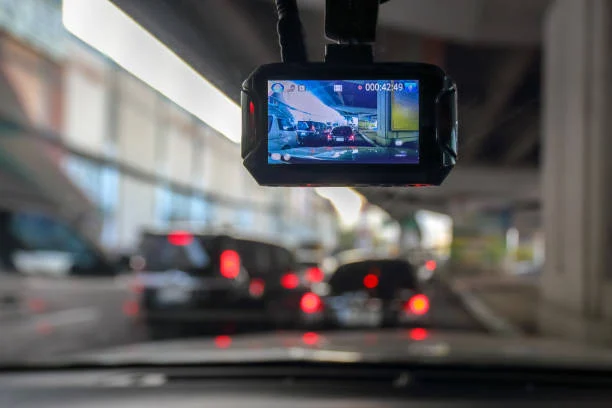
A dashcam is a small camera mounted on your windshield or dashboard that records the road while you drive. Its main value is simple: it creates a neutral record of what happened in the seconds before, during, and after a crash.
Fault disputes usually come down to one driver’s word against another’s. Video removes most of that guesswork and gives insurers and courts something they cannot argue away.
Dashcams offer many great benefits beyond crash evidence, including protection against staged accidents, false complaints, and disputed parking lot damage. The cost is low compared to a single claim going the wrong way.
What a Dashcam Records
Modern units capture far more than a picture of the road. Most save a continuous loop, overwriting old files until an impact locks a clip.
- Video of the lanes ahead, and rear or cabin views on dual-channel models.
- Date, time, and GPS coordinates stamped onto the file.
- Speed at the moment of impact on units with GPS logging.
- G-force data that marks hard braking, swerving, and collisions.
- Audio inside the cabin, which can be turned off on most models.
How Video Changes an Insurance Claim
Insurers assign fault based on the evidence in front of them. Without video, adjusters rely on two conflicting statements and a diagram drawn after the fact.
Clear footage often ends that process early. Claims that would take weeks of back-and-forth can settle once the video is shared, and comparative fault percentages tend to move in favor of the driver who has proof.
Video evidence safeguards against misleading injury claims, as low-speed impacts are less likely to be perceived as severe collisions.
Where Dashcam Video Matters Most
Some situations depend on details that witnesses may not remember accurately. In these cases, a recording can provide clear evidence of what happened.
Hit-and-Run Incidents
A plate number captured on video is often the only way a fleeing driver is identified. Police can act on a clear clip within hours instead of closing the file.
Staged Crash and Fraud Schemes
Brake-checking and swoop-and-squat setups depend on the victim having no proof. Video showing a sudden intentional stop shifts fault immediately.
Commercial and Fleet Drivers
Drivers on the job face claims that threaten their license and their employer. Footage supports both the driver’s account and the company’s defense in the same claim.
Is Recording from Your Car Legal?
Video of a public roadway is generally lawful, since no one on a public street has a reasonable expectation of privacy. Audio is where the rules tighten.
The federal Wiretap Act, 18 U.S.C. § 2511, permits recording a conversation when one party consents. Several states go further and require consent from everyone recorded, which matters when passengers or rideshare customers are in the car.
Mounting rules also vary. Most states restrict objects that obstruct the windshield, so cameras are usually placed behind the mirror or in a lower corner.
Getting Footage Accepted as Evidence
A recording only helps if it survives scrutiny. Federal Rule of Evidence 901, reflected in most state rules, requires proof that the video is what you claim it is. That means keeping the original file rather than a trimmed copy or a phone recording of a screen.
Accurate clock and date settings matter, because a wrong timestamp gives the other side an easy challenge. Save any important clip the same day. Loop recording will overwrite it, sometimes within a few hours of continued driving.
What a Dashcam Will Not Do
Video has blind spots, and expecting too much creates its own risk. A forward-facing camera cannot show what happened beside or behind your vehicle unless it has a second lens. The footage can also work against you if it captures actions that may affect your claim. A clip showing your own speeding or rolling stop becomes evidence the other driver can request.
Key Takeaways
- A dashcam creates a neutral record of how a crash happened.
- Video often shortens fault disputes and speeds up settlements.
- Plate numbers on video help identify hit-and-run drivers.
- Audio recording rules vary, and some states require all-party consent.
- Save original files the same day before the loop overwrites them.