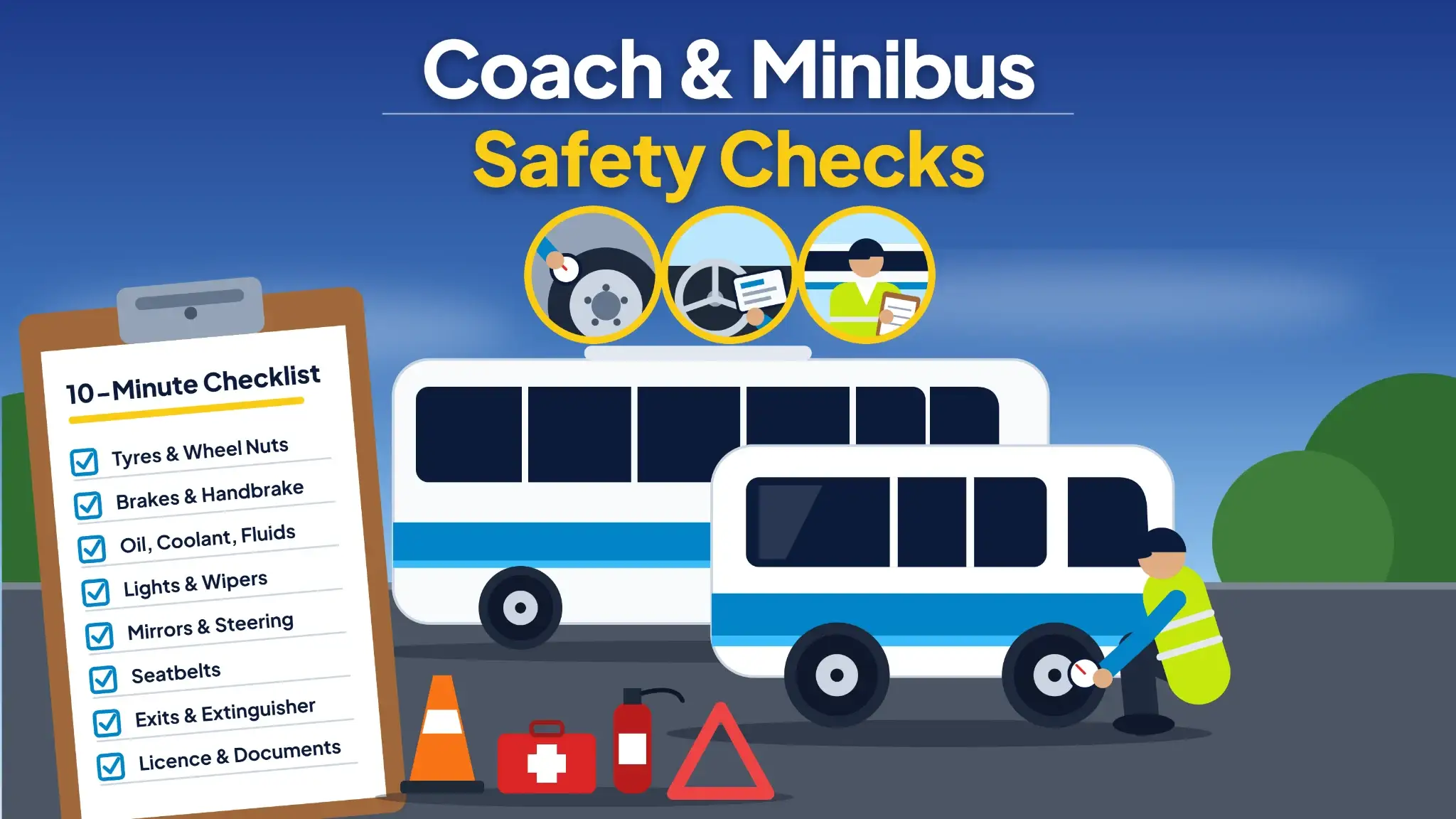

Before a long group trip, a coach or minibus needs a full walk-around safety check covering tyres (pressure, tread and sidewall damage), brakes, fluid levels, lights, steering, seatbelts, mirrors, emergency exits and legal documents. Professional operators repeat this check before every journey, not just long ones. Most roadside breakdowns and failed roadside inspections on group vehicles come from simple items on this list that were skipped.
Why Group Vehicles Need Stricter Checks Than Cars
A minibus carrying 16 passengers or a coach carrying 50 puts far more stress on tyres, brakes and suspension than a family car doing the school run. The vehicle is heavier, the distances are longer, and the driver is responsible for every passenger on board. That is why coach and minibus hire operators in the UK work to a daily check standard, and why the same routine is worth copying if you run a club, school, sports team or community group vehicle of your own.
The good news: none of this needs a workshop. Almost every check below takes minutes, needs no tools beyond a tyre pressure gauge and a tread depth gauge, and catches problems while they are still cheap to fix.
1. Tyres: Pressure, Tread and Sidewalls
Tyres are the single most common failure point on large passenger vehicles.
- Pressure: Check when cold, against the vehicle manufacturer’s plate (usually inside the door frame or fuel flap), not the number on the tyre sidewall. Under-inflated tyres overheat on long motorway runs and are a leading cause of blowouts.
- Tread depth: The UK legal minimum is 1.6mm across the central three-quarters of the tyre. On a heavy vehicle, treat 3mm as your real replacement point — wet grip drops sharply below it.
- Sidewalls: Look for cuts, bulges and cracks. A bulge means internal damage and the tyre should not be driven on at all.
- Wheel nuts: Check for the tell-tale markers (nut indicators) being out of line, and look for rust streaks running from a nut — both suggest a loose wheel.
2. Brakes: Feel, Sound and Warning Lights
- Press the pedal before setting off: it should feel firm, not spongy or sinking.
- Listen on the first few stops. Grinding means pads are likely down to the metal; squealing is an early wear warning.
- Check the handbrake holds the vehicle on a slope — critical on a loaded coach.
- Any brake warning light on the dashboard means the vehicle does not travel. No exceptions.
3. Fluids: Oil, Coolant, Brake Fluid and Screenwash
Open the bonnet (or engine bay) and check levels against the min/max marks:
- Engine oil — low oil on a long run can destroy an engine in minutes.
- Coolant — never open a hot system; check the expansion tank level when cold. Overheating is one of the most common causes of coach breakdowns in summer traffic.
- Brake fluid — if it is dropping, there is a leak or worn pads. Both need a mechanic, not a top-up and hope.
- Screenwash — a full tank matters more than people think on a long trip; motorway spray can blind a driver in seconds with an empty washer bottle.
4. Lights, Indicators and Wipers
Walk around with the lights on: headlights, indicators, brake lights (ask someone to press the pedal), reverse lights and the number plate light. Then test the wipers and washers together. On a group vehicle, a failed brake light is not a small thing — following drivers get almost no warning from a vehicle that size slowing down.
5. Steering, Mirrors and Driver Visibility
- Steering should feel direct with no knocking, pulling or excessive play.
- Mirrors on coaches and minibuses are large and easily knocked — check both sides are secure and correctly set before moving off.
- Clear the windscreen fully, inside and out. A smeared screen in low sun is a genuine hazard on early morning departures.
6. Inside the Cabin: Seatbelts, Exits and Safety Equipment
- Seatbelts: Pull each belt out fully and check it retracts and locks. Every passenger seat needs a working belt.
- Emergency exits: Make sure exit doors and hammer points for emergency windows are unobstructed and the signage is visible.
- Fire extinguisher and first aid kit: Check they are present, in date, and reachable — not buried under luggage.
- Luggage: Heavy bags belong in the boot or hold, never in the aisle. Loose items become projectiles in an emergency stop.
7. Documents and Legal Checks
Before the wheels move, the driver should have: a valid driving licence with the correct category for the vehicle size, the vehicle documents, insurance details and — for hired or commercial vehicles — the operator’s contact number for breakdowns. If you are booking transport rather than driving yourself, this is exactly the standard a professional operator should already be working to. Companies offering group transport services build these checks into every booking, and it is one of the clearest signs you are dealing with a properly run operator rather than a casual one.
The 10-Minute Pre-Trip Checklist
Run through this list in order, every time:
- Tyre pressures, tread and sidewalls — all wheels, including the spare
- Wheel nut indicators in line
- Brake pedal feel, handbrake hold, no warning lights
- Oil, coolant, brake fluid and screenwash levels
- All lights and indicators working
- Wipers and washers working, screen clean
- Mirrors secure and adjusted
- Every seatbelt pulls out, retracts and locks
- Emergency exits clear, extinguisher and first aid kit in place
- Documents, licence and breakdown number in the cab
When to Hire a Professional Instead
There is a point where running your own vehicle stops making sense: no qualified driver with the right licence category, a vehicle due a major service, or a group too large for one minibus. That is where professional coach and minibus hire earns its cost , the maintenance, the legal checks, and the driver all become someone else’s problem. An established operator such as BritWheel Travels runs this standard on every vehicle, whether it is a short school run or a full-day tour.
For smaller groups, choosing minibus hire with a professional driver removes the licence-category problem entirely, because minibuses above a certain weight and seat count need more than a standard car licence when driven commercially. The same logic applies at the start and end of a trip: pre-booked group airport transfers mean the vehicle waiting for your group has already been checked, fuelled and legally cleared before it arrives.
Frequently Asked Questions
How often should a minibus or coach be safety checked?
A full walk-around check should happen before every journey, and at least daily when the vehicle is in regular use. A deeper inspection by a mechanic, including brakes, steering and suspension components, should follow the manufacturer’s service schedule.
What is the legal tyre tread depth for a minibus in the UK?
The legal minimum is 1.6mm across the central three-quarters of the tread, the same as a car. In practice, operators replace tyres at around 3mm because wet-weather grip falls away quickly below that point on a heavy vehicle.
Can I drive a minibus on a normal car licence?
It depends on the vehicle size, when you passed your test, and whether the trip is commercial. Many minibuses need a D1 category entitlement, which is one reason groups often hire a vehicle with a professional driver instead.
What is the most common cause of coach breakdowns on long trips?
Overheating and tyre problems account for a large share of long-distance breakdowns. Both are usually preventable: coolant level and condition, plus tyre pressure and tread, are the two checks that get skipped most often.
Who is responsible for safety checks on a hired coach or minibus?
The operator. When you hire a vehicle with a driver, the operator is legally responsible for the vehicle’s roadworthiness and the driver’s hours and licence. Checking that your operator follows a visible daily-check routine is a fair question to ask before you book.
Final Word
Safety checks on a coach or minibus are not paperwork; they are the difference between a group trip that runs quietly and one that ends on the hard shoulder. Ten minutes with a checklist before departure covers almost everything that commonly goes wrong. And if your group does not have the vehicle, the licence, or the time, hiring from an operator who treats these checks as non-negotiable is the simplest way to travel.