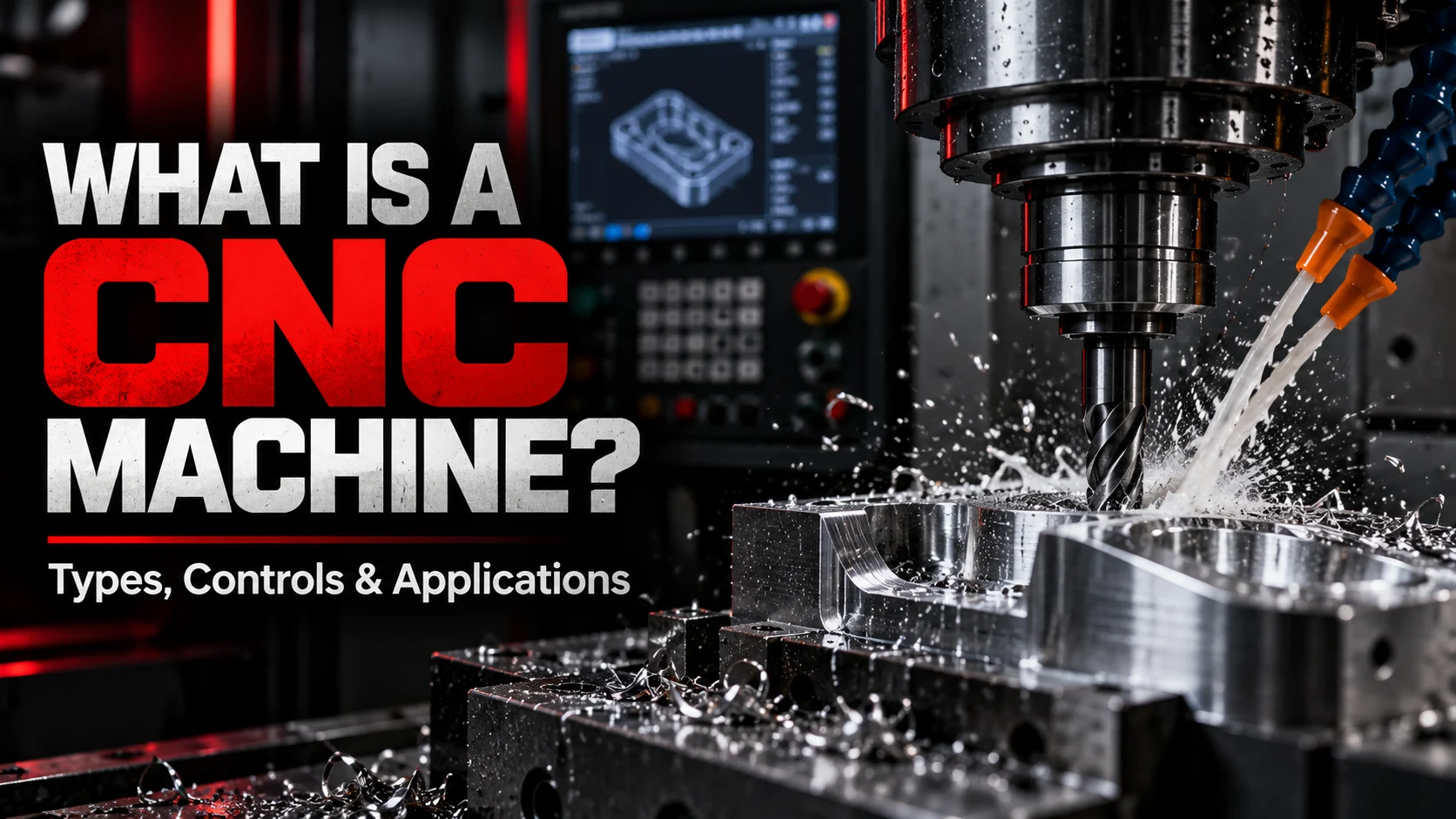
A CNC machine is a manufacturing machine controlled by programmed computer instructions rather than relying entirely on manual movement. Modern CNC controlled machines can position cutting tools, move machine axes, control spindle speed, adjust feed rates, and perform repeatable machining operations with high consistency.
CNC technology is widely used in automotive, aerospace, medical, electronics, metalworking, woodworking, and general manufacturing. Although the machines can appear complex, the basic idea is simple: the controller reads programmed instructions and tells the machine how and where to move.
Quick definition: CNC stands for Computer Numerical Control. It describes machines whose movement and functions are controlled by computer-based numerical instructions.
What Is a CNC Machine?
A CNC machine is a machine tool equipped with a computerized control system. Instead of requiring an operator to manually guide every cutting movement, the CNC controller follows a programmed sequence.
Depending on the machine, these programmed instructions can control tool position, axis movement, spindle speed, feed rate, coolant, tool changes, drilling cycles, and other machining functions.
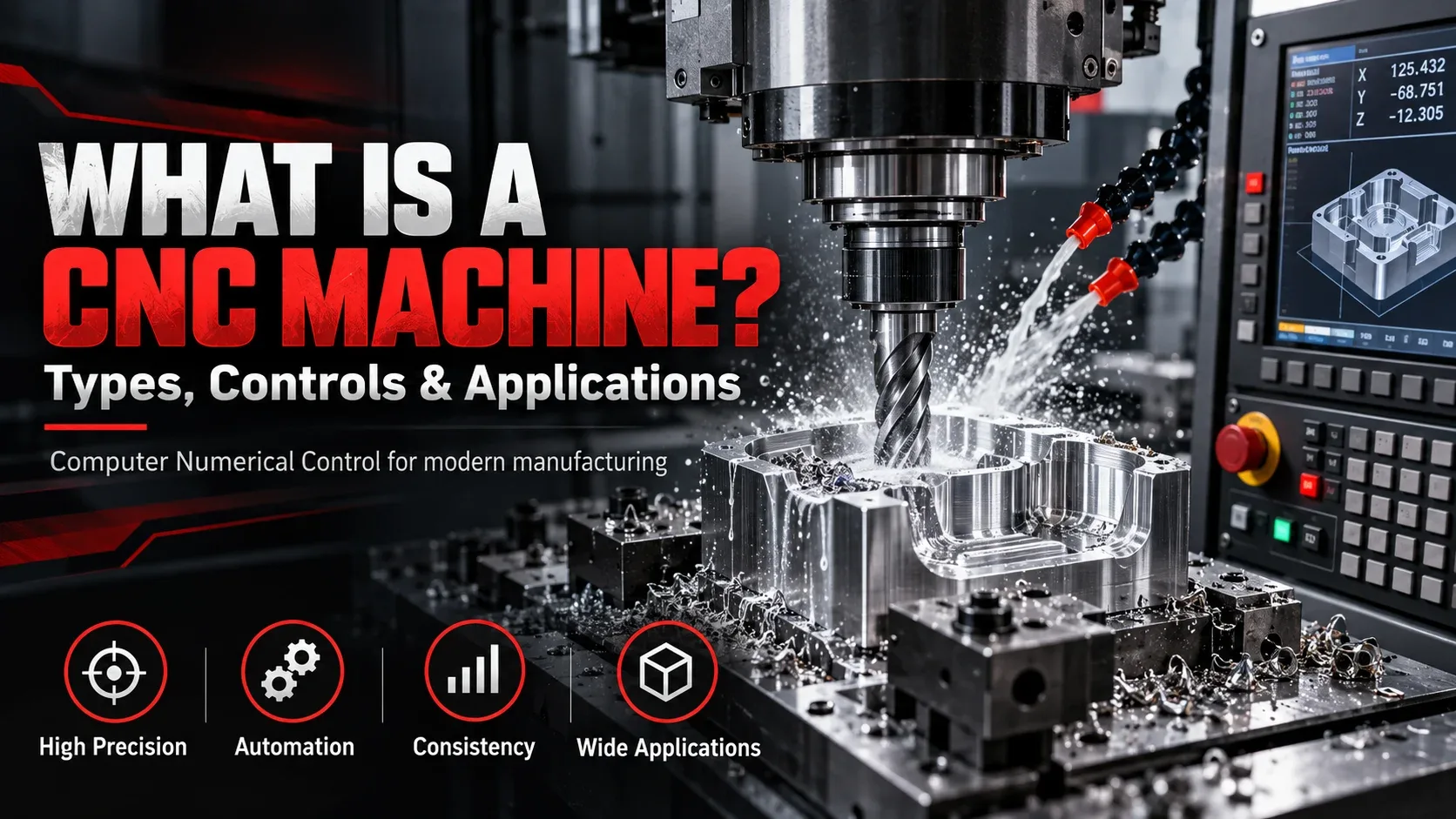
For example, an aluminum bracket can first be designed in CAD software. Toolpaths are then created in CAM software and converted into instructions the CNC machine can understand. Once the workpiece and tools are correctly set up, the machine follows the programmed path to produce the part.
What Does CNC Stand For?
CNC stands for Computer Numerical Control.
- Computer: Processes programmed instructions.
- Numerical: Positions, dimensions, speeds, and movements are represented with numerical values.
- Control: The system controls motors, axes, spindle functions, tooling, and other machine operations.
CNC technology developed from earlier numerical-control systems. Modern machines combine digital controllers, servo motors, sensors, software, tooling, and precision mechanical systems.
How Do CNC Controlled Machines Work?
A typical CNC workflow moves from a digital design to a physical finished component.
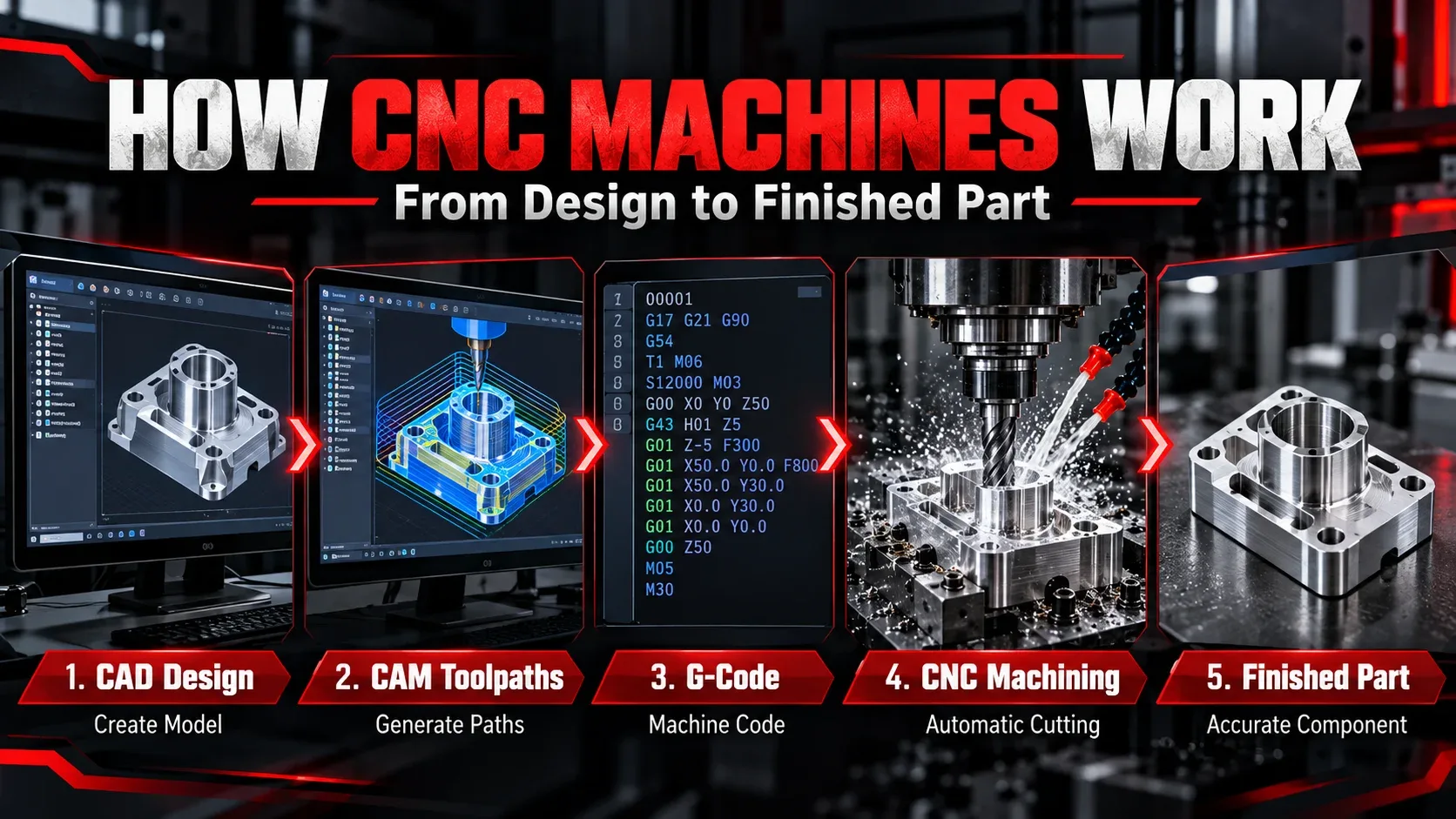
1. Design the Part
A component is usually created using computer-aided design, or CAD, software. The model defines the required geometry, dimensions, and features.
2. Generate Toolpaths
Computer-aided manufacturing, or CAM, software can be used to determine how cutting tools should move across the workpiece.
3. Generate the CNC Program
CAM toolpaths are converted into machine instructions, often containing G-code and M-code commands.
4. Set Up the CNC Machine
The operator installs the workpiece, loads the correct tools, sets work coordinates, verifies tool offsets, and checks the program.
5. Run the Program
The controller sends commands to the machine’s motors, spindle, tool changer, coolant system, and other components.
6. Inspect the Finished Part
Finished components may be checked using calipers, micrometers, gauges, probes, or coordinate-measuring equipment.
Main Parts of a CNC Machine
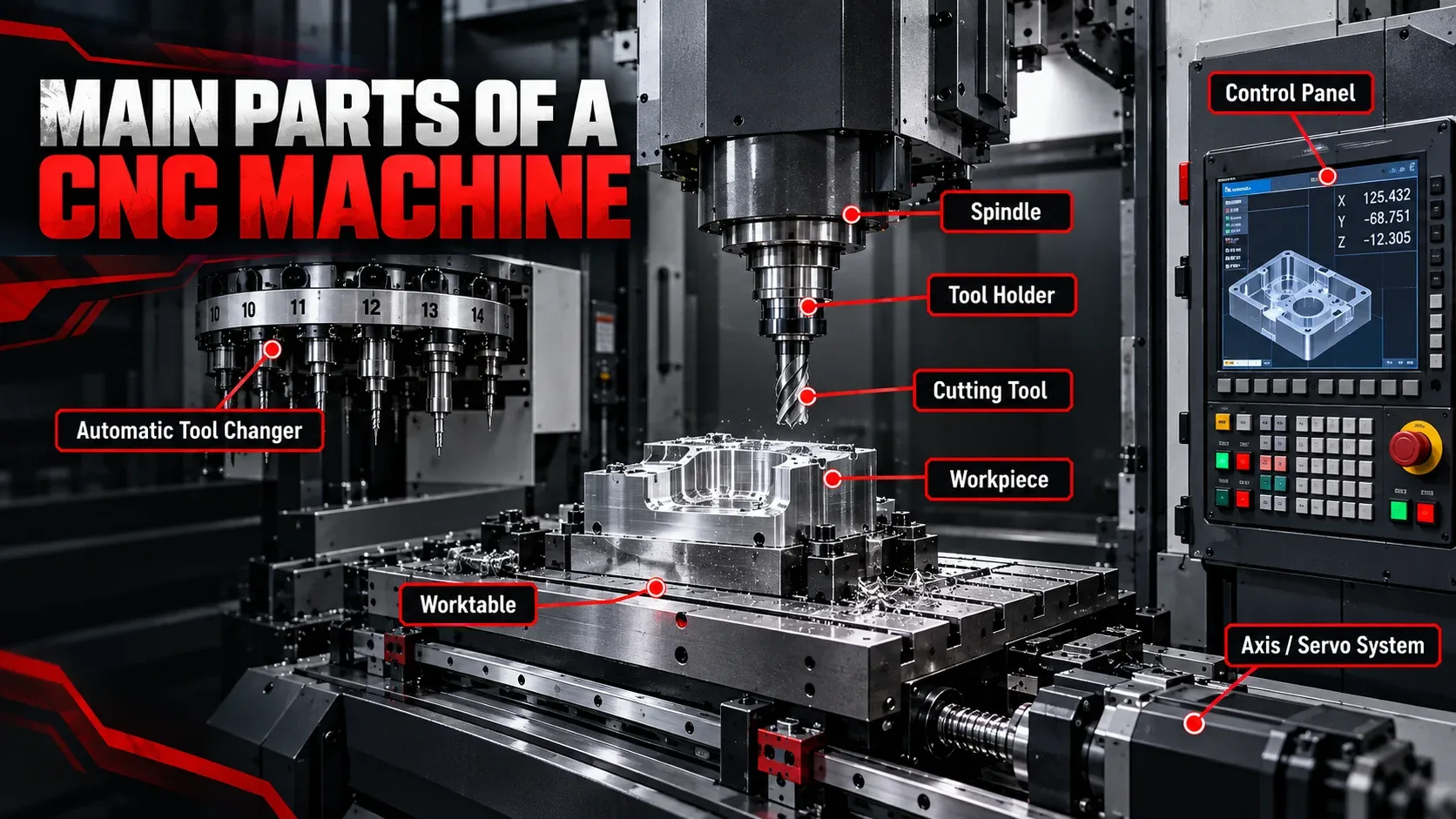
CNC Controller
The controller reads the program and coordinates the machine’s motion and functions.
Control Panel
The operator uses the control panel to load programs, move axes, change settings, and start machining cycles.
Spindle
The spindle rotates either the cutting tool or workpiece, depending on the machine configuration.
Servo Motors
Servo motors provide controlled movement of the machine axes.
Workholding
Vises, fixtures, chucks, collets, and clamps secure the material during machining.
Cutting Tools
End mills, drills, inserts, taps, and turning tools remove material and create features.
Axis Drive System
Motors, ball screws, linear guides, and encoders help convert control commands into movement.
Automatic Tool Changer
Many CNC machines can automatically switch between different tools during a program.
How CNC Machine Controls Work
The CNC controller acts as the command center of the machine. Operators use it to load programs, move individual axes, set work coordinates, control the spindle, monitor machine status, and run machining cycles.
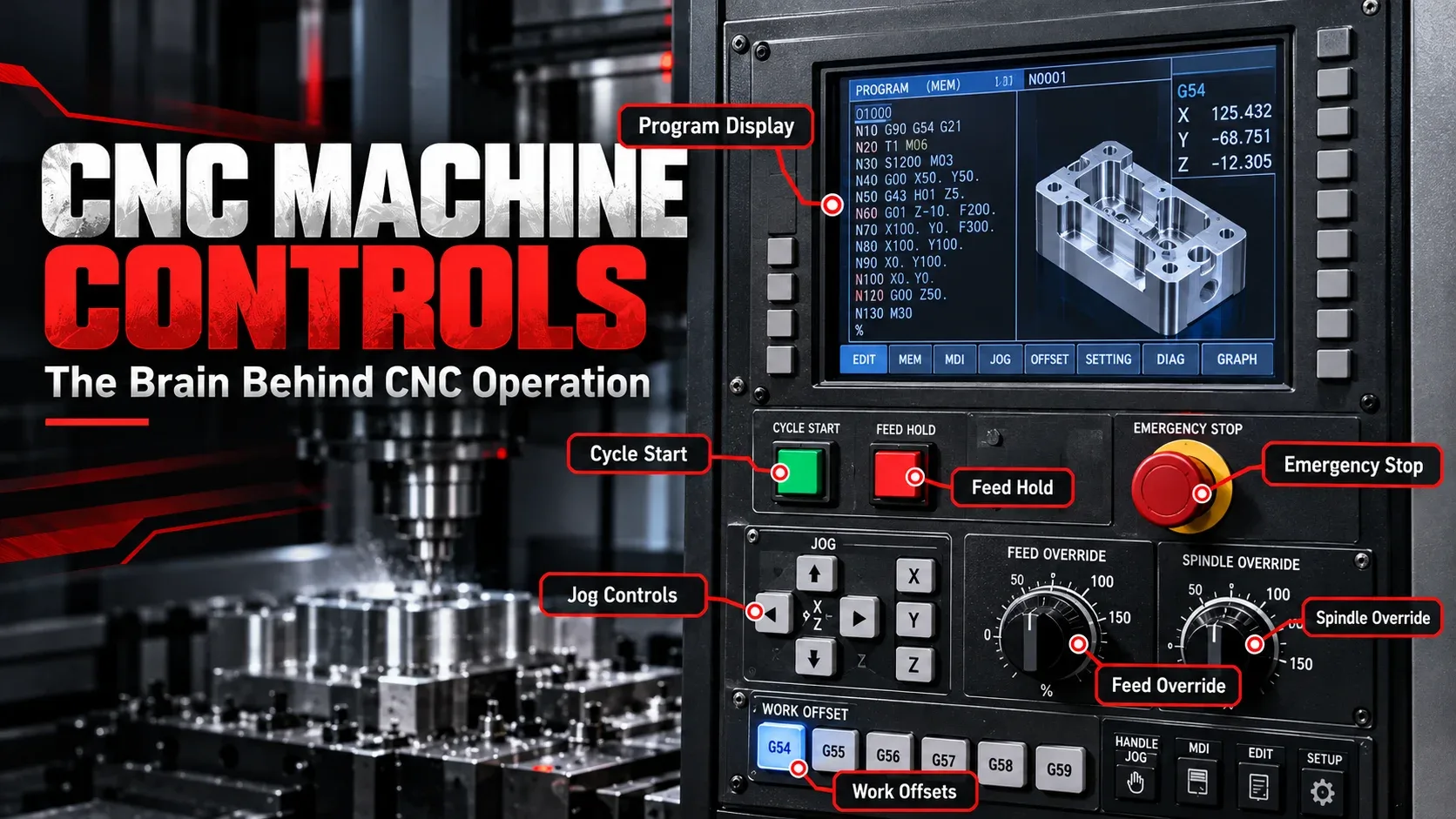
- Cycle Start: Begins or resumes program execution.
- Feed Hold: Temporarily pauses programmed axis movement.
- Emergency Stop: Stops machine operation during an emergency.
- Jog Mode: Allows an operator to move individual axes manually.
- Manual Data Input: Allows commands to be entered directly.
- Feed Override: Adjusts programmed feed speed.
- Rapid Override: Changes rapid movement speed.
- Spindle Control: Controls spindle operation and speed.
- Work Offsets: Define the location of the workpiece.
- Tool Offsets: Compensate for tool length, diameter, position, or wear.
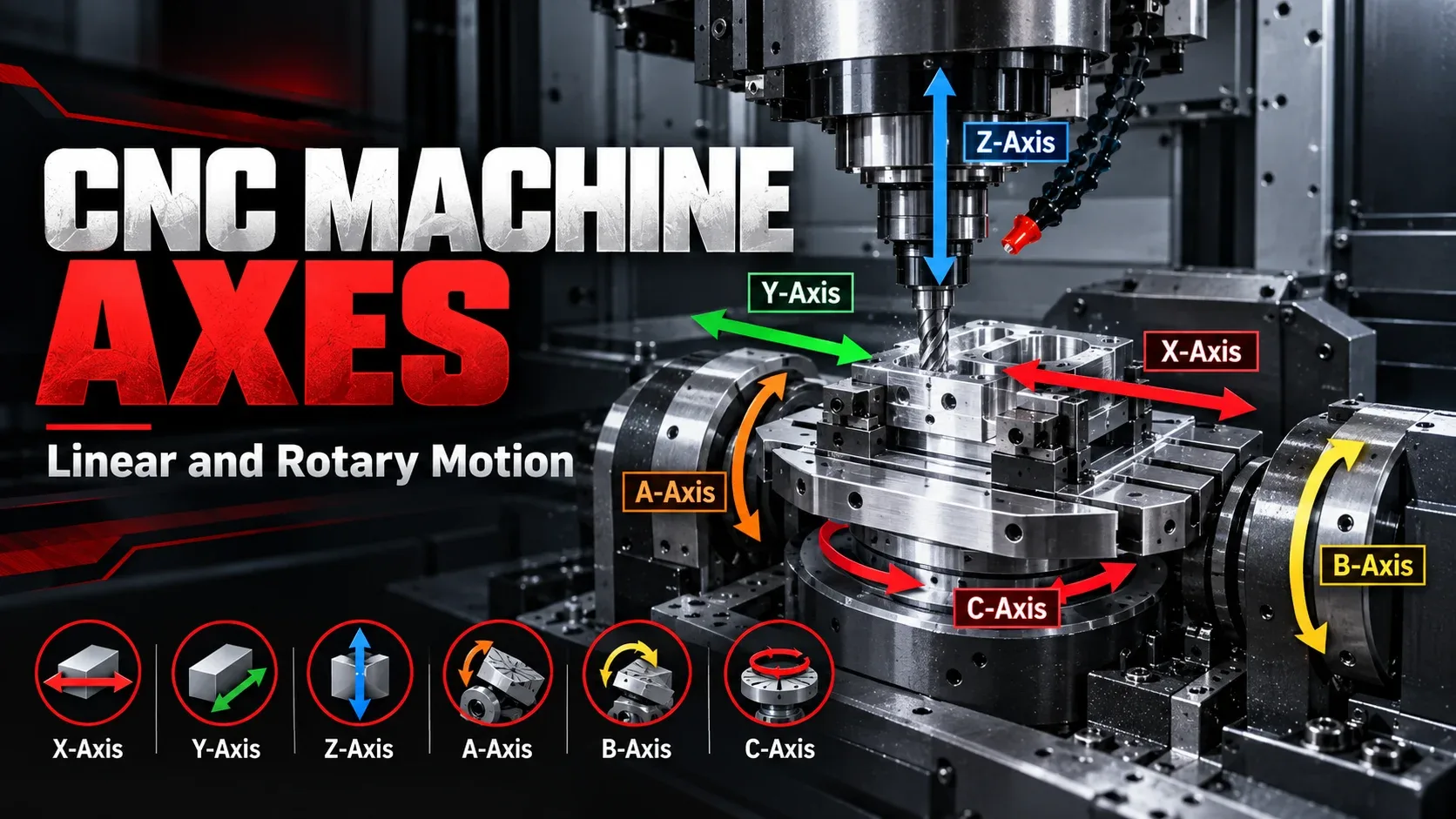
CNC Machine Axes: X, Y, Z, A, B and C
CNC axes define the directions in which a machine can move.
3-Axis vs 4-Axis vs 5-Axis CNC Machines
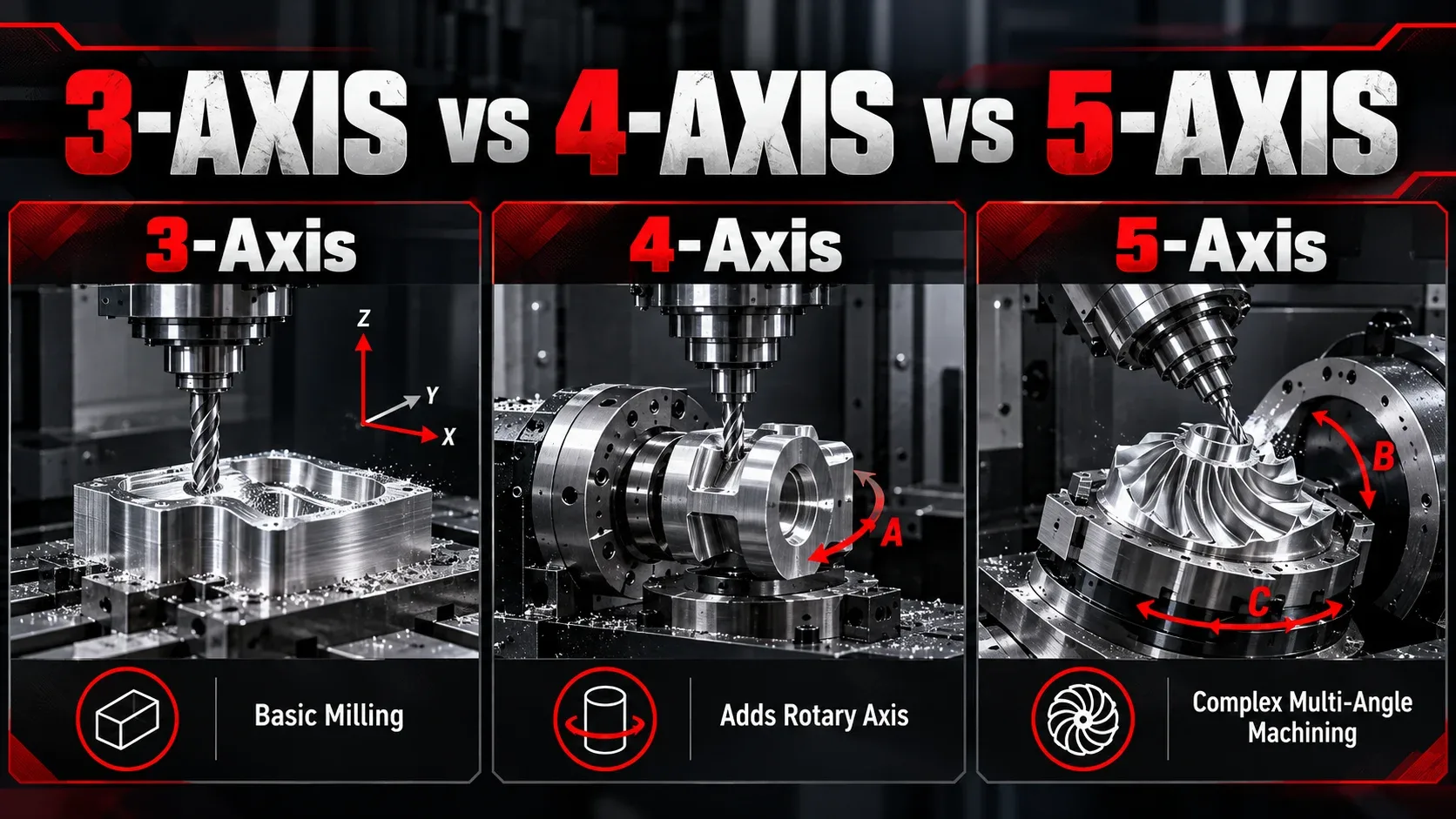
| Type | Movement | Typical Capability | Applications |
|---|---|---|---|
| 3-Axis CNC | X, Y and Z | Standard linear machining | Plates, pockets, brackets and general parts |
| 4-Axis CNC | X, Y, Z plus one rotary axis | Machining around an additional rotational direction | Cylindrical and multi-side components |
| 5-Axis CNC | Three linear plus two rotary axes | Complex multi-angle machining | Aerospace parts, molds and medical components |
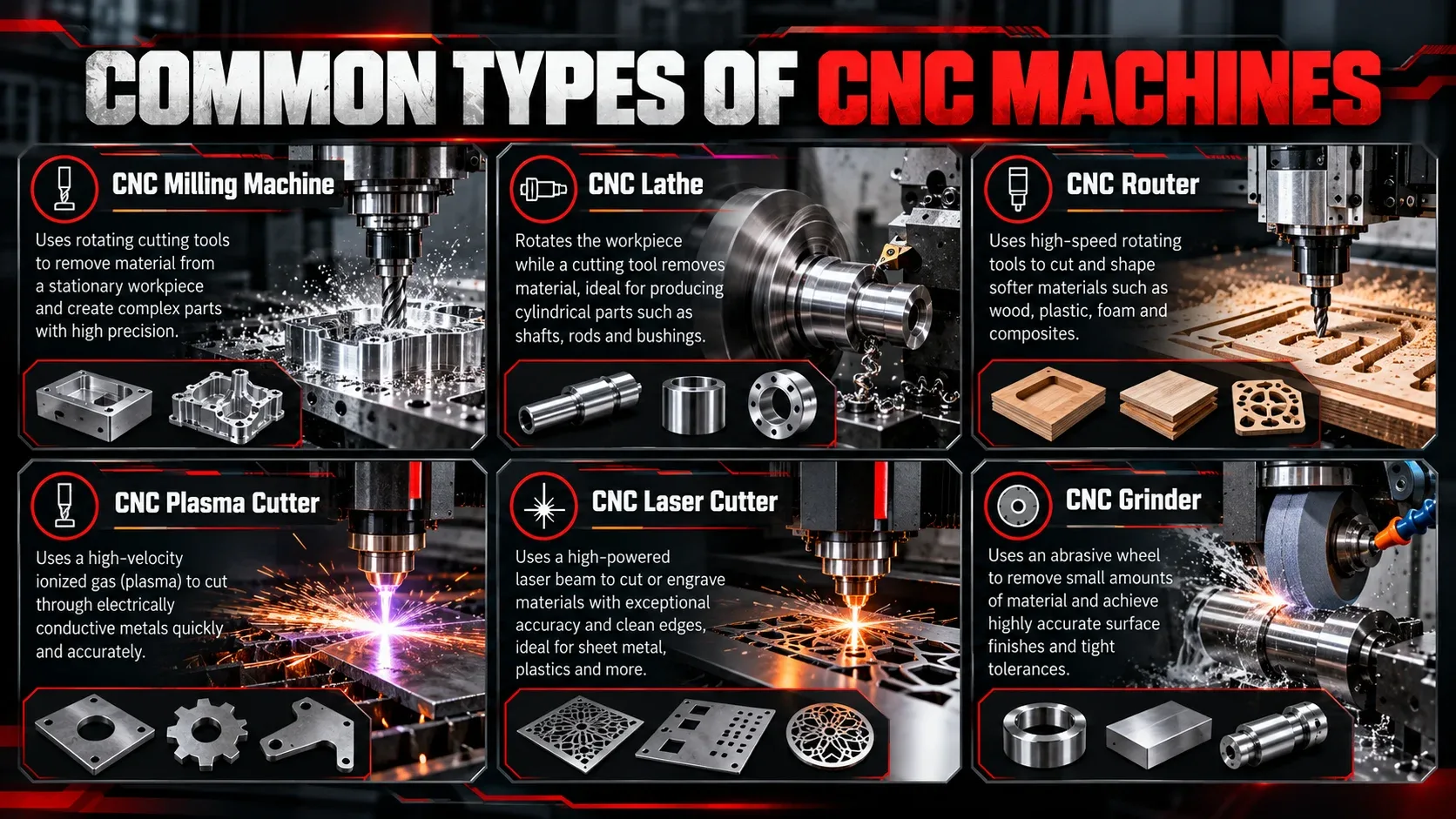
Common Types of CNC Machines
CNC Milling Machines
CNC milling machines use rotating cutting tools to remove material from a workpiece. They are widely used for brackets, housings, molds, engine components, fixtures, and complex mechanical parts.
CNC Lathes and Turning Centers
CNC lathes usually rotate the workpiece while cutting tools move along controlled axes. They are well suited to shafts, bushings, pins, threaded parts, spacers, and other cylindrical components.
CNC Routers
CNC routers are commonly used for wood, plastics, composites, foam, and some non-ferrous materials. They are popular in furniture production, cabinet making, sign work, and prototyping.
CNC Laser Cutters
CNC laser cutters use a focused laser beam to cut material along programmed paths. They are widely used in sheet-metal fabrication and precision cutting.
CNC Plasma Cutters
CNC plasma machines use a high-temperature plasma arc to cut electrically conductive metals such as steel and aluminum.
CNC Grinding Machines
CNC grinders use abrasive wheels to produce controlled dimensions and fine surface finishes.
CNC EDM Machines
Electrical discharge machining removes material using controlled electrical discharges. It is useful for hard conductive materials and complex shapes.
CNC Drilling Machines
CNC drilling systems automate drilling, reaming, countersinking, and tapping operations.
Swiss-Type CNC Machines
Swiss-type CNC machines are designed for high-precision production of small, long, and complex components.
CNC Mill vs CNC Lathe
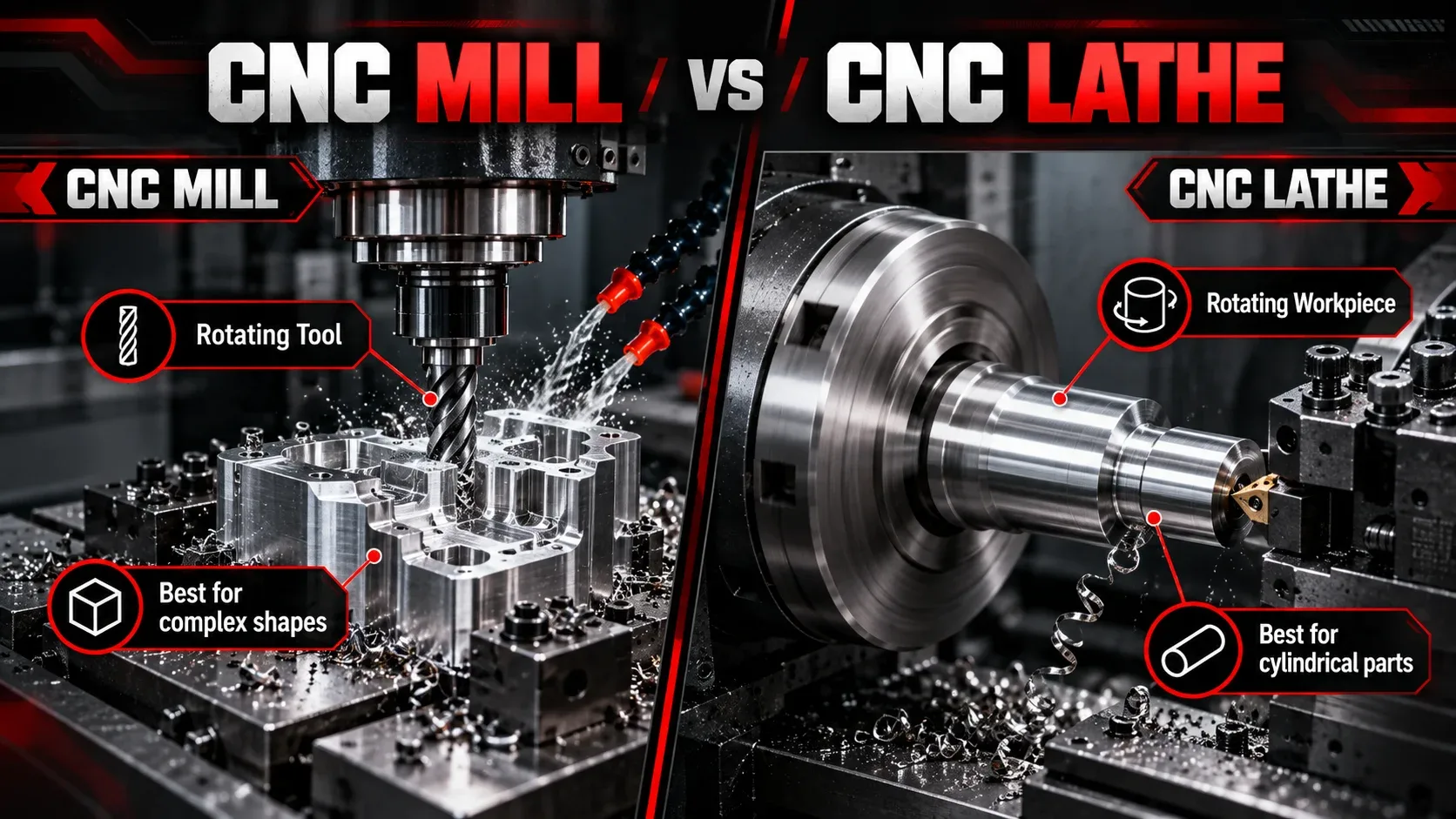
| Feature | CNC Mill | CNC Lathe |
|---|---|---|
| Main rotating component | Usually the cutting tool | Usually the workpiece |
| Best for | Complex and prismatic parts | Cylindrical components |
| Common axes | X, Y and Z | X and Z |
| Typical parts | Brackets, housings and molds | Shafts, bushings and fittings |
CNC Programming: G-Code and M-Code Basics
CNC programs contain instructions that tell the machine what actions to perform.
| Code | Typical Function |
|---|---|
| G00 | Rapid positioning |
| G01 | Linear cutting movement |
| G02 | Clockwise circular movement |
| G03 | Counterclockwise circular movement |
| M03 | Commonly spindle start |
| M05 | Spindle stop |
| M08 | Commonly coolant on |
| M09 | Commonly coolant off |
G00 X0 Y0
G00 Z5.0
M03 S2500
G01 Z-2.0 F100
G01 X50.0 F250
G00 Z5.0
M05
How CAD and CAM Connect to CNC Machines
CAD
Computer-Aided Design software creates the digital model or geometry of the part.
CAM
Computer-Aided Manufacturing software creates toolpaths and machining strategies.
Post-Processor
Converts CAM output into code suitable for the specific CNC machine and controller.
CNC Controller
Reads the program and controls machine movement and functions.
Where Are CNC Machines Used?
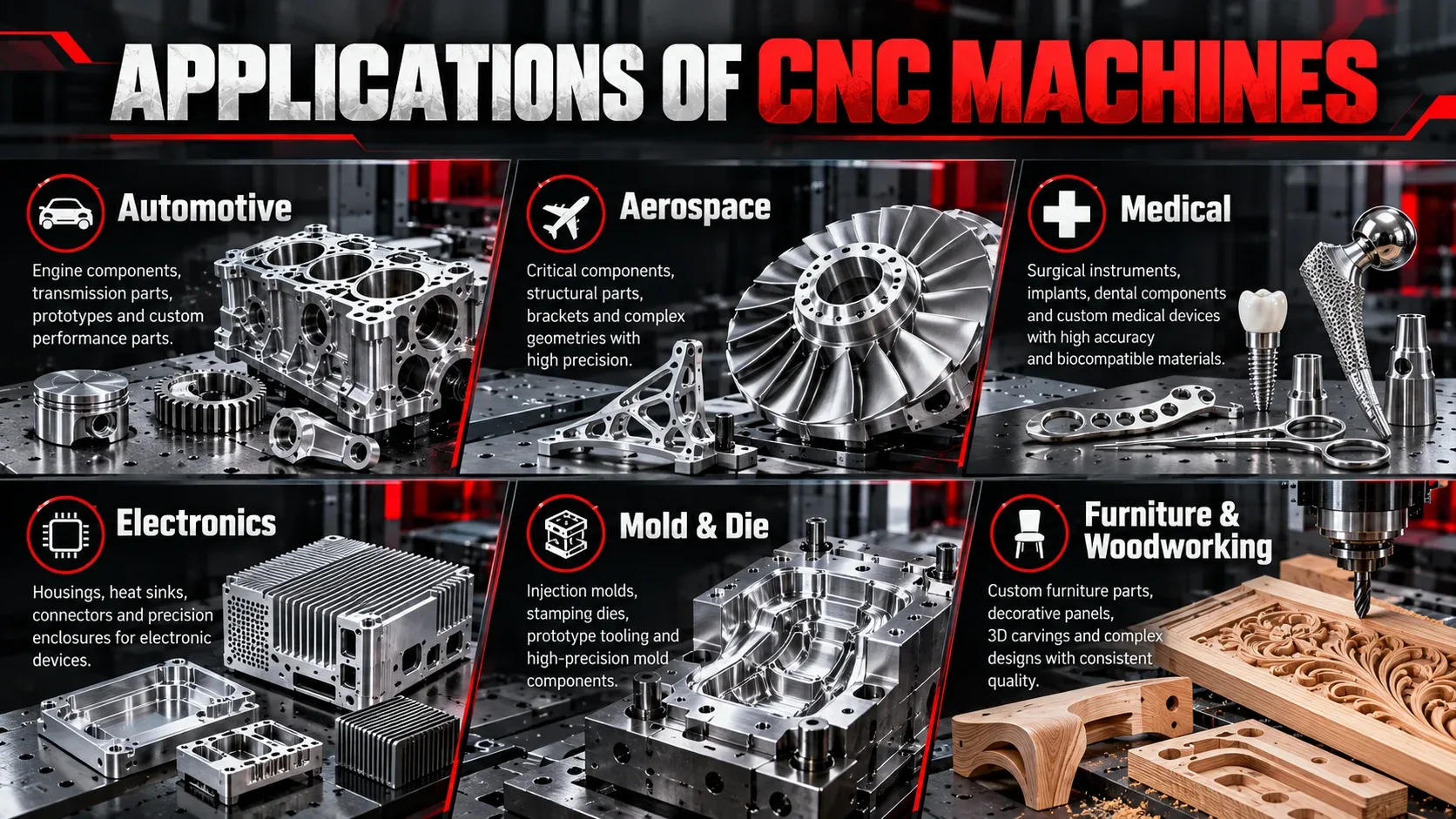
| Industry | Typical Applications |
|---|---|
| Automotive | Engine components, transmission parts, brackets and housings |
| Aerospace | Structural parts, housings and complex lightweight components |
| Medical | Precision instruments and medical-device components |
| Electronics | Enclosures, heat sinks and precision hardware |
| Mold & Die | Molds, dies, inserts and tooling |
| Furniture | Panels, joinery and decorative components |
| General Manufacturing | Fixtures, prototypes, machine parts and production components |
What Materials Can CNC Machines Cut?
Metals
- Aluminum
- Steel
- Stainless steel
- Brass
- Copper
- Titanium
Plastics
- ABS
- Nylon
- Acrylic
- Acetal
- Polycarbonate
Other Materials
- Wood
- Foam
- Graphite
- Selected composites
Advantages and Limitations of CNC Machines
Advantages
- High repeatability
- Complex machining capability
- Consistent production
- Reduced manual tool movement
- CAD/CAM integration
- Multi-axis capability
- Efficient repeat production
Limitations
- Higher initial cost
- Programming knowledge required
- Setup errors can cause damage
- Maintenance is required
- Tool wear affects machining quality
- Not every job benefits from CNC automation
CNC Machines vs Conventional Machines
| Factor | CNC Machine | Conventional Machine |
|---|---|---|
| Control | Computer-programmed | Primarily manual |
| Repeatability | High for repeated programmed tasks | More operator-dependent |
| Complex geometry | Well suited to automated complex toolpaths | More dependent on operator skill |
| Programming | Usually required | Typically not required |
| Initial cost | Usually higher | Often lower |
Basic CNC Machine Safety
- Receive appropriate training before operating CNC equipment.
- Secure the workpiece and tools correctly.
- Check tool offsets and work offsets before machining.
- Verify the program before automatic execution.
- Keep guards and machine doors properly positioned.
- Know the location of the emergency stop.
- Keep hands away from moving tools and machine components.
- Follow manufacturer and workplace safety procedures.
How to Choose the Right CNC Machine
The correct CNC machine depends on the part and manufacturing process.
- Part shape and dimensions
- Material
- Required tolerance
- Surface finish
- Production volume
- Number of required axes
- Tooling
- Workholding
- Automation needs
- Budget
Round Shaft
A CNC lathe is usually a practical choice.
Complex Aluminum Housing
A CNC machining center may be better suited.
Wood Cabinet Panel
A CNC router is often appropriate.
Complex Aerospace Component
A 5-axis machining center may reduce setups and improve access.
Frequently Asked Questions About CNC Machines
What does CNC mean in machining?
CNC means Computer Numerical Control. It refers to using computer-based numerical instructions to control machine movements and functions.
Are CNC machines fully automatic?
Many operations can be automated, but operators are still needed for setup, programming, tooling, inspection, maintenance, and troubleshooting.
What is the most common CNC machine?
CNC milling machines and CNC lathes are among the most widely used types.
What programming language do CNC machines use?
Many CNC machines use G-code and M-code, although exact syntax varies between controllers and manufacturers.
What is a 5-axis CNC machine?
A 5-axis CNC machine combines three linear axes with two rotary axes, allowing machining from multiple directions.
Can CNC machines cut steel?
Yes. CNC mills, lathes, plasma systems, lasers, and other suitable CNC equipment can process steel when the machine and tooling are appropriate.
Is CNC machining difficult to learn?
Basic concepts are straightforward, but professional CNC machining requires practical knowledge of tooling, materials, workholding, programming, measurement, setup, and safety.
What industries use CNC controlled machines?
CNC controlled machines are used in automotive, aerospace, medical, electronics, metalworking, woodworking, fabrication, prototyping, and general manufacturing.
Final Thoughts
CNC controlled machines combine computerized instructions, precision machine tools, drive systems, and automated movement to produce components efficiently and consistently.
CNC technology is used in milling, turning, routing, drilling, grinding, laser cutting, plasma cutting, EDM, and many other manufacturing processes.
The right CNC machine depends on the material, component geometry, required tolerances, production quantity, surface finish, tooling, and manufacturing process.