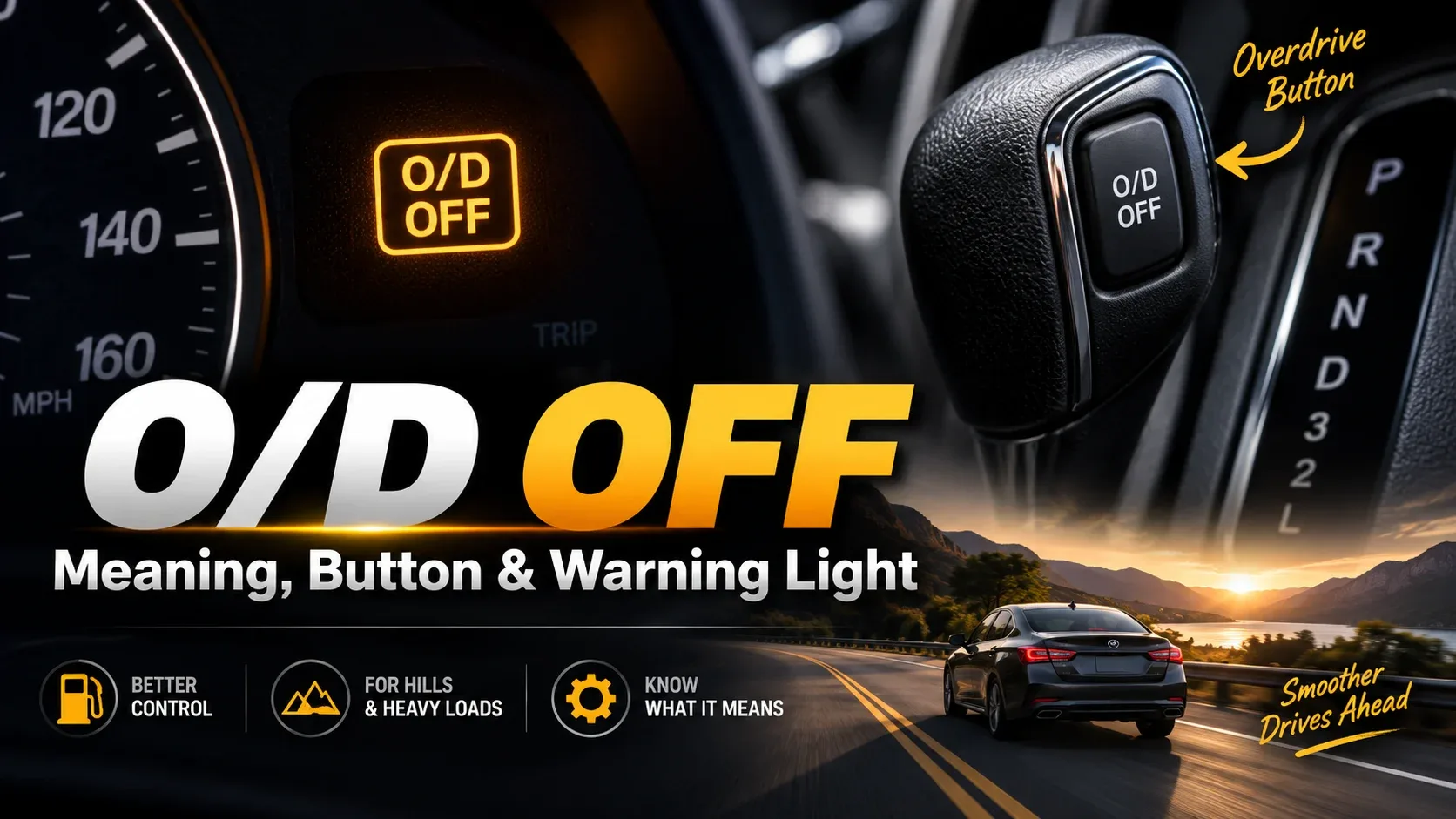
If your dashboard says O/D OFF, you may have simply switched off overdrive. Here is what that means, when it can help, and when the light deserves a closer look.
O/D means overdrive — a higher cruising gear your automatic transmission can use.
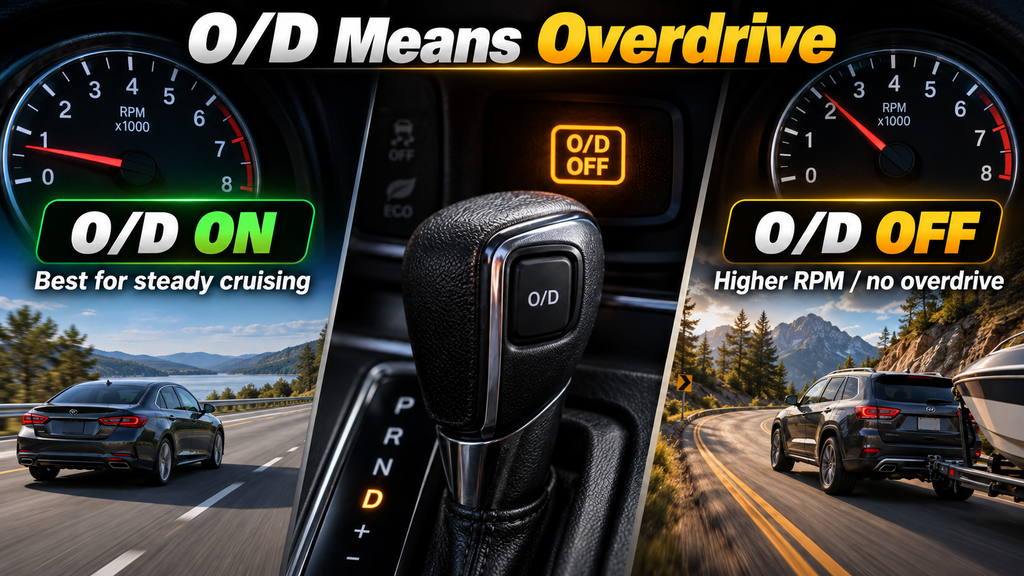
On many vehicles, O/D OFF means the transmission has been told not to use its highest overdrive gear. It is usually a setting, not a fault. Pressing the button again commonly restores normal operation.
O/D on
Best for steady cruising
The transmission can select its higher cruising gear when conditions allow. Engine RPM is often lower during level highway driving.
O/D off
Keeps the transmission out of overdrive
The engine may run at a higher RPM. This can reduce repeated shifting and offer more engine braking in certain demanding conditions.
Think of overdrive as a cruising option, not one universal gear number
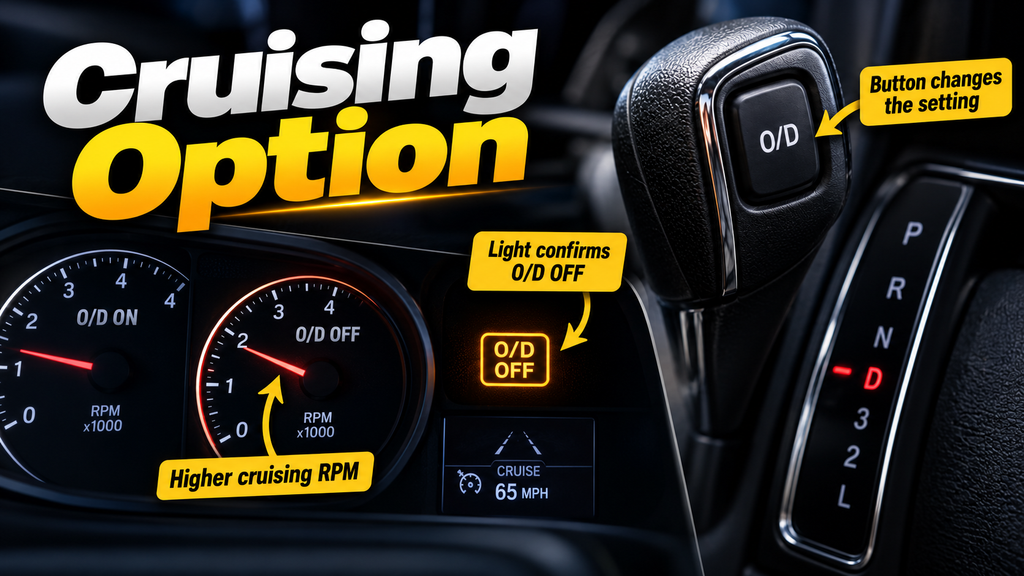
The button changes a transmission setting
Depending on the design, the button may be on the shifter, console, dashboard, or steering-column selector. Check your owner’s manual for its exact location.
O/D OFF usually raises cruising RPM
Without the higher overdrive ratio, the engine can turn faster at the same road speed. The exact RPM change depends on your vehicle and transmission.
The dashboard light confirms the setting
A steady O/D OFF indicator commonly means overdrive has been disabled. It should not be confused with every possible transmission warning.
For ordinary driving, leaving overdrive available is generally the practical choice

For many automatic-transmission vehicles, overdrive is useful during steady, light-load cruising because it lets the engine run more slowly when the vehicle does not need as much pulling power. That can make highway driving quieter and may support fuel economy.
Turning O/D off can be useful when the transmission repeatedly shifts between gears, when climbing or descending long grades, or in other conditions described by your manufacturer. It is not a universal towing mode, so follow the recommendations for your specific vehicle.
Highway driving
O/D on is often suitable on level roads.
If the road is relatively flat and the vehicle is not heavily loaded, allowing overdrive can help the transmission settle into an efficient cruising ratio.
Towing and hills
Use the setting your manufacturer specifies.
Some vehicles benefit from restricting overdrive to prevent gear hunting or improve engine braking. Others have a dedicated Tow/Haul mode instead of, or alongside, O/D control.
Driving with O/D OFF does not automatically damage your car
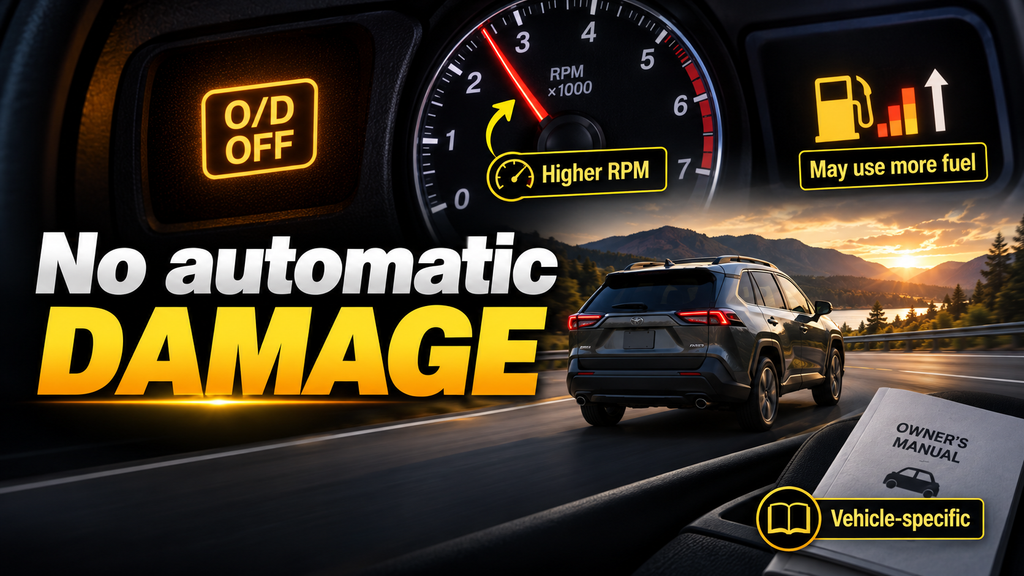
With O/D OFF, the engine may run at a higher RPM at the same speed. That is expected because the transmission is avoiding its higher cruising ratio. A higher RPM can be appropriate when you need more consistent pulling power or engine braking.
However, using O/D OFF during long, easy highway trips can use more fuel than necessary in many vehicles. There is no single percentage because road grade, speed, load, engine design, and transmission programming all matter.
Important vehicle-specific note
Overdrive behavior varies by make, model year, and transmission design. Your owner’s manual is the authority for towing, mountain driving, button location, and indicator-light meanings for your vehicle.
A steady O/D OFF light and a flashing light are not the same situation
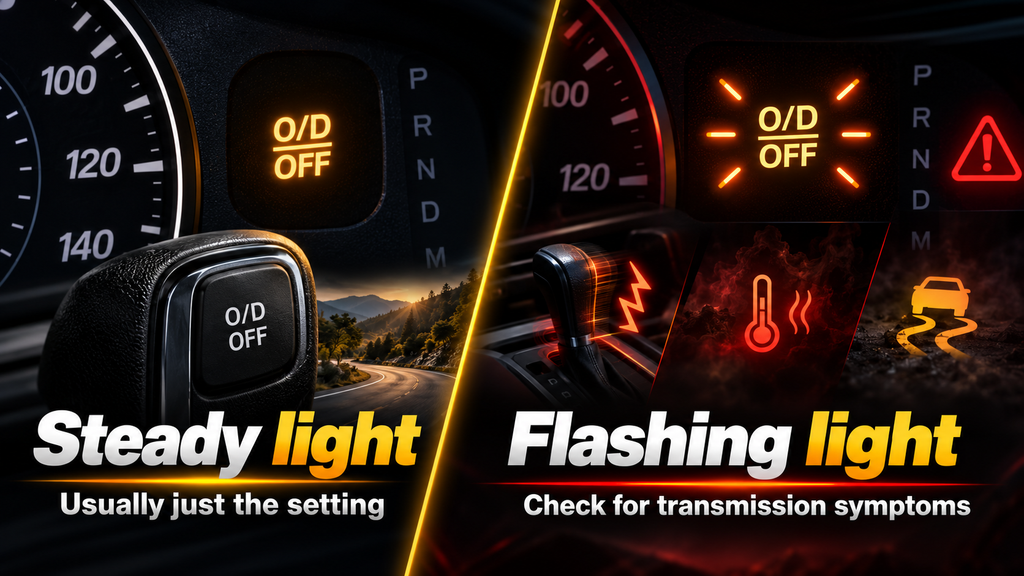
The wording can be confusing, but a steady indicator is often simply confirming the button setting. A flashing O/D light, a message, or poor transmission behavior calls for more caution.
Steady O/D OFF light
In many vehicles, this means overdrive is switched off. If the car drives normally, press the O/D button once when safe and see whether the indicator goes out.
Flashing light or transmission symptoms
A flashing indicator may signal a transmission-related fault on some vehicles. Do not assume it is only a button setting, especially with slipping, harsh shifts, overheating, unusual noise, or another warning message.
A simple check if you may have pressed the O/D button accidentally
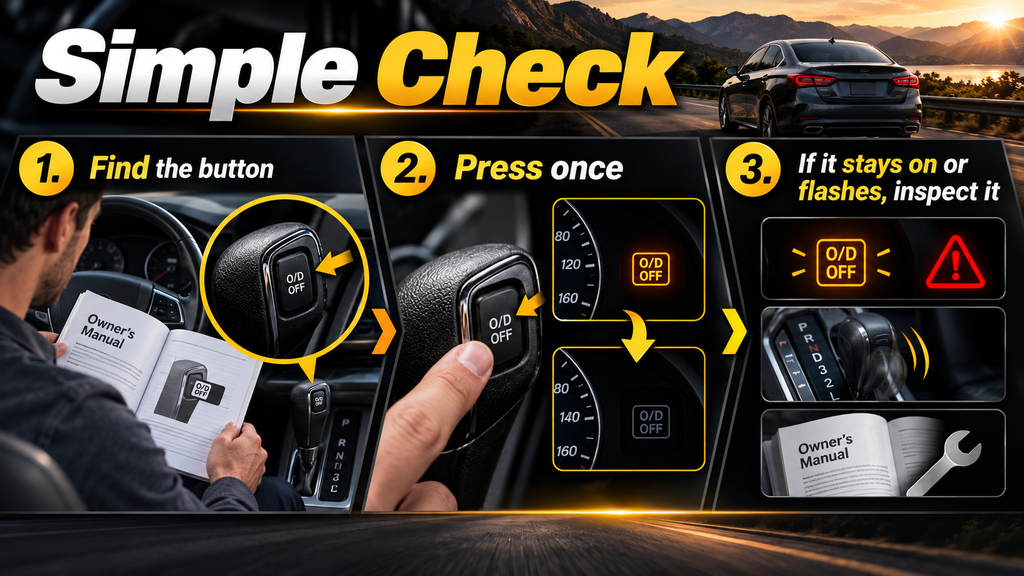
- Park safely or wait until you can operate the control without distraction. Locate the O/D button using your owner’s manual if needed.
- Press the O/D button once. On many vehicles, the steady O/D OFF indicator will turn off when overdrive is available again.
- If the light remains, flashes, or the vehicle shifts abnormally, consult the manual and arrange inspection rather than repeatedly cycling the control.
Treat a flashing O/D light or abnormal shifting as a reason to have the vehicle checked
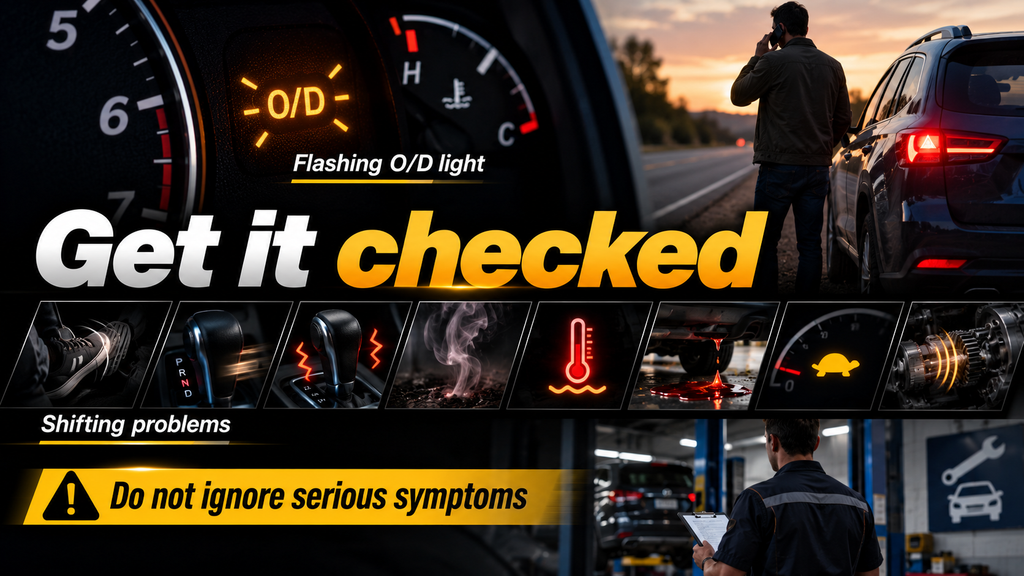
Arrange qualified diagnosis if you notice slipping, delayed engagement, severe or repeated harsh shifts, a burning smell, overheating, fluid leaks, reduced power, unusual noises, or a transmission warning message. Continuing to drive with serious symptoms can worsen a transmission problem.
O/D OFF FAQ
What does O/D mean in a car?
O/D generally means overdrive. In an automatic transmission, it refers to a higher cruising ratio that can lower engine RPM when driving conditions allow. The exact design varies between vehicles.
Is it safe to drive with O/D OFF?
Usually, a steady O/D OFF light simply means overdrive has been disabled and the engine may run at higher RPM. It is generally safe for normal driving, but it may not be the most efficient setting for extended level-road cruising. Follow your owner’s manual for vehicle-specific advice.
Why is my O/D OFF light flashing?
On some vehicles, a flashing O/D indicator can point to a transmission control or mechanical issue. Check your owner’s manual and arrange professional diagnosis, especially if the vehicle has shifting problems, overheating, noises, or other dashboard warnings.