
Recognise the most common throttle position sensor symptoms, understand what’s causing them, and learn when to seek professional diagnosis.
Is your car hesitating when you press the accelerator, idling roughly, or suddenly losing power? These are classic throttle position sensor symptoms — and they can leave you wondering whether it’s safe to keep driving. The good news is that TPS problems usually follow recognisable patterns that help distinguish them from other engine faults.
In this guide, we’ll cover the signs of a bad throttle position sensor, explain how the TPS works, show you a symptom comparison table to rule out similar faults, and walk you through how a technician confirms the diagnosis. Whether you’re a beginner or an intermediate DIYer, this article will help you avoid replacing the wrong part.
Common Throttle Position Sensor Symptoms at a Glance
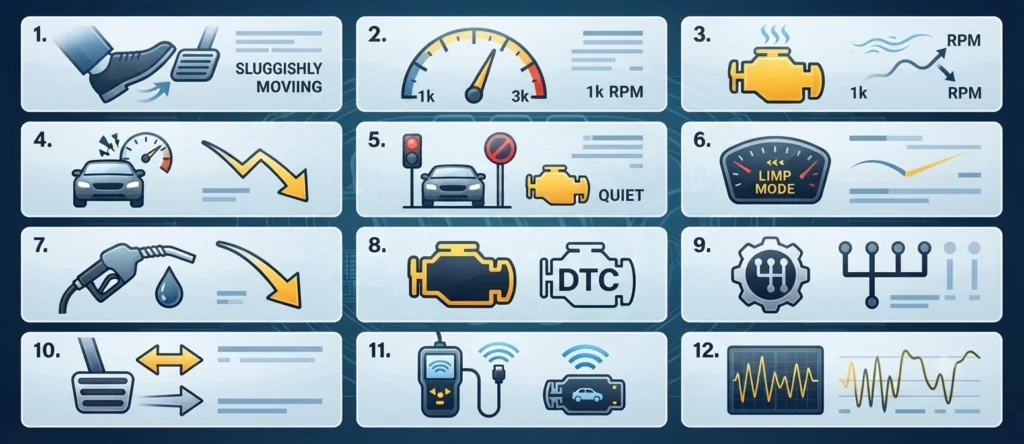
- Hesitation or delayed throttle response during acceleration
- Rough, fluctuating, or unstable idle
- Engine surging — RPMs rise and fall without driver input
- Sudden loss of power while driving
- Stalling at idle or during deceleration
- Limp mode (reduced engine power warning)
- Poor fuel economy
- Check engine light (often with TPS-related codes)
- Unusual or harsh automatic transmission shifting
- Inconsistent throttle response — sometimes normal, sometimes sluggish
What Does a Throttle Position Sensor Do?
The throttle position sensor (TPS) is a small electronic sensor mounted on the throttle body. Its job is to monitor the exact angle of the throttle plate — from fully closed at idle to wide open at full acceleration — and send that information as a voltage signal to the engine control module (ECM). The ECM uses this data to calculate fuel delivery, ignition timing, idle speed control, and transmission shift points.
Some vehicles use a separate TPS bolted to the outside of the throttle body, while newer models use an electronic throttle body with integrated dual position sensors. Both designs serve the same purpose, but the integrated type means you may need to replace the entire throttle body rather than just the sensor. Your vehicle’s design depends on the make, model, and year.
Detailed Symptoms of a Faulty TPS
1. Hesitation or Delayed Acceleration
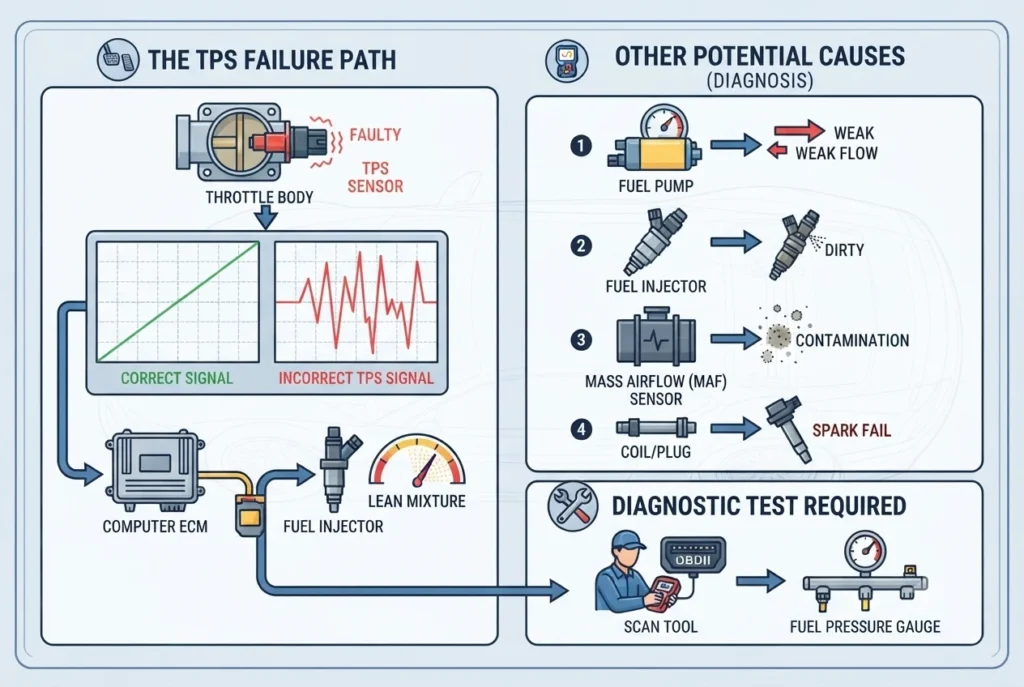
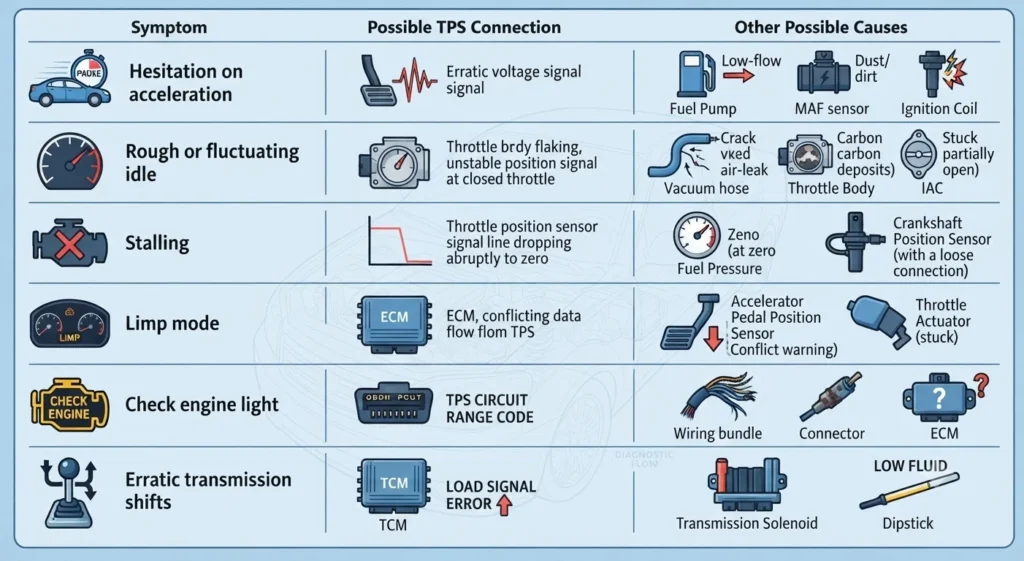
When you press the accelerator and the car pauses before responding — or feels sluggish for a moment — the ECM may be receiving an incorrect or delayed signal from the TPS. The computer doesn’t know you’ve opened the throttle, so it can’t add the extra fuel needed. This symptom is often most noticeable from a standstill or during gentle acceleration. However, hesitation can also be caused by a weak fuel pump, dirty fuel injectors, a failing mass airflow sensor, or ignition problems — so testing is required before blaming the TPS.
2. Rough or Fluctuating Idle
If the TPS sends an unstable voltage signal at closed throttle, the ECM may constantly adjust fuel trim and idle speed, causing the engine to hunt or feel lumpy at idle. You might notice the tachometer needle bobbing up and down. Other causes of rough idle include vacuum leaks, a contaminated throttle body, a faulty idle air control valve, or worn spark plugs. A dirty throttle body is especially worth checking because carbon buildup can physically prevent the plate from closing fully — mimicking a TPS fault.
3. Engine Surging
Surging means the engine RPMs rise and fall on their own while you hold a steady throttle position. A TPS with a dead spot or erratic output can make the ECM think the driver is opening and closing the throttle repeatedly. The computer responds by adding and removing fuel, creating a surging sensation. This is one of the more distinctive bad TPS sensor symptoms because it occurs while cruising at constant speed.
4. Stalling
If the TPS signal drops to zero unexpectedly — due to a dead spot, worn resistive track, or intermittent wiring fault — the ECM may cut fuel delivery or retard timing abruptly, causing the engine to stall. This typically happens at idle or while decelerating to a stop. Stalling can also result from low fuel pressure, a failing crankshaft position sensor, or electrical faults in the throttle-control circuit. Stalling in traffic is a safety concern and should be investigated promptly.
5. Limp Mode (Reduced Engine Power)
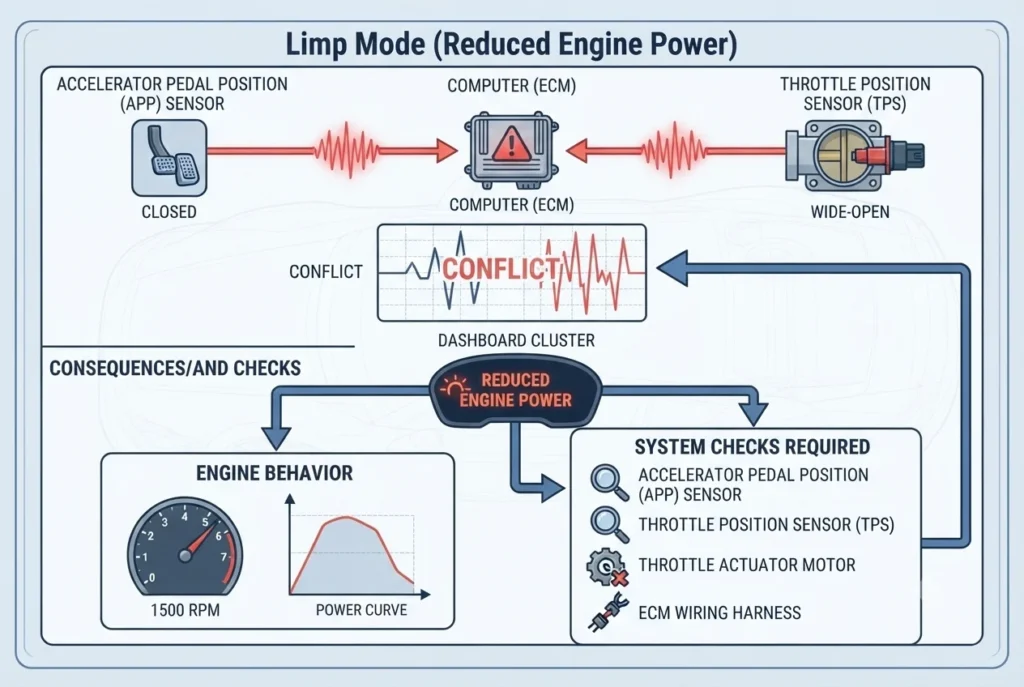
Modern vehicles enter limp mode when the ECM detects implausible throttle data — for example, the TPS reports wide-open throttle while the accelerator pedal sensor reports closed. The engine is limited to low RPMs and reduced power to prevent damage. You’ll typically see a ‘Reduced Engine Power’ warning on the dashboard. Limp mode can also be triggered by a faulty accelerator pedal position sensor or a stuck throttle actuator motor, so both the TPS and the pedal sensor should be checked.
6. Poor Fuel Economy
When the TPS sends inaccurate data, the ECM may deliver more fuel than necessary (running rich) or less than needed (running lean, forcing the engine to work harder). Either condition wastes fuel. If you’ve noticed a gradual or sudden increase in fuel consumption alongside other symptoms on this list, a failing TPS may be contributing — but fuel economy is also affected by tyre pressure, driving habits, air filter condition, and dozens of other factors.
7. Check Engine Light
A failing TPS commonly triggers diagnostic trouble codes such as P0120 (Throttle Position Sensor Circuit Malfunction), P0121 (Range/Performance Problem), P0122 (Circuit Low), or P0123 (Circuit High). These codes indicate the ECM has detected a voltage reading outside the expected range. However, the same codes can be caused by damaged wiring, a corroded connector, or even a poor ground connection — so a trouble code alone does not confirm a defective sensor.
8. Unusual Automatic Transmission Shifting
Many automatic transmissions use TPS data to determine shift points. If the sensor reports incorrect throttle opening, the transmission may shift too early, too late, or harshly. Some drivers notice the car ‘hunting’ between gears on hills or during light acceleration. This symptom is often overlooked because drivers assume it’s a transmission fault rather than an engine sensor issue.
TPS Symptom Comparison Table
What Causes a Throttle Position Sensor to Fail?
Contact-type TPS units use a resistive track and a wiper that slides across it every time the throttle moves. Over tens of thousands of cycles, the track wears thin — creating dead spots where the voltage signal drops out or becomes erratic. This is the most common failure mode and explains why symptoms often appear intermittently at first.
Other causes include connector corrosion (especially in humid or road-salt environments), damaged wiring harness, water intrusion into the sensor housing, excessive engine heat degrading internal components, and physical damage from engine work or aftermarket intake installations. In some cases, the sensor itself is fine but a contaminated throttle body prevents the plate from moving smoothly, giving inconsistent position readings.
How a Technician Diagnoses a Bad TPS
Proper diagnosis begins with scanning stored trouble codes and reviewing freeze-frame data to see when the fault occurred. A technician will then observe live TPS voltage data on a scan tool while slowly opening and closing the throttle by hand. The voltage should rise smoothly and steadily from approximately 0.5V (closed) to around 4.5V (wide open) with no dropouts, spikes, or flat spots.
If dropouts appear, the next step is determining whether the fault is in the sensor itself or in the wiring. The technician inspects the connector for corrosion, bent pins, or water damage, and may back-probe the wiring to check reference voltage (5V) and ground continuity. On electronic throttle bodies, the dual sensors are compared to check for correlation faults.
Important: Symptoms alone cannot confirm a defective TPS. Technicians also compare TPS data with accelerator pedal position data, check for throttle-body contamination, and verify that the throttle plate moves freely. After replacement, many vehicles require a throttle relearn or calibration procedure — without it, the idle may remain unstable even with a new sensor.
Common TPS Trouble Codes
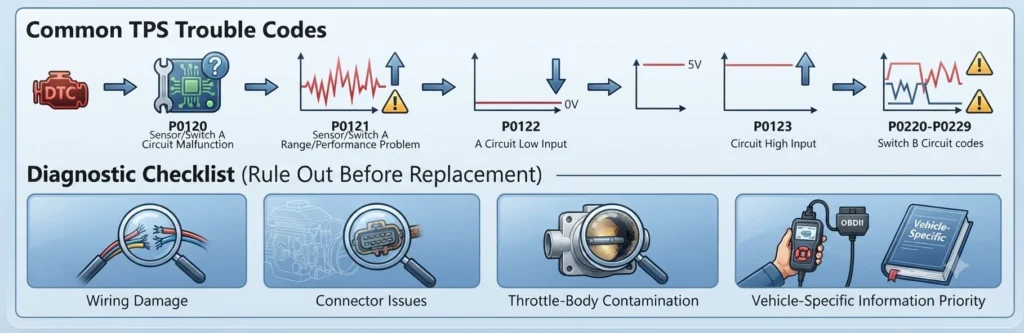
P0120 — Throttle Position Sensor/Switch A Circuit Malfunction. P0121 — Throttle Position Sensor/Switch A Range/Performance Problem. P0122 — Throttle Position Sensor/Switch A Circuit Low Input. P0123 — Throttle Position Sensor/Switch A Circuit High Input. P0220–P0229 — Throttle Position Sensor/Switch B Circuit codes (for dual-sensor systems).
Remember: a trouble code identifies a circuit or performance problem, not necessarily a defective sensor. Wiring damage, connector issues, and throttle-body contamination should all be ruled out before replacing the TPS. Vehicle-specific service information should always take priority over general advice.
Frequently Asked Questions
Can I drive with a bad throttle position sensor?
It depends on the severity. Mild symptoms like slight hesitation may allow short-distance driving, but stalling, limp mode, or unpredictable acceleration make the vehicle unsafe — especially in traffic. Have the fault diagnosed promptly and avoid motorway driving if the symptoms are severe.
Can a bad TPS cause rough idle?
Yes. If the TPS sends an unstable or incorrect signal at closed throttle, the ECM may continuously adjust fuel delivery and idle speed, creating a rough or hunting idle. However, a dirty throttle body, vacuum leak, or faulty idle air control valve can produce identical symptoms — testing is needed to confirm the cause.
Can a faulty TPS affect transmission shifting?
Yes. Many automatic transmissions rely on TPS data to determine shift points and shift firmness. An inaccurate throttle signal can cause harsh shifts, late shifts, or gear hunting. If you notice shifting problems alongside engine hesitation or surging, the TPS is worth investigating.
Does a replacement TPS need calibration?
Many modern vehicles require a throttle relearn or idle relearn procedure after TPS replacement. This may involve a scan tool or a specific key-on sequence. Without calibration, the idle may remain rough or the ECM may not recognise the new sensor’s baseline voltage. Check your vehicle’s service manual for the correct procedure.
Can a dirty throttle body mimic TPS failure?
Absolutely. Carbon buildup on the throttle bore can physically prevent the plate from closing or opening smoothly. This causes the TPS to report erratic positions — even though the sensor itself is working correctly. A technician should inspect and clean the throttle body before condemning the TPS.
How much does TPS replacement cost?
A standalone TPS typically costs £15–£80 (or equivalent) for the part. Labour is usually 30–60 minutes. However, on vehicles with an integrated electronic throttle body, the entire unit may need replacing — which can cost significantly more. Always get a diagnosis before purchasing parts to avoid replacing a working sensor.
Conclusion: Recognising Throttle Position Sensor Symptoms
If you’re experiencing hesitation, rough idle, stalling, or limp mode, the signs of a bad throttle position sensor are worth investigating. The key takeaway is that these symptoms may indicate a TPS fault — but proper testing is required to confirm the diagnosis and rule out wiring problems, throttle-body contamination, or other sensor failures.
Start by scanning for trouble codes. If TPS-related codes appear, have a technician inspect live data, wiring, and the throttle body before replacing parts. Catching the problem early helps you avoid unnecessary repairs, stay safe on the road, and get your engine running smoothly again.