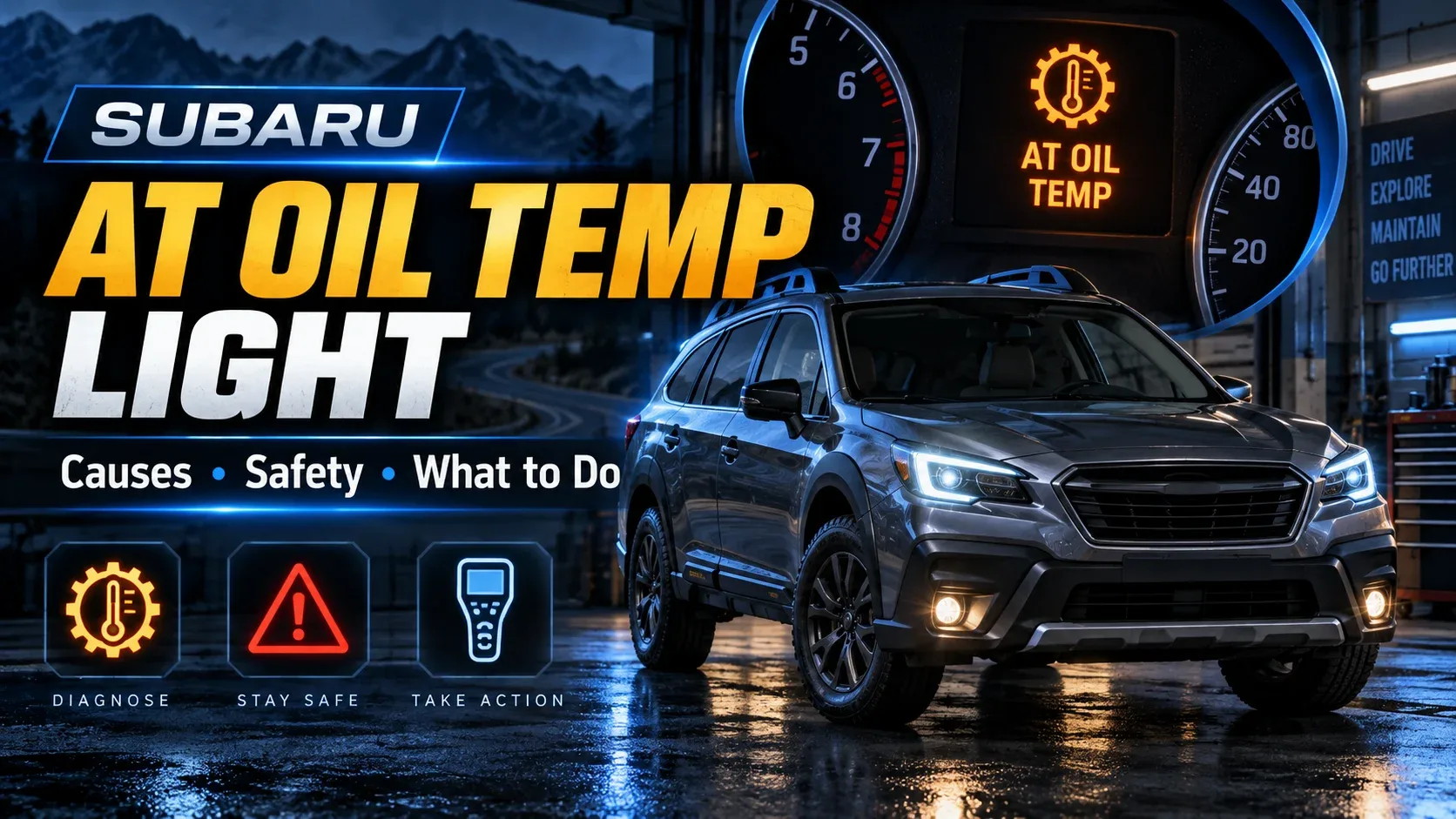

The AT OIL TEMP warning usually relates to automatic-transmission or CVT fluid temperature—not engine oil. Here is how to respond safely, what may have triggered it, and when the warning needs diagnosis.
First, protect the transmission
Reduce load, avoid towing or hard acceleration, and follow the owner’s manual for your exact model. If the warning remains on, flashes, or is paired with unusual driving symptoms, stop safely when practical and arrange diagnosis.
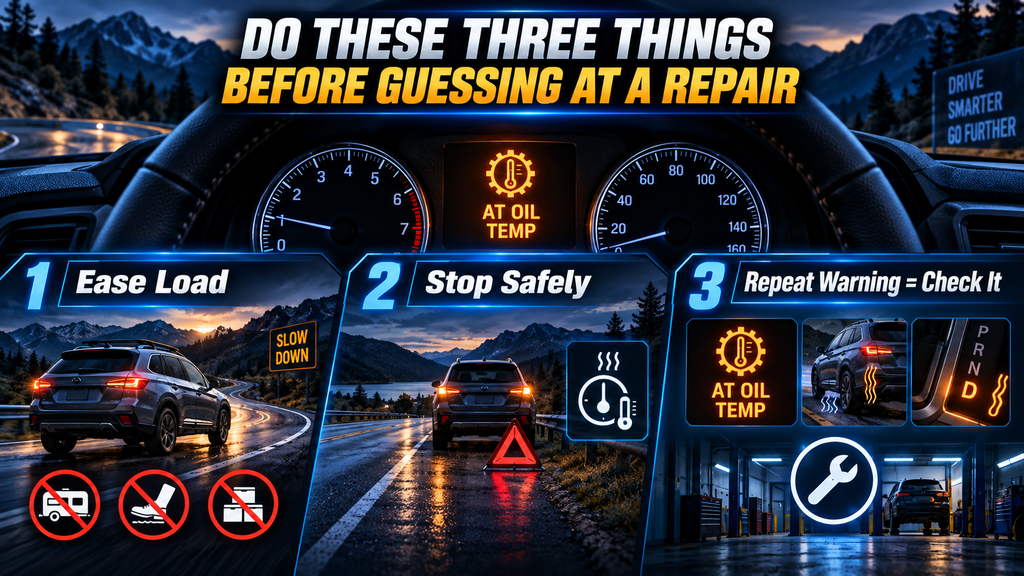
Do these three things before guessing at a repair
There is no single rule for every year and transmission. Your Subaru owner’s manual is the primary source for the warning procedure.
Ease the load
Back off the throttle, avoid steep climbing if you can, and pause towing, deep-snow, sand, or other high-load driving.
Stop safely if needed
Choose a safe location and let the vehicle cool if your manual instructs you to do so. Do not create a roadside hazard just to stop immediately.
Treat a repeat warning seriously
If the light returns after cooling, flashes, or arrives with slipping, shuddering, or reduced drive, arrange a proper inspection instead of simply clearing it.
AT OIL TEMP is about transmission fluid heat.
AT commonly means automatic transmission. On many Subaru models, the warning relates to fluid temperature in the automatic transmission or CVT system.
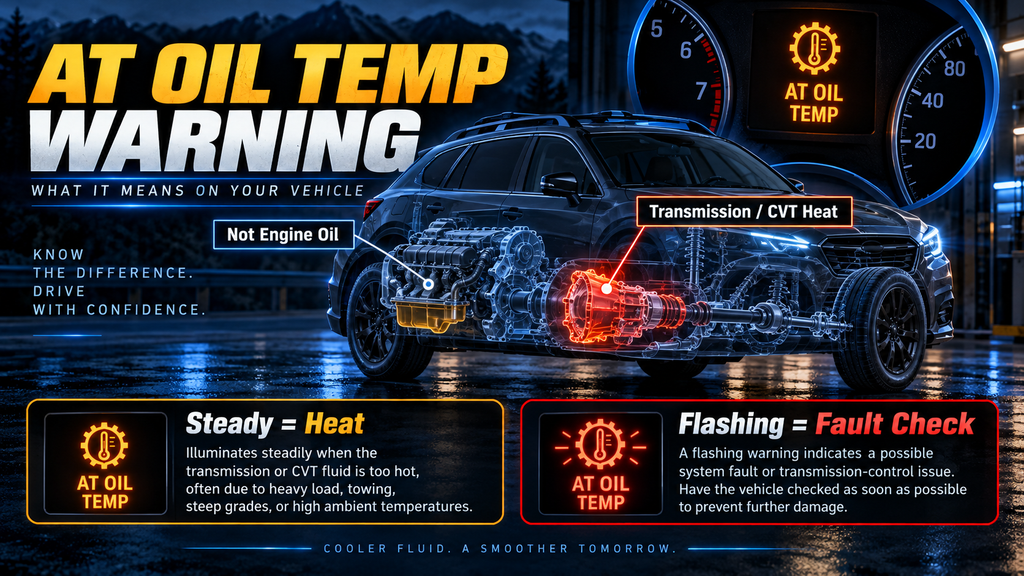
It is not the engine-oil temperature light.
The wording is easy to misread. Engine oil, engine coolant, and transmission or CVT fluid all manage heat differently. An AT OIL TEMP warning points you toward the transmission system, not an engine-oil service interval.
When the light is steady
Often associated with excess heat.
A steady warning can appear after sustained load, such as a long grade, towing, hot weather, stop-and-go traffic, or low-speed driving in difficult terrain. It does not alone prove permanent damage.
When the light flashes
Think system fault, not just heat.
On some Subaru models, flashing warning behavior can indicate a transmission-control or related system concern. Check the manual for your model and have recurring or flashing warnings diagnosed.
Important: warning behavior differs by model year, powertrain, and transmission. Use this guide to understand the possibilities, then follow the exact instructions in your Subaru owner’s manual.
The warning is a clue—not a complete diagnosis
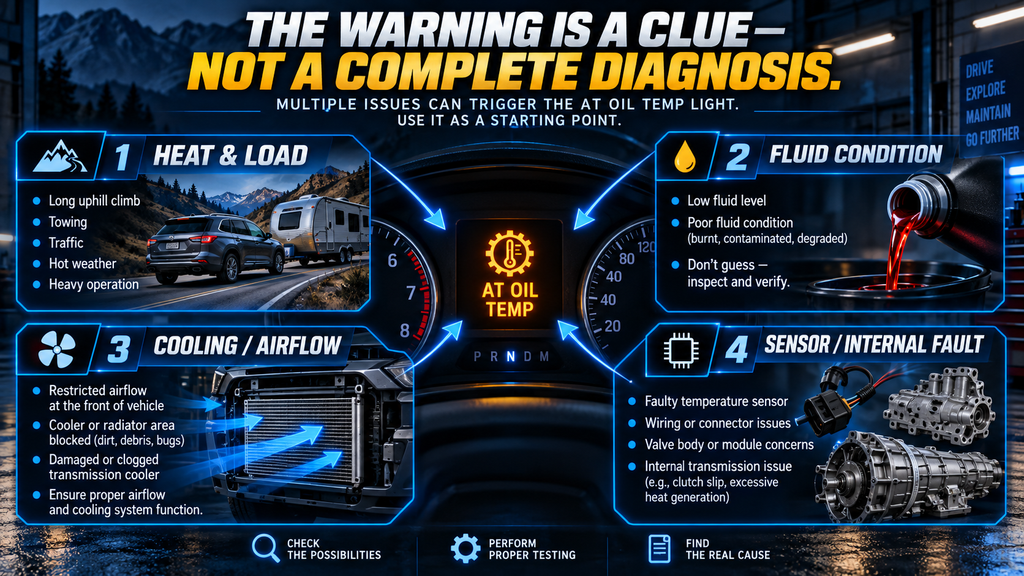
A warning light can result from a temporary heat event, a fluid-related issue, reduced cooling capacity, or an electrical or internal transmission fault. These are diagnostic paths, not guaranteed answers.
High load and high ambient heat
Long uphill climbs, towing, repeated low-speed traction work, heavy traffic, and very warm weather can raise transmission-fluid temperature.
Fluid level or fluid condition
Low, degraded, or incorrect fluid can contribute to heat and poor operation. Subaru checking procedures and approved fluid specifications vary, so avoid guessing or topping up blindly.
Cooling or airflow concern
A restricted cooler, poor airflow, radiator-area issue, or related cooling-system problem can reduce how effectively heat leaves the transmission fluid.
Control, sensor, or internal fault
Temperature-sensor wiring, pressure-control issues, valve-body faults, or internal slip can trigger a warning even when the cause is not simply outside temperature.
Heat rises when the transmission works hard for a long time
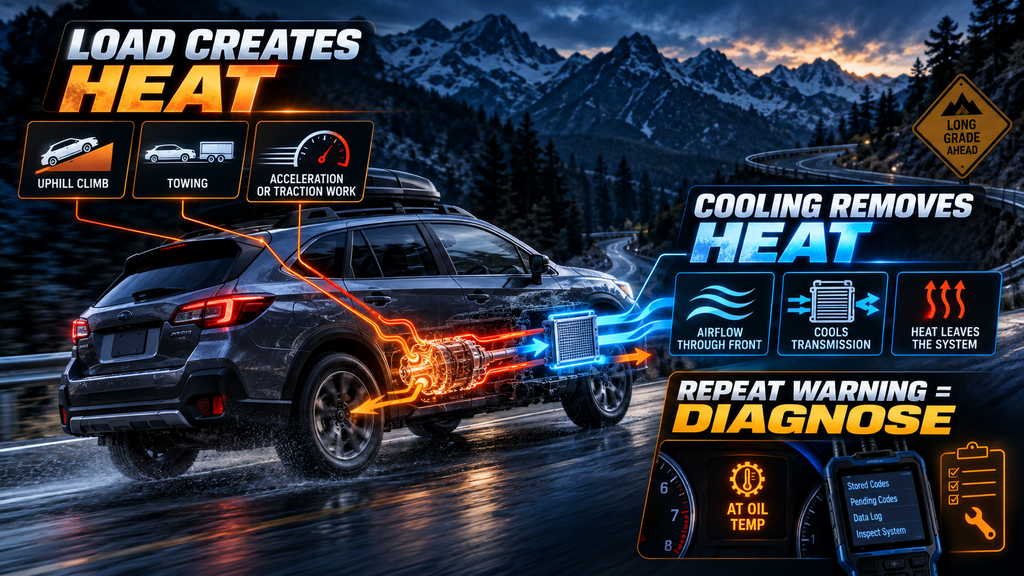
A long mountain grade is a useful real-world example. Power demand stays high, road speed may be low, and less airflow may pass through the front of the vehicle. A healthy system can still reach a warning threshold under enough load.
Load creates heat
Towing, climbing, acceleration, and traction work can make the transmission work harder.
Cooling removes heat
Fluid and vehicle cooling systems carry heat away at a rate that depends on the design and operating conditions.
A repeat warning needs evidence
A technician can use the exact vehicle history and diagnostic information to separate a one-time load event from a fault.
When should you stop, and when should you book a check?
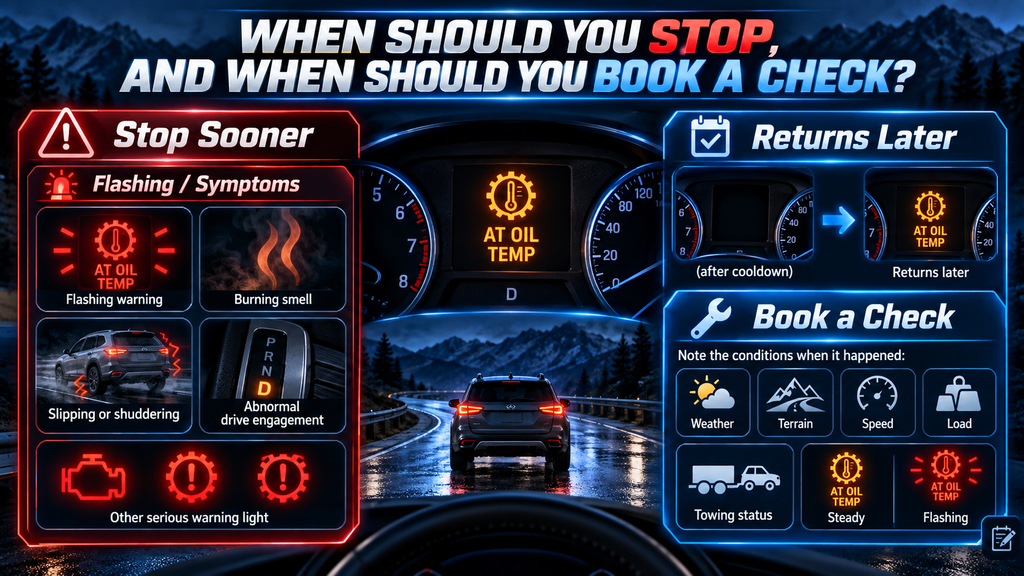
The safest next step depends on the warning behavior and how the car feels. Do not use the absence of a warning after cooling as proof that a recurring condition has been fixed.
Stop safely and seek help sooner if…
The light is flashing, remains on despite reduced load, the vehicle shudders or slips, there is a burning smell, drive engagement feels abnormal, or another serious warning appears. Follow your manual’s instructions.
Arrange diagnosis if it returns.
Even if the light goes out after a cooldown, repeated warnings deserve attention. Note the model, weather, terrain, speed, load, towing status, and whether the warning was steady or flashing.
Good diagnosis is model-specific
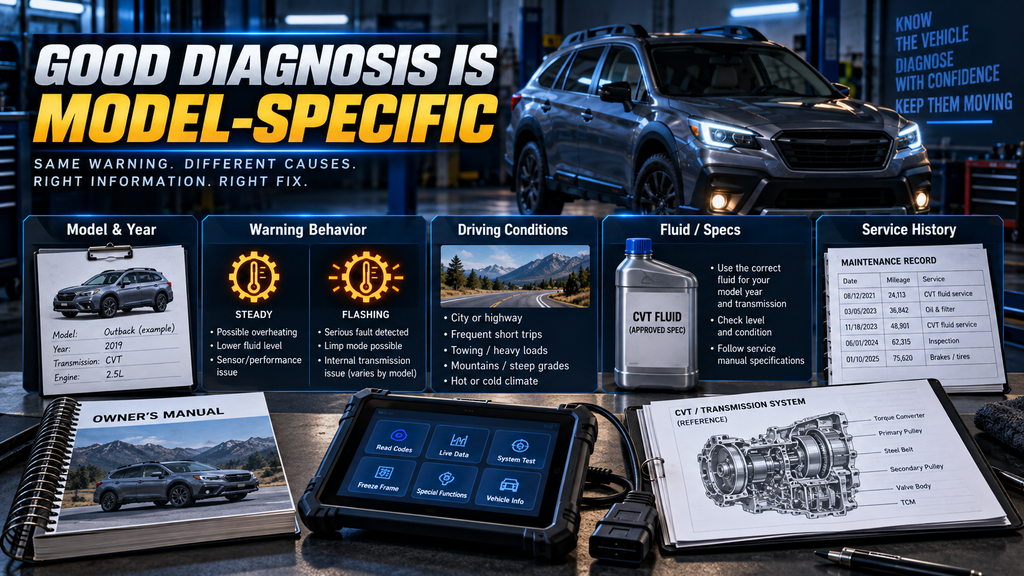
This article is designed to help you understand the AT OIL TEMP Subaru warning and communicate clearly with a qualified technician. It does not replace the instructions for your exact model year, transmission, maintenance history, or operating conditions.
For warning-light behavior, fluid procedures, towing limits, and approved fluid specifications, rely on the Subaru owner’s manual and service information for your vehicle identification and model year.
AT OIL TEMP Subaru FAQ
Can I keep driving when the AT OIL TEMP light comes on?
Do not treat it as a universal yes-or-no decision. Reduce load and consult the owner’s manual for your specific Subaru. A persistent, flashing, or recurring warning—especially with driving symptoms—should be assessed rather than ignored.
Can low transmission fluid cause an AT OIL TEMP warning?
It can be one possible contributor, but the warning alone cannot confirm it. Fluid level and condition must be checked using the correct Subaru procedure and approved fluid for the specific transmission or CVT.
Will changing CVT fluid automatically fix the warning?
No. A fluid service is not a universal repair for an AT OIL TEMP warning. The underlying cause could involve operating conditions, cooling, fluid condition, a sensor, control hardware, or an internal transmission concern.