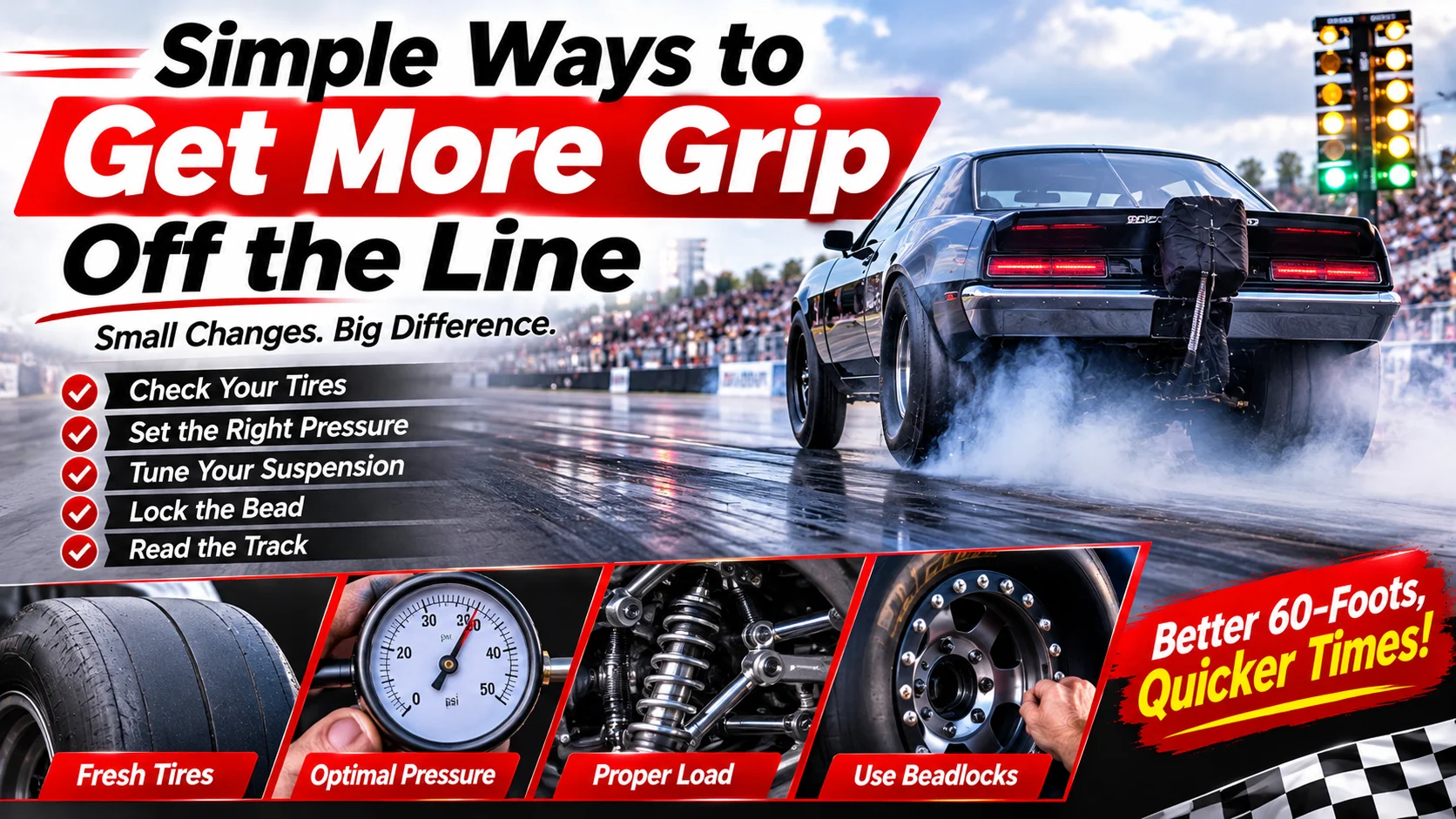
The lights come down, you leave hard, and the tach spikes before the car has gone anywhere. Everybody has had that run. It stings more than a bad reaction time, because the power was there and the track just refused to take it. Traction problems feel mysterious when you are strapped in, yet most of them trace back to a handful of unglamorous details that cost very little to fix.
Grip off the line is not one big secret. It is a chain of small agreements between the tire, the wheel, the suspension, and the surface, and the weakest link sets the whole result. Add power to a car that cannot hold what it already makes, and you simply spin sooner. Sort the chain first, then the power shows up on the timeslip.
What follows is the practical version, written for the racer with a trailer and a torque wrench rather than a wind tunnel. None of it requires a new combination, and most of it can happen between rounds. The order matters, so work from the contact patch outward instead of guessing at the far end.
Start With the Tire, Not the Horsepower
Your tire is the only part of the car touching the track, so it deserves the first look. Check the date code, because a slick that has been sitting in a hot garage for five seasons has hardened whether or not the tread still looks new. Look at how the rubber wore on your last pass too, since the wear pattern tells you plainly what the contact patch did under load. A tire cooking only through the middle was too hard, while one scuffing at the shoulders was too soft, and neither one ever put a full footprint down.
Pressure Is the Cheapest Tuning Tool You Own
Two or three pounds of air changes a launch more than most bolt on parts do. Lower pressure lets the sidewall wrinkle, which softens the hit and spreads the footprint, while higher pressure crowns the tread and shrinks the very patch you need. Move in small steps, log every change, and check pressure cold rather than right after a burnout, because heat will lie to you. Goodyear’s own technical information for racing tires also draws a hard line at 35 psi for seating beads, and that number is a safety limit rather than a suggestion.
Let the Chassis Load the Tire
A tire can only bite if something presses it into the pavement at the right moment. That is the job of the rear suspension, and the geometry behind it is far less mystical than it sounds. DragCoverage walked through instant center without a single equation, and the short version is that a short, high instant center hits the tire hard while a longer one loads it gradually. Aggressive is not automatically better. On a marginal surface the gentler load usually wins, because the tire keeps working instead of shocking and turning loose.
Lock the Bead So the Tire Stops Fighting the Rim
Here is where low pressure can get you into trouble. Once you air a slick down far enough to be useful, not much holds the bead against the wheel except friction, and a violent launch can spin the tire right on the rim. You will see it as a smeared paint mark, a sudden loss of air, or a car that wanders for no reason you can name. Beadlock rings fix it by clamping the bead mechanically, which is why serious combinations run them and why sanctioning bodies mandate them above certain speeds. Speedway Motors lays out the horsepower thresholds in detail, and a set of beadlock ready drag racing wheels takes the variable off the table entirely, so you can chase pressure without gambling on the bead.
Read the Track Before You Change Anything
Surfaces vary wildly from morning to night, and a setup that dead hooked at nine in the morning can shake your fillings loose by mid afternoon. Walk the groove, feel how tacky it is, and watch what the cars ahead of you do on the hit. Then change one thing. Racers burn whole weekends adjusting pressure, bars, and shocks on the same pass, and afterward nobody knows which change actually helped. Discipline is dull, yet it is the only way to build a baseline you can trust.
None of this is exotic. It is a tire fresh enough to work, a pressure you arrived at on purpose, a chassis that loads instead of slamming, and a bead that stays where you put it. Stack those four and the car stops surprising you, which is worth more than any single tenth.
Feel matters here too, and it is not a soft idea. The way a car talks to you through the seat and the steering wheel comes straight out of mechanical choices, something My Car Heaven explored in its look at how mechanical design shapes the feel of a vehicle. A car that tells you clearly what the tire is doing lets you fix the problem in one pass instead of five.
So go simple before you go big. Sixty feet decides more races than the top end ever does, and the changes that clean it up are cheap, reversible, and mostly sitting in your toolbox already.