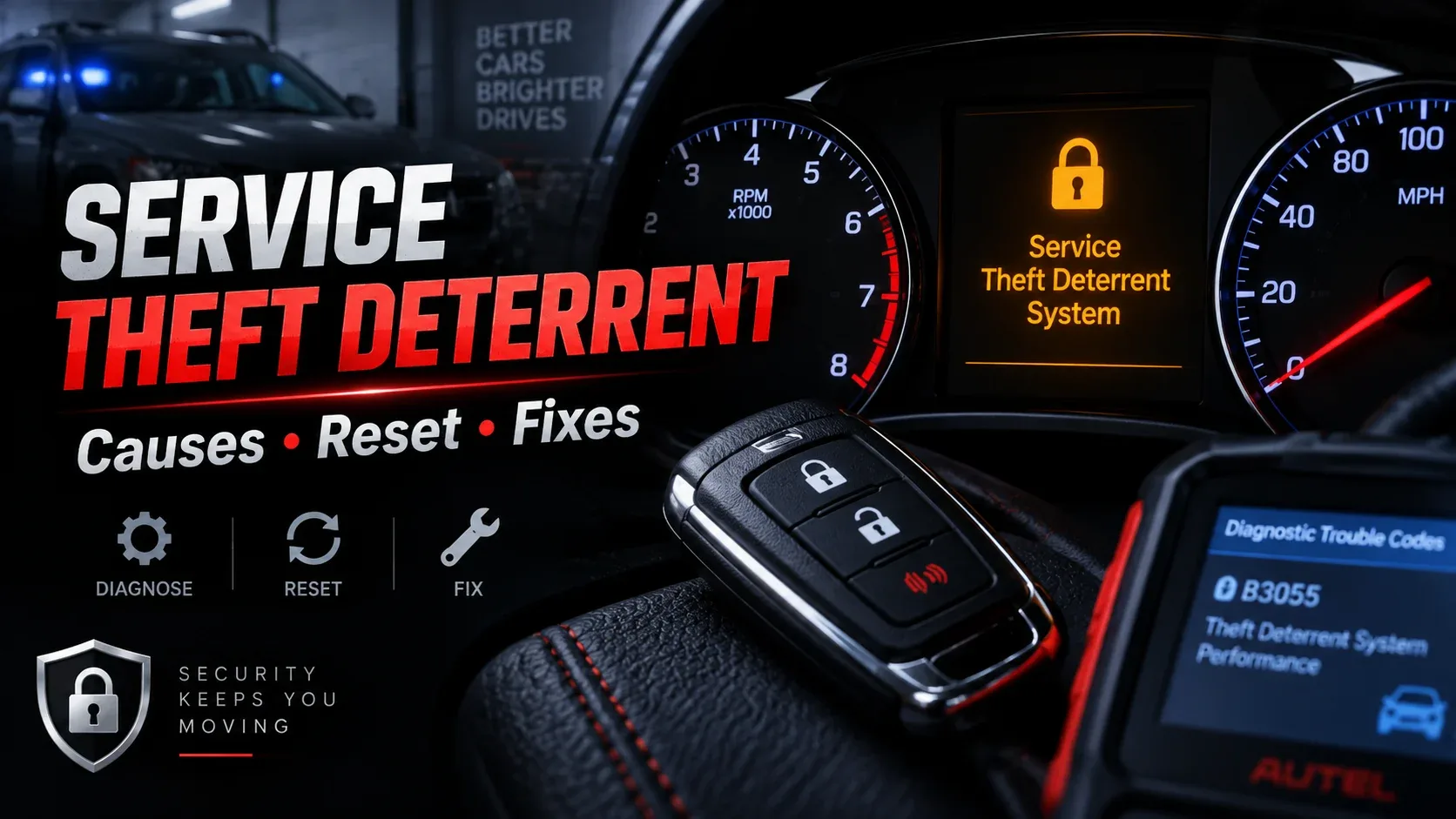
A Service Theft Deterrent System warning usually points to a problem in the vehicle’s anti-theft or immobilizer system—not proof that someone tried to steal your car. Start with symptoms, keys, battery condition, and vehicle-specific diagnostic information.
Your next step depends more on the symptom than on the warning alone
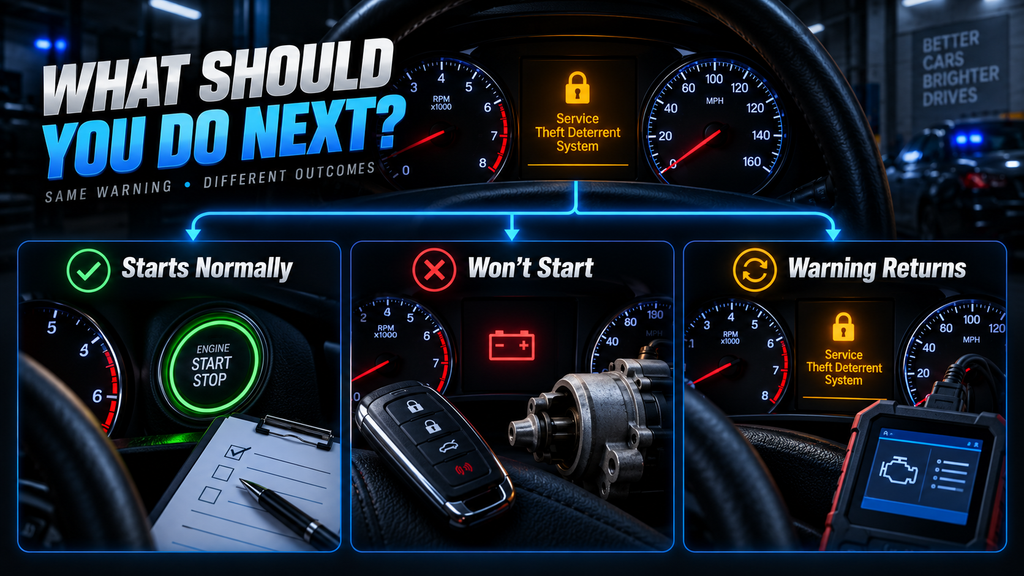
It starts normally
Plan to investigate soon. Note when the warning began and whether it followed battery, key, or electrical work.
It cranks or will not start
Try the correct known-good spare key and check the 12V battery before arranging deeper diagnosis.
The warning keeps returning
A reset may only hide the symptom temporarily. Stored codes and system testing become the useful next step.
A theft deterrent system warning means the vehicle detected a security-system concern
Modern theft deterrent systems often combine a programmed key or fob, transponder recognition, an immobilizer, security-related modules, and communication between vehicle computers. If the vehicle cannot verify a signal it expects, it may show a warning, turn on a security light, limit starting, or allow the engine to start briefly and then shut off.
The dashboard message does not identify a failed part by itself. A weak 12V battery, a damaged or unprogrammed key, a power-supply issue, wiring damage, or a module communication fault can all lead a technician in different directions. It also does not, by itself, prove that an attempted theft occurred.
Resetting a warning is not the same as repairing the reason it appeared.
Battery disconnection, key cycling, or clearing codes may affect a message on some vehicles, but none is a universal repair. A relearn or programming procedure is vehicle-specific, and a recurring warning deserves diagnosis rather than repeated resets.
Common causes range from a low-voltage event to a key-recognition or communication fault
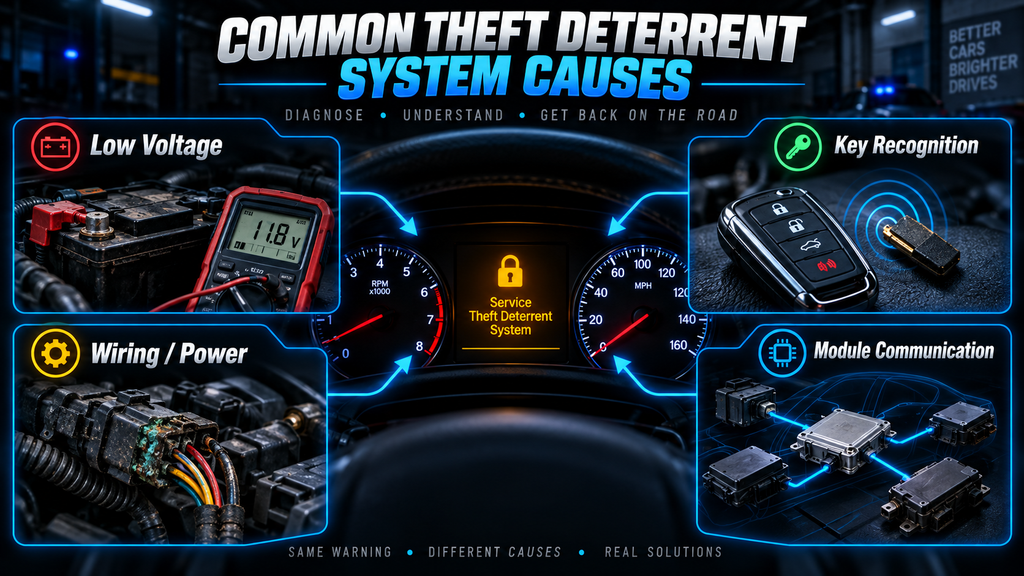
These are diagnostic directions, not part-replacement instructions. The most useful clues are the exact warning, whether the vehicle starts, recent work, battery condition, the behavior of a spare key, and stored manufacturer-specific codes.
Weak or recently disconnected 12V battery
Low voltage can cause modules to communicate poorly, lose learned settings, or report faults during a weak start. Battery replacement or a jump-start can be relevant timing clues.
Key, fob, or transponder recognition problem
A damaged key, flat fob battery where applicable, unprogrammed replacement, or transponder issue may prevent the vehicle from authenticating the key it expects.
Fuse, power supply, wiring, or connector concern
A security-related module needs stable power, ground, and communication. Water intrusion, corrosion, repairs, or damaged wiring can create intermittent symptoms.
Immobilizer, BCM, or network communication issue
Depending on the vehicle, the body control module, immobilizer antenna or reader, ignition components, or another control module may require targeted testing.
A symptom can point the inspection in a useful direction.
No row below is a definitive diagnosis. It is a way to avoid guessing and to decide what information is worth gathering before a repair visit.
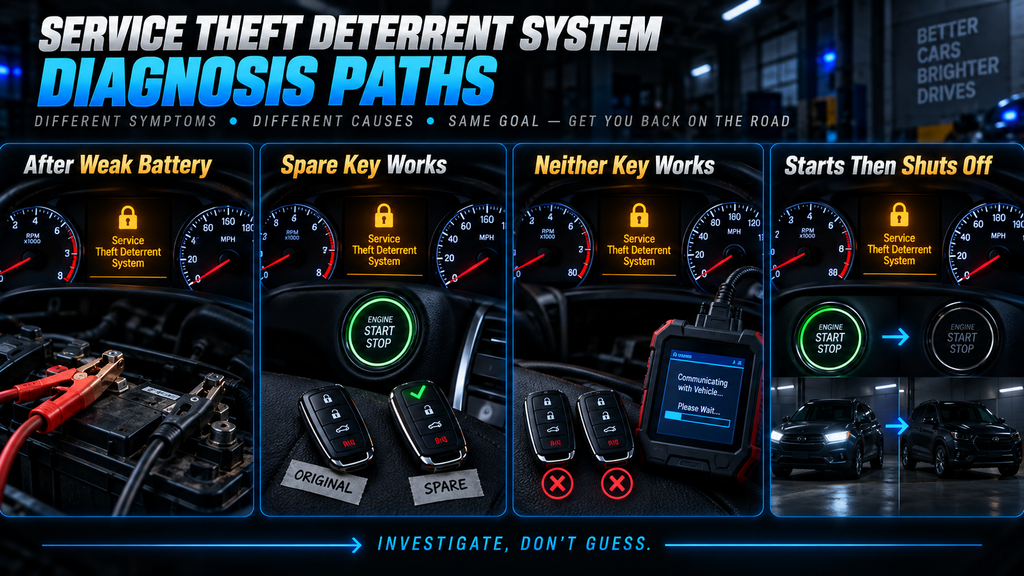
| Symptom | Possible direction | Recommended next step |
|---|---|---|
| Warning appeared after a dead or weak battery | Low voltage or an initialization-related concern | Verify battery condition and charging performance; check vehicle-specific procedures. |
| A known-good spare key works | The original key, fob, transponder, or programming becomes more likely | Use the spare and consult a qualified locksmith, dealer, or repairer for the original key. |
| Neither programmed key works | A vehicle-side security, power, or communication issue deserves attention | Arrange a scan that can access manufacturer and body/security modules. |
| Engine starts then shuts off with a security light | Immobilizer authentication may be involved | Avoid repeated attempts that drain the battery; seek vehicle-specific diagnosis. |
Four checks that can provide useful information without guessing at repairs
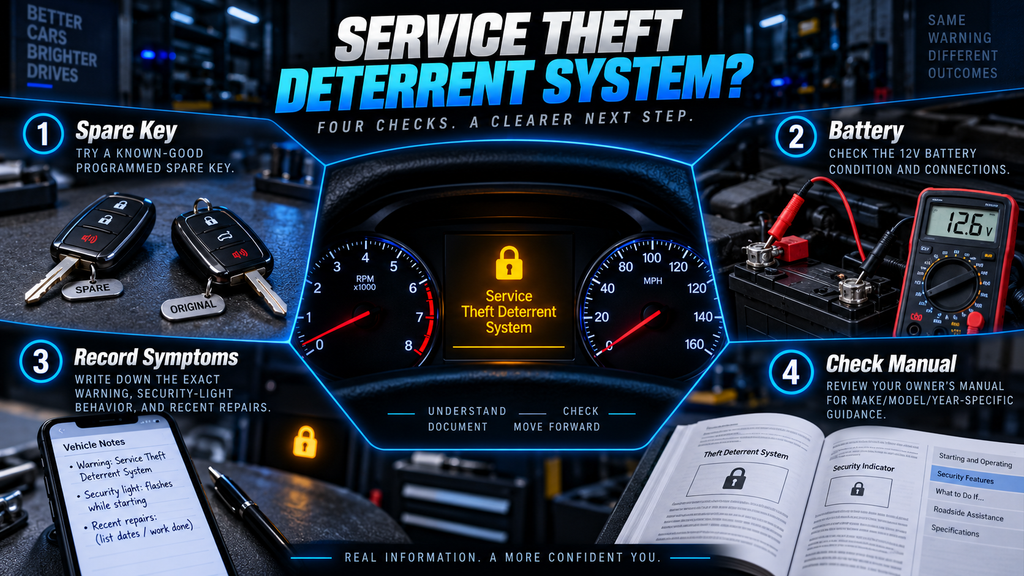
Do not bypass security components, force ignition parts, or replace modules based on the warning alone. Start by collecting simple facts that narrow the diagnostic path.
Try the correct spare key
If you have a known programmed spare, try it exactly as the owner’s manual describes. Its behavior is a meaningful clue, not a final diagnosis.
Check for a battery event
Consider whether the battery was weak, disconnected, replaced, jump-started, or repeatedly drained just before the warning began.
Write down the exact clues
Record the exact message, security-light behavior, start behavior, recent repairs, and whether other warning lamps appeared at the same time.
Use the right manual
Verify procedures using the owner’s information for your exact make, model, year, and key type—not a generic video or forum post.
These three actions can sound similar, but they solve different problems
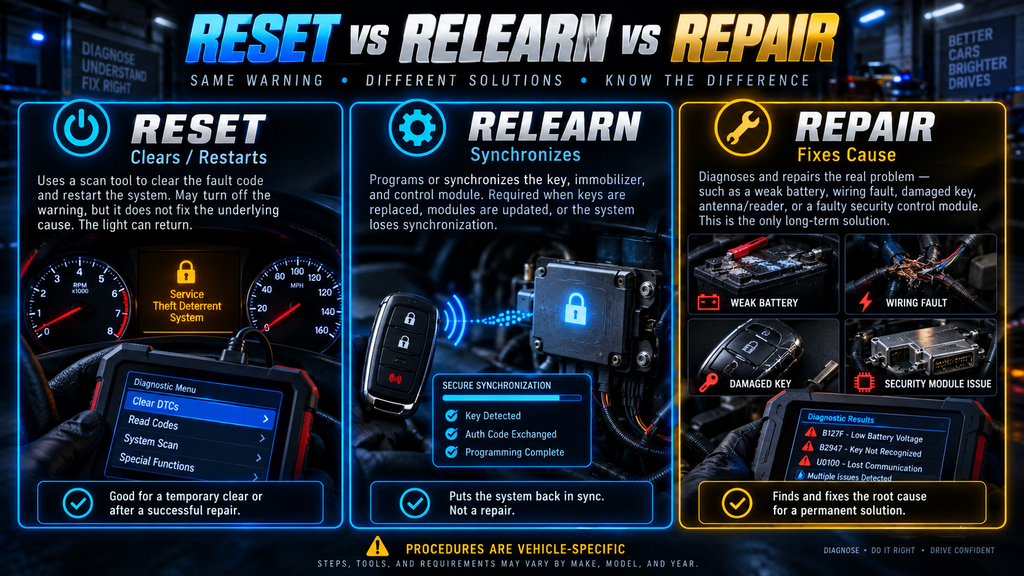
A reliable repair plan begins by identifying which of these the vehicle actually needs. Security systems vary too much for one universal sequence to be responsible advice.
Clearing or resetting a message
This may remove a stored warning temporarily after a voltage event or scan-tool action. If the fault remains, the message or code may return.
Relearning or programming
A relearn synchronizes a key, module, or security function when the vehicle supports that process. The method and prerequisites are vehicle-specific.
Repairing the underlying fault
A bad battery, damaged key, wiring issue, weak connection, antenna/reader concern, or module fault needs proper testing and repair before the warning can stay gone.
Avoid the universal-reset trap
Disconnecting the battery is not a guaranteed theft deterrent system fix and can create additional relearn needs on some vehicles. If your car needs a security relearn, use verified service information for the exact vehicle or have a qualified professional perform it.
Stored codes provide a starting point—not an automatic shopping list.
A basic code reader may only show generic engine information. Theft deterrent concerns can involve body, immobilizer, keyless-entry, communication, and manufacturer-specific modules that require more capable equipment.
A technician should use the code together with battery voltage, wiring checks, key behavior, module communication, and manufacturer test steps. This is why replacing an expensive module solely because of a dashboard message is risky.
Theft deterrent system FAQ
Can I drive with a Service Theft Deterrent System warning?
If the vehicle starts and drives normally, the message may not prevent immediate operation, but it should be investigated soon because it can become a no-start concern. If the vehicle behaves unpredictably, stalls, or has other serious warnings, do not continue driving normally.
Will disconnecting the battery reset the theft deterrent system?
It may clear or change a warning on some vehicles, but it does not reliably repair the underlying cause and can create additional initialization needs. Follow the owner’s manual and verified service information for your exact vehicle.
Does the warning mean someone tried to steal my car?
Not necessarily. The warning usually means the vehicle detected a problem or mismatch involving its security-related system. Low voltage, key recognition, communication faults, and recent electrical work are all possible explanations.