
A practical visual guide to car wheel parts, what each component is called, where the tire sits, how the wheel mounts, and which measurements matter for fitment.
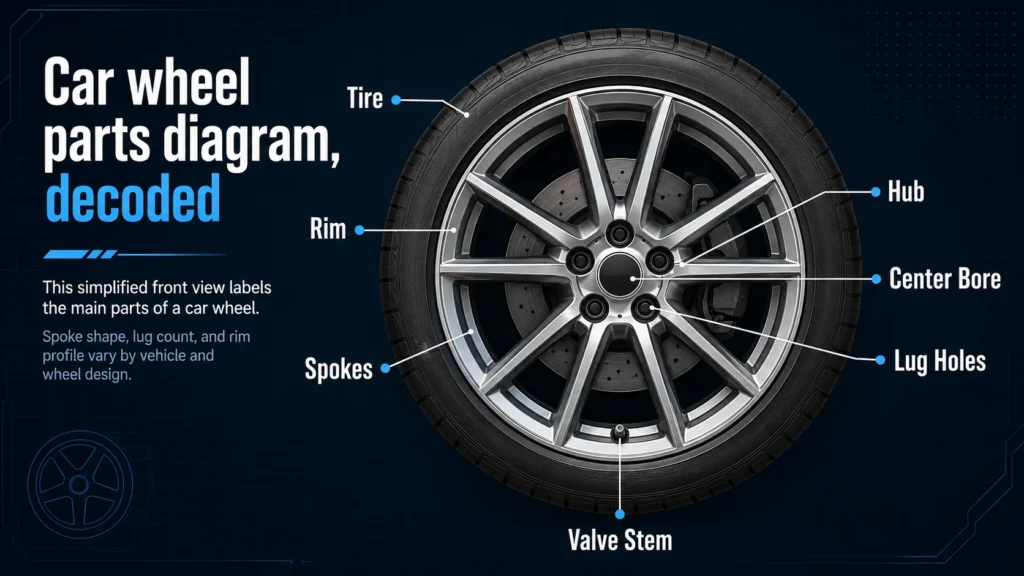
Car wheel parts diagram, decoded
This simplified front view labels the main parts of a car wheel. Exact spoke shape, lug count, and rim profile vary by vehicle and wheel design.
Wheel vs. rim vs. tire
People often use these words interchangeably. In everyday conversation that is common, but the technical distinction makes diagrams and fitment information much easier to understand.
Wheel
The complete structural metal component: center section, spokes or disc, and the outer rim section that carries the tire.
Rim
Technically, the outer portion of the wheel where the tire mounts. Many drivers casually use “rim” for the entire wheel.
Tire
The separate rubber assembly that contacts the road. Its beads lock onto the wheel’s bead seats.
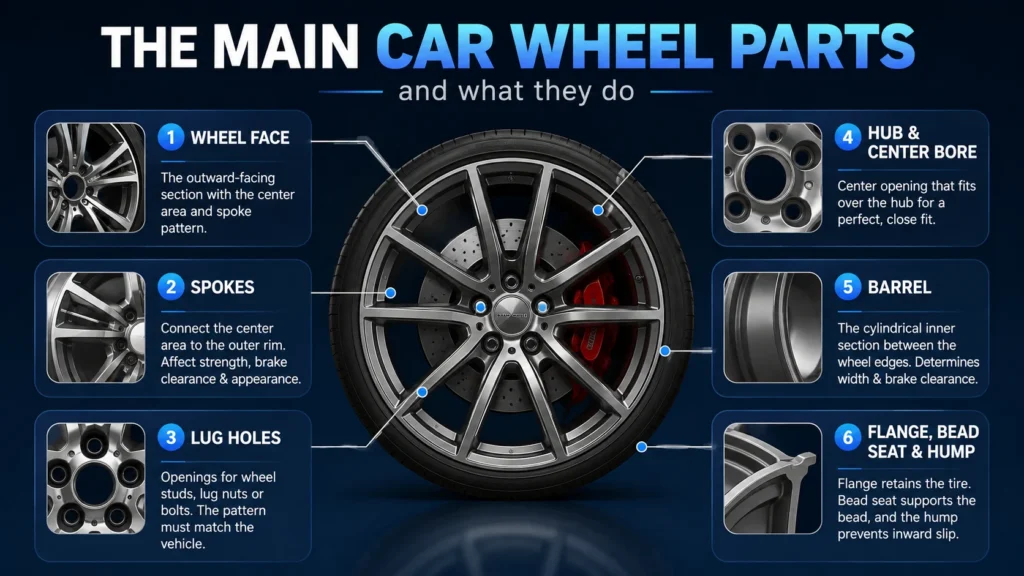
The main car wheel parts and what they do
A wheel has visible styling features and less-visible tire-mounting surfaces. Both matter: the face transfers loads through the spokes, while the rim profile keeps the tire positioned and sealed.
Wheel face
The outward-facing section of the wheel, including its center area and spoke pattern. This is the part most people see first.
Spokes
Structural sections connecting the center area to the outer rim. Their shape affects strength, brake clearance, weight, and appearance.
Hub & center bore
The center bore is the opening that fits over the vehicle hub. A hub-centric wheel is primarily located by this close-fitting connection.
Lug holes
Openings for wheel studs and lug nuts, or for wheel bolts. Their bolt pattern must exactly match the vehicle application.
Barrel
The cylindrical inner section between the wheel edges. The barrel contributes to wheel width and provides brake-caliper clearance.
Flange, bead seat & hump
The raised flange helps retain the tire. The bead seat supports the tire bead, and the bead hump helps prevent it from sliding inward.
The hub, center bore, and lug hardware work together
The wheel bolts to the hub through its lug holes. On a hub-centric design, the center bore closely locates the wheel on the hub. A lug-centric wheel is centered primarily by the lug hardware arrangement. Correct bolt pattern, center bore, wheel seat type, load rating, and hardware are all vehicle-specific.
Fitment and tightening note
Never assume one lug-nut torque value suits every vehicle or wheel. Use the vehicle or wheel manufacturer’s specification, appropriate hardware, and the correct tightening sequence. If a wheel is cracked, severely bent, or losing air, have it professionally inspected before driving.
Four fitment terms worth knowing
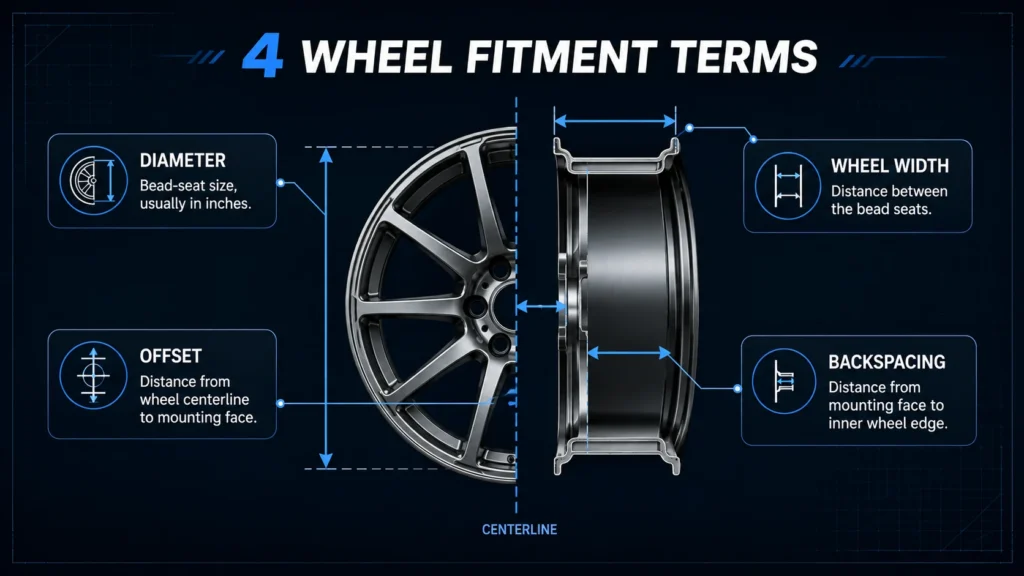
Wheel size is not just diameter. Width, offset, and backspacing determine where the wheel and tire sit relative to suspension components, brakes, bodywork, and steering clearance.
Diameter
The bead-seat diameter, usually expressed in inches, such as 17 or 18 inches.
Wheel width
The distance between the bead seats, not the outermost lip-to-lip measurement.
Offset
The distance between the wheel centerline and mounting surface. It influences how far in or out the wheel sits.
Backspacing
The distance from the hub mounting surface to the inner edge of the wheel; commonly used to assess inner clearance.
Which wheel parts can be damaged?
Bent flange or barrel
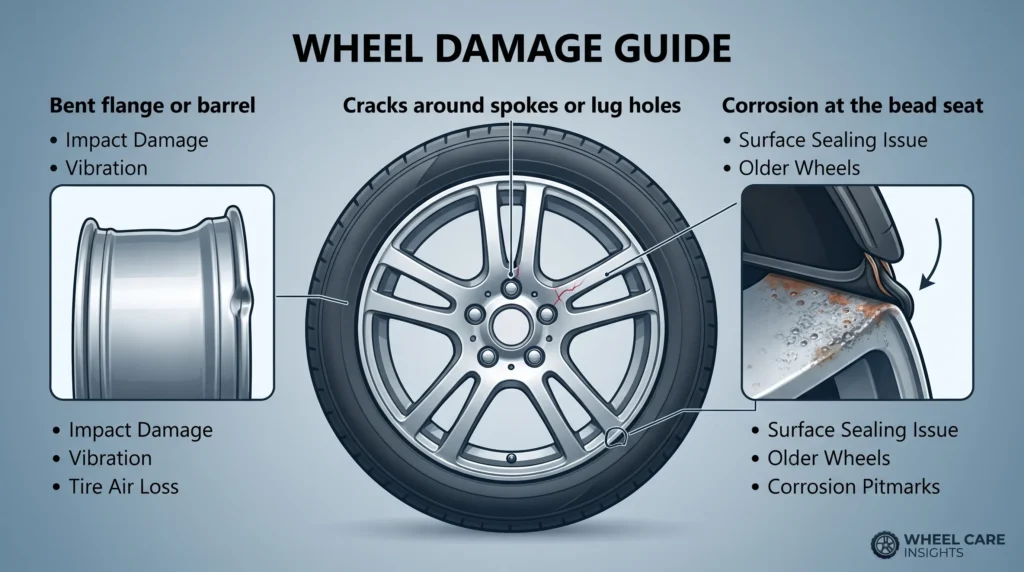
Pothole or curb impacts can bend the outer flange or barrel. Clues can include vibration, visible runout, or a tire that slowly loses air at the bead.
Cracks around spokes or lug holes
Cracks can develop after impacts, overload, or improper repair. Do not ignore a visible crack, repeated air loss, or unexplained vibration—seek professional assessment.
Corrosion at the bead seat
Corrosion can disrupt the sealing surface where the tire bead rests, especially on older alloy wheels. A tire professional can inspect and advise on suitable repair or replacement.
Car wheel parts FAQs
What is the metal part inside a tire called?
It is commonly called the wheel or rim. Technically, the wheel is the entire metal assembly, while the rim is the outer section where the tire mounts.
Where does the tire actually sit on the wheel?
The tire’s beads sit on the wheel’s bead seats. Flanges help keep the tire located at the edges, while the drop center makes tire mounting and removal possible.
What is the center bore for?
The center bore fits around the vehicle hub. On hub-centric wheels, this fit helps center the wheel accurately before the lug hardware is tightened.
Can I use any wheel with the same diameter?
No. Diameter alone is not enough. Bolt pattern, center bore, width, offset, backspacing, brake clearance, load rating, and approved tire size must suit the exact vehicle application.