
A parking brake malfunction warning means the vehicle detected a problem with the system or how it is operating. It does not identify the failed part. Start by confirming whether the brake is applied or released—and whether other brake warnings are active.
First, find out which safety problem you have
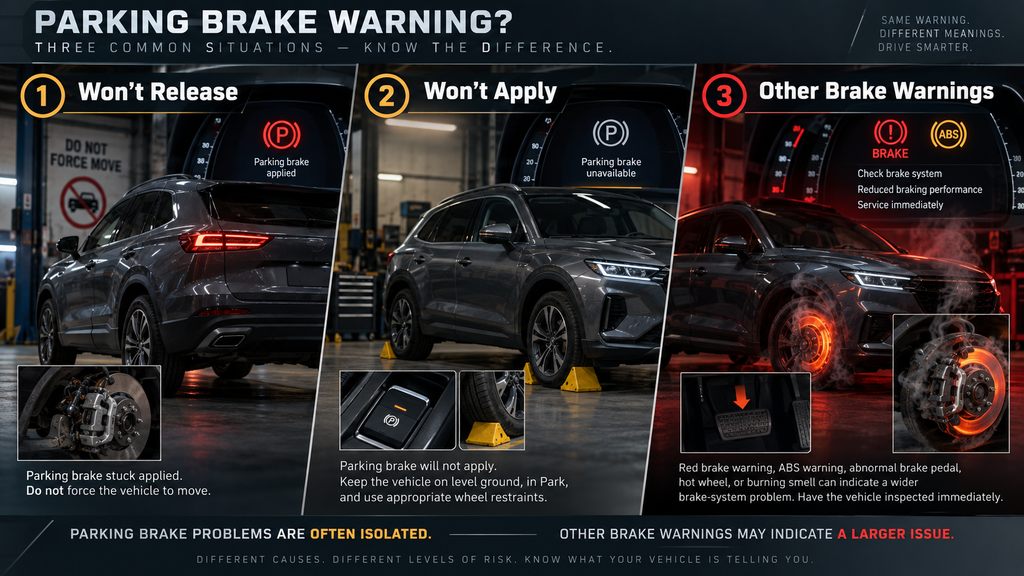
“Parking brake malfunction” is a symptom message, not a diagnosis. The immediate decision is different when the brake appears stuck on versus when it will not hold the vehicle.
If the parking brake will not release
Do not force the vehicle to move against a brake that may still be applied. Keep the vehicle secure, follow the exact release guidance in the owner’s manual, and arrange assistance if it cannot be released normally.
If the parking brake will not apply
Do not rely on the malfunctioning parking brake to prevent movement. Park on level ground where possible, select Park on an automatic transmission, follow your manual’s guidance, and use appropriate wheel restraint if needed.
A wider brake warning changes the urgency.
Stop driving and seek qualified help if a red brake-system warning, ABS warning, unusual brake-pedal feel, reduced braking performance, burning smell, or wheel heat appears with the parking brake warning. The parking brake system is different from the normal hydraulic service brakes, but related warnings should never be ignored.
Check the situation before trying to reset anything
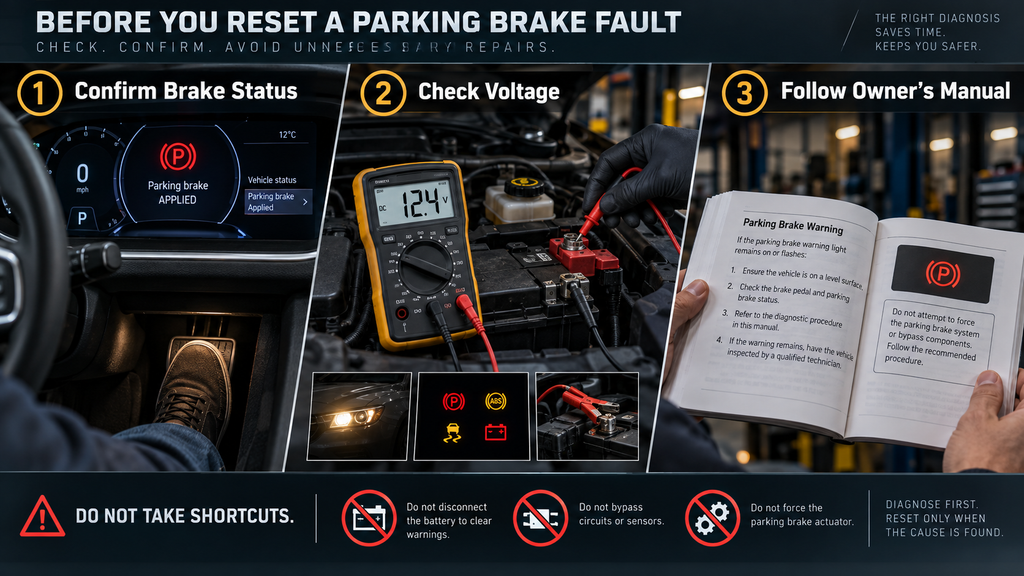
Avoid bypassing circuits, forcing an actuator, or disconnecting the battery as a universal “fix.” A warning that clears can still return if the underlying fault remains.
Confirm the vehicle is secure
Look at the cluster message and parking-brake indicator, then note whether the vehicle actually moves freely or feels held. Do this only in a safe, level location with your foot on the service brake.
Look for low-voltage clues
A weak 12V battery or charging issue can create multiple warning messages, slow cranking, dim lights, or problems after a jump-start or battery replacement. It is a diagnostic direction—not proof that the battery is the cause.
Read the vehicle-specific guidance
Search the exact message in your owner’s manual. Manufacturers distinguish faults where an electronic parking brake has malfunctioned, failed to apply, or failed to release, and their emergency procedures can differ.
An electronic parking brake is not just a handbrake with a button
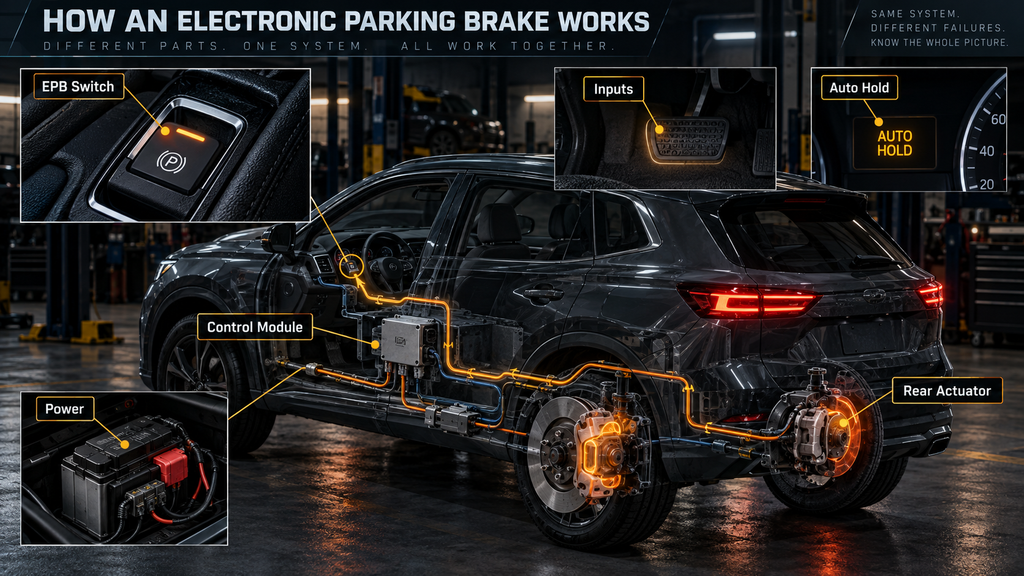
An electronic parking brake (EPB) uses electric controls and, on many vehicles, rear-brake actuators to apply or release the parking brake. The system may also interact with Auto Hold or Brake Hold functions. A warning indicates the vehicle detected an operating or monitoring problem somewhere in that chain.
That does not automatically mean your normal hydraulic service brakes have failed, and it does not prove the actuator motor is bad. Power supply, a switch, a fuse, a connector, wiring, a sensor input, rear-brake mechanical resistance, or module communication may produce similar messages.
Five areas a proper diagnosis may investigate
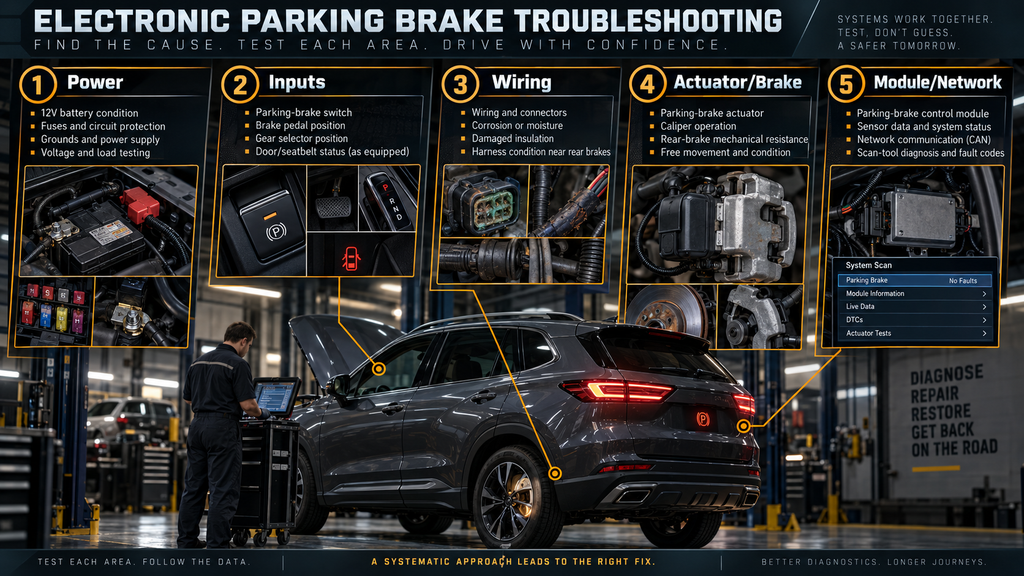
A technician normally confirms the warning, checks whether the brake applies or releases, scans the relevant modules for diagnostic trouble codes, and tests the circuit or component indicated. Replacing parts before those steps can be expensive guesswork.
12V battery, fuse, or power supply
Low voltage, poor battery connections, a blown fuse, weak grounds, or charging-system issues can affect electrically operated brake functions.
Parking-brake switch or input
The EPB switch, brake-pedal input, gear-position signal, door status, or another required input may be missing or implausible.
Wiring, connectors, or moisture
Corrosion, loose plugs, damaged insulation, water intrusion, or wiring damage around the rear brakes can interrupt power or communication.
Actuator, caliper, or rear-brake issue
An actuator motor or mechanism may bind, or rear brake hardware may create resistance that prevents proper apply or release operation.
Control module or communication fault
The electronic controller, a related module, sensor data, or vehicle network communication can set the warning and needs targeted testing.
Can a weak battery cause a parking brake malfunction?
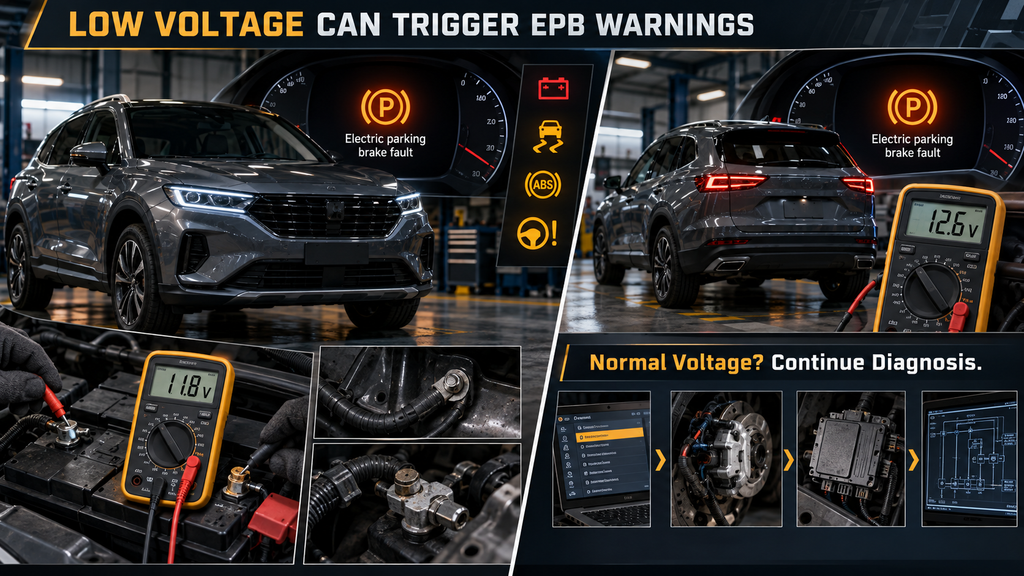
Yes, a weak 12V battery can contribute to EPB warnings because the system relies on stable electrical power. But battery replacement alone is not a diagnosis. If the message stays after voltage is confirmed, the vehicle needs further testing.
Why an actuator is not the automatic answer
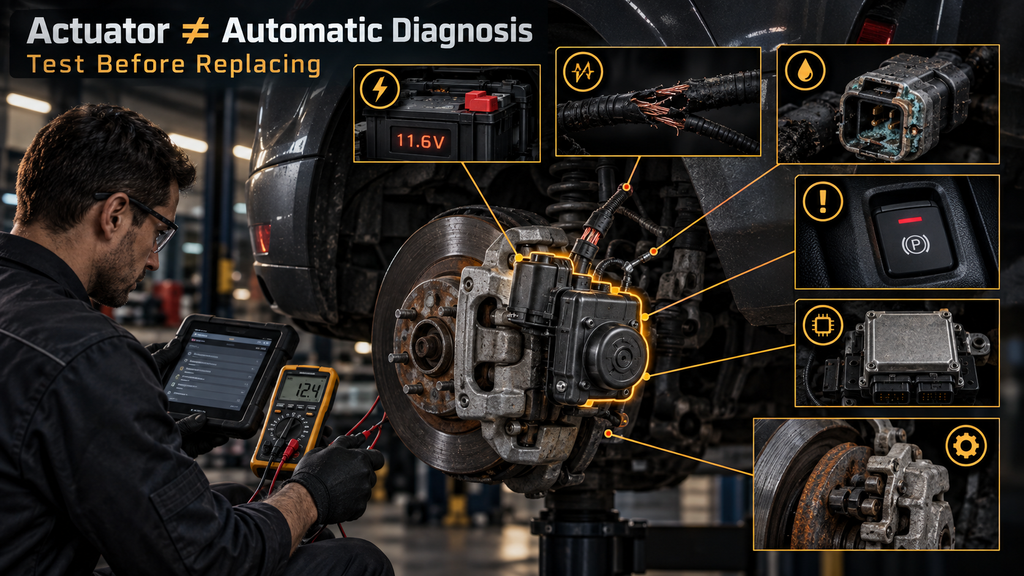
A parking-brake actuator is an electric motor or mechanism that applies or releases the brake. It can fail, but its warning can look like a voltage, wiring, switch, control-module, or rear-caliper problem. Codes and circuit tests help separate those possibilities.
A reset may clear a message. It does not prove the fault is gone.
Some warnings disappear after a normal drive cycle, battery recovery, or an approved service procedure. If the system has an intermittent electrical or mechanical issue, though, the warning may return. Treat the message as information to investigate—not a cue to erase codes and hope.
What professional diagnosis should establish
A capable scan tool can read diagnostic trouble codes from the relevant module, but codes are a starting point. The next step is checking the vehicle-specific service information and confirming power, grounds, wiring, switch inputs, actuator operation, and mechanical condition before replacing parts.
Arrange professional diagnosis when safety or certainty is missing
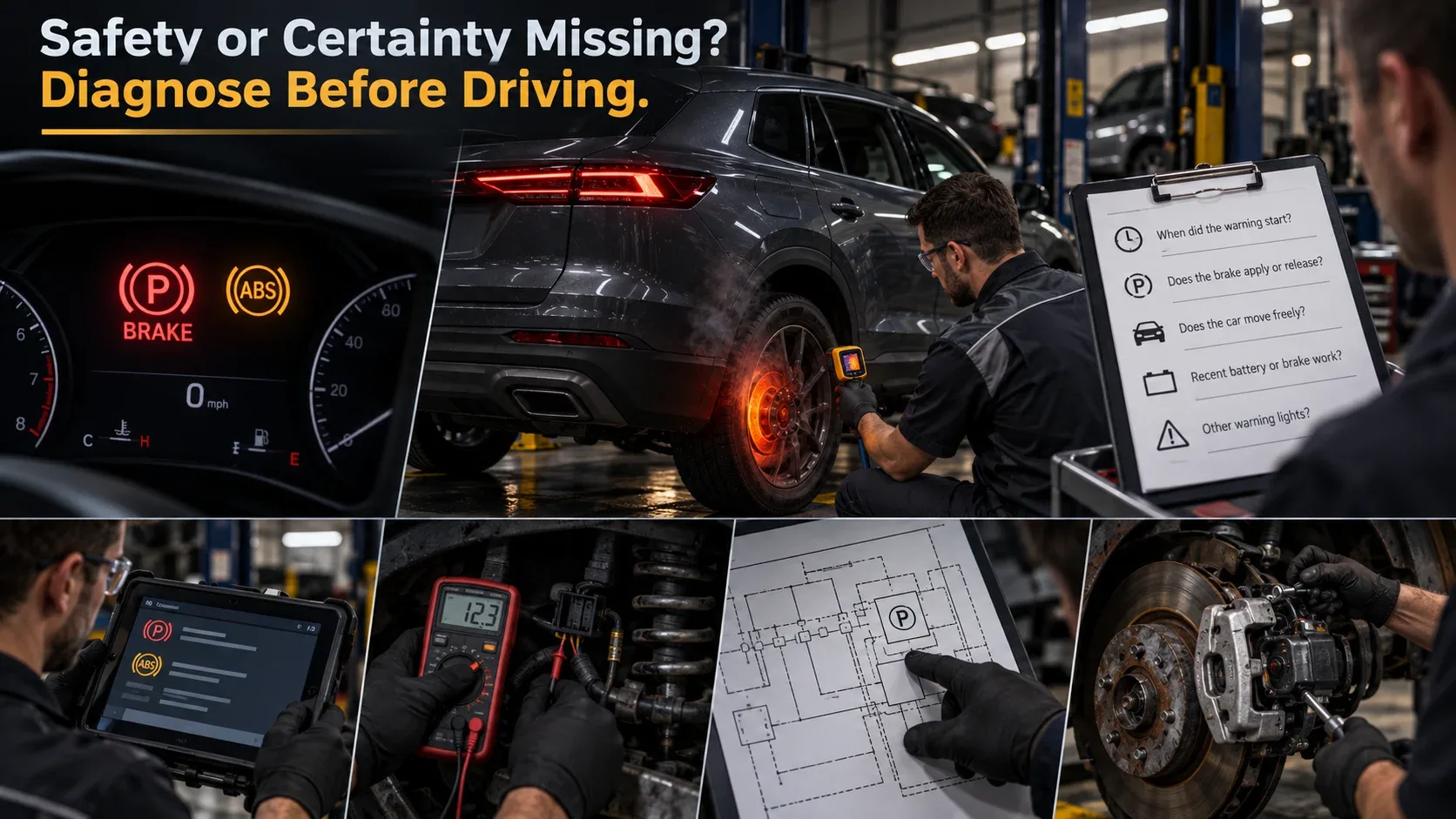
The safest choice is qualified help if the vehicle cannot be reliably secured, the parking brake remains applied, the warning persists, or additional brake-system symptoms appear. Tell the shop exactly when the warning began and what the system did.
- The car will not move freely, a wheel feels hot, or you suspect the brake is dragging.
- The parking brake will not apply and you cannot safely leave the vehicle secured.
- A red brake warning, ABS warning, abnormal brake pedal, or reduced braking performance is also present.
Parking brake malfunction FAQ
Can I drive with a parking brake malfunction warning?
It depends on whether the parking brake has released, whether normal braking feels normal, which other warnings are active, and what your manufacturer instructs. Do not drive against a potentially applied brake, and do not leave the vehicle parked where it could roll if the parking brake cannot apply.
Why did the warning appear after battery replacement or a jump-start?
Low voltage or an interrupted power supply can set electronic warnings. Check that the battery and terminals are in good condition and follow the vehicle’s documented procedures. If the warning remains or returns, scan and diagnose the system rather than assuming the new battery fixed it.
Can I reset an EPB malfunction myself?
Only use a reset or service procedure specified for your exact vehicle. Clearing a message without understanding the stored fault can hide useful diagnostic evidence, and some electronic parking brake procedures require a scan tool or a controlled service mode.